
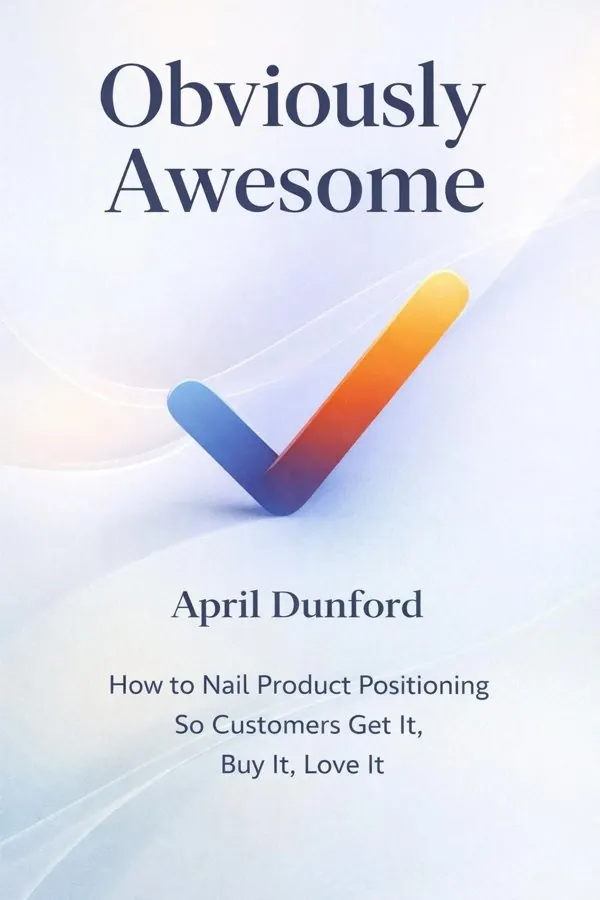
Obviously Awesome: How to Nail Product Positioning So Customers Get It, Buy It, Love It: Summary & Key Insights
 10 min12 chaptersAudio available
What Is Obviously Awesome: How to Nail Product Positioning So Customers Get It, Buy It, Love It About?
Obviously Awesome: How to Nail Product Positioning So Customers Get It, Buy It, Love It by April Dunford is a marketing book spanning 12 pages. Obviously Awesome is a practical guide to mastering product positioning. April Dunford, a veteran marketing executive, explains how to identify what makes your product unique, define its true market category, and communicate its value so customers immediately understand and want it. The book provides a step-by-step framework for startups and established companies to clarify their message and stand out in competitive markets.
This FizzRead summary covers all 12 key chapters of Obviously Awesome: How to Nail Product Positioning So Customers Get It, Buy It, Love It in approximately 10 minutes, distilling the most important ideas, arguments, and takeaways from April Dunford's work. Also available as an audio summary and Key Quotes Podcast.
Obviously Awesome: How to Nail Product Positioning So Customers Get It, Buy It, Love It
Obviously Awesome is a practical guide to mastering product positioning. April Dunford, a veteran marketing executive, explains how to identify what makes your product unique, define its true market category, and communicate its value so customers immediately understand and want it. The book provides a step-by-step framework for startups and established companies to clarify their message and stand out in competitive markets.
Who Should Read Obviously Awesome: How to Nail Product Positioning So Customers Get It, Buy It, Love It?
This book is perfect for anyone interested in marketing and looking to gain actionable insights in a short read. Whether you're a student, professional, or lifelong learner, the key ideas from Obviously Awesome: How to Nail Product Positioning So Customers Get It, Buy It, Love It by April Dunford will help you think differently.
- ✓Readers who enjoy marketing and want practical takeaways
- ✓Professionals looking to apply new ideas to their work and life
- ✓Anyone who wants the core insights of Obviously Awesome: How to Nail Product Positioning So Customers Get It, Buy It, Love It in just 10 minutes
Want the full summary?
Get instant access to this book summary and 100K+ more with Fizz Moment.
Get Free SummaryAvailable on App Store • Free to download
Key Chapters
Positioning is one of those marketing concepts that often gets warped into a vague catch-all term. People talk about branding or messaging when they mean positioning, or they treat positioning as if it’s something that happens once during launch and never needs revisiting. But positioning is far more foundational than any of those things.
In essence, positioning is the process of deliberately defining how your product is the best in the world for a specific set of customers under specific conditions. It is not about manipulating perception or inventing a story—it’s about uncovering and clarifying truths that already exist in your market and product. Branding expresses who you are; messaging conveys how you talk about yourself; vision describes where you’re going. But positioning ties all these threads together and gives them direction. Without clear positioning, everything else becomes inconsistent and confusing.
Imagine you’ve invented a tool that automates part of data analytics workflows. If you describe it as an 'AI platform,' customers might compare it to products far more general than yours and conclude it falls short. But if you position it as a 'data workflow accelerator for analytics teams drowning in manual cleanup,' suddenly your market frame is sharper, and the product’s value is instantly comprehensible.
The reason this matters is that customers never evaluate your product in isolation—they always compare it to something else. Positioning defines what those 'something elses' are and how you measure against them. It’s not the story you tell in ads—it’s the handle customers use to categorize your product in their minds. And if you don’t give them that handle intentionally, they’ll create it themselves, often incorrectly. Great companies take control of this mental framing.
In practice, positioning demands understanding your product’s unique attributes, what customers perceive as alternatives, and the context that makes those attributes valuable. My method builds on those elements systematically so that instead of guessing how to frame your product, you can construct a defensible, evidence-driven positioning foundation.
Context is how customers decide what your product is. No one encounters a new product as a blank slate—they filter it through past experiences, comparable categories, and known references. That’s why positioning is so deeply tied to market context: if you put your product in the wrong frame, it will be judged against inappropriate standards.
Consider the classic case of Salesforce. If Marc Benioff had described his product simply as 'CRM software,' customers might have compared it to Siebel, which required massive on-premise installations. Instead, Salesforce used the phrase 'CRM in the cloud,' creating a new context—one that emphasized convenience, scalability, and freedom from IT complexity. The context made it obvious why Salesforce was better.
Every product lives or dies by its chosen frame of reference. Put a baby stroller beside a sports car and it looks out of place; put it beside other strollers and suddenly we can discern its advantages. The same principle applies in technology, retail, or any domain: context determines perception. If your product is compared to something that highlights its weaknesses, you lose. If you anchor it to a context that amplifies its strengths, you win.
This means positioning is not only definitional—it’s strategic. You can’t simply describe your product by what it technically is; you must describe it in a way that defines how people should think about it. The right context creates understanding. The wrong context breeds confusion.
When I work with companies to reposition, we start by identifying what customers currently compare the product to. These comparisons reveal the implicit context already in play. Once we understand that, we can shift the frame strategically, choosing a market category that makes our strengths shine. Context is a lens you control—use it wisely, and customers will not only 'get it' but also feel it’s the obvious choice.
+ 10 more chapters — available in the FizzRead app
All Chapters in Obviously Awesome: How to Nail Product Positioning So Customers Get It, Buy It, Love It
About the Author
April Dunford is a positioning consultant, speaker, and author with over 25 years of experience in marketing and product strategy. She has led marketing teams at several successful technology startups and now advises companies worldwide on positioning and go-to-market strategy.
Get This Summary in Your Preferred Format
Read or listen to the Obviously Awesome: How to Nail Product Positioning So Customers Get It, Buy It, Love It summary by April Dunford anytime, anywhere. FizzRead offers multiple formats so you can learn on your terms — all free.
Available formats: App · Audio · PDF · EPUB — All included free with FizzRead
Download Obviously Awesome: How to Nail Product Positioning So Customers Get It, Buy It, Love It PDF and EPUB Summary
Key Quotes from Obviously Awesome: How to Nail Product Positioning So Customers Get It, Buy It, Love It
“Positioning is one of those marketing concepts that often gets warped into a vague catch-all term.”
“Context is how customers decide what your product is.”
Frequently Asked Questions about Obviously Awesome: How to Nail Product Positioning So Customers Get It, Buy It, Love It
Obviously Awesome: How to Nail Product Positioning So Customers Get It, Buy It, Love It by April Dunford is a marketing book that explores key ideas across 12 chapters. Obviously Awesome is a practical guide to mastering product positioning. April Dunford, a veteran marketing executive, explains how to identify what makes your product unique, define its true market category, and communicate its value so customers immediately understand and want it. The book provides a step-by-step framework for startups and established companies to clarify their message and stand out in competitive markets.
More by April Dunford

You Might Also Like

Captivology: The Science of Capturing People's Attention
Ben Parr
10 min
Marketing 5.0: Technology for Humanity
Philip Kotler, Hermawan Kartajaya, Iwan Setiawan
10 min
Marketing Strategy
Paul Fifield
10 min
UnMarketing: Stop Marketing. Start Engaging.
Scott Stratten
10 min
$100M Leads: How to Get Strangers to Want to Buy Your Stuff
Alex Hormozi
10 min
80/20 Sales and Marketing: The Definitive Guide to Working Less and Making More
Perry Marshall
10 minBrowse by Category
Ready to read Obviously Awesome: How to Nail Product Positioning So Customers Get It, Buy It, Love It?
Get the full summary and 100K+ more books with Fizz Moment.