
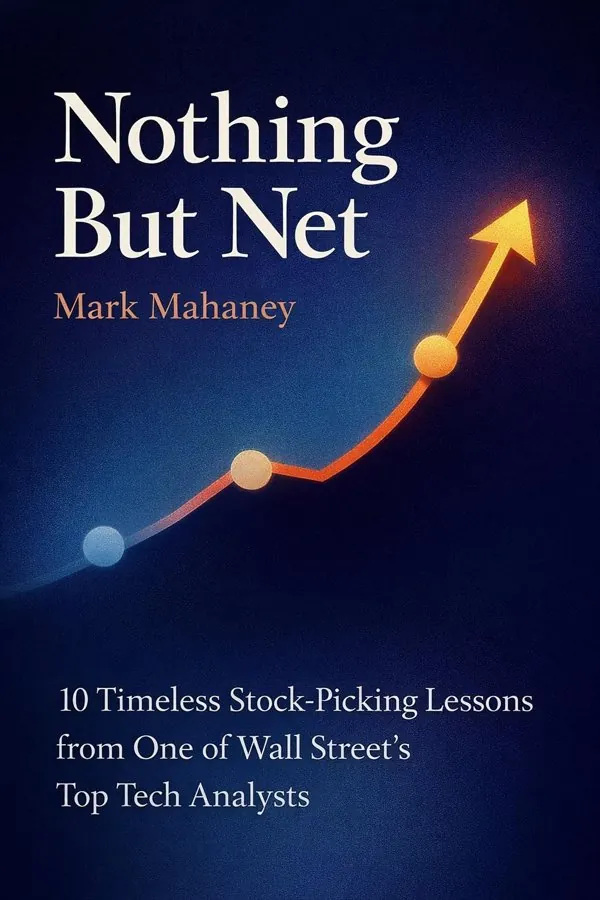
Nothing But Net: 10 Timeless Stock-Picking Lessons from One of Wall Street’s Top Tech Analysts: Summary & Key Insights
by Mark Mahaney
 10 min10 chaptersAudio available
Key Takeaways from Nothing But Net: 10 Timeless Stock-Picking Lessons from One of Wall Street’s Top Tech Analysts
The market often rewards patience far more than prediction.
A stock is not a ticker symbol; it is a business with an economic engine.
In technology, management quality is not a soft factor; it is often the deciding one.
Some of the best investments emerge when the market underestimates a change that is about to accelerate growth.
Every investor makes mistakes; the difference between average and excellent investors is what they do with them.
What Is Nothing But Net: 10 Timeless Stock-Picking Lessons from One of Wall Street’s Top Tech Analysts About?
Nothing But Net: 10 Timeless Stock-Picking Lessons from One of Wall Street’s Top Tech Analysts by Mark Mahaney is a finance book spanning 10 pages. In Nothing But Net, veteran internet analyst Mark Mahaney turns decades of Wall Street experience into a practical guide for investing in technology and internet companies without getting lost in hype. Rather than offering flashy predictions or short-term trading tips, Mahaney focuses on the deeper patterns that separate durable winners from temporary market darlings. Drawing on years of covering companies such as Amazon, Google, Netflix, and eBay, he shows how great tech investments are usually built on a few repeatable qualities: large market opportunities, strong business models, customer obsession, capable leadership, and disciplined execution. What makes this book valuable is its combination of analytical rigor and lived experience. Mahaney has watched the dot-com boom, the crash, the rise of platform businesses, and the evolution of digital consumer behavior from the front row. That perspective allows him to explain not only what investors should look for, but also what they must avoid—overconfidence, shallow analysis, and the temptation to chase trends. For investors, operators, and anyone trying to understand how enduring value is created in fast-moving markets, this book offers a grounded and highly usable framework.
This FizzRead summary covers all 10 key chapters of Nothing But Net: 10 Timeless Stock-Picking Lessons from One of Wall Street’s Top Tech Analysts in approximately 10 minutes, distilling the most important ideas, arguments, and takeaways from Mark Mahaney's work. Also available as an audio summary and Key Quotes Podcast.
Nothing But Net: 10 Timeless Stock-Picking Lessons from One of Wall Street’s Top Tech Analysts
In Nothing But Net, veteran internet analyst Mark Mahaney turns decades of Wall Street experience into a practical guide for investing in technology and internet companies without getting lost in hype. Rather than offering flashy predictions or short-term trading tips, Mahaney focuses on the deeper patterns that separate durable winners from temporary market darlings. Drawing on years of covering companies such as Amazon, Google, Netflix, and eBay, he shows how great tech investments are usually built on a few repeatable qualities: large market opportunities, strong business models, customer obsession, capable leadership, and disciplined execution.
What makes this book valuable is its combination of analytical rigor and lived experience. Mahaney has watched the dot-com boom, the crash, the rise of platform businesses, and the evolution of digital consumer behavior from the front row. That perspective allows him to explain not only what investors should look for, but also what they must avoid—overconfidence, shallow analysis, and the temptation to chase trends. For investors, operators, and anyone trying to understand how enduring value is created in fast-moving markets, this book offers a grounded and highly usable framework.
Who Should Read Nothing But Net: 10 Timeless Stock-Picking Lessons from One of Wall Street’s Top Tech Analysts?
This book is perfect for anyone interested in finance and looking to gain actionable insights in a short read. Whether you're a student, professional, or lifelong learner, the key ideas from Nothing But Net: 10 Timeless Stock-Picking Lessons from One of Wall Street’s Top Tech Analysts by Mark Mahaney will help you think differently.
- ✓Readers who enjoy finance and want practical takeaways
- ✓Professionals looking to apply new ideas to their work and life
- ✓Anyone who wants the core insights of Nothing But Net: 10 Timeless Stock-Picking Lessons from One of Wall Street’s Top Tech Analysts in just 10 minutes
Want the full summary?
Get instant access to this book summary and 100K+ more with Fizz Moment.
Get Free SummaryAvailable on App Store • Free to download
Key Chapters
The market often rewards patience far more than prediction. One of Mahaney’s central lessons is that the biggest returns in technology investing rarely come from reacting to quarterly earnings noise; they come from correctly identifying a strong business early and holding it through volatility. Investors are constantly tempted to overreact to a weak quarter, a cautious management comment, or a headline about competition. But many of the greatest internet companies looked expensive, controversial, or temporarily flawed on their way to becoming dominant franchises.
Mahaney argues that long-term thinking is especially important in technology because the best companies are usually investing heavily ahead of visible profits. Amazon is the classic example: for years, skeptics focused on thin margins while the company built logistics, cloud infrastructure, and customer loyalty. Those who judged the business by short-term earnings missed the scale and durability of what was being created. The same principle applies to firms expanding into new verticals, entering adjacent markets, or building platforms whose economics strengthen over time.
This does not mean investors should ignore fundamentals. It means they should prioritize the trajectory of the business over temporary fluctuations. Key questions include: Is the addressable market still growing? Is the company gaining share? Are customer relationships deepening? Is management investing intelligently for the future? A quarter matters, but the direction of the enterprise matters more.
Actionable takeaway: Before buying or selling any stock, write a three- to five-year thesis based on market opportunity, competitive edge, and business quality, then evaluate new information against that thesis rather than against daily price moves.
A stock is not a ticker symbol; it is a business with an economic engine. Mahaney emphasizes that investors must understand not just what a company sells, but how it makes money, how customers behave, and why the model can endure. In internet and software investing, this is critical because revenue can look impressive while the underlying economics remain fragile. A flashy top line means little if customer acquisition is too expensive, retention is weak, or monetization depends on unsustainable subsidies.
He encourages investors to study the mechanics of revenue generation. Is the company transaction-based like eBay? Subscription-based like Netflix? Advertising-driven like Google? Marketplace-based, where network effects can create defensibility? Each model has different strengths, risks, and valuation implications. For instance, recurring subscription revenue may deserve more confidence than one-time transaction revenue, while ad-based businesses require close attention to user engagement, pricing power, and advertiser demand.
Mahaney also highlights the importance of unit economics. A company may be growing rapidly, but if each new customer adds little profit, scale will not solve the problem. By contrast, businesses with improving margins, strong retention, and low incremental distribution costs often become exceptionally valuable over time. Investors who understand these details are less likely to be fooled by promotional narratives.
A practical way to apply this lesson is to map the company’s value chain. Identify who the customer is, what they pay for, what it costs to serve them, and what drives repeat usage. When you understand the economic logic, forecasts become more grounded and risks become easier to spot.
Actionable takeaway: For every company you analyze, summarize its revenue model, cost structure, retention dynamics, and path to scale in one page before looking at valuation.
In technology, management quality is not a soft factor; it is often the deciding one. Mahaney argues that when markets are changing quickly, strong leadership determines whether a company adapts, innovates, allocates capital well, and executes against opportunity. A weak team can squander even a large market, while an exceptional one can build category leadership from an early advantage.
He looks for management teams that combine strategic clarity with operational discipline. Vision matters, but so does the ability to execute consistently. Leaders must make intelligent trade-offs: investing aggressively when returns justify it, staying focused when distractions multiply, and resisting the pressure to optimize for short-term optics. Founder-led companies often stand out because founders may think more expansively and act with longer time horizons, though Mahaney does not treat founder status as a guarantee of quality.
Investors should also pay attention to credibility. Does management communicate clearly? Do they acknowledge risks? Do they meet commitments over time? A leadership team that explains the business honestly and allocates resources rationally deserves more trust than one that constantly changes the story. Amazon’s long-term communication style is an example of management aligning investors with a durable strategy rather than quarter-to-quarter theater.
Practical evaluation can include reading shareholder letters, listening to earnings calls over multiple years, and comparing promises with outcomes. The goal is to judge not charisma, but judgment. When management repeatedly makes smart decisions under uncertainty, that becomes a powerful compounding asset.
Actionable takeaway: Track management on three dimensions—strategy, execution, and credibility—and review a company’s last several years of communications to see whether leadership’s words and actions consistently match.
Some of the best investments emerge when the market underestimates a change that is about to accelerate growth. Mahaney calls attention to inflection points—moments when a company’s product, market, monetization, or operating leverage shifts meaningfully enough to alter its future earnings power. These moments are often uncomfortable because they are visible in pieces before they are obvious in consensus forecasts.
An inflection point can take many forms. A company may reach enough scale for margins to improve rapidly. A new product may begin contributing meaningfully to revenue. Customer adoption may move from early enthusiasts to the mainstream. An online platform may hit the level where network effects strengthen and competition weakens. In each case, historical numbers can make the business look ordinary just before the economics become much better.
The challenge is that investors often rely too heavily on backward-looking data. Mahaney’s approach encourages looking for leading indicators instead: user engagement trends, cohort retention, improving conversion rates, better unit economics, stronger management commentary, or structural changes in the market. Netflix’s streaming transition, for example, required investors to see beyond near-term disruption and recognize a far larger eventual platform.
This lesson also has a defensive side. Inflection points can turn negative. A rising customer acquisition cost, slowing engagement, or platform dependence can signal weakening economics before the income statement fully reflects it. Spotting these turning points early is one of the most valuable skills in growth investing.
Actionable takeaway: Build a list of leading indicators for each company you follow and review them regularly to identify whether the business is approaching a positive or negative inflection before consensus catches up.
Every investor makes mistakes; the difference between average and excellent investors is what they do with them. Mahaney is candid about the errors that shape an analyst’s judgment, and he treats mistakes not as embarrassment, but as a vital source of learning. In technology investing, where uncertainty is high and narratives are seductive, errors are inevitable. What matters is building a process that turns those errors into sharper pattern recognition.
Common mistakes include overestimating total addressable markets, underestimating competition, trusting management too easily, paying too much for growth, or failing to appreciate how quickly business models can weaken. Sometimes the problem is analytical. Other times it is behavioral: anchoring to a price target, becoming emotionally attached to a thesis, or confusing a good company with a good stock at any price.
Mahaney’s message is that postmortems are essential. If an investment fails, ask why. Was the original thesis wrong, early, or poorly sized? Did new facts emerge, or were warning signs ignored? A disciplined review process helps separate bad luck from bad thinking. Over time, this improves not only stock selection, but position sizing, risk control, and humility.
This lesson is particularly useful for individual investors who may focus only on winners. Studying losers is often more educational because it exposes blind spots. The point is not self-criticism; it is process improvement. Better investing comes from repeatedly reducing the same category of mistakes.
Actionable takeaway: Keep an investment journal that records your original thesis, expected drivers, valuation assumptions, and risks, then revisit it after major outcomes to identify exactly what you understood and what you missed.
In digital markets, customer trust compounds just like capital. Mahaney stresses that many of the most successful internet companies win not because they start with the best margins, but because they relentlessly improve the user experience. Businesses that solve customer problems better, faster, and more conveniently often create loyalty, word-of-mouth growth, and lower long-term acquisition costs. Over time, that customer focus can become a stronger moat than traditional assets.
Amazon is again an instructive case. Its commitment to selection, price, speed, and convenience helped it build extraordinary loyalty. What looked like expensive overinvestment in fulfillment and service turned into a major competitive advantage. Netflix similarly centered ease of use, content access, and personalization. Google won users by delivering better search results quickly and consistently. In each case, the company’s internal priorities aligned with making the product more useful for the customer.
For investors, this means qualitative questions matter. Does the company improve the product regularly? Are customers staying longer, spending more, and recommending it to others? Does management speak about user value with specificity, or only about monetization? The best businesses usually earn pricing power after they earn trust, not before.
Customer obsession does not mean every customer metric is perfect or that profitability is irrelevant. It means sustainable profitability is often downstream of superior customer experience. A company that treats users well can build stronger cohorts, lower churn, and greater lifetime value, all of which feed into better economics.
Actionable takeaway: Add customer-focused indicators—retention, repeat usage, net promoter signals, reviews, engagement, and service quality—to your investment checklist so you evaluate user value alongside financial performance.
Technology investing is rich in data, but numbers alone do not guarantee insight. Mahaney emphasizes the importance of using metrics intelligently. Great analysts know which indicators truly drive value and how those indicators connect to a company’s business model. Weak analysts drown in data or rely on metrics that look impressive but have little economic meaning.
The right metrics vary by company. For an e-commerce platform, gross merchandise volume, order frequency, and take rate may matter. For a subscription service, subscriber growth, churn, and average revenue per user are critical. For an advertising platform, engagement, ad load, and pricing trends deserve close attention. Mahaney’s point is not to collect every statistic, but to focus on the handful that reveal customer behavior, monetization efficiency, and scalability.
At the same time, he warns against metric worship. A rise in users may be less valuable if engagement falls. Revenue growth may be less impressive if it is driven by heavy promotions. Margin expansion may not be healthy if it comes from cutting product investment. Metrics gain meaning only when placed in strategic context. Investors must ask what the numbers imply about competitive position, customer quality, and long-term economics.
A practical example is comparing growth quality. Two companies may both grow revenue 25 percent, but one may do so with strong retention, efficient acquisition, and improving cash flow, while the other relies on discounting and rising marketing expense. The headline is the same; the business quality is not.
Actionable takeaway: Identify the three to five most decision-relevant metrics for each company and interpret them together, not in isolation, to judge the quality and sustainability of growth.
A wonderful business can still be a poor investment if purchased at the wrong price. Mahaney does not reject paying up for quality growth, but he strongly believes that valuation discipline is essential, especially in sectors prone to enthusiasm and narrative excess. Investors often lose money not because they found a bad company, but because they overpaid for a good one under unrealistic expectations.
In high-growth technology, traditional valuation tools can be less straightforward because current earnings may understate future profit potential. That makes it tempting to justify almost any price. Mahaney argues for balancing optimism with scenario analysis. What assumptions are embedded in the stock? How much market share, margin expansion, or duration of growth is already reflected? If execution remains strong but not perfect, is there still upside? These questions help investors distinguish between expensive but reasonable and simply dangerous.
He also encourages comparing valuation with business quality. Companies with recurring revenue, network effects, strong free cash flow potential, and long growth runways may deserve premium multiples. But even then, the premium must have limits. Markets often extrapolate recent success too far, especially when a company has become culturally dominant.
This lesson is useful in both bull and bear markets. In euphoric periods, valuation discipline prevents reckless entry. In pessimistic periods, it helps investors recognize when high-quality businesses are being mispriced. Good investing requires both conviction and restraint.
Actionable takeaway: Before initiating a position, test your thesis under bull, base, and bear cases, and do not buy unless the expected return remains attractive even if growth or margins turn out somewhat below the market’s best-case assumptions.
Products change, markets shift, and competitors emerge, but a strong culture can keep a company adaptable long after its first success. Mahaney highlights culture and innovation as underappreciated drivers of durable performance in technology businesses. A company’s culture shapes how quickly it learns, how honestly it confronts problems, and how willing it is to reinvest in the future. In fast-moving sectors, these qualities are often more important than near-term financial polish.
Innovative firms tend to share a few traits: they tolerate experimentation, recruit strong talent, maintain a bias toward action, and stay close to customer needs. They are willing to disrupt themselves before someone else does. This can look messy from the outside because experimentation creates uneven results and occasional failures. But over time, a culture that supports learning and adaptation is far more valuable than one that simply protects current margins.
Investors can see culture indirectly through product cadence, employee quality, strategic consistency, and the company’s response to setbacks. Does the firm launch improvements regularly? Does it enter adjacent markets thoughtfully? Does leadership reward long-term thinking? Amazon’s culture of experimentation and Netflix’s willingness to evolve its model illustrate how internal norms can become strategic assets.
Culture is harder to measure than revenue, but ignoring it leaves investors blind to a major source of competitive advantage. Some companies stagnate not because the opportunity disappears, but because bureaucracy slows innovation and risk-taking. A healthy culture helps an enterprise stay relevant.
Actionable takeaway: When assessing a company, look beyond current products and ask whether its culture appears capable of generating the next wave of growth through disciplined experimentation and continuous innovation.
The most dangerous phrase in investing may be “I already know.” Mahaney closes with a mindset lesson that ties the entire book together: successful investors stay humble enough to revise their views and curious enough to keep learning. Technology markets evolve quickly, consumer habits shift, and competitive advantages can strengthen or erode faster than expected. In that environment, rigid conviction becomes a liability.
Humility does not mean indecision. It means recognizing that even a well-researched thesis is a probability, not a guarantee. Curious investors continue asking questions after they buy a stock. They read broadly, test assumptions, seek disconfirming evidence, and watch how reality compares with the original thesis. They are willing to say, “I was wrong,” before a manageable error becomes a major loss.
This mindset also improves idea generation. Curiosity leads investors to study adjacent industries, new business models, and emerging consumer behaviors. Many of the best opportunities appear strange or overcomplicated at first. Investors who remain open-minded are more likely to understand them early. Humility keeps that openness grounded in discipline rather than excitement.
Mahaney’s broader point is that investing is not a game of perfect forecasts. It is a process of making better decisions under uncertainty. The analyst who keeps learning, adapts to new facts, and resists ego has a lasting edge over the one who confuses confidence with skill.
Actionable takeaway: Create a routine for challenging your own views—read opposing opinions, update your thesis when facts change, and treat every investment as a learning process rather than a verdict on your intelligence.
All Chapters in Nothing But Net: 10 Timeless Stock-Picking Lessons from One of Wall Street’s Top Tech Analysts
About the Author
Mark Mahaney is a highly respected Wall Street analyst known for his long career covering internet and technology companies. With more than 25 years of experience, he has analyzed many of the most important digital businesses of the modern era, including major platform, e-commerce, and streaming companies. He has held senior research roles at leading financial institutions such as RBC Capital Markets and Evercore ISI, where his work earned repeated recognition from Institutional Investor. Mahaney is widely regarded for combining deep industry knowledge with disciplined financial analysis and a strong understanding of business models, competitive dynamics, and management quality. In Nothing But Net, he translates that experience into a practical framework for investors seeking to navigate fast-changing markets with greater clarity and confidence.
Get This Summary in Your Preferred Format
Read or listen to the Nothing But Net: 10 Timeless Stock-Picking Lessons from One of Wall Street’s Top Tech Analysts summary by Mark Mahaney anytime, anywhere. FizzRead offers multiple formats so you can learn on your terms — all free.
Available formats: App · Audio · PDF · EPUB — All included free with FizzRead
Download Nothing But Net: 10 Timeless Stock-Picking Lessons from One of Wall Street’s Top Tech Analysts PDF and EPUB Summary
Key Quotes from Nothing But Net: 10 Timeless Stock-Picking Lessons from One of Wall Street’s Top Tech Analysts
“The market often rewards patience far more than prediction.”
“A stock is not a ticker symbol; it is a business with an economic engine.”
“In technology, management quality is not a soft factor; it is often the deciding one.”
“Some of the best investments emerge when the market underestimates a change that is about to accelerate growth.”
“Every investor makes mistakes; the difference between average and excellent investors is what they do with them.”
Frequently Asked Questions about Nothing But Net: 10 Timeless Stock-Picking Lessons from One of Wall Street’s Top Tech Analysts
Nothing But Net: 10 Timeless Stock-Picking Lessons from One of Wall Street’s Top Tech Analysts by Mark Mahaney is a finance book that explores key ideas across 10 chapters. In Nothing But Net, veteran internet analyst Mark Mahaney turns decades of Wall Street experience into a practical guide for investing in technology and internet companies without getting lost in hype. Rather than offering flashy predictions or short-term trading tips, Mahaney focuses on the deeper patterns that separate durable winners from temporary market darlings. Drawing on years of covering companies such as Amazon, Google, Netflix, and eBay, he shows how great tech investments are usually built on a few repeatable qualities: large market opportunities, strong business models, customer obsession, capable leadership, and disciplined execution. What makes this book valuable is its combination of analytical rigor and lived experience. Mahaney has watched the dot-com boom, the crash, the rise of platform businesses, and the evolution of digital consumer behavior from the front row. That perspective allows him to explain not only what investors should look for, but also what they must avoid—overconfidence, shallow analysis, and the temptation to chase trends. For investors, operators, and anyone trying to understand how enduring value is created in fast-moving markets, this book offers a grounded and highly usable framework.
You Might Also Like





Browse by Category
Ready to read Nothing But Net: 10 Timeless Stock-Picking Lessons from One of Wall Street’s Top Tech Analysts?
Get the full summary and 100K+ more books with Fizz Moment.