
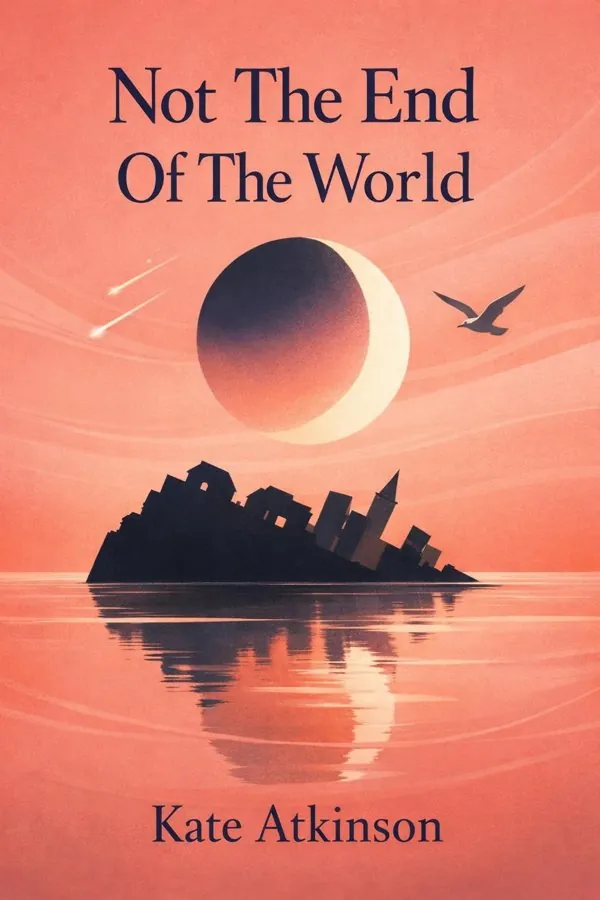
Not The End Of The World: Summary & Key Insights
 10 min9 chaptersAudio available
Key Takeaways from Not The End Of The World
One of Atkinson’s sharpest insights is that modern life often distracts us from existential anxiety not by solving it, but by decorating it.
Atkinson repeatedly suggests that the most important moments in life happen at thresholds, those in-between spaces where one reality gives way to another.
Affection is rarely pure, and Atkinson is too perceptive a writer to pretend otherwise.
A striking feature of Not The End Of The World is the ease with which biblical, folkloric, and mythic elements flow into modern settings.
Atkinson understands that words are never neutral tools.
What Is Not The End Of The World About?
Not The End Of The World by Kate Atkinson is a bestsellers book spanning 12 pages. Kate Atkinson’s Not The End Of The World is a dazzling collection of interconnected stories that asks a disarming question: what if apocalypse does not arrive as a single dramatic event, but as a series of private collapses, strange coincidences, and surreal interruptions in ordinary life? Moving between shopping malls, family homes, mythic landscapes, underwater tunnels, and emotional wastelands, Atkinson blends realism, folklore, biblical echoes, and dark comedy into fiction that feels both playful and profound. The result is a book about contemporary existence under pressure: consumerism, loneliness, family dysfunction, desire, memory, and mortality all appear here, but never in predictable form. What makes this collection matter is Atkinson’s extraordinary ability to show how the everyday already contains the uncanny. A trip to the shops becomes a ritual. A domestic conversation opens onto grief. A seemingly comic situation reveals spiritual emptiness. Best known for award-winning novels such as Behind the Scenes at the Museum and later the Jackson Brodie series, Atkinson brings the same intelligence, structural daring, and emotional sharpness to these stories. Not The End Of The World rewards readers who enjoy literary fiction that is witty, unsettling, humane, and alive to the hidden myths beneath modern life.
This FizzRead summary covers all 9 key chapters of Not The End Of The World in approximately 10 minutes, distilling the most important ideas, arguments, and takeaways from Kate Atkinson's work. Also available as an audio summary and Key Quotes Podcast.
Not The End Of The World
Kate Atkinson’s Not The End Of The World is a dazzling collection of interconnected stories that asks a disarming question: what if apocalypse does not arrive as a single dramatic event, but as a series of private collapses, strange coincidences, and surreal interruptions in ordinary life? Moving between shopping malls, family homes, mythic landscapes, underwater tunnels, and emotional wastelands, Atkinson blends realism, folklore, biblical echoes, and dark comedy into fiction that feels both playful and profound. The result is a book about contemporary existence under pressure: consumerism, loneliness, family dysfunction, desire, memory, and mortality all appear here, but never in predictable form.
What makes this collection matter is Atkinson’s extraordinary ability to show how the everyday already contains the uncanny. A trip to the shops becomes a ritual. A domestic conversation opens onto grief. A seemingly comic situation reveals spiritual emptiness. Best known for award-winning novels such as Behind the Scenes at the Museum and later the Jackson Brodie series, Atkinson brings the same intelligence, structural daring, and emotional sharpness to these stories. Not The End Of The World rewards readers who enjoy literary fiction that is witty, unsettling, humane, and alive to the hidden myths beneath modern life.
Who Should Read Not The End Of The World?
This book is perfect for anyone interested in bestsellers and looking to gain actionable insights in a short read. Whether you're a student, professional, or lifelong learner, the key ideas from Not The End Of The World by Kate Atkinson will help you think differently.
- ✓Readers who enjoy bestsellers and want practical takeaways
- ✓Professionals looking to apply new ideas to their work and life
- ✓Anyone who wants the core insights of Not The End Of The World in just 10 minutes
Want the full summary?
Get instant access to this book summary and 100K+ more with Fizz Moment.
Get Free SummaryAvailable on App Store • Free to download
Key Chapters
One of Atkinson’s sharpest insights is that modern life often distracts us from existential anxiety not by solving it, but by decorating it. In “Charlene and Trudi Go Shopping,” the bright surfaces of malls, products, food courts, and repetitive consumer rituals become more than social observation; they reveal how consumption can function like a secular religion. Charlene and Trudi are not simply shopping. They are participating in routines that offer belonging, control, and temporary relief from uncertainty. The joke is funny because it is familiar: many people use errands, purchases, or lifestyle habits to create meaning when deeper purpose feels absent.
Atkinson treats this world with both satire and sympathy. She does not mock ordinary pleasures outright. Instead, she shows how the shopping center becomes a modern temple, full of scripted behaviors and artificial light, where people seek comfort from loneliness, boredom, and the fear that life may be passing without significance. That is what makes the story resonate beyond its comic setup. It suggests that ordinary habits can reveal what we worship, avoid, or fear.
In practical terms, this idea applies far beyond retail culture. Today, endless scrolling, online purchases, productivity tools, or curated self-improvement routines can serve similar emotional functions. They are not inherently bad, but they can become substitutes for reflection, intimacy, or genuine renewal.
A useful takeaway is to examine one routine that feels harmless but repetitive and ask: what emotional need is this really meeting? Once you know that, you can decide whether the habit is nourishing you or merely numbing you.
Atkinson repeatedly suggests that the most important moments in life happen at thresholds, those in-between spaces where one reality gives way to another. “Tunnel of Fish” is built around exactly such an image: a passage that is both literal and symbolic. A journalist enters an underwater exhibit and finds himself crossing not just physical space but a border between the familiar and the uncanny. The tunnel evokes dream logic, mythic descent, and the unsettling feeling that ordinary perception can suddenly break open.
This matters because thresholds are central to how human beings experience transformation. We tend to imagine change as a planned sequence, yet much of life shifts us in liminal moments: a diagnosis, a divorce, a relocation, a conversation that cannot be taken back, the first day after a death. Atkinson turns that emotional truth into narrative architecture. Her stories hover in zones where identities loosen and certainties become unstable.
What makes her approach powerful is that she never fully explains the mystery. The strange remains strange. That artistic choice mirrors real life. Major transitions often feel ambiguous while we are living through them. We do not understand immediately who we are becoming.
A practical application is to take liminal periods seriously instead of trying to rush past them. If you are between jobs, relationships, homes, or versions of yourself, consider that uncertainty may be part of the transformation rather than a sign of failure. Journaling, walking, or setting aside time for reflection can help make such periods more conscious.
Actionable takeaway: when you next enter a period of uncertainty, name it as a threshold. That simple act can shift your mindset from panic to attention.
A striking feature of Not The End Of The World is the ease with which biblical, folkloric, and mythic elements flow into modern settings. Stories such as “What is the Star of Bethlehem?”, “The Marriage of Mary,” and “The Birds of the Innocent Wood” do not treat myth as decorative reference material. Instead, Atkinson suggests that ancient narratives continue to structure how people interpret suffering, wonder, guilt, destiny, and hope. Even in a secular age, we still think in symbols.
This is one reason the collection feels larger than social realism. A marriage problem can echo sacred narrative. A family conflict can take on fairy-tale menace. A child’s perspective can reveal a world charged with omens. Atkinson never insists on a single interpretation, which is part of her brilliance. Myth here is not doctrine. It is a framework for feeling, a language through which private experience becomes resonant.
In practical terms, this idea invites readers to notice the stories they unconsciously inherit. Many of us frame our lives as redemption arcs, tragedies, tests, exile journeys, second chances, or battles between innocence and corruption. Those frames influence how we interpret events and what choices we believe are available.
You can apply this by reflecting on the dominant story you tell about your current life chapter. Are you imagining yourself as abandoned, chosen, trapped, punished, or beginning again? Changing the underlying narrative can alter your sense of agency.
Actionable takeaway: write down the myth, fairy tale, or biblical story that most resembles your current emotional life. Then ask whether that narrative is helping you understand yourself or limiting what you believe can happen next.
Atkinson understands that words are never neutral tools. In “Unseen Translation” and “The Lying Game,” language becomes a subject in itself: unstable, seductive, partial, and often unreliable. People narrate events in ways that protect themselves, distort motives, or create coherence where none exists. Translation, whether literal or emotional, is always imperfect. We are forever trying to convert private experience into communicable form, and something always slips away.
This theme runs through the collection as a whole. Characters misunderstand one another not only because they are careless, but because language cannot fully contain memory, grief, desire, or fear. Even the title of a story can redirect meaning. Atkinson plays with tone, perspective, and irony to remind us that what is spoken, remembered, or reported is never the whole truth.
That insight has practical relevance in everyday life. Much conflict arises because people assume their interpretation is the event itself. Yet between intention and reception lies a wide gap. An offhand comment lands as an insult. A silence is read as rejection. A repeated anecdote becomes accepted family history whether or not it is accurate.
One useful application is to separate facts from interpretations in difficult conversations. Instead of saying, “You ignored me,” say, “I sent a message and didn’t hear back for two days, and I felt dismissed.” That shift opens space for clarity. Similarly, when hearing a story about yourself or someone else, it helps to ask what may be omitted.
Actionable takeaway: in your next disagreement, identify one sentence that states an interpretation as if it were fact, and rewrite it in more precise terms.
Few ideas are more unsettling than the possibility that the self is not fixed. Atkinson explores this directly in stories like “Evil Doppelgangers” and indirectly across the collection through mirrored characters, shifting roles, and uncanny repetitions. The doppelganger motif is not just gothic playfulness. It expresses a serious psychological truth: each person contains unrealized versions of themselves, and social identity is thinner than we like to believe.
Atkinson’s characters often find themselves displaced from the stories they tell about who they are. A respectable life reveals hidden strangeness. A stable relationship contains a stranger. A familiar body or face feels uncannily altered. These moments dramatize how identity can fracture under stress, memory, fantasy, or desire. The self is partly performance, partly invention, and partly mystery.
This insight matters because many people suffer from the pressure to maintain a single coherent image. We want to be dependable, consistent, and understandable. Yet human beings are contradictory. We are generous in one context and selfish in another, brave one year and frightened the next. Atkinson does not treat this multiplicity as a flaw to erase. She treats it as a condition to acknowledge.
In practical life, this can be freeing. If you feel stuck in an old identity, the problem may not be that you are false, but that you are incomplete. New work, relationships, or losses can bring forward aspects of the self you had not met before.
Actionable takeaway: make a list of three identities you currently inhabit and one hidden or neglected identity you want to explore more consciously. Then choose one small action that would give that neglected self more room.
For all its wit and invention, Not The End Of The World never forgets that human life is physical and finite. In “The Bodies Reside” and elsewhere, Atkinson returns to the body as the place where time, vulnerability, pleasure, illness, and death become impossible to ignore. This grounds the collection. However surreal things become, bodies remain stubbornly real. They age, ache, desire, fail, and carry memory in ways the mind cannot fully master.
Atkinson’s treatment of embodiment resists both sentimentality and abstraction. She understands that mortality enters ordinary life through details: fatigue, hospital rooms, domestic caretaking, sexual awkwardness, inherited features, and sudden awareness of fragility. The body is not separate from the self’s emotional life; it is the medium through which fear, grief, and love are experienced. This is one reason her stories feel emotionally dense even when they are playful in tone.
In practical terms, this theme reminds readers that denial of mortality often distorts priorities. We postpone conversations, neglect health, and imagine endless time. Yet awareness of finitude can sharpen attention. It can make ordinary moments more vivid and relationships more urgent.
A useful application is to treat physical life as part of meaning rather than a distraction from it. Rest, exercise, medical care, touch, and sensory pleasure are not trivial concerns; they are how life is actually lived. The body’s signals often reveal truths the intellect avoids.
Actionable takeaway: choose one neglected area of bodily care this week, sleep, movement, appointments, nutrition, or recovery, and treat it as an existential priority rather than a minor task.
Atkinson has always been a great anatomist of family life, and this collection shows why. In stories such as “The Lying Game,” “The Marriage of Mary,” and others threaded by domestic unease, family appears as both refuge and theatrical construction. People inherit not only genes and furniture, but scripts. Certain topics become unsayable, certain roles harden, and certain stories are repeated until they feel like truth. Families survive partly by selective storytelling.
This does not mean family narratives are merely dishonest. Often they are protective. They help people contain shame, manage grief, and preserve continuity. But they can also trap individuals in outdated identities: the difficult child, the dependable sibling, the absent father, the saintly mother. Atkinson is attentive to the comedy and damage this creates. Her gift lies in showing how the smallest domestic pattern can carry mythic weight.
The practical lesson is that many adult struggles are sustained by inherited interpretations. You may still be reacting to an old family script even when circumstances have changed. For example, someone praised only for competence may find it hard to ask for help. Someone cast as disruptive may overidentify with rebellion long after it stops serving them.
One useful exercise is to identify a recurring line or role from your family system and ask whether it still defines you. Sometimes changing your life begins with changing the sentence that has been repeated about you for years.
Actionable takeaway: write down one family story about who you are. Then rewrite it from a more generous and current perspective.
The title Not The End Of The World is ironic, reassuring, and quietly ominous all at once. Atkinson’s most original achievement in the collection may be her redefinition of apocalypse. Rather than treating the end of the world as a singular catastrophe, she presents it as something dispersed across ordinary life: marriages ending, illusions collapsing, identities dissolving, grief arriving, trust breaking, systems failing to provide meaning. In “Pleasureland” and throughout the book, disaster is both cosmic and intimate.
This expanded idea of apocalypse is powerful because it matches lived experience. Most people do not encounter the literal end of the world. They encounter the end of a world: the one they expected, relied on, or built their identity around. Atkinson recognizes that these endings can feel total even when life outwardly continues. That is why her stories are emotionally piercing. They honor the magnitude of private collapse without losing humor or perspective.
The phrase “not the end of the world” is often used to minimize distress. Atkinson turns it inside out. It may not be the end of everything, but it may well be the end of something central. And that deserves attention. Yet the title also implies survival. Endings are devastating, but they are not always final annihilations. After one world ends, another begins to form.
In practical life, this perspective can help people navigate change with greater honesty. You do not need to dramatize every setback, but neither should you dismiss real losses.
Actionable takeaway: name one “small apocalypse” you have endured, and list what ended, what remained, and what new life emerged afterward.
All Chapters in Not The End Of The World
About the Author
Kate Atkinson is an acclaimed British author born in York, England, in 1951. She studied English literature and later began publishing fiction that quickly earned critical recognition for its intelligence, originality, and emotional range. Her debut novel, Behind the Scenes at the Museum, won the Whitbread Book of the Year award and established her as a major literary voice. She has since written widely praised novels including Human Croquet, Life After Life, A God in Ruins, and the popular Jackson Brodie detective series. Atkinson is known for combining literary fiction with mystery, sharp humor, structural experimentation, and occasional touches of magical realism. Her work often explores family, memory, chance, mortality, and the strange patterns hidden within everyday life, making her one of the most distinctive contemporary voices in British fiction.
Get This Summary in Your Preferred Format
Read or listen to the Not The End Of The World summary by Kate Atkinson anytime, anywhere. FizzRead offers multiple formats so you can learn on your terms — all free.
Available formats: App · Audio · PDF · EPUB — All included free with FizzRead
Download Not The End Of The World PDF and EPUB Summary
Key Quotes from Not The End Of The World
“One of Atkinson’s sharpest insights is that modern life often distracts us from existential anxiety not by solving it, but by decorating it.”
“Atkinson repeatedly suggests that the most important moments in life happen at thresholds, those in-between spaces where one reality gives way to another.”
“Affection is rarely pure, and Atkinson is too perceptive a writer to pretend otherwise.”
“A striking feature of Not The End Of The World is the ease with which biblical, folkloric, and mythic elements flow into modern settings.”
“Atkinson understands that words are never neutral tools.”
Frequently Asked Questions about Not The End Of The World
Not The End Of The World by Kate Atkinson is a bestsellers book that explores key ideas across 9 chapters. Kate Atkinson’s Not The End Of The World is a dazzling collection of interconnected stories that asks a disarming question: what if apocalypse does not arrive as a single dramatic event, but as a series of private collapses, strange coincidences, and surreal interruptions in ordinary life? Moving between shopping malls, family homes, mythic landscapes, underwater tunnels, and emotional wastelands, Atkinson blends realism, folklore, biblical echoes, and dark comedy into fiction that feels both playful and profound. The result is a book about contemporary existence under pressure: consumerism, loneliness, family dysfunction, desire, memory, and mortality all appear here, but never in predictable form. What makes this collection matter is Atkinson’s extraordinary ability to show how the everyday already contains the uncanny. A trip to the shops becomes a ritual. A domestic conversation opens onto grief. A seemingly comic situation reveals spiritual emptiness. Best known for award-winning novels such as Behind the Scenes at the Museum and later the Jackson Brodie series, Atkinson brings the same intelligence, structural daring, and emotional sharpness to these stories. Not The End Of The World rewards readers who enjoy literary fiction that is witty, unsettling, humane, and alive to the hidden myths beneath modern life.
You Might Also Like
The Godfather
Mario Puzo
10 min
The Handmaid's Tale
Margaret Atwood
10 min
The Hunger Games
Suzanne Collins
10 min
The Nightingale
Kristin Hannah
10 min
The Seven Husbands of Evelyn Hugo
Taylor Jenkins Reid
10 min
Backwater Justice
Fern Michaels
10 minBrowse by Category
Ready to read Not The End Of The World?
Get the full summary and 100K+ more books with Fizz Moment.