
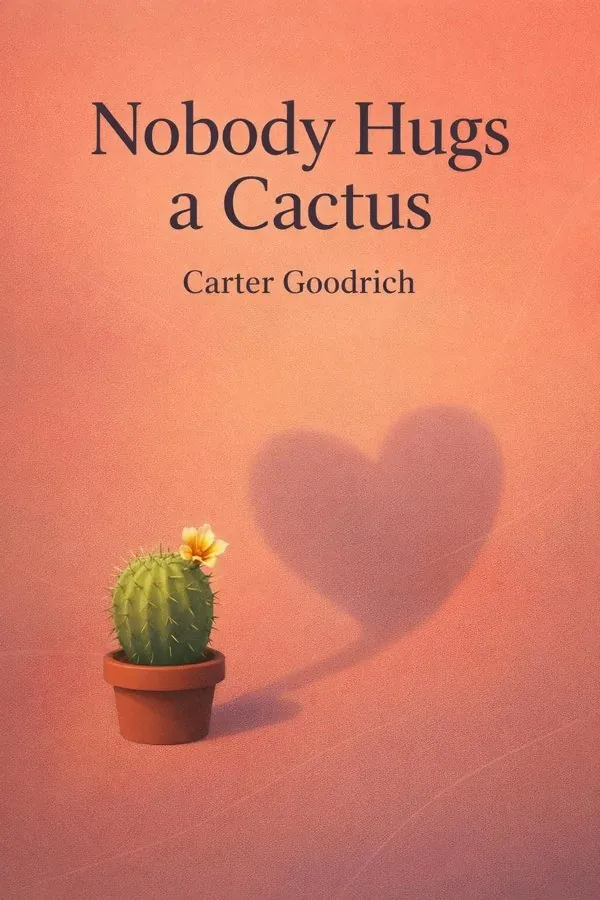
Nobody Hugs a Cactus: Summary & Key Insights
 10 min8 chaptersAudio available
Key Takeaways from Nobody Hugs a Cactus
Sometimes loneliness does not look sad at first; it looks like control.
Connection often arrives in imperfect, inconvenient ways.
The traits that keep us safe can also keep us lonely.
Many people do not accept help until life makes self-sufficiency impossible.
Real change rarely begins with appearances; it begins with a softened heart.
What Is Nobody Hugs a Cactus About?
Nobody Hugs a Cactus by Carter Goodrich is a bestsellers book spanning 4 pages. Nobody Hugs a Cactus is a warm, witty picture book about a character who seems built to keep everyone away. Hank is a cactus with sharp spines, a sour expression, and a firm belief that solitude is safer than connection. From his desert home, he watches life happen at a distance and insists he wants no part of it. But as the story unfolds, Hank discovers that isolation may protect him from discomfort, yet it also keeps him from joy, friendship, and the simple comfort of being seen. What makes this book memorable is how gently it explores emotional defenses that readers of any age will recognize. Children see a funny, stubborn cactus learning to open up. Adults see a tender portrait of guardedness, fear, and the vulnerability required to let others in. Carter Goodrich brings unusual authority to this emotional journey. Known for his character design work on beloved animated films, he combines expressive illustration, visual humor, and emotional precision to turn a simple premise into a resonant story about empathy, self-discovery, and belonging. This is a picture book with a small setting and a big heart.
This FizzRead summary covers all 8 key chapters of Nobody Hugs a Cactus in approximately 10 minutes, distilling the most important ideas, arguments, and takeaways from Carter Goodrich's work. Also available as an audio summary and Key Quotes Podcast.
Nobody Hugs a Cactus
Nobody Hugs a Cactus is a warm, witty picture book about a character who seems built to keep everyone away. Hank is a cactus with sharp spines, a sour expression, and a firm belief that solitude is safer than connection. From his desert home, he watches life happen at a distance and insists he wants no part of it. But as the story unfolds, Hank discovers that isolation may protect him from discomfort, yet it also keeps him from joy, friendship, and the simple comfort of being seen.
What makes this book memorable is how gently it explores emotional defenses that readers of any age will recognize. Children see a funny, stubborn cactus learning to open up. Adults see a tender portrait of guardedness, fear, and the vulnerability required to let others in. Carter Goodrich brings unusual authority to this emotional journey. Known for his character design work on beloved animated films, he combines expressive illustration, visual humor, and emotional precision to turn a simple premise into a resonant story about empathy, self-discovery, and belonging. This is a picture book with a small setting and a big heart.
Who Should Read Nobody Hugs a Cactus?
This book is perfect for anyone interested in bestsellers and looking to gain actionable insights in a short read. Whether you're a student, professional, or lifelong learner, the key ideas from Nobody Hugs a Cactus by Carter Goodrich will help you think differently.
- ✓Readers who enjoy bestsellers and want practical takeaways
- ✓Professionals looking to apply new ideas to their work and life
- ✓Anyone who wants the core insights of Nobody Hugs a Cactus in just 10 minutes
Want the full summary?
Get instant access to this book summary and 100K+ more with Fizz Moment.
Get Free SummaryAvailable on App Store • Free to download
Key Chapters
Sometimes loneliness does not look sad at first; it looks like control. Hank begins the story in a carefully protected routine, perched in his quiet place and watching the desert world without joining it. Around him, life bustles with movement, sound, and possibility. Dust swirls, animals wander past, and strangers move through the landscape with ease. Yet Hank interprets all of this not as invitation but as intrusion. He has convinced himself that distance is comfort and that keeping others away is a sign of strength.
This opening matters because it captures a deeply human habit: building a private world that feels safe precisely because it asks nothing of us. Hank’s silence is not only about preference. It suggests fear of discomfort, fear of rejection, and perhaps fear of being known. His spines become a visual metaphor for emotional defenses. We all have versions of them: sarcasm, busyness, aloofness, perfectionism, or the habit of saying “I’m fine” when we are not.
Goodrich presents Hank’s solitude with humor, but he never mocks it. Instead, he shows how self-protection can slowly harden into disconnection. In everyday life, this can look like avoiding new friendships, declining invitations, or assuming others will not understand us anyway. The result is often a smaller life than we truly want.
The insight is simple but powerful: solitude can be nourishing, but isolation becomes limiting when it is driven by fear. Hank’s desert is not empty because nobody is there. It feels empty because he refuses to step into relationship.
Actionable takeaway: Notice one “spine” you use to keep people at a distance, and experiment with lowering it in one small interaction this week.
Connection often arrives in imperfect, inconvenient ways. In Hank’s case, the outside world does not leave him alone just because he wants it to. A tumbleweed rolls by with lighthearted energy, inviting him into play. A cowboy offers a cheerful greeting. Other signs of friendliness appear in forms that are casual, ordinary, and easy to dismiss. Hank responds the same way each time: with irritation, suspicion, and refusal. If the world is reaching toward him, he is determined to pull away.
This pattern reveals how resistance to friendship often has less to do with the people approaching us and more to do with the story we tell ourselves about them. Hank assumes that every social gesture is a threat to his peace. He does not pause to consider that others may simply be kind. His defensiveness turns even harmless invitations into sources of annoyance.
This dynamic is familiar in real life. A child may reject classmates before they can reject them first. An adult may brush off a neighbor’s friendliness, decline team lunches, or keep conversations short because openness feels risky. The problem is not that opportunities for connection are absent. It is that they are filtered through distrust.
Goodrich uses comedy to show how exhausting this can be. Hank works hard to remain unavailable. His effort to avoid people becomes its own kind of entanglement. Ironically, defending his independence leaves him reactive and tense rather than peaceful.
The chapter’s deeper lesson is that friendship does not always enter dramatically. It often arrives as a small wave, a hello, a playful invitation, or a repeated kindness. We miss many potential relationships not because nobody reaches out, but because we dismiss connection before it has a chance to grow.
Actionable takeaway: The next time someone offers a simple gesture of connection, respond with curiosity instead of reflexive refusal, even if only for a minute.
The traits that keep us safe can also keep us lonely. Hank is a cactus, and his spines make perfect sense in the natural world. They are practical, protective, and part of who he is. But in the emotional logic of the story, those same spines symbolize the barriers people develop after disappointment, fear, or discomfort. Hank’s prickliness is not random temperament alone; it is his strategy for making sure no one gets too close.
This is one of the book’s most elegant ideas. Goodrich does not suggest that sensitivity or caution are bad. On the contrary, boundaries matter. Some distance is healthy. The problem begins when a defense mechanism becomes an identity. Hank stops being a cactus who has spines and starts behaving as though his spines define his whole way of relating to the world.
Children can understand this through behavior: someone may be grumpy, bossy, or withdrawn because closeness feels hard. Adults can see the broader application. We might hide behind competence, humor, criticism, or independence. These patterns protect us from embarrassment or hurt, but they also block affection, trust, and mutual care.
The story invites compassion for difficult behavior without excusing it. Hank’s roughness affects others, but it also reveals vulnerability. That makes the book useful not just for readers who identify with Hank, but also for those who live with prickly people. Often, sharp edges are signs of unspoken fear.
A practical lesson emerges here: emotional growth does not require becoming someone entirely different. Hank does not need to stop being a cactus. He needs to learn that his defenses are tools, not a prison. We all need that distinction.
Actionable takeaway: Ask yourself whether one protective habit in your life is serving a real need today or simply repeating an old fear.
Many people do not accept help until life makes self-sufficiency impossible. In Hank’s journey, a turning point comes when his rigid distance can no longer hold. He falls, struggles, or otherwise finds himself in a vulnerable position where his usual defenses are not enough. This moment matters because it interrupts the illusion that he can manage everything alone. For perhaps the first time, connection is no longer just an optional nuisance. It becomes a lifeline.
This is a classic emotional shift: the realization that independence has limits. In children’s stories, such moments often appear through physical mishaps. In adult life, they show up as burnout, loneliness, disappointment, or a crisis that exposes how much we need others. What changes us is not simply the fall itself, but who responds when we are down.
Goodrich uses this beat to reveal the generosity of the world Hank has rejected. The same community he pushed away does not answer his need with revenge. Instead, it answers with care. That contrast is powerful. Hank expects judgment or continued distance; instead, he encounters grace.
This part of the story teaches readers that vulnerability is not only dangerous. It can also be the beginning of belonging. When we let others see our need, we often discover who is willing to show up. A child might learn that asking for help at school is brave, not shameful. An adult might recognize the value of admitting stress, accepting support, or reconnecting after withdrawing.
Being found changes Hank because it gives him evidence against his deepest assumption: that closeness only harms. Sometimes we need a lived experience of kindness before we can trust it.
Actionable takeaway: In one area where you are struggling, name your need clearly to a trusted person instead of trying to handle it silently.
Real change rarely begins with appearances; it begins with a softened heart. By the later part of the story, Hank starts to open, and that opening is suggested not only through behavior but through the imagery of growth and bloom. For a cactus, blooming is especially meaningful. It does not erase the plant’s nature. It reveals a hidden possibility inside it. Hank remains Hank, yet something beautiful becomes visible because he is no longer closed against the world.
This is an important corrective to simplistic lessons about personal transformation. The book does not imply that emotional growth means becoming endlessly cheerful, socially effortless, or pleasing to everyone. Instead, it shows that warmth can emerge from unlikely places once fear loosens its grip. Blooming is not performance. It is authenticity finally given room to show itself.
In practical terms, many people experience this kind of inner bloom when they feel accepted. A reserved child may become playful in a trusting classroom. A guarded adult may become generous and funny in a relationship where they feel safe. The right conditions do not manufacture a new person; they reveal more of the person already there.
Goodrich’s visual storytelling reinforces this beautifully. The desert setting, with its sparse textures and bursts of life, mirrors Hank’s own emotional landscape. The bloom symbolizes what connection makes possible: not loss of self, but fuller expression of self.
The lesson extends beyond friendship. Communities, families, and classrooms often flourish when they create environments where difficult or withdrawn individuals are met with patience rather than labels. Sometimes what looks like coldness is simply unopened potential.
Actionable takeaway: Create one condition that helps you or someone else feel safer opening up, such as consistent kindness, patient listening, or a low-pressure invitation.
People often absorb difficult truths more easily when they are allowed to laugh. One of the great strengths of Nobody Hugs a Cactus is that it never turns Hank’s emotional struggle into a heavy lesson. His stubbornness is funny. His grumpiness is exaggerated in a charming way. The contrast between a hug-resistant cactus and a world full of warmth creates immediate comic tension. Yet beneath the humor lies a serious emotional reality: some individuals push others away because closeness feels uncomfortable or unsafe.
This balance matters, especially in children’s literature. If a story becomes too moralizing, readers may resist it. If it becomes too light, the emotional core disappears. Goodrich threads the needle by making Hank entertaining while preserving his dignity. Readers can laugh at his overreactions and still recognize his loneliness.
Humor also works as an emotional bridge in everyday life. Parents, teachers, and caregivers often use playful language to help children approach topics like friendship, anger, and social fear. Adults do the same with each other, sometimes making a joke before admitting something vulnerable. Laughter lowers defenses. It makes difficult conversations possible.
The book demonstrates that emotional education does not have to be solemn to be meaningful. A funny story can teach empathy. A whimsical character can illuminate real patterns of avoidance, defensiveness, and growth. In this way, Hank becomes memorable not just because he is prickly, but because his prickliness is both amusing and recognizably human.
The practical implication is clear: when trying to address emotional barriers, gentleness often works better than pressure. Humor can invite reflection without triggering shame.
Actionable takeaway: When discussing difficult feelings with a child or even with yourself, try using a playful metaphor or light touch to make honesty feel less threatening.
It is easy to label someone as mean, rude, or unfriendly; it is harder and wiser to ask what pain or fear sits underneath. Hank could be dismissed as simply bad-tempered. Instead, the story invites readers to look again. His behavior is undeniably prickly, but the narrative encourages empathy without denying the impact of his actions. That balance is one of the book’s most valuable contributions.
For children, this is a crucial social lesson. The classmate who snaps at others, the sibling who withdraws, or the neighbor who seems gruff may not be rejecting connection because they do not need it. They may be struggling to receive it. Learning this early helps children develop compassion instead of jumping immediately to judgment.
For adults, the lesson is equally relevant. Workplaces, families, and communities are full of people whose hard edges conceal insecurity, exhaustion, grief, or old hurt. Empathy does not require tolerating harmful behavior without boundaries. Rather, it means responding with curiosity and steadiness instead of contempt.
Goodrich’s storytelling shows that seeing someone more deeply can become the beginning of transformation. Hank changes not because he is shamed into niceness, but because the world around him continues to offer care. That repeated kindness creates the possibility of trust. This is not always enough in every real-life situation, but it is often more effective than retaliation.
The insight here is that difficult personalities are sometimes unfinished stories. When we stop at the surface, we reinforce disconnection. When we pair boundaries with empathy, we create a chance for better outcomes.
Actionable takeaway: The next time someone behaves defensively, pause before labeling them and ask what unmet need or fear might be driving the behavior.
Many people postpone connection until they feel more likable, less awkward, or more emotionally polished. Hank’s story quietly dismantles that idea. He does not become worthy of companionship only after turning into an entirely different character. His path toward belonging begins when he risks openness, not when he achieves perfection. This is a subtle but liberating message.
Belonging is often misunderstood as a reward for having the right personality. In reality, it grows through participation. We become connected by showing up, receiving kindness, offering some in return, and tolerating the discomfort of being known. Hank’s challenge is not that he lacks value. It is that he refuses the vulnerability that relationships require.
This lesson is especially useful for readers who identify as shy, sensitive, or socially hesitant. The story suggests that one does not need to be effortlessly outgoing to have meaningful bonds. One needs willingness. A child may not become the loudest student in class, but they can still answer a friendly question or join a game for a few minutes. An adult may not love parties, but they can still send a text, accept an invitation, or speak honestly to one trusted friend.
Goodrich’s cactus metaphor is perfect here. Hank will always have spines. There will always be some complexity in getting close to him. Yet relationship becomes possible anyway. This is a deeply hopeful idea: our imperfections do not disqualify us from love or friendship.
If readers carry one lasting truth from the book, it may be this: you do not need to stop being yourself to belong. You simply need the courage to let others come a little nearer.
Actionable takeaway: Choose one small social risk that feels manageable today, such as saying hello first, accepting help, or expressing appreciation.
All Chapters in Nobody Hugs a Cactus
About the Author
Carter Goodrich is an American illustrator, author, and acclaimed character designer whose work is known for its wit, expressiveness, and emotional warmth. He has contributed to several major animated films, including Finding Nemo, Ratatouille, and Despicable Me, helping shape memorable characters through his distinctive visual style. Alongside his film career, Goodrich has written and illustrated a number of celebrated picture books, earning praise for combining playful humor with genuine psychological insight. His illustrations are especially effective at revealing personality through small visual details, making his characters feel both funny and deeply human. In Nobody Hugs a Cactus, Goodrich brings those strengths together beautifully, crafting a story that is accessible to children while also resonating with adults through its gentle exploration of loneliness, vulnerability, and connection.
Get This Summary in Your Preferred Format
Read or listen to the Nobody Hugs a Cactus summary by Carter Goodrich anytime, anywhere. FizzRead offers multiple formats so you can learn on your terms — all free.
Available formats: App · Audio · PDF · EPUB — All included free with FizzRead
Download Nobody Hugs a Cactus PDF and EPUB Summary
Key Quotes from Nobody Hugs a Cactus
“Sometimes loneliness does not look sad at first; it looks like control.”
“Connection often arrives in imperfect, inconvenient ways.”
“The traits that keep us safe can also keep us lonely.”
“Many people do not accept help until life makes self-sufficiency impossible.”
“Real change rarely begins with appearances; it begins with a softened heart.”
Frequently Asked Questions about Nobody Hugs a Cactus
Nobody Hugs a Cactus by Carter Goodrich is a bestsellers book that explores key ideas across 8 chapters. Nobody Hugs a Cactus is a warm, witty picture book about a character who seems built to keep everyone away. Hank is a cactus with sharp spines, a sour expression, and a firm belief that solitude is safer than connection. From his desert home, he watches life happen at a distance and insists he wants no part of it. But as the story unfolds, Hank discovers that isolation may protect him from discomfort, yet it also keeps him from joy, friendship, and the simple comfort of being seen. What makes this book memorable is how gently it explores emotional defenses that readers of any age will recognize. Children see a funny, stubborn cactus learning to open up. Adults see a tender portrait of guardedness, fear, and the vulnerability required to let others in. Carter Goodrich brings unusual authority to this emotional journey. Known for his character design work on beloved animated films, he combines expressive illustration, visual humor, and emotional precision to turn a simple premise into a resonant story about empathy, self-discovery, and belonging. This is a picture book with a small setting and a big heart.
You Might Also Like

The Godfather
Mario Puzo
10 min
The Handmaid's Tale
Margaret Atwood
10 min
The Hunger Games
Suzanne Collins
10 min
The Nightingale
Kristin Hannah
10 min
The Seven Husbands of Evelyn Hugo
Taylor Jenkins Reid
10 min
Backwater Justice
Fern Michaels
10 minBrowse by Category
Ready to read Nobody Hugs a Cactus?
Get the full summary and 100K+ more books with Fizz Moment.