
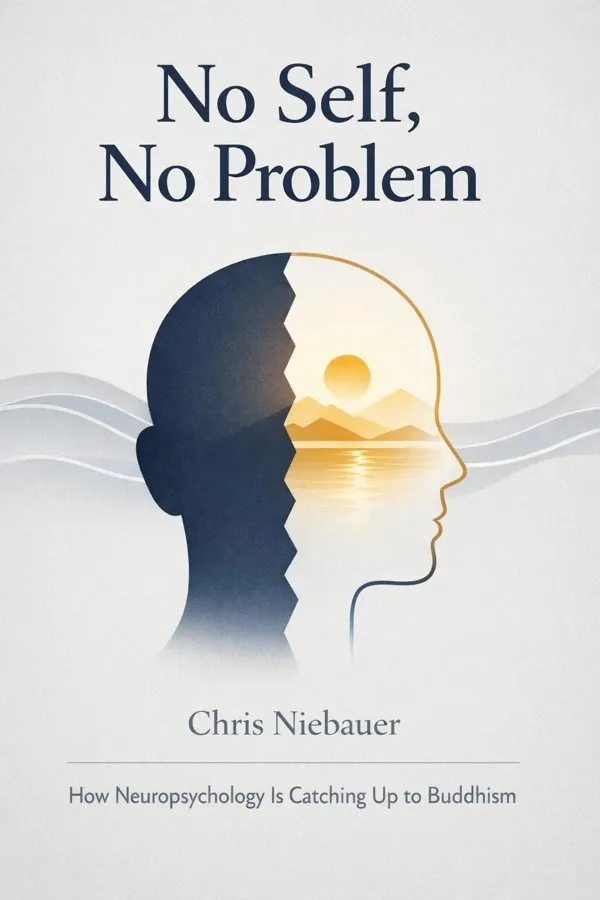
No Self, No Problem: How Neuropsychology Is Catching Up to Buddhism: Summary & Key Insights
 10 min9 chaptersAudio available
What Is No Self, No Problem: How Neuropsychology Is Catching Up to Buddhism About?
No Self, No Problem: How Neuropsychology Is Catching Up to Buddhism by Chris Niebauer is a neuroscience book spanning 9 pages. This book explores the intersection between modern neuropsychology and ancient Buddhist philosophy. Chris Niebauer argues that the concept of the 'self' is an illusion created by the left hemisphere of the brain, and that understanding this illusion can lead to greater peace and clarity. Drawing on cognitive science and mindfulness practices, the author presents a compelling case for how neuroscience supports the Buddhist idea of non-self.
This FizzRead summary covers all 9 key chapters of No Self, No Problem: How Neuropsychology Is Catching Up to Buddhism in approximately 10 minutes, distilling the most important ideas, arguments, and takeaways from Chris Niebauer's work. Also available as an audio summary and Key Quotes Podcast.
No Self, No Problem: How Neuropsychology Is Catching Up to Buddhism
This book explores the intersection between modern neuropsychology and ancient Buddhist philosophy. Chris Niebauer argues that the concept of the 'self' is an illusion created by the left hemisphere of the brain, and that understanding this illusion can lead to greater peace and clarity. Drawing on cognitive science and mindfulness practices, the author presents a compelling case for how neuroscience supports the Buddhist idea of non-self.
Who Should Read No Self, No Problem: How Neuropsychology Is Catching Up to Buddhism?
This book is perfect for anyone interested in neuroscience and looking to gain actionable insights in a short read. Whether you're a student, professional, or lifelong learner, the key ideas from No Self, No Problem: How Neuropsychology Is Catching Up to Buddhism by Chris Niebauer will help you think differently.
- ✓Readers who enjoy neuroscience and want practical takeaways
- ✓Professionals looking to apply new ideas to their work and life
- ✓Anyone who wants the core insights of No Self, No Problem: How Neuropsychology Is Catching Up to Buddhism in just 10 minutes
Want the full summary?
Get instant access to this book summary and 100K+ more with Fizz Moment.
Get Free SummaryAvailable on App Store • Free to download
Key Chapters
For decades, neuroscientists have mapped the distinct roles of the brain’s hemispheres. The left hemisphere is analytical, linguistic, and reductionist—it loves categories, explanations, and stories. The right hemisphere, by contrast, perceives the world holistically, directly, and nonverbally. It engages with the world as a dynamic, living whole, while the left tends to abstract and label that world into tidy concepts.
In Western culture, we have largely ceded our awareness to the left-brain mode of operation. We live in a world of symbols—language, ideas, plans, digital representations—and have come to mistake these representations for reality itself. The left hemisphere’s obsession with analysis and labeling gives rise to the illusion that there exists a separate observer who stands apart from the unfolding flow of experience. The right hemisphere has no such notion; it simply experiences. It sees patterns and relationships instead of isolated entities. In Buddhist terms, the right hemisphere dwells where direct awareness meets impermanence—it recognizes no borders between self and world.
Understanding these hemispheric distinctions is not theoretical indulgence; it changes how we inhabit our lives. When we recognize that the 'I' who thinks is largely a left-brain construct, the world begins to soften. We can glimpse moments when attention shifts—when a sunset stops being 'a sunset' we are naming, and instead becomes a wordless act of being. In such moments, reality and observer merge, and what remains is simple, unmediated presence.
Among the most fascinating findings in split-brain research is the discovery of what neuroscientists call the 'interpreter.' This mechanism in the left hemisphere fabricates coherence, inventing causal narratives to explain whatever the person experiences. In classic experiments, when the right hemisphere performed an action that the speaking left hemisphere was unaware of, the interpreter would still conjure a plausible reason—often completely false—for why the action occurred. The human brain, it turns out, prefers a coherent story over honest confusion.
This left-hemispheric interpreter constructs not only isolated explanations but the entire narrative of who we are. Thoughts such as 'I decided to do this,' or 'I am the kind of person who…' are generated automatically by a storytelling brain. It tells a continuous, internally consistent story that links the present to imagined past and projected future. Yet when we honestly observe our experience, we see that decisions arise spontaneously, emotions appear unbidden, and thoughts flow autonomously. The interpreter claims ownership over them, saying 'I did that,' but there is no 'doer' apart from the narration itself.
When we sit quietly in meditation or mindfulness practice, we can begin to watch this interpreter at work. We see how ceaselessly it interprets, justifies, and judges. Realizing that these are neural events, not profound truths, loosens their grip. The insight is not nihilistic but profoundly freeing: the story isn’t the storyteller. There is no thinker behind the thoughts, only thinking itself.
+ 7 more chapters — available in the FizzRead app
All Chapters in No Self, No Problem: How Neuropsychology Is Catching Up to Buddhism
About the Author
Chris Niebauer, Ph.D., is a cognitive neuropsychologist and professor at Slippery Rock University in Pennsylvania. His research focuses on consciousness, the left and right hemispheres of the brain, and the relationship between psychology and Eastern philosophy.
Get This Summary in Your Preferred Format
Read or listen to the No Self, No Problem: How Neuropsychology Is Catching Up to Buddhism summary by Chris Niebauer anytime, anywhere. FizzRead offers multiple formats so you can learn on your terms — all free.
Available formats: App · Audio · PDF · EPUB — All included free with FizzRead
Download No Self, No Problem: How Neuropsychology Is Catching Up to Buddhism PDF and EPUB Summary
Key Quotes from No Self, No Problem: How Neuropsychology Is Catching Up to Buddhism
“For decades, neuroscientists have mapped the distinct roles of the brain’s hemispheres.”
“Among the most fascinating findings in split-brain research is the discovery of what neuroscientists call the 'interpreter.”
Frequently Asked Questions about No Self, No Problem: How Neuropsychology Is Catching Up to Buddhism
No Self, No Problem: How Neuropsychology Is Catching Up to Buddhism by Chris Niebauer is a neuroscience book that explores key ideas across 9 chapters. This book explores the intersection between modern neuropsychology and ancient Buddhist philosophy. Chris Niebauer argues that the concept of the 'self' is an illusion created by the left hemisphere of the brain, and that understanding this illusion can lead to greater peace and clarity. Drawing on cognitive science and mindfulness practices, the author presents a compelling case for how neuroscience supports the Buddhist idea of non-self.
You Might Also Like
Anxious
Joseph LeDoux
10 min
Hallucinations
Oliver Sacks
10 min
The Biological Mind: How Brain, Body, and Environment Collaborate to Make Us Who We Are
Alan Jasanoff
10 min
The Feeling of Life Itself: Why Consciousness Is Widespread but Can't Be Computed
Christof Koch
10 min
The No-Nonsense Meditation Book
Steven Laureys
10 min
A General Theory of Love
Thomas Lewis, Fari Amini, Richard Lannon
10 minBrowse by Category
Ready to read No Self, No Problem: How Neuropsychology Is Catching Up to Buddhism?
Get the full summary and 100K+ more books with Fizz Moment.