
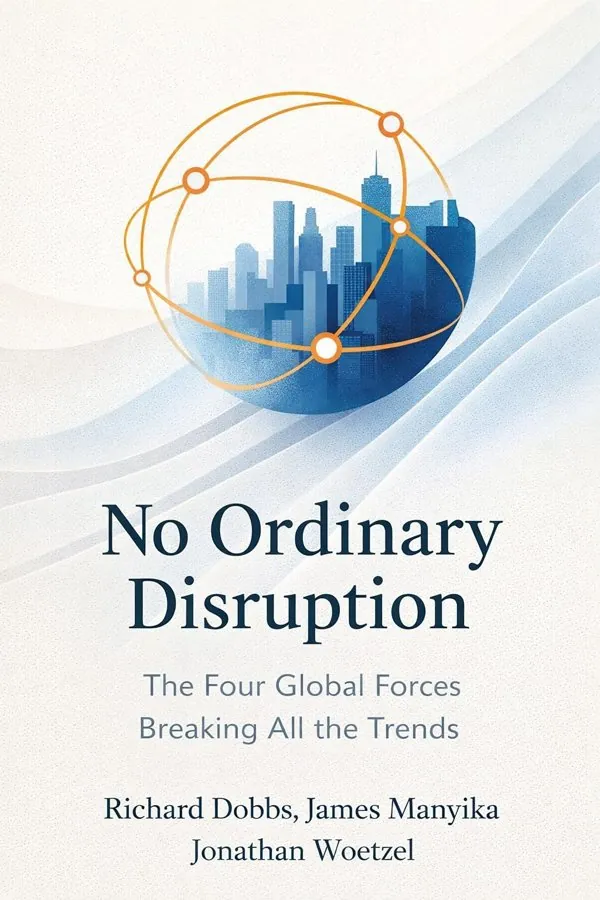
No Ordinary Disruption: The Four Global Forces Breaking All the Trends: Summary & Key Insights
by Richard Dobbs, James Manyika, Jonathan Woetzel
 10 min9 chaptersAudio available
What Is No Ordinary Disruption: The Four Global Forces Breaking All the Trends About?
No Ordinary Disruption: The Four Global Forces Breaking All the Trends by Richard Dobbs, James Manyika, Jonathan Woetzel is a economics book spanning 9 pages. This book explores how four powerful global forces—urbanization, technological change, aging populations, and global interconnectivity—are reshaping the world economy. The authors, senior partners at McKinsey & Company, argue that these disruptions are transforming industries, labor markets, and societies faster than most organizations can adapt. They provide insights and frameworks to help leaders understand and respond to these unprecedented shifts.
This FizzRead summary covers all 9 key chapters of No Ordinary Disruption: The Four Global Forces Breaking All the Trends in approximately 10 minutes, distilling the most important ideas, arguments, and takeaways from Richard Dobbs, James Manyika, Jonathan Woetzel's work. Also available as an audio summary and Key Quotes Podcast.
No Ordinary Disruption: The Four Global Forces Breaking All the Trends
This book explores how four powerful global forces—urbanization, technological change, aging populations, and global interconnectivity—are reshaping the world economy. The authors, senior partners at McKinsey & Company, argue that these disruptions are transforming industries, labor markets, and societies faster than most organizations can adapt. They provide insights and frameworks to help leaders understand and respond to these unprecedented shifts.
Who Should Read No Ordinary Disruption: The Four Global Forces Breaking All the Trends?
This book is perfect for anyone interested in economics and looking to gain actionable insights in a short read. Whether you're a student, professional, or lifelong learner, the key ideas from No Ordinary Disruption: The Four Global Forces Breaking All the Trends by Richard Dobbs, James Manyika, Jonathan Woetzel will help you think differently.
- ✓Readers who enjoy economics and want practical takeaways
- ✓Professionals looking to apply new ideas to their work and life
- ✓Anyone who wants the core insights of No Ordinary Disruption: The Four Global Forces Breaking All the Trends in just 10 minutes
Want the full summary?
Get instant access to this book summary and 100K+ more with Fizz Moment.
Get Free SummaryAvailable on App Store • Free to download
Key Chapters
When we look at a map of global growth today, the outlines have blurred and shifted dramatically since the middle of the 20th century. In the span of just a few decades, the epicenter of economic gravity has migrated from the developed economies of the West to the emerging markets of the East. China, India, Southeast Asia, and parts of sub-Saharan Africa are now shaping global consumption, innovation, and production in ways once unimaginable.
In our research, we showed that by 2025, almost half of global GDP growth would come from cities in the developing world, many of which most business leaders have never even heard of. The scale of this shift is breathtaking. It’s not merely that new economies are catching up—it’s that the entire structure of global demand is being rewritten. Millions are entering the consuming class annually, each bringing fresh preferences, purchasing power, and aspirations. The Western-centric model of growth—where developed markets dictated trends and emerging ones followed—has flipped. Today’s emerging markets are defining what global competitiveness and innovation look like.
For established companies and policymakers, this transformation demands humility and curiosity. Growth strategies built on the assumption of Western predominance will falter. It’s not enough to adapt gradually; leaders must confront their blind spots. When rapid urban expansion in China drives steel, cement, and energy markets worldwide, when rising incomes in India redefine digital consumption, the implications ripple far beyond regional boundaries. This redistribution of economic weight alters everything from trade patterns to financial flows and geopolitical relationships.
The heart of this disruption lies in calibration: the world must learn to operate in a multipolar economy where influence is spread rather than concentrated. Those who recognize this early will discover vast opportunity—in infrastructure investment, consumer markets, and innovation ecosystems. Those who cling to outdated maps will find themselves directionless.
The message is clear: global balance has shifted irreversibly. To thrive, one must learn the new coordinates of growth.
Cities have always been engines of human progress. But today, urbanization is occurring at a pace unprecedented in history. Every month, millions of people move into cities; by 2030, nearly 60 percent of the world’s population will live in urban areas. Among these are brand-new megacities—urban clusters with populations above ten million—that are transforming geography, economics, and innovation simultaneously.
We emphasize in the book that this isn’t a simple story of people gathering in one place. What makes contemporary urbanization disruptive is its speed, scale, and economic dynamism. Urban areas concentrate talent, infrastructure, and consumption. They foster productivity by enabling specialization and connectivity. Yet, they also expose deep challenges: strained housing, transportation, and governance systems struggle to keep up.
Consider China’s Pearl River Delta, now the largest urban cluster in the world. It didn’t grow gradually over centuries; it surged within a generation. Its transformation has influenced global supply chains, technology manufacturing, and even cultural dynamics. Similar patterns appear in Mumbai, Lagos, Jakarta, and São Paulo—locations that were peripheral to global markets decades ago but now stand at their center.
From a business standpoint, urbanization reshapes demand. Companies no longer market to homogeneous national populations; they target micro-markets defined by city-level incomes, tastes, and infrastructure conditions. Policy leaders likewise must shift their thinking—from regulating nations to managing urban ecosystems. The success or failure of cities will determine not only economic outcomes but also environmental sustainability and social stability.
For leaders trying to navigate this change, understanding the pulse of cities becomes indispensable. Cities are where innovation happens, where digital platforms grow, and where future consumers live. The rise of megacities isn’t just a demographic trend—it’s the physical embodiment of progress itself.
+ 7 more chapters — available in the FizzRead app
All Chapters in No Ordinary Disruption: The Four Global Forces Breaking All the Trends
About the Authors
Richard Dobbs, James Manyika, and Jonathan Woetzel are senior partners at McKinsey & Company. They have extensive experience advising governments and corporations on global economic trends, productivity, and growth strategies. Their research focuses on the intersection of technology, globalization, and business transformation.
Get This Summary in Your Preferred Format
Read or listen to the No Ordinary Disruption: The Four Global Forces Breaking All the Trends summary by Richard Dobbs, James Manyika, Jonathan Woetzel anytime, anywhere. FizzRead offers multiple formats so you can learn on your terms — all free.
Available formats: App · Audio · PDF · EPUB — All included free with FizzRead
Download No Ordinary Disruption: The Four Global Forces Breaking All the Trends PDF and EPUB Summary
Key Quotes from No Ordinary Disruption: The Four Global Forces Breaking All the Trends
“When we look at a map of global growth today, the outlines have blurred and shifted dramatically since the middle of the 20th century.”
“Cities have always been engines of human progress.”
Frequently Asked Questions about No Ordinary Disruption: The Four Global Forces Breaking All the Trends
No Ordinary Disruption: The Four Global Forces Breaking All the Trends by Richard Dobbs, James Manyika, Jonathan Woetzel is a economics book that explores key ideas across 9 chapters. This book explores how four powerful global forces—urbanization, technological change, aging populations, and global interconnectivity—are reshaping the world economy. The authors, senior partners at McKinsey & Company, argue that these disruptions are transforming industries, labor markets, and societies faster than most organizations can adapt. They provide insights and frameworks to help leaders understand and respond to these unprecedented shifts.
You Might Also Like

Business Adventures
John Brooks
10 min
Nudge
Richard H. Thaler, Cass R. Sunstein
10 min
The Hitchhiker"s Guide to the Galaxy
Douglas Adams
10 minThe Muqaddimah
Ibn Khaldun
10 minThe Outsiders
William N. Thorndike
10 min
A Little History of Economics
Niall Kishtainy
10 minBrowse by Category
Ready to read No Ordinary Disruption: The Four Global Forces Breaking All the Trends?
Get the full summary and 100K+ more books with Fizz Moment.