
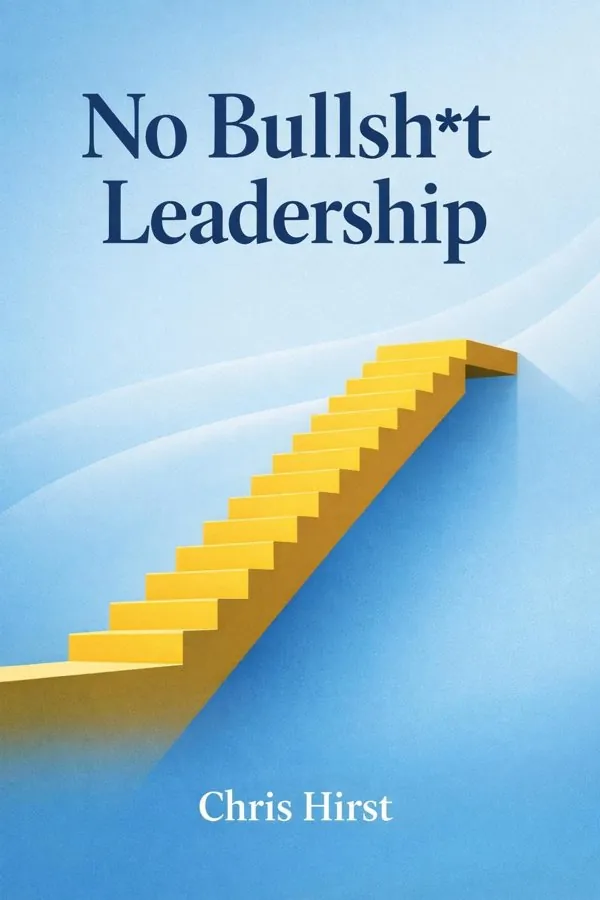
No Bullsh*t Leadership: Why the World Needs More Everyday Leaders and Why That Leader Is You: Summary & Key Insights
by Chris Hirst
 10 min10 chaptersAudio available
Key Takeaways from No Bullsh*t Leadership: Why the World Needs More Everyday Leaders and Why That Leader Is You
One of the most damaging ideas in modern work is the belief that leaders are born, not made.
If organizations fail for one everyday reason, it is usually not lack of talent but lack of clarity.
Many people think leadership means having better answers.
People often talk about trust as if it were built by warmth alone.
A common leadership trap is believing that caring deeply about results means staying close to every detail.
What Is No Bullsh*t Leadership: Why the World Needs More Everyday Leaders and Why That Leader Is You About?
No Bullsh*t Leadership: Why the World Needs More Everyday Leaders and Why That Leader Is You by Chris Hirst is a leadership book spanning 10 pages. No Bullsh*t Leadership is a direct, practical challenge to one of the most persistent myths in business: that leadership belongs to a gifted few. Chris Hirst argues the opposite. Leadership is not a mysterious quality reserved for charismatic CEOs, visionary founders, or naturally dominant personalities. It is a set of learnable behaviors that ordinary people can practice every day, in meetings, projects, team conversations, and moments of uncertainty. The book strips away corporate jargon and leadership theater to focus on what actually matters: clarity, sound decisions, trust, accountability, and the courage to act. What makes this book especially valuable is Hirst’s credibility. As Global CEO of Havas Creative, he led large international teams through complexity, change, and pressure. His lessons come not from abstract theory but from real organizational experience. The result is a leadership manual that feels grounded, usable, and honest. For managers, founders, team leads, and ambitious professionals who want to make a bigger impact, this book offers a refreshing message: you do not need to become someone else to lead well. You need to become clearer, braver, and more consistent.
This FizzRead summary covers all 10 key chapters of No Bullsh*t Leadership: Why the World Needs More Everyday Leaders and Why That Leader Is You in approximately 10 minutes, distilling the most important ideas, arguments, and takeaways from Chris Hirst's work. Also available as an audio summary and Key Quotes Podcast.
No Bullsh*t Leadership: Why the World Needs More Everyday Leaders and Why That Leader Is You
No Bullsh*t Leadership is a direct, practical challenge to one of the most persistent myths in business: that leadership belongs to a gifted few. Chris Hirst argues the opposite. Leadership is not a mysterious quality reserved for charismatic CEOs, visionary founders, or naturally dominant personalities. It is a set of learnable behaviors that ordinary people can practice every day, in meetings, projects, team conversations, and moments of uncertainty. The book strips away corporate jargon and leadership theater to focus on what actually matters: clarity, sound decisions, trust, accountability, and the courage to act.
What makes this book especially valuable is Hirst’s credibility. As Global CEO of Havas Creative, he led large international teams through complexity, change, and pressure. His lessons come not from abstract theory but from real organizational experience. The result is a leadership manual that feels grounded, usable, and honest. For managers, founders, team leads, and ambitious professionals who want to make a bigger impact, this book offers a refreshing message: you do not need to become someone else to lead well. You need to become clearer, braver, and more consistent.
Who Should Read No Bullsh*t Leadership: Why the World Needs More Everyday Leaders and Why That Leader Is You?
This book is perfect for anyone interested in leadership and looking to gain actionable insights in a short read. Whether you're a student, professional, or lifelong learner, the key ideas from No Bullsh*t Leadership: Why the World Needs More Everyday Leaders and Why That Leader Is You by Chris Hirst will help you think differently.
- ✓Readers who enjoy leadership and want practical takeaways
- ✓Professionals looking to apply new ideas to their work and life
- ✓Anyone who wants the core insights of No Bullsh*t Leadership: Why the World Needs More Everyday Leaders and Why That Leader Is You in just 10 minutes
Want the full summary?
Get instant access to this book summary and 100K+ more with Fizz Moment.
Get Free SummaryAvailable on App Store • Free to download
Key Chapters
One of the most damaging ideas in modern work is the belief that leaders are born, not made. We picture leadership as charisma, confidence, and effortless authority, as if some people simply arrive in the world equipped to inspire others while the rest are destined to follow. Chris Hirst dismantles this fantasy. In his view, the myth of the natural leader is comforting because it lets people off the hook. If leadership is innate, then you either have it or you do not. But if leadership is learned, then you are responsible for developing it.
Hirst argues that effective leadership is usually much less glamorous than people imagine. It is not about grand speeches or magnetic personality. It is about making decisions when facts are incomplete, giving people direction when things are messy, communicating honestly when problems arise, and taking responsibility when outcomes are uncertain. These are behaviors, not personality traits. Introverts can do them. Analysts can do them. Middle managers can do them. So can people without formal authority.
This idea matters because it democratizes leadership. A project manager who clarifies priorities, a teacher who creates accountability, or a team member who speaks up about a problem is already leading. Once you stop waiting to feel naturally leader-like, you begin to practice leadership in real situations.
A useful application is to replace identity questions with behavior questions. Instead of asking, “Am I a leader?” ask, “What leadership action does this situation require from me?” That shift turns leadership from a label into a discipline.
Actionable takeaway: stop measuring yourself against charismatic stereotypes and start building leadership through repeatable actions like clarity, ownership, and honest communication.
If organizations fail for one everyday reason, it is usually not lack of talent but lack of clarity. People cannot perform well when they do not understand the goal, the priority, the decision-maker, or the standard for success. Hirst makes a strong case that clarity is the leader’s central responsibility. Before motivation, innovation, or execution can happen, people need to know what matters and what to do next.
Clarity sounds simple, but in practice it is rare. Leaders often confuse complexity with sophistication. They hide behind vague strategy language, overloaded slides, or endless caveats. Teams leave meetings unsure what was decided, who owns what, and what deadline matters. The result is drift, duplicated work, frustration, and politics. Hirst insists that good leaders reduce ambiguity. They define the mission in plain English, narrow the focus, and communicate priorities repeatedly.
This is not about oversimplifying reality. It is about making reality actionable. For example, instead of telling a team to “drive customer-centric transformation,” a clear leader might say, “Over the next 90 days, our top priority is reducing response time for customer complaints from 48 hours to 12.” That creates alignment. It also makes accountability possible because everyone knows what success looks like.
Clarity also applies to behavior. Teams need to know not just what to deliver but how decisions will be made, what trade-offs are acceptable, and what values are non-negotiable. In uncertain times, people do not expect leaders to know everything. They do expect them to make things understandable.
Actionable takeaway: at the end of every major meeting, state the objective, the decision, the owner, and the next deadline in one minute or less. If you cannot do that, you are not yet clear enough.
Many people think leadership means having better answers. Hirst argues that it more often means deciding before certainty arrives. In real organizations, leaders almost never get complete information, unlimited time, or risk-free options. Waiting until everything is known usually means waiting too long. The ability to decide under uncertainty is therefore one of the defining tests of leadership.
Hirst does not promote reckless speed. He promotes timely judgment. Strong leaders gather the best available evidence, listen to dissenting views, understand the likely trade-offs, and then commit. What they avoid is paralysis disguised as rigor. Endless analysis can feel responsible, but it often pushes risk into the future while confusing everyone in the present.
A useful way to think about decisions is to separate reversible choices from irreversible ones. If a decision can be adjusted later, make it faster. If it is truly high stakes and hard to reverse, slow down enough to challenge assumptions. In both cases, indecision has a cost. Teams lose momentum, confidence, and trust when leaders refuse to choose.
Hirst also emphasizes that people can live with difficult decisions more easily than with opaque ones. If a leader explains the reasoning, the constraints, and the criteria used, even those who disagree are more likely to commit. Transparency builds confidence that choices are thoughtful rather than arbitrary.
In practice, this might mean choosing a strategic direction with only 70 percent of the data you wanted, then defining what signals would trigger a course correction. Good leadership is not pretending uncertainty does not exist. It is acting responsibly within it.
Actionable takeaway: when facing a decision, define what you know, what you do not know, the deadline for choosing, and what would make you revisit the choice. Then decide.
People often talk about trust as if it were built by warmth alone. Hirst takes a more grounded view: trust grows when leaders are honest, predictable, and aligned between words and actions. Teams do not need perfection from leaders. They need reliability. They need to believe that what they are told is true, that commitments will be honored, and that difficult realities will not be hidden behind spin.
Authenticity in this book is not performative vulnerability or confessional management. It is straightforwardness. If things are going badly, say so. If a decision is unpopular, explain it directly. If you made a mistake, own it. This kind of honesty creates psychological steadiness. People can handle bad news better than uncertainty mixed with optimism theater.
Consistency matters just as much. A leader who talks about empowerment but micromanages, or who praises collaboration but rewards internal politics, destroys trust quickly. Teams pay close attention to behavior patterns. They notice whether standards are applied fairly, whether promises are kept, and whether values survive pressure. Trust is not built in speeches. It is built in repeated moments when people see that the leader means what they say.
Practical examples include admitting when a forecast was wrong, sharing the rationale behind resource cuts, or setting a boundary and enforcing it equally for everyone. These actions reduce cynicism because they show integrity under stress.
Trust also makes performance easier. People waste less energy reading hidden agendas. They speak up earlier about risks. They recover faster from setbacks because they believe the environment is honest.
Actionable takeaway: choose one area where your words and behavior may be misaligned, then fix the inconsistency immediately. Trust grows fastest when actions confirm intentions.
A common leadership trap is believing that caring deeply about results means staying close to every detail. Hirst warns that this instinct often weakens teams instead of strengthening them. Real leadership is not about being the smartest person in every discussion. It is about creating the conditions in which other people can think, decide, and execute effectively.
Empowerment is often misunderstood as simply delegating tasks. But giving someone work without authority, context, or trust is not empowerment. It is dumping. Hirst argues that strong leaders provide three things: a clear outcome, the boundaries within which decisions can be made, and the confidence that the team member is genuinely trusted to deliver. Once those are in place, the leader must resist the urge to take control back at the first sign of discomfort.
This matters because overcontrol creates dependency. Teams stop taking initiative when they suspect every decision will be second-guessed. They learn to wait for instructions rather than solve problems. In contrast, when leaders step back appropriately, capability expands. People become more resourceful, more accountable, and more invested in results.
A practical example is assigning ownership of a product launch. Instead of reviewing every email and approving every detail, the leader sets the target, clarifies budget and deadlines, agrees on check-in points, and lets the owner run the work. Support remains available, but ownership stays where it belongs.
Empowerment also requires tolerance for methods different from your own. If someone reaches the outcome competently without doing it exactly how you would, that is success, not a problem.
Actionable takeaway: identify one responsibility you are holding too tightly, define the outcome and guardrails clearly, assign ownership fully, and limit yourself to scheduled check-ins instead of constant intervention.
No serious leader gets through their career without mistakes. The real question is not whether failure will happen, but how leaders respond when it does. Hirst argues that mature leadership treats failure neither as something to deny nor something to romanticize. Failure is data. It reveals weak assumptions, hidden risks, and capability gaps. Handled well, it becomes a source of learning and resilience.
The problem in many workplaces is that fear distorts behavior. If people think mistakes will be punished harshly, they hide bad news, avoid experimentation, and protect themselves politically. That creates much larger failures later. Effective leaders instead distinguish between intelligent risk and careless behavior. A thoughtful experiment that does not work is different from repeated negligence or avoidable sloppiness.
This distinction is crucial for innovation and adaptation. Teams need room to test ideas, challenge old methods, and move without certainty. But they also need clear expectations around preparation, ethics, and accountability. Hirst’s approach balances both. Leaders should create an environment where problems surface early, postmortems are honest, and the focus is on improving decisions rather than assigning theatrical blame.
For example, after a missed product deadline, a poor leader looks for someone to shame. A better leader asks: Were priorities unclear? Did we underestimate complexity? Did people raise concerns that were ignored? What process change would reduce the risk next time? This does not remove responsibility. It makes responsibility useful.
Teams that learn quickly recover faster and become more courageous over time. They stop confusing error-free appearances with real effectiveness.
Actionable takeaway: after every setback, run a short review with three questions: what happened, why it happened, and what specific behavior or process will change next time.
Culture is often discussed in vague, inspirational terms, but Hirst brings it back to something concrete: what people are expected to do, and what happens when they do not do it. In this sense, accountability is not a punitive add-on to culture. It is the mechanism that makes culture believable. Without accountability, values are decoration.
Many leaders avoid accountability because they fear conflict or want to be liked. Others mistake it for harshness and overcorrect into blame. Hirst rejects both extremes. Healthy accountability is clear, fair, and consistent. It starts with explicit expectations. People need to know what outcomes they own, what standards apply, and how performance will be assessed. Once those things are clear, leaders must follow through.
This includes addressing underperformance early. Allowing poor behavior or weak execution to continue unchecked sends a message to everyone else that standards are optional. High performers become disengaged when they see that effort and discipline are not protected. In contrast, a culture of accountability creates trust because people know the system is serious.
Accountability also applies upward and sideways, not just downward. Leaders should invite challenge, welcome feedback, and hold themselves to the same standards they expect from others. When accountability becomes shared rather than hierarchical, teams operate with more maturity.
A practical example is setting quarterly commitments with visible owners and reviewing them regularly. If a target is missed, the conversation should examine causes, corrective steps, and support needed, not just excuses. The goal is learning combined with ownership.
Actionable takeaway: choose one recurring issue your team tolerates, define the expected standard clearly, and address breaches consistently. Culture changes when tolerated behavior changes.
Change fails less because people hate it and more because they do not understand it. Hirst sees leadership during change as a communication and coherence challenge. When organizations restructure, launch new strategies, adopt new tools, or face market disruption, uncertainty rises quickly. In that environment, rumors spread, priorities blur, and energy fragments. The leader’s job is not to eliminate discomfort but to reduce unnecessary confusion.
A central insight here is that people do not only ask, “What is changing?” They also ask, “Why is this happening, what does it mean for me, and what do I need to do now?” Leaders who communicate only at the strategic level often miss these practical concerns. Hirst advocates repeated, plainspoken communication that connects the big picture to immediate action.
Good change leadership also requires visible alignment. If senior people say one thing and behave another way, cynicism grows fast. Processes, incentives, and decisions must reinforce the new direction. Otherwise teams conclude that the change is temporary rhetoric.
Importantly, Hirst reminds leaders that change is emotional as well as operational. Even positive change can trigger loss, anxiety, and resistance. Strong leaders acknowledge that honestly instead of dismissing it. They listen, answer hard questions where possible, and avoid fake certainty where they do not have answers.
For example, during a reorganization, a leader might explain the business reasons, outline the timeline, clarify what decisions have and have not been made, and commit to weekly updates. That steadiness builds confidence even in unsettled circumstances.
Actionable takeaway: when leading change, communicate the why, the practical impact, the immediate next steps, and the update schedule. Repetition is not redundancy; it is leadership.
One of the book’s most empowering ideas is that leadership is not confined to hierarchy. Too many people postpone leadership until they get promoted, manage a team, or receive formal authority. Hirst argues that this mindset is both limiting and false. Leadership is available in ordinary moments to anyone willing to take responsibility for clarity, progress, and standards.
Everyday leadership might look small from the outside, but its effects are significant. It includes spotting a problem others are ignoring, organizing a confused project, calming a tense meeting, mentoring a colleague, or raising a hard truth respectfully. None of these actions requires a senior title. They require initiative and courage.
This perspective changes how people think about influence. If you believe authority is permission-based, you wait. If you understand leadership as behavior, you act. That does not mean overstepping recklessly or pretending to have power you do not have. It means using the power you do have: your judgment, your communication, your example, and your willingness to own outcomes.
This idea also matters organizationally. The healthiest companies are not those with a few heroic leaders at the top. They are those where leadership is distributed. Problems get solved faster because people do not freeze waiting for approval. Standards rise because peers reinforce them. Adaptation improves because initiative exists across levels.
A practical example is a junior employee who notices repeated customer complaints and creates a simple tracking process, then presents patterns and recommendations to the manager. That person is leading by improving clarity and action.
Actionable takeaway: do not wait for a title to practice leadership. This week, identify one area of confusion or drift around you and take responsibility for improving it.
The final message running through Hirst’s book is that leadership is never finished. It is not a status you achieve once and then possess permanently. It is a skill set that needs constant refinement. Markets change, teams change, pressure changes, and your own blind spots shift over time. Sustaining leadership growth therefore requires self-awareness, feedback, and deliberate practice.
Many professionals assume experience alone will make them better leaders. Experience helps, but only if it is examined. Without reflection, people simply repeat habits, including ineffective ones. Hirst encourages leaders to review their actions honestly: Was I clear enough? Did I avoid a hard conversation? Did I overcontrol? Did I decide too slowly? These questions turn experience into learning.
Feedback is equally important. Leaders often occupy roles where people are hesitant to be candid. That makes it essential to invite specific input and respond well when it arrives. Generic questions like “Any feedback for me?” usually produce little. Better questions are narrower: “Was the direction clear?” “Did I leave enough ownership with you?” “What am I doing that makes your work harder?”
Growth also benefits from repetition in small moments. You do not become a better leader by waiting for a major crisis. You improve by practicing clear communication, accountability, listening, and decision-making every day. Over time, these habits become more natural and more effective.
Leadership, in Hirst’s framework, is accessible precisely because it is trainable. You do not need reinvention. You need disciplined improvement.
Actionable takeaway: pick one leadership behavior to improve over the next month, ask two trusted colleagues to observe it, and review your progress weekly with concrete examples.
All Chapters in No Bullsh*t Leadership: Why the World Needs More Everyday Leaders and Why That Leader Is You
About the Author
Chris Hirst is a British business leader, speaker, and author known for his practical, candid approach to management and leadership. He is best known for serving as Global CEO of Havas Creative, where he led a large international organization across markets, teams, and disciplines. His leadership philosophy was shaped not by abstract theory but by the realities of running complex businesses, making difficult decisions, and helping people perform under pressure. Hirst has become recognized for challenging outdated ideas about leadership, especially the myth that great leaders are born with special charisma. Through his writing and speaking, he focuses on clarity, accountability, trust, and everyday leadership. His work resonates with readers who want straightforward advice they can actually apply in modern organizations.
Get This Summary in Your Preferred Format
Read or listen to the No Bullsh*t Leadership: Why the World Needs More Everyday Leaders and Why That Leader Is You summary by Chris Hirst anytime, anywhere. FizzRead offers multiple formats so you can learn on your terms — all free.
Available formats: App · Audio · PDF · EPUB — All included free with FizzRead
Download No Bullsh*t Leadership: Why the World Needs More Everyday Leaders and Why That Leader Is You PDF and EPUB Summary
Key Quotes from No Bullsh*t Leadership: Why the World Needs More Everyday Leaders and Why That Leader Is You
“One of the most damaging ideas in modern work is the belief that leaders are born, not made.”
“If organizations fail for one everyday reason, it is usually not lack of talent but lack of clarity.”
“Many people think leadership means having better answers.”
“People often talk about trust as if it were built by warmth alone.”
“A common leadership trap is believing that caring deeply about results means staying close to every detail.”
Frequently Asked Questions about No Bullsh*t Leadership: Why the World Needs More Everyday Leaders and Why That Leader Is You
No Bullsh*t Leadership: Why the World Needs More Everyday Leaders and Why That Leader Is You by Chris Hirst is a leadership book that explores key ideas across 10 chapters. No Bullsh*t Leadership is a direct, practical challenge to one of the most persistent myths in business: that leadership belongs to a gifted few. Chris Hirst argues the opposite. Leadership is not a mysterious quality reserved for charismatic CEOs, visionary founders, or naturally dominant personalities. It is a set of learnable behaviors that ordinary people can practice every day, in meetings, projects, team conversations, and moments of uncertainty. The book strips away corporate jargon and leadership theater to focus on what actually matters: clarity, sound decisions, trust, accountability, and the courage to act. What makes this book especially valuable is Hirst’s credibility. As Global CEO of Havas Creative, he led large international teams through complexity, change, and pressure. His lessons come not from abstract theory but from real organizational experience. The result is a leadership manual that feels grounded, usable, and honest. For managers, founders, team leads, and ambitious professionals who want to make a bigger impact, this book offers a refreshing message: you do not need to become someone else to lead well. You need to become clearer, braver, and more consistent.
You Might Also Like

Extreme Ownership
Jocko Willink
10 min
Dare to Lead
Brene Brown
10 min
Leaders Eat Last
Simon Sinek
10 min
The 21 Irrefutable Laws of Leadership
John Maxwell
10 min
Start With Why
Simon Sinek
10 min
How to Lead When You're Not in Charge
Clay Scroggins
10 minBrowse by Category
Ready to read No Bullsh*t Leadership: Why the World Needs More Everyday Leaders and Why That Leader Is You?
Get the full summary and 100K+ more books with Fizz Moment.