
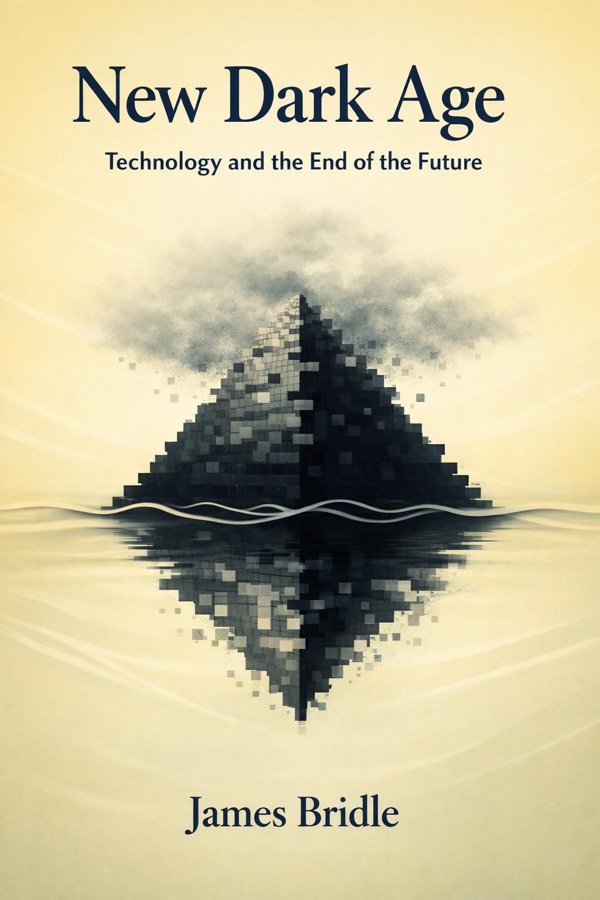
New Dark Age: Technology and the End of the Future: Summary & Key Insights
by James Bridle
 10 min7 chaptersAudio available
What Is New Dark Age: Technology and the End of the Future About?
New Dark Age: Technology and the End of the Future by James Bridle is a digital_culture book spanning 7 pages. In this thought-provoking work, James Bridle explores how technology, data, and algorithms have reshaped our understanding of the world. He argues that rather than bringing clarity, the digital age has plunged us into a new kind of darkness—one defined by complexity, misinformation, and uncertainty. Through examples from art, science, and politics, Bridle reveals how our reliance on technology obscures truth and challenges our ability to imagine the future.
This FizzRead summary covers all 7 key chapters of New Dark Age: Technology and the End of the Future in approximately 10 minutes, distilling the most important ideas, arguments, and takeaways from James Bridle's work. Also available as an audio summary and Key Quotes Podcast.
New Dark Age: Technology and the End of the Future
In this thought-provoking work, James Bridle explores how technology, data, and algorithms have reshaped our understanding of the world. He argues that rather than bringing clarity, the digital age has plunged us into a new kind of darkness—one defined by complexity, misinformation, and uncertainty. Through examples from art, science, and politics, Bridle reveals how our reliance on technology obscures truth and challenges our ability to imagine the future.
Who Should Read New Dark Age: Technology and the End of the Future?
This book is perfect for anyone interested in digital_culture and looking to gain actionable insights in a short read. Whether you're a student, professional, or lifelong learner, the key ideas from New Dark Age: Technology and the End of the Future by James Bridle will help you think differently.
- ✓Readers who enjoy digital_culture and want practical takeaways
- ✓Professionals looking to apply new ideas to their work and life
- ✓Anyone who wants the core insights of New Dark Age: Technology and the End of the Future in just 10 minutes
Want the full summary?
Get instant access to this book summary and 100K+ more with Fizz Moment.
Get Free SummaryAvailable on App Store • Free to download
Key Chapters
To understand the crisis of the present, we must first understand the Enlightenment’s enduring dream. The seventeenth and eighteenth centuries saw science and rational inquiry rise as beacons meant to dispel ignorance and superstition. The Enlightenment’s heroes, from Bacon to Newton, built their project on the belief that the accumulation of knowledge would bring progress. The metaphors of light and darkness were central — light represented truth and understanding; darkness, fear and deception.
But as the centuries passed, this faith in progress hardened into dogma. We built machines to extend our senses and institutions to preserve our knowledge, yet these very mechanisms began to obscure as much as they revealed. Today’s digital systems represent the Enlightenment’s logical endpoint: the belief that enough data, processed fast enough, can solve any problem. We built the internet as an instrument of connection and democratization. We built computation as a language of order. Yet what emerged was messier, stranger, and more human than we anticipated.
This book argues that the Enlightenment assumption—that light always dispels darkness—is fundamentally mistaken. Darkness is not ignorance, but a space of possibility. Our pursuit of total transparency and control, through technology and surveillance, has paradoxically produced confusion, alienation, and the erosion of truth itself. The line between knowledge and ignorance has never been thinner, and understanding that reversal is the first step toward navigating our ‘New Dark Age.’
We live surrounded by data — oceans of it. Every search, every transaction, every heartbeat from a smartwatch contributes to the digital environment in which we now exist. But abundance has not made us wiser. The deluge of information exceeds our capacity to interpret it, and the algorithms that sift through it often amplify error and bias instead of clarity.
Machines now filter everything we see and know. The internet’s early ideal of open access has devolved into a labyrinth of invisible curation. Search engines, social platforms, and predictive models operate in darkness — proprietary, automated, and largely unaccountable. The result is what I call algorithmic opacity: systems that make decisions on our behalf without revealing their logic. Whether it’s credit scoring, law enforcement surveillance, or medical diagnosis, the human capacity to contest and interpret is being displaced by code.
The more dependent we become on these systems, the greater our ignorance of how they function. We are no longer in the driver’s seat — we are driven by algorithms whose inner workings we cannot see. This is not a conspiracy; it is a crisis of epistemology. Automation introduces a new kind of darkness: one born of complexity so deep that no individual mind can grasp it. And if we cannot understand the tools that shape our lives, how can we hope to govern them?
+ 5 more chapters — available in the FizzRead app
All Chapters in New Dark Age: Technology and the End of the Future
About the Author
James Bridle is a British artist, writer, and technologist known for his work on the intersections of culture, technology, and politics. His projects and writings often examine the social and ethical implications of digital systems and artificial intelligence.
Get This Summary in Your Preferred Format
Read or listen to the New Dark Age: Technology and the End of the Future summary by James Bridle anytime, anywhere. FizzRead offers multiple formats so you can learn on your terms — all free.
Available formats: App · Audio · PDF · EPUB — All included free with FizzRead
Download New Dark Age: Technology and the End of the Future PDF and EPUB Summary
Key Quotes from New Dark Age: Technology and the End of the Future
“To understand the crisis of the present, we must first understand the Enlightenment’s enduring dream.”
“We live surrounded by data — oceans of it.”
Frequently Asked Questions about New Dark Age: Technology and the End of the Future
New Dark Age: Technology and the End of the Future by James Bridle is a digital_culture book that explores key ideas across 7 chapters. In this thought-provoking work, James Bridle explores how technology, data, and algorithms have reshaped our understanding of the world. He argues that rather than bringing clarity, the digital age has plunged us into a new kind of darkness—one defined by complexity, misinformation, and uncertainty. Through examples from art, science, and politics, Bridle reveals how our reliance on technology obscures truth and challenges our ability to imagine the future.
You Might Also Like
An Ugly Truth: Inside Facebook’s Battle for Domination
Sheera Frenkel, Cecilia Kang
10 min
Cyber Citizens
Ian Goodfellow
10 min
Digital Minimalism: Choosing a Focused Life in a Noisy World
Cal Newport
10 min
E‑Books & Beyond
Various Authors
10 min
The Future of Media
Various Authors
10 min
This Is Why We Can't Have Nice Things
Whitney Phillips
10 minBrowse by Category
Ready to read New Dark Age: Technology and the End of the Future?
Get the full summary and 100K+ more books with Fizz Moment.