
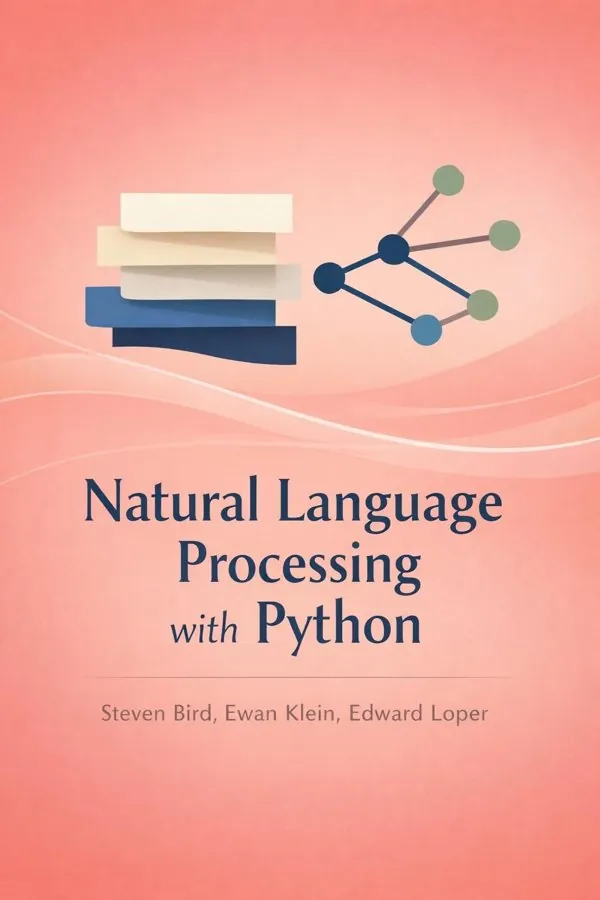
Natural Language Processing with Python: Analyzing Text with the Natural Language Toolkit: Summary & Key Insights
by Steven Bird, Ewan Klein, Edward Loper
 10 min6 chaptersAudio available
What Is Natural Language Processing with Python: Analyzing Text with the Natural Language Toolkit About?
Natural Language Processing with Python: Analyzing Text with the Natural Language Toolkit by Steven Bird, Ewan Klein, Edward Loper is a ai_ml book spanning 6 pages. This book introduces the fundamentals of natural language processing (NLP) using the Python programming language and the Natural Language Toolkit (NLTK). It provides practical examples and exercises for text analysis, linguistic data processing, and building language-aware applications. The authors guide readers through tokenization, tagging, parsing, and semantic interpretation, making it a comprehensive resource for both students and practitioners in computational linguistics and data science.
This FizzRead summary covers all 6 key chapters of Natural Language Processing with Python: Analyzing Text with the Natural Language Toolkit in approximately 10 minutes, distilling the most important ideas, arguments, and takeaways from Steven Bird, Ewan Klein, Edward Loper's work. Also available as an audio summary and Key Quotes Podcast.
Natural Language Processing with Python: Analyzing Text with the Natural Language Toolkit
This book introduces the fundamentals of natural language processing (NLP) using the Python programming language and the Natural Language Toolkit (NLTK). It provides practical examples and exercises for text analysis, linguistic data processing, and building language-aware applications. The authors guide readers through tokenization, tagging, parsing, and semantic interpretation, making it a comprehensive resource for both students and practitioners in computational linguistics and data science.
Who Should Read Natural Language Processing with Python: Analyzing Text with the Natural Language Toolkit?
This book is perfect for anyone interested in ai_ml and looking to gain actionable insights in a short read. Whether you're a student, professional, or lifelong learner, the key ideas from Natural Language Processing with Python: Analyzing Text with the Natural Language Toolkit by Steven Bird, Ewan Klein, Edward Loper will help you think differently.
- ✓Readers who enjoy ai_ml and want practical takeaways
- ✓Professionals looking to apply new ideas to their work and life
- ✓Anyone who wants the core insights of Natural Language Processing with Python: Analyzing Text with the Natural Language Toolkit in just 10 minutes
Want the full summary?
Get instant access to this book summary and 100K+ more with Fizz Moment.
Get Free SummaryAvailable on App Store • Free to download
Key Chapters
Language data is the raw material of NLP, and one of the first things you’ll learn is how to handle corpora—collections of text that represent real-world language in use. In this book, we walk you through the concept of a corpus, introducing the Brown corpus, the Gutenberg corpus, movie reviews, and even chat data. Each corpus is more than a dataset; it embodies a distinct style and domain.
We teach you how to access these corpora programmatically with NLTK, showing how simple commands allow you to extract sentences, tokenize words, and inspect structure. You’ll soon realize that every corpus carries linguistic variation. The syntax differs from everyday usage, and that variation matters when building systems that generalize across contexts.
By interacting directly with language samples, you start to see data not as arbitrary strings but as evidence of linguistic behavior. Frequency distributions, concordances, collocations—all these tools help you explore patterns within the text. They reveal which words co-occur, how authors build rhythm through repetition, or how sentiment leans positive or negative.
Our aim in this part of the book is to make linguistic data tangible. You will learn to manipulate text so that it can serve analytic goals: extracting terms, measuring diversity, or generating statistics that explain style and meaning. Once you gain fluency in corpus exploration, every subsequent NLP technique begins to feel more intuitive.
Language isn’t just made of words; it’s made of relationships between them. That’s why we dedicate chapters to lexical semantics and resources like WordNet—a remarkable database of word meanings and relations. Here, the focus shifts from surface text to the knowledge embodied in vocabulary.
We guide you through synsets (groups of synonyms), hypernyms (general categories), and hyponyms (specific examples), illustrating how computational models can grasp semantic hierarchy. NLTK offers tools to navigate WordNet programmatically, allowing you to ask questions like: What are the senses of the word ‘bank’? What’s its most general concept? What other words share that concept?
As you work with examples, you begin to see lexical structure as a form of computation—a network where meaning propagates through links. This chapter invites you to think deeply about ambiguity. How does a computer know whether ‘bank’ refers to a financial institution or a river’s edge? The answer lies in context, and your job as an NLP practitioner is to design systems that weigh contextual signals thoughtfully.
By combining corpus analysis with lexical databases, you move closer to semantic understanding. It’s the difference between counting words and comprehending their meaning.
+ 4 more chapters — available in the FizzRead app
All Chapters in Natural Language Processing with Python: Analyzing Text with the Natural Language Toolkit
About the Authors
Steven Bird is a computational linguist and researcher known for his work on the Natural Language Toolkit (NLTK) and linguistic data management. Ewan Klein is a professor of linguistics and informatics at the University of Edinburgh, specializing in computational semantics. Edward Loper is a software engineer and researcher who contributed extensively to the development of NLTK.
Get This Summary in Your Preferred Format
Read or listen to the Natural Language Processing with Python: Analyzing Text with the Natural Language Toolkit summary by Steven Bird, Ewan Klein, Edward Loper anytime, anywhere. FizzRead offers multiple formats so you can learn on your terms — all free.
Available formats: App · Audio · PDF · EPUB — All included free with FizzRead
Download Natural Language Processing with Python: Analyzing Text with the Natural Language Toolkit PDF and EPUB Summary
Key Quotes from Natural Language Processing with Python: Analyzing Text with the Natural Language Toolkit
“Language data is the raw material of NLP, and one of the first things you’ll learn is how to handle corpora—collections of text that represent real-world language in use.”
“Language isn’t just made of words; it’s made of relationships between them.”
Frequently Asked Questions about Natural Language Processing with Python: Analyzing Text with the Natural Language Toolkit
Natural Language Processing with Python: Analyzing Text with the Natural Language Toolkit by Steven Bird, Ewan Klein, Edward Loper is a ai_ml book that explores key ideas across 6 chapters. This book introduces the fundamentals of natural language processing (NLP) using the Python programming language and the Natural Language Toolkit (NLTK). It provides practical examples and exercises for text analysis, linguistic data processing, and building language-aware applications. The authors guide readers through tokenization, tagging, parsing, and semantic interpretation, making it a comprehensive resource for both students and practitioners in computational linguistics and data science.
You Might Also Like

Life 3.0
Max Tegmark
10 min
Superintelligence
Nick Bostrom
10 min
TensorFlow in Action
Thushan Ganegedara
10 min
AI Made Simple: A Beginner’s Guide to Generative AI, ChatGPT, and the Future of Work
Rajeev Kapur
10 min
AI Snake Oil
Arvind Narayanan, Sayash Kapoor
10 min
AI Superpowers: China, Silicon Valley, and the New World Order
Kai-Fu Lee
10 minBrowse by Category
Ready to read Natural Language Processing with Python: Analyzing Text with the Natural Language Toolkit?
Get the full summary and 100K+ more books with Fizz Moment.