
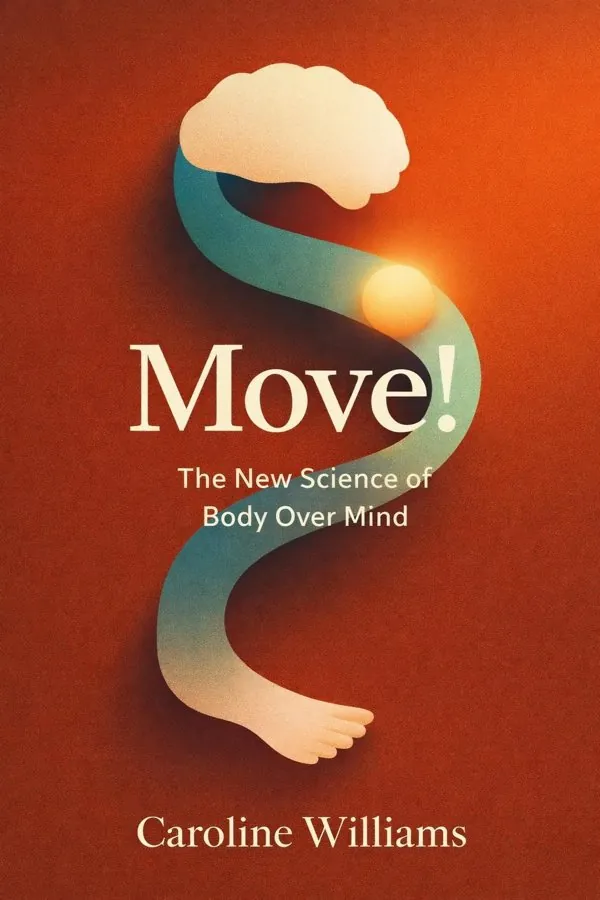
Move!: The New Science of Body Over Mind: Summary & Key Insights
 10 min9 chaptersAudio available
Key Takeaways from Move!: The New Science of Body Over Mind
A still body can produce a restless mind because the human brain was built in partnership with movement.
The brain is not a machine that gradually wears down without hope of repair; it is a living system that changes in response to what we do.
We often talk as if thinking happens in the head and the body merely carries it around, but Williams shows that cognition is deeply embodied.
Mood is not produced by thoughts alone; it is also shaped by bodily action.
Some of our clearest thoughts arrive when we stop trying to force them.
What Is Move!: The New Science of Body Over Mind About?
Move!: The New Science of Body Over Mind by Caroline Williams is a neuroscience book spanning 8 pages. What if movement is not just something the body does, but one of the primary ways the brain stays healthy, focused, creative, and emotionally balanced? In Move!: The New Science of Body Over Mind, science journalist Caroline Williams explores a powerful idea: the mind does not operate separately from the body, and our mental lives are deeply shaped by how we move through the world. Drawing on neuroscience, psychology, evolutionary biology, and first-hand reporting, Williams shows that physical activity affects far more than fitness. It changes mood, sharpens attention, supports memory, strengthens resilience, and even influences identity and social connection. What makes this book especially valuable is its balance of rigor and accessibility. Williams does not simply repeat generic advice to exercise more. Instead, she investigates why different kinds of movement matter, how the brain responds to motion, and why modern sedentary life clashes with what human minds evolved to need. As an experienced science writer for outlets such as New Scientist, The Guardian, and BBC Future, Williams brings credibility, curiosity, and clarity to a topic that touches nearly every part of daily life. The result is a persuasive, practical rethinking of the relationship between body and mind.
This FizzRead summary covers all 9 key chapters of Move!: The New Science of Body Over Mind in approximately 10 minutes, distilling the most important ideas, arguments, and takeaways from Caroline Williams's work. Also available as an audio summary and Key Quotes Podcast.
Move!: The New Science of Body Over Mind
What if movement is not just something the body does, but one of the primary ways the brain stays healthy, focused, creative, and emotionally balanced? In Move!: The New Science of Body Over Mind, science journalist Caroline Williams explores a powerful idea: the mind does not operate separately from the body, and our mental lives are deeply shaped by how we move through the world. Drawing on neuroscience, psychology, evolutionary biology, and first-hand reporting, Williams shows that physical activity affects far more than fitness. It changes mood, sharpens attention, supports memory, strengthens resilience, and even influences identity and social connection.
What makes this book especially valuable is its balance of rigor and accessibility. Williams does not simply repeat generic advice to exercise more. Instead, she investigates why different kinds of movement matter, how the brain responds to motion, and why modern sedentary life clashes with what human minds evolved to need. As an experienced science writer for outlets such as New Scientist, The Guardian, and BBC Future, Williams brings credibility, curiosity, and clarity to a topic that touches nearly every part of daily life. The result is a persuasive, practical rethinking of the relationship between body and mind.
Who Should Read Move!: The New Science of Body Over Mind?
This book is perfect for anyone interested in neuroscience and looking to gain actionable insights in a short read. Whether you're a student, professional, or lifelong learner, the key ideas from Move!: The New Science of Body Over Mind by Caroline Williams will help you think differently.
- ✓Readers who enjoy neuroscience and want practical takeaways
- ✓Professionals looking to apply new ideas to their work and life
- ✓Anyone who wants the core insights of Move!: The New Science of Body Over Mind in just 10 minutes
Want the full summary?
Get instant access to this book summary and 100K+ more with Fizz Moment.
Get Free SummaryAvailable on App Store • Free to download
Key Chapters
A still body can produce a restless mind because the human brain was built in partnership with movement. One of Williams’s central insights is that our nervous system did not evolve for a life of chairs, screens, and prolonged inactivity. For most of human history, survival required walking, climbing, carrying, scanning the environment, coordinating with others, and reacting quickly to changing conditions. In other words, cognition developed in a moving body, not in isolation from it.
This evolutionary perspective helps explain why sedentary living can feel mentally draining even when it seems physically easy. The brain expects a steady stream of sensory and motor input. Movement tells it where we are, what matters, and how to prepare for the next task. When that input disappears for long periods, our attention can dull, our mood can dip, and our thinking may become sluggish. This is not simply a failure of discipline; it is a mismatch between modern routines and ancient biology.
Williams uses this framework to challenge the assumption that exercise is an optional add-on for health enthusiasts. Instead, movement is a baseline requirement for mental functioning. That does not mean everyone needs intense training. Everyday activities such as walking while thinking, taking stairs, stretching between tasks, gardening, and standing during calls can reintroduce the bodily signals the brain is designed to use.
The practical implication is simple but important: stop treating movement as separate from thinking. Build motion into ordinary routines rather than waiting for the perfect workout. Actionable takeaway: if you spend much of the day seated, add brief movement breaks every hour and include at least one daily walk to give your brain the kind of stimulation it evolved to expect.
The brain is not a machine that gradually wears down without hope of repair; it is a living system that changes in response to what we do. Williams highlights a key finding from neuroscience: movement supports neuroplasticity, the brain’s ability to reorganize, strengthen connections, and adapt across the lifespan. Physical activity increases blood flow, stimulates beneficial chemicals, and supports processes linked to learning and memory, including the growth and survival of new neurons in areas involved in cognition.
This matters because many people assume that mental sharpness depends mostly on genetics, age, or intellectual effort alone. The book argues that movement is one of the most reliable ways to create the biological conditions for a more flexible brain. Exercise has been linked to better memory, stronger executive function, and improved capacity to learn new skills. Importantly, these benefits are not reserved for elite athletes. Moderate, regular activity can help protect brain health and enhance cognitive performance.
Think about how this applies in daily life. Students may retain information better when they combine study with walks. Professionals tackling complex projects may think more clearly after a brisk break. Older adults concerned about cognitive decline may find that consistent movement supports both brain function and confidence. Williams’s point is not that movement is magical, but that it creates fertile ground for the brain to do its best work.
A useful shift is to see physical activity as brain training, not merely body maintenance. Actionable takeaway: pair your most important learning goals with regular aerobic movement, such as walking, cycling, or dancing three to five times a week, and notice how it affects your attention, recall, and mental energy.
We often talk as if thinking happens in the head and the body merely carries it around, but Williams shows that cognition is deeply embodied. The way we stand, breathe, gesture, balance, and move influences how we perceive the world and process information. This idea, known as embodied cognition, suggests that thought is not detached from physical experience. Instead, the brain uses signals from the body to build emotion, meaning, and understanding.
This changes how we interpret everyday states. Feeling stuck may not be purely a mental problem; it may be related to physical immobility. Confidence can be affected by posture and breathing. Focus can improve when the body is engaged rather than suppressed. Even abstract thinking can be supported by movement, because the brain relies on sensory and motor systems to structure concepts and make decisions.
Williams brings this science down to earth by showing that small physical shifts can alter mental experience. Walking can help organize thoughts. Rhythmic movement can calm internal noise. Gesturing while explaining an idea can improve clarity. A grounded stance and slower breathing can reduce the sense of overwhelm before a difficult conversation. These effects are not superficial tricks. They reflect the constant communication between body and brain.
The broader lesson is that self-management should include bodily strategies, not just mental ones. When people rely only on willpower, they overlook a powerful route into the mind: changing physical state. Actionable takeaway: the next time you feel mentally blocked, do not stay frozen at your desk. Change posture, breathe deeply, walk for ten minutes, or use your hands while thinking to recruit the body as part of the solution.
Mood is not produced by thoughts alone; it is also shaped by bodily action. Williams explores how movement can regulate emotions by influencing stress systems, nervous system balance, and the brain circuits involved in fear, reward, and resilience. This is one of the book’s most practical contributions because it reframes movement as an emotional tool, not just a fitness habit.
When people are anxious or low, they often feel trapped inside their own minds. Yet the body offers a direct way to interrupt that cycle. Physical activity can reduce stress hormones, release mood-supporting neurochemicals, and provide a sense of agency at moments when life feels uncontrollable. Different forms of movement may serve different emotional needs. A brisk walk can discharge tension. Gentle stretching or yoga can signal safety and calm. Dancing can restore pleasure and spontaneity. Strength training can build confidence and a feeling of capability.
Williams is careful not to suggest that movement replaces therapy, medication, or other forms of support when needed. Instead, she shows that movement can be part of a broader mental health toolkit. The key is to understand that emotional states are embodied states. If stress changes breathing, posture, muscle tension, and energy, then changing those physical patterns can help change the emotional experience as well.
In practice, this means designing movement around mood rather than treating all exercise as interchangeable. Actionable takeaway: create a personal movement menu for different emotional states, such as walking for rumination, slow stretching for anxiety, music-based movement for low mood, and strength work for confidence, so that movement becomes a reliable form of emotional self-regulation.
Some of our clearest thoughts arrive when we stop trying to force them. Williams examines the link between movement and creativity, especially the remarkable cognitive effects of walking. Creative insight often emerges when the brain is active but not overly constrained. Walking seems to provide exactly that balance: enough stimulation to energize the mind, enough looseness to allow associations to form.
This helps explain why writers, scientists, and leaders across history have used walks to think. Rhythmic movement can reduce mental rigidity, refresh attention, and encourage the kind of flexible thinking needed for problem-solving. Instead of narrowing the mind onto a single fixed track, movement appears to widen the field of awareness. New ideas become more accessible because the brain is not locked in the same physical and mental posture.
Williams’s broader argument is that creativity is not only a matter of talent or technique. It is also a state that can be supported by the body. Sitting for too long, especially under pressure, can make thinking repetitive and stale. By contrast, changing location, pace, and bodily rhythm can help generate novel connections. Walking meetings, solo idea walks, and movement breaks during creative work are not indulgences. They are tools.
This applies beyond artistic work. Anyone facing a difficult decision, strategic problem, or interpersonal challenge can benefit from moving before expecting clarity. The insight may not arrive instantly, but movement often creates the conditions for it. Actionable takeaway: whenever you are stuck on a problem, take a 15- to 20-minute walk without constant phone distraction and use the first half to decompress, then the second half to gently revisit the question.
One of the most overlooked powers of movement is that it brings people into sync. Williams explores the social and communal dimensions of moving with others, showing that shared physical activity can increase trust, bonding, and a sense of belonging. Humans are intensely social creatures, and our brains respond strongly to rhythm, coordination, and collective action. Group movement is not just enjoyable; it can change how connected we feel.
Think about what happens during dancing, team sports, group exercise, marching, or even walking side by side. People often begin to mirror one another’s tempo, posture, and effort. This synchrony can reduce social distance and increase cooperation. It may also help explain why communal movement rituals have appeared in cultures throughout history, from ceremony and celebration to work and worship. Moving together tells the nervous system that we are part of something larger than ourselves.
In a modern world where loneliness is widespread, this insight matters. Many people pursue health in isolated ways, yet social movement may offer benefits that solo exercise cannot fully replicate. Joining a class, hiking with friends, or participating in a local sports group can improve consistency while also nourishing emotional well-being. For children and adolescents, shared movement can support confidence and social development. For older adults, it may protect both mood and cognitive vitality.
Williams’s message is that movement is not merely personal maintenance. It is also a language of connection. Actionable takeaway: choose at least one form of regular movement that includes other people, whether a dance class, walking group, recreational sport, or exercise club, and treat the social element as part of the benefit rather than a bonus.
Movement does not only affect performance and mood; it also contributes to identity. Williams considers how the body becomes part of the self we experience and present to the world. The ways we move, and the ways we believe we can move, influence confidence, agency, and the story we tell about ourselves. Someone who sees themselves as strong, capable, graceful, adventurous, or resilient often has embodied experiences reinforcing that identity.
This perspective is especially important because many adults inherit limiting narratives about movement. They may believe they are not athletic, not coordinated, too old to start, or unsuited to certain activities. Such beliefs can become self-fulfilling, narrowing both physical behavior and psychological possibility. Williams encourages readers to recognize that identity is more flexible than it seems. Trying new forms of movement can expand not only skill but self-concept.
For example, a person who begins strength training may discover a new sense of competence. Someone who learns to dance may feel more expressive and socially open. A person recovering from illness or burnout may use walking as a way to reclaim trust in their body. These shifts matter because identity influences behavior. Once movement becomes part of who you are rather than just what you should do, consistency becomes easier and more meaningful.
The takeaway is not to adopt a narrow performance-based identity. It is to develop a more generous sense of self through movement. Actionable takeaway: choose one kind of movement you have always assumed was not for you, try it with a beginner’s mindset for several weeks, and notice whether your sense of who you are begins to widen.
A major barrier to change is the belief that movement only counts if it is intense, structured, and time-consuming. Williams pushes back against this all-or-nothing mindset by emphasizing the value of practical, everyday movement. While deliberate exercise has clear benefits, the brain and body also respond to smaller doses spread throughout the day. What matters is not perfection but frequency, variety, and sustainability.
This is liberating because it makes movement accessible. A ten-minute walk between meetings, stretching while waiting for the kettle to boil, standing during a phone call, taking a longer route home, carrying groceries, playing with children, or using a bike for short errands can all contribute to better mental and physical functioning. These activities keep the brain supplied with sensory input, interrupt long sedentary periods, and prevent the sharp divide many people create between exercise time and the rest of life.
Williams’s approach is especially useful for people who feel intimidated by gym culture or constrained by busy schedules. If movement is understood as part of living rather than a separate project, it becomes easier to repeat. That consistency may matter more than occasional bursts of heroic effort. Small actions can also build identity and momentum. Once people feel the immediate mental benefits, they are often more willing to do more.
The broader lesson is that the best movement habit is the one you can actually maintain. Actionable takeaway: stop waiting for ideal conditions and build three simple movement anchors into your existing day, such as a morning stretch, a midday walk, and standing or pacing during one routine call or task.
Perhaps the most transformative idea in the book is that movement should not be treated as a remedy for the damage caused by daily life; daily life itself should be designed to include movement. Williams argues that if motion supports attention, emotion, creativity, and resilience, then the smartest approach is to structure environments and routines accordingly. This is a design problem as much as a motivation problem.
Many people assume they need more discipline, when in fact they need fewer obstacles. If the workday requires uninterrupted sitting, if transportation eliminates walking, and if home life revolves around screens, then movement becomes something that must be added through effort. A more effective strategy is to make movement the default wherever possible. This could mean walking meetings, keeping shoes by the door, placing reminders to stretch, choosing stairs, using public transit that requires walking, arranging social plans around activity, or setting up workspaces that allow standing and pacing.
This systems view also reduces guilt. The goal is not to become morally better by exercising harder. It is to build a lifestyle that aligns with how human brains and bodies function best. When movement is built into the environment, mental benefits come more naturally and regularly. Over time, these changes compound into better focus, steadier mood, and a more alive relationship with the world.
Williams ultimately invites readers to stop asking whether movement is worth the effort and start recognizing it as a foundation for mental life. Actionable takeaway: audit one ordinary day and identify three places where you can redesign your routine or environment so that movement happens automatically rather than depending on motivation.
All Chapters in Move!: The New Science of Body Over Mind
About the Author
Caroline Williams is a British science journalist, editor, and author known for making complex ideas in neuroscience and psychology accessible to general readers. She has written for leading publications including New Scientist, The Guardian, and BBC Future, with a focus on how scientific research can improve everyday life. Her work often explores the brain, behavior, mental health, and human potential, combining careful reporting with practical relevance. Williams has built a reputation for translating cutting-edge findings into engaging narratives that invite readers to rethink familiar assumptions. In Move!: The New Science of Body Over Mind, she brings that talent to the relationship between physical movement and mental function, showing how the body plays a central role in thought, emotion, creativity, and resilience.
Get This Summary in Your Preferred Format
Read or listen to the Move!: The New Science of Body Over Mind summary by Caroline Williams anytime, anywhere. FizzRead offers multiple formats so you can learn on your terms — all free.
Available formats: App · Audio · PDF · EPUB — All included free with FizzRead
Download Move!: The New Science of Body Over Mind PDF and EPUB Summary
Key Quotes from Move!: The New Science of Body Over Mind
“A still body can produce a restless mind because the human brain was built in partnership with movement.”
“The brain is not a machine that gradually wears down without hope of repair; it is a living system that changes in response to what we do.”
“We often talk as if thinking happens in the head and the body merely carries it around, but Williams shows that cognition is deeply embodied.”
“Mood is not produced by thoughts alone; it is also shaped by bodily action.”
“Some of our clearest thoughts arrive when we stop trying to force them.”
Frequently Asked Questions about Move!: The New Science of Body Over Mind
Move!: The New Science of Body Over Mind by Caroline Williams is a neuroscience book that explores key ideas across 9 chapters. What if movement is not just something the body does, but one of the primary ways the brain stays healthy, focused, creative, and emotionally balanced? In Move!: The New Science of Body Over Mind, science journalist Caroline Williams explores a powerful idea: the mind does not operate separately from the body, and our mental lives are deeply shaped by how we move through the world. Drawing on neuroscience, psychology, evolutionary biology, and first-hand reporting, Williams shows that physical activity affects far more than fitness. It changes mood, sharpens attention, supports memory, strengthens resilience, and even influences identity and social connection. What makes this book especially valuable is its balance of rigor and accessibility. Williams does not simply repeat generic advice to exercise more. Instead, she investigates why different kinds of movement matter, how the brain responds to motion, and why modern sedentary life clashes with what human minds evolved to need. As an experienced science writer for outlets such as New Scientist, The Guardian, and BBC Future, Williams brings credibility, curiosity, and clarity to a topic that touches nearly every part of daily life. The result is a persuasive, practical rethinking of the relationship between body and mind.
You Might Also Like

Anxious
Joseph LeDoux
10 min
Hallucinations
Oliver Sacks
10 min
The Biological Mind: How Brain, Body, and Environment Collaborate to Make Us Who We Are
Alan Jasanoff
10 min
The Feeling of Life Itself: Why Consciousness Is Widespread but Can't Be Computed
Christof Koch
10 min
The No-Nonsense Meditation Book
Steven Laureys
10 min
A General Theory of Love
Thomas Lewis, Fari Amini, Richard Lannon
10 minBrowse by Category
Ready to read Move!: The New Science of Body Over Mind?
Get the full summary and 100K+ more books with Fizz Moment.