
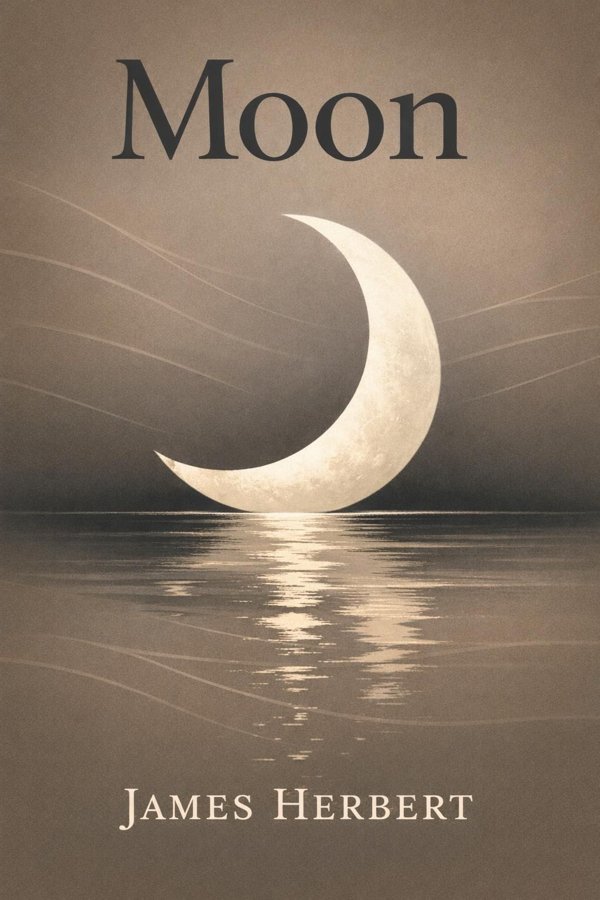
Moon: Summary & Key Insights
 10 min9 chaptersAudio available
Key Takeaways from Moon
The most frightening disruptions are not the ones that come from outside, but the ones that begin within.
A private terror often becomes more dangerous than a public one.
Human closeness can rescue us, but it can also expose us.
Not all hauntings come from ghosts; some come from wounds the mind cannot integrate.
When terror becomes contagious, reality turns into a collective negotiation.
What Is Moon About?
Moon by James Herbert is a bestsellers book spanning 4 pages. What if the images that flashed through your mind in the dark were not fantasies, but warnings? In Moon, James Herbert turns that disturbing question into a tense, psychologically charged horror novel about perception, trauma, and the terrifying possibility that reality is far less stable than we assume. At the center of the story is Jonathan Childes, a capable, rational computer expert whose ordered life begins to unravel when he is assaulted by grotesque visions and a growing sense that something malevolent is moving just beyond the reach of ordinary explanation. As his experiences intensify, the novel shifts from mystery into a deeper exploration of fear itself: fear of losing control, fear of inherited darkness, and fear that the mind may be both witness and battleground. What makes Moon matter is not only its supernatural suspense, but the way Herbert binds horror to emotional vulnerability. A master of British popular horror, Herbert was known for blending visceral shocks with human fragility, and this novel shows that talent in full. Moon is not simply about monsters. It is about how terror invades identity, relationships, and the fragile stories we tell ourselves to remain sane.
This FizzRead summary covers all 9 key chapters of Moon in approximately 10 minutes, distilling the most important ideas, arguments, and takeaways from James Herbert's work. Also available as an audio summary and Key Quotes Podcast.
Moon
What if the images that flashed through your mind in the dark were not fantasies, but warnings? In Moon, James Herbert turns that disturbing question into a tense, psychologically charged horror novel about perception, trauma, and the terrifying possibility that reality is far less stable than we assume. At the center of the story is Jonathan Childes, a capable, rational computer expert whose ordered life begins to unravel when he is assaulted by grotesque visions and a growing sense that something malevolent is moving just beyond the reach of ordinary explanation. As his experiences intensify, the novel shifts from mystery into a deeper exploration of fear itself: fear of losing control, fear of inherited darkness, and fear that the mind may be both witness and battleground. What makes Moon matter is not only its supernatural suspense, but the way Herbert binds horror to emotional vulnerability. A master of British popular horror, Herbert was known for blending visceral shocks with human fragility, and this novel shows that talent in full. Moon is not simply about monsters. It is about how terror invades identity, relationships, and the fragile stories we tell ourselves to remain sane.
Who Should Read Moon?
This book is perfect for anyone interested in bestsellers and looking to gain actionable insights in a short read. Whether you're a student, professional, or lifelong learner, the key ideas from Moon by James Herbert will help you think differently.
- ✓Readers who enjoy bestsellers and want practical takeaways
- ✓Professionals looking to apply new ideas to their work and life
- ✓Anyone who wants the core insights of Moon in just 10 minutes
Want the full summary?
Get instant access to this book summary and 100K+ more with Fizz Moment.
Get Free SummaryAvailable on App Store • Free to download
Key Chapters
The most frightening disruptions are not the ones that come from outside, but the ones that begin within. Jonathan Childes starts as a man defined by reason. He is technically skilled, methodical, and used to working inside systems where causes produce effects and problems can be diagnosed. That is precisely why his ordeal feels so destabilizing. Without warning, horrific visions invade his consciousness, not as vague impressions but as vivid, sensory assaults. These images do more than disturb him; they challenge the foundation of his identity, because they cannot be easily filed under stress, fatigue, or imagination. Herbert uses these early episodes to create a central tension: if a rational person cannot trust his own mind, what can he trust at all?
This idea gives Moon much of its power. The novel understands that modern people often rely on logic as a shield. We tell ourselves that if we stay informed, skeptical, and disciplined, chaos will remain manageable. Childes’s experience exposes the limits of that belief. The mind can become unfamiliar territory, and when it does, even ordinary routines begin to feel menacing. A commute, a conversation, or an evening alone can become charged with dread.
In practical terms, the novel speaks to moments when certainty cracks in everyday life: a recurring nightmare that affects waking judgment, a trauma response that appears without warning, or an intuition that feels irrational but impossible to dismiss. Herbert dramatizes these experiences through horror, but the emotional truth is recognizably human. We all build narratives to explain the world; fear begins when those narratives no longer hold.
The takeaway is simple but important: when your inner experience starts to contradict your outer assumptions, do not dismiss the tension too quickly. Pay attention. Uncertainty may be terrifying, but naming it is the first step toward confronting it.
A private terror often becomes more dangerous than a public one. One of Herbert’s sharpest insights in Moon is that fear thrives when it cannot be shared. Jonathan Childes’s visions do not merely frighten him; they isolate him. Because what he experiences sounds impossible, he risks ridicule, disbelief, or even being labeled unstable if he speaks openly. That social danger compounds the supernatural one. As a result, he becomes trapped in a classic spiral: the more frightened he becomes, the less able he is to communicate clearly; the less he communicates, the more alone he feels; and the more alone he feels, the stronger the fear becomes.
This is not just a narrative device. Herbert is exploring a familiar psychological pattern through horror. People facing panic, grief, intrusive thoughts, or trauma often hesitate to explain what they are living through because language feels inadequate or shame gets in the way. Silence then allows distorted thinking to expand unchecked. In Moon, Herbert turns that phenomenon into escalating suspense. Childes is not only fighting a threat; he is fighting the social and emotional mechanisms that keep him from getting help.
The novel also shows how isolation alters interpretation. When no one else can confirm what is real, every clue becomes suspect. A sound in the night, a fleeting expression on someone’s face, a strange coincidence—each can seem loaded with hidden significance. This is how paranoia gains momentum. Left alone with terror, the mind begins to manufacture patterns even as it tries to survive them.
In everyday life, the lesson is widely applicable. Whether the pressure comes from mental strain, family history, or overwhelming stress, secrecy rarely strengthens resilience. Trusted conversation can interrupt fear’s self-feeding cycle. Herbert’s horror exaggerates the stakes, but the principle remains practical.
Actionable takeaway: when something is troubling you repeatedly, speak to at least one grounded person before your private interpretation hardens into your only reality.
Human closeness can rescue us, but it can also expose us. When Joanna enters Jonathan Childes’s life, she provides a counterweight to his accelerating descent. She is neither blindly credulous nor coldly dismissive. That balance matters. Her presence offers compassion without surrendering judgment, making her more than a love interest or narrative comfort. She becomes a test of whether meaningful connection can survive when fear begins to deform reality. Through her, Herbert suggests that relationships are one of the few forces capable of pushing back against psychological collapse.
Yet Moon is too honest to romanticize intimacy. The moment Childes allows Joanna closer, he also places her in danger. Terror is rarely self-contained; it spills outward into the lives of those who care. This is one of the novel’s most affecting dynamics. Joanna represents hope, but also vulnerability. She can listen, steady, challenge, and encourage, but she cannot remain untouched by the darkness surrounding him. Herbert uses that tension to deepen the emotional stakes. If Childes withdraws, he loses an anchor. If he opens up, he risks spreading the corruption.
This pattern is familiar outside fiction. In real life, supportive relationships often make crises bearable, but they also require difficult honesty. Illness, grief, addiction, or psychological strain do not affect just one person. Partners, friends, and family members become participants in the struggle. The healthiest bonds are not the ones untouched by fear, but the ones able to bear fear without collapsing into denial or rescue fantasies.
Joanna’s role reminds readers that support is most powerful when it combines empathy with steadiness. She does not simply reassure Childes; she helps him remain engaged with the world. That distinction matters. Good support does not erase pain. It prevents total surrender to it.
Actionable takeaway: if someone you care about is in distress, aim to be present, curious, and grounded. Offer belief without abandoning critical thinking, and support without trying to control the outcome.
Not all hauntings come from ghosts; some come from wounds the mind cannot integrate. One of Moon’s deeper strengths is the way it ties horror to buried damage. As Jonathan Childes is pursued by visions and revelations, the novel increasingly asks whether terror is emerging from an external evil, an internal fracture, or a terrible combination of both. Herbert understands that trauma does not simply remain in the past. It resurfaces in images, compulsions, bodily reactions, and altered perception. In that sense, Moon uses supernatural storytelling to dramatize how unresolved pain invades the present.
This ambiguity gives the book emotional weight. If the threat were purely outside Childes, the story would function as conventional horror. If it were purely psychological, it would become a clinical breakdown narrative. Herbert keeps both possibilities alive long enough to make the reader inhabit Childes’s instability. That is the genius of the novel’s fear. It does not ask only, “What is attacking him?” It asks, “How much of a person can be overtaken before he no longer knows which experiences belong to memory, imagination, or reality?”
The concept has broad resonance. Many people know what it feels like to have old pain suddenly color current events. A harmless remark may trigger shame. A place may provoke panic. A dream may leave a residue that changes an entire day. Trauma compresses time, making the past feel immediate. Herbert exaggerates this into horror imagery, but the mechanism is recognizable.
What Moon ultimately suggests is that refusing to face buried fear gives it more power, not less. Suppression does not create safety; it creates pressure. The longer the truth remains inaccessible, the more violently it may return.
Actionable takeaway: treat recurring fear as meaningful information rather than a nuisance to outrun. Reflection, honest conversation, and deliberate self-examination can help prevent the unprocessed past from ruling the present.
The most effective forms of evil rarely begin by overpowering us; they begin by fragmenting us. In Moon, Herbert suggests that darkness gains access through confusion, doubt, and unresolved fractures in the self. Jonathan Childes is not simply hunted by an external menace. He is progressively destabilized at the level of identity. His memories, instincts, and perceptions cease to align cleanly. That misalignment creates openings. Once a person can no longer say with confidence, “This is who I am, and this is what is real,” he becomes easier to manipulate, terrify, and consume.
This idea gives the novel moral and psychological depth. Herbert does not present evil as merely physical brutality or theatrical monstrosity. He presents it as a force that benefits from inner weakness, hidden damage, and divided consciousness. That does not mean Childes is to blame for what happens to him. Rather, it means that vulnerability itself becomes a terrain of conflict. The battle is not only against a hostile power, but for the preservation of a coherent self.
Readers can recognize versions of this outside horror fiction. High stress, shame, unresolved grief, burnout, and emotional exhaustion all make people more susceptible to destructive patterns. Manipulative individuals often exploit uncertainty. Harmful habits take root when values lose clarity. In that sense, Herbert’s supernatural evil mirrors ordinary life: what erodes our sense of self also erodes our defenses.
Moon therefore asks an unsettling question: what anchors identity when reason, memory, and social trust all begin to fail? The answer is never simplistic, but the book points toward self-knowledge, emotional honesty, and connection as partial forms of resistance.
Actionable takeaway: strengthen your internal clarity before crisis arrives. Know your values, notice your recurring vulnerabilities, and maintain habits that reinforce a stable sense of self when external conditions become chaotic.
Long before the mind understands danger, the body often knows. One reason Moon is so effective is Herbert’s attention to physical fear. Jonathan Childes does not experience terror only as an abstract idea. He sweats, jolts, tenses, recoils, loses rest, and feels his nerves revolt against him. These bodily reactions are not incidental details; they are part of the novel’s core argument. Horror is not merely philosophical uncertainty. It is visceral invasion. The body becomes the first witness to threat, often before logic can construct an explanation.
This matters because it grounds the supernatural in lived sensation. Readers may not share Childes’s exact experiences, but they understand adrenaline, nausea, sleeplessness, and the tightening of the chest that accompanies dread. Herbert uses those familiar responses to make the extraordinary believable. In doing so, he also reveals how physical stress can intensify psychological collapse. Exhaustion weakens judgment. Hypervigilance makes ordinary stimuli feel sinister. Repeated shock leaves the nervous system unable to settle, and that constant activation blurs the line between real danger and anticipated danger.
In everyday terms, this is highly relatable. Anyone who has endured anxiety, chronic stress, or severe grief knows that the body can become a battlefield. You may know intellectually that a situation is manageable, yet your heart races as if catastrophe were imminent. Herbert converts this pattern into narrative momentum: the body’s alarm keeps the story moving even when the mind hesitates.
The broader insight is that we should not dismiss physical responses as weakness or melodrama. They are information. They may not always identify the source correctly, but they signal that the system feels threatened and needs attention.
Actionable takeaway: when fear becomes physical, pause and notice it. Sleep, breathing, movement, and regulation are not minor comforts; they are practical defenses against letting bodily alarm dictate your entire reality.
The end of a horror story matters most when it reveals not just what happened, but what it meant. In Moon, the climax delivers more than spectacle. It brings Jonathan Childes to a point where revelation and destruction become inseparable. The mysteries driving the novel finally gather into a larger pattern, and what emerges is not comforting clarity but devastating recognition. Herbert understands that some truths do not restore order. They expose how fragile order always was.
This final movement is powerful because it forces every earlier tension into confrontation. The visions, the uncertainty, the relationships, the hints of corruption, and the pressure on Childes’s sanity all culminate in a reckoning with origins, consequences, and the cost of knowledge. By the time the truth surfaces, the question is no longer whether reality is stable. That hope has already been broken. The real question is whether understanding can save anyone once ruin is already underway.
There is a broader human lesson here. We often imagine revelation as liberation: if we could just know the truth about a fear, a relationship, a family secret, or a hidden pattern in our lives, we would be free. Herbert offers a harsher possibility. Sometimes insight is painful because it demands irreversible action. Sometimes seeing clearly means accepting loss. Sometimes the price of understanding is innocence.
That is why Moon lingers. Its ending is not merely about solving a supernatural puzzle. It is about confronting the fact that knowledge changes the knower. Childes does not emerge untouched by revelation, because no one could.
Actionable takeaway: do not confuse truth with comfort. When long-avoided realities come into focus, ask not only what they explain, but what they now require of you.
The monsters that stay with us are usually the ones that symbolize something we already fear. Moon succeeds not only because it is frightening, but because its terror reflects recognizable human anxieties: mental collapse, inherited darkness, loneliness, helplessness, and the suspicion that our inner lives may contain forces we do not control. Herbert’s larger achievement is to make the supernatural feel emotionally true. Even when the plot moves into extreme territory, the fears underneath remain deeply familiar.
This is why the novel has lasting appeal beyond genre fans looking for shocks. Herbert uses horror as a way to magnify ordinary vulnerability. Jonathan Childes’s struggle may involve uncanny visions and malign influence, but at heart he is wrestling with questions many readers understand: Can I trust my perceptions? What part of my suffering belongs to the past? How much damage can a relationship bear? What if the thing I fear is also part of me?
That mirroring function is one reason horror can be so useful as a genre. It externalizes anxiety, giving shape to what would otherwise remain diffuse. A reader may not face supernatural evil, but may still recognize the emotional mechanics of dread, denial, and desperate hope. Stories like Moon allow us to rehearse confrontation. They let us imagine surviving what feels unspeakable.
For practical reading, this means horror should not be dismissed as empty sensation. At its best, it is diagnostic. It shows us where our cultural and personal fears are concentrated. Herbert was especially good at pairing visceral intensity with these deeper undercurrents.
Actionable takeaway: when a horror story unsettles you, ask why. The scenes may be fictional, but the fear they activate can reveal something real about your own boundaries, vulnerabilities, and unspoken concerns.
All Chapters in Moon
About the Author
James Herbert (1943–2013) was one of Britain’s most successful horror writers, celebrated for bringing supernatural and psychological terror to a wide popular audience. He rose to fame with The Rats and went on to write bestselling novels including The Fog, The Survivor, Shrine, Haunted, and Others. Herbert’s fiction is known for its vivid imagery, relentless suspense, and ability to place ordinary people inside extraordinary nightmares. While his books often contain shocking and visceral elements, they also explore fear, grief, trauma, and the fragile limits of sanity. Over his career, he became a major figure in modern commercial horror and helped shape the genre for generations of readers. Moon reflects many of his signature strengths: emotional intensity, mounting dread, and a powerful interest in what happens when the mind can no longer trust reality.
Get This Summary in Your Preferred Format
Read or listen to the Moon summary by James Herbert anytime, anywhere. FizzRead offers multiple formats so you can learn on your terms — all free.
Available formats: App · Audio · PDF · EPUB — All included free with FizzRead
Download Moon PDF and EPUB Summary
Key Quotes from Moon
“The most frightening disruptions are not the ones that come from outside, but the ones that begin within.”
“A private terror often becomes more dangerous than a public one.”
“Human closeness can rescue us, but it can also expose us.”
“Not all hauntings come from ghosts; some come from wounds the mind cannot integrate.”
“When terror becomes contagious, reality turns into a collective negotiation.”
Frequently Asked Questions about Moon
Moon by James Herbert is a bestsellers book that explores key ideas across 9 chapters. What if the images that flashed through your mind in the dark were not fantasies, but warnings? In Moon, James Herbert turns that disturbing question into a tense, psychologically charged horror novel about perception, trauma, and the terrifying possibility that reality is far less stable than we assume. At the center of the story is Jonathan Childes, a capable, rational computer expert whose ordered life begins to unravel when he is assaulted by grotesque visions and a growing sense that something malevolent is moving just beyond the reach of ordinary explanation. As his experiences intensify, the novel shifts from mystery into a deeper exploration of fear itself: fear of losing control, fear of inherited darkness, and fear that the mind may be both witness and battleground. What makes Moon matter is not only its supernatural suspense, but the way Herbert binds horror to emotional vulnerability. A master of British popular horror, Herbert was known for blending visceral shocks with human fragility, and this novel shows that talent in full. Moon is not simply about monsters. It is about how terror invades identity, relationships, and the fragile stories we tell ourselves to remain sane.
You Might Also Like
The Godfather
Mario Puzo
10 min
The Handmaid's Tale
Margaret Atwood
10 min
The Hunger Games
Suzanne Collins
10 min
The Nightingale
Kristin Hannah
10 min
The Seven Husbands of Evelyn Hugo
Taylor Jenkins Reid
10 min
Backwater Justice
Fern Michaels
10 minBrowse by Category
Ready to read Moon?
Get the full summary and 100K+ more books with Fizz Moment.