
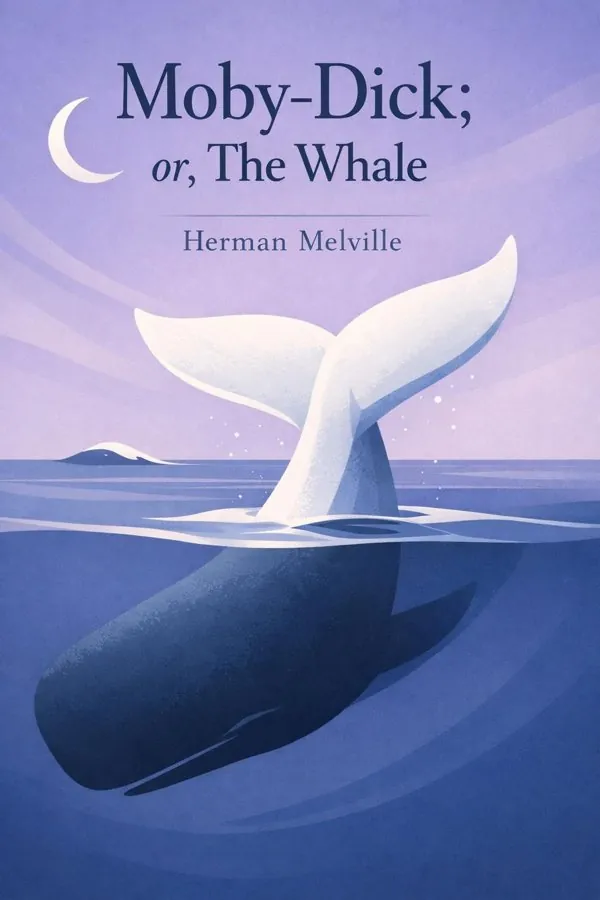
Moby-Dick; or, The Whale: Summary & Key Insights
 10 min9 chaptersAudio available
Key Takeaways from Moby-Dick; or, The Whale
A journey often begins long before a ship leaves port; it starts when ordinary life becomes spiritually unbearable.
One of the novel’s quietest revolutions is also one of its warmest: friendship can emerge where prejudice expects fear.
Leadership becomes dangerous when a shared mission is secretly replaced by one person’s psychological war.
A tragedy deepens when wisdom is present but unable to govern events.
Some of the novel’s strangest and richest chapters are not plot-driven at all; they are attempts to classify, describe, and understand the whale.
What Is Moby-Dick; or, The Whale About?
Moby-Dick; or, The Whale by Herman Melville is a classics book spanning 4 pages. Moby-Dick; or, The Whale is far more than a sea adventure about a captain hunting a legendary whale. Published in 1851, Herman Melville’s novel follows Ishmael, a restless young sailor who joins the whaling ship Pequod and becomes witness to one of literature’s most haunting descents into obsession. Under Captain Ahab, the voyage transforms from a commercial expedition into a personal crusade against Moby Dick, the white whale that took Ahab’s leg and now occupies his entire soul. Along the way, Melville blends action, philosophy, natural history, religion, comedy, and tragedy into a work of astonishing range. The novel matters because it asks enduring questions: What happens when purpose becomes fixation? Can human beings truly master nature, fate, or themselves? And how do we live in a world whose deepest meanings remain uncertain? Melville wrote with unusual authority, drawing on his own years at sea and his knowledge of whaling life. The result is a classic that still feels immense, daring, and unsettlingly modern.
This FizzRead summary covers all 9 key chapters of Moby-Dick; or, The Whale in approximately 10 minutes, distilling the most important ideas, arguments, and takeaways from Herman Melville's work. Also available as an audio summary and Key Quotes Podcast.
Moby-Dick; or, The Whale
Moby-Dick; or, The Whale is far more than a sea adventure about a captain hunting a legendary whale. Published in 1851, Herman Melville’s novel follows Ishmael, a restless young sailor who joins the whaling ship Pequod and becomes witness to one of literature’s most haunting descents into obsession. Under Captain Ahab, the voyage transforms from a commercial expedition into a personal crusade against Moby Dick, the white whale that took Ahab’s leg and now occupies his entire soul. Along the way, Melville blends action, philosophy, natural history, religion, comedy, and tragedy into a work of astonishing range. The novel matters because it asks enduring questions: What happens when purpose becomes fixation? Can human beings truly master nature, fate, or themselves? And how do we live in a world whose deepest meanings remain uncertain? Melville wrote with unusual authority, drawing on his own years at sea and his knowledge of whaling life. The result is a classic that still feels immense, daring, and unsettlingly modern.
Who Should Read Moby-Dick; or, The Whale?
This book is perfect for anyone interested in classics and looking to gain actionable insights in a short read. Whether you're a student, professional, or lifelong learner, the key ideas from Moby-Dick; or, The Whale by Herman Melville will help you think differently.
- ✓Readers who enjoy classics and want practical takeaways
- ✓Professionals looking to apply new ideas to their work and life
- ✓Anyone who wants the core insights of Moby-Dick; or, The Whale in just 10 minutes
Want the full summary?
Get instant access to this book summary and 100K+ more with Fizz Moment.
Get Free SummaryAvailable on App Store • Free to download
Key Chapters
A journey often begins long before a ship leaves port; it starts when ordinary life becomes spiritually unbearable. Ishmael does not go to sea because he is ambitious, heroic, or hungry for riches. He goes because he feels the pull of melancholy, alienation, and a need to escape the deadening routines of life on land. In one of the novel’s most famous gestures, he presents the sea as both remedy and mirror: a place where human beings confront vastness, danger, and themselves. This opening matters because it frames Moby-Dick not simply as an adventure story, but as an existential search.
Ishmael’s decision reflects a recognizable human pattern. Many people do not change their lives when things are terrible; they change when something feels numb, stale, or spiritually misaligned. The sea, for Ishmael, represents movement against paralysis. He chooses the rough uncertainty of whaling over the slow suffocation of comfort without meaning. Melville suggests that a hard life with purpose may be preferable to an easy life without depth.
This beginning also prepares us to trust Ishmael as a narrator. He is reflective, self-aware, and curious rather than dogmatic. He enters the world of the Pequod as both participant and observer, which lets the novel move fluidly between event and meditation.
In practical terms, Ishmael’s choice asks readers to examine their own forms of drift. Are you staying in routines that flatten your mind? Are you mistaking familiarity for fulfillment? You do not need to board a whaling ship to respond. Sometimes the equivalent is changing careers, committing to study, traveling, beginning therapy, or simply admitting that your current path no longer fits.
Actionable takeaway: when restlessness keeps returning, treat it as information rather than weakness, and make one concrete move toward a life that feels more awake.
One of the novel’s quietest revolutions is also one of its warmest: friendship can emerge where prejudice expects fear. Before Ishmael boards the Pequod, he shares a bed at the Spouter-Inn with Queequeg, a Polynesian harpooner whom he first regards with alarm. Queequeg looks unfamiliar, follows different rituals, and seems to embody everything conventional society labels strange. Yet what begins in discomfort becomes one of the deepest bonds in the novel. Ishmael comes to see Queequeg not as an exotic outsider but as a courageous, generous, and dignified equal.
This relationship matters because Melville uses it to challenge easy assumptions about civilization, religion, and moral worth. In the world of Moby-Dick, the supposedly civilized are often petty, arrogant, or blind, while Queequeg—dismissed by some as a "cannibal"—shows loyalty, calm, competence, and spiritual seriousness. Melville thus turns social hierarchy upside down. He suggests that character matters more than custom, and that genuine human connection requires humility before difference.
The friendship also stabilizes Ishmael. Before Ahab’s obsession dominates the ship, Queequeg gives the narrative emotional warmth and a model of trust. Their bond demonstrates that companionship is not a sentimental extra; it is one of the few forces capable of making a harsh world livable.
The idea remains practical today. In workplaces, communities, and personal relationships, we often misread unfamiliarity as threat. We sort people too quickly based on accent, background, belief, or appearance. Melville invites us to suspend first judgments and look for courage, kindness, and integrity instead.
Actionable takeaway: choose one person outside your usual social circle and replace assumption with conversation; meaningful respect often begins where comfort ends.
Leadership becomes dangerous when a shared mission is secretly replaced by one person’s psychological war. At first, Captain Ahab is an absence more than a presence, a mysterious authority recovering below deck while the officers and crew manage the ship. When he finally appears, he electrifies the Pequod. Scarred, intense, and commanding, he reveals that the voyage is not merely about harvesting whale oil. He is hunting Moby Dick, the white whale that maimed him, and he wants every man aboard to join his revenge.
Ahab’s great power lies not only in his will, but in his ability to turn obsession into collective purpose. He stages his declaration theatrically, nails a gold doubloon to the mast, and binds the crew through ritual, reward, and emotional contagion. Even the more sober officers feel the pull of his charisma. Starbuck, the chief mate, recognizes the madness of sacrificing ship, crew, and commerce to one man’s vendetta, yet he struggles to resist. Melville shows how easily institutions can be captured by overwhelming personalities, especially when those personalities speak the language of destiny.
This is one of the novel’s most modern insights. Companies, political movements, and even families can drift from their real purpose when a dominant individual turns everything toward grievance, ego, or revenge. The warning is not simply against strong leadership, but against unaccountable leadership—vision severed from ethics.
Ahab also illustrates a subtler danger: pain can become identity. Instead of healing around his wound, he organizes his entire existence around it. The injury gives him meaning, and that meaning becomes fatal.
Actionable takeaway: in any group you belong to, ask whether the stated mission still serves the whole, or whether it has been captured by one person’s unresolved obsession.
A tragedy deepens when wisdom is present but unable to govern events. Starbuck, the Pequod’s first mate, is competent, moral, and deeply uneasy about Ahab’s campaign. Unlike Ahab, he views whaling as labor, not metaphysical warfare. He believes in duty, prudence, and reverence before God. When Ahab turns the voyage into a hunt for personal revenge, Starbuck sees clearly that something has gone terribly wrong. Yet despite his insight, he does not stop the disaster.
Starbuck matters because he embodies one of Melville’s hardest truths: recognizing evil is not the same as resisting it effectively. He questions Ahab, protests at key moments, and senses the doom gathering around the ship. But he is constrained by hierarchy, temperament, and hesitation. He is too conscientious to mutiny lightly and too cautious to act decisively when the cost of inaction becomes catastrophic. His moral intelligence is real, but it remains largely internal.
This makes Starbuck painfully relevant. In many organizations, people notice bad leadership long before collapse becomes visible. They see ethical shortcuts, emotional instability, or strategic recklessness. Yet they rationalize, delay, or hope someone else will intervene. Melville suggests that conscience without courage may become a witness to disaster rather than a barrier against it.
Starbuck is not a coward in any simple sense. He is a decent man trapped in an extreme situation. That complexity is precisely the point. Catastrophe often depends not only on villains, but on good people who cannot convert judgment into action.
In practical life, Starbuck’s example urges us to prepare before crisis. Build principles, channels of accountability, and the confidence to speak early rather than late. Waiting until danger is undeniable usually means waiting too long.
Actionable takeaway: if you see a harmful pattern in a leader or group, raise it while correction is still possible, not after the culture has normalized it.
Some of the novel’s strangest and richest chapters are not plot-driven at all; they are attempts to classify, describe, and understand the whale. Melville fills Moby-Dick with cetology, anatomy, whaling lore, speculation, and contradictory observations. At first, these sections can seem like digressions, but they perform essential philosophical work. The whale is not just an animal in the story. It becomes a test case for human knowledge itself.
Again and again, Ishmael tries to impose order on something vast, elusive, and partially unknowable. He categorizes whales like books in a library, describes their bodies in detail, and reflects on how little people really understand about the creatures they hunt. The effort is sincere and intelligent, yet never complete. Melville shows that knowledge is both necessary and limited. Human beings study the world passionately, but reality exceeds every system we build to contain it.
This idea reaches beyond natural history. We do the same thing with people, institutions, and even ourselves. We create labels, diagnoses, models, and narratives because uncertainty is difficult to bear. These frameworks are useful, but they can tempt us into false mastery. Moby-Dick warns that naming a thing is not the same as possessing its truth.
At the same time, Melville does not mock inquiry. Ishmael’s curiosity is admirable. The lesson is not to stop studying, but to combine learning with humility. The world is intelligible in part, mysterious in part, and dangerous when we pretend otherwise.
In everyday practice, this means leaving room for revision. A manager should not assume a spreadsheet captures all human dynamics. A reader should not assume one interpretation exhausts a text. A person should not assume a first explanation for another’s behavior is final.
Actionable takeaway: pursue understanding rigorously, but hold your conclusions lightly whenever the subject is larger than your categories.
The most powerful symbols endure because they resist reduction. Moby Dick is, on one level, a real whale: massive, dangerous, scarred by previous encounters, and capable of destroying ships. But in Ahab’s imagination, the whale becomes much more. It stands for malice, fate, evil, cosmic insult, and the hidden force behind all suffering. Ahab does not merely want to kill an animal; he wants to strike through the visible world and wound the power he believes operates behind it.
This symbolic pressure is what makes the novel so inexhaustible. Moby Dick can be read as nature’s indifference, God’s silence, the universe’s opacity, the randomness of suffering, or the object onto which human beings project their deepest fears. Ishmael remains more open to ambiguity, while Ahab insists on turning mystery into enemy. That contrast is crucial. The whale may or may not mean what Ahab thinks it means, but his certainty about its meaning drives him to ruin.
Melville invites readers to consider how often we create our own white whales. We concentrate diffuse frustration into a single target: a rival, an institution, a diagnosis, a historical event, even a version of ourselves. This can feel clarifying, but it often distorts reality. Complex suffering gets translated into one supposedly total explanation.
The practical lesson is not that symbols are false. Human beings need meaning. The warning is against absolutizing our interpretations. Once we believe one object or enemy explains everything, we become vulnerable to fanaticism.
A useful modern example is burnout interpreted as the fault of one colleague, when the real causes include overwork, poor boundaries, and unresolved personal strain. The single target may feel satisfying, but it oversimplifies the truth.
Actionable takeaway: whenever one person, event, or symbol seems to explain all your pain, pause and ask what complexity your mind may be collapsing into a single enemy.
Grand ideas in Moby-Dick are inseparable from physical labor. Melville never lets readers forget that whaling is work: dirty, dangerous, technical, repetitive, and communal. The sailors scrub decks, stand watch, lower boats, cut blubber, process oil, repair equipment, and endure long stretches of monotony punctuated by terror. This attention to labor grounds the novel’s philosophy in bodily reality. The Pequod is not merely a stage for symbols; it is a functioning workplace where survival depends on skill and coordination.
Melville’s descriptions of shipboard routines reveal an important truth: meaning is often built not only through dramatic purpose, but through shared practice. Rituals at sea—meals, watches, commands, tasks—create temporary order amid uncertainty. Even scenes that seem comic or mundane contribute to the novel’s vision of human interdependence. Men from different nations, religions, and temperaments are forced into cooperation by the demands of the hunt.
This dimension of the book matters because obsession can make us forget the ordinary structures that sustain life. Ahab treats the crew as instruments in his metaphysical quest, but the ship itself runs on disciplined labor. There is a lesson here for any ambitious project. Vision matters, but so do operations. Ideals collapse without systems, and systems become dehumanizing when stripped of moral purpose.
In contemporary life, this appears in startups, creative projects, hospitals, schools, and households. People often celebrate bold missions while neglecting maintenance, care, and process. Melville honors the reality that every large endeavor rests on countless practical acts performed by imperfect people.
Actionable takeaway: if you are pursuing a major goal, strengthen the daily routines and cooperative habits that make endurance possible; big purposes survive through small disciplines.
Few novels stage the tension between destiny and choice as dramatically as Moby-Dick. Ahab speaks and acts as though he has been appointed to a terrible purpose. Omens gather around him, prophecies seem to trail the voyage, and the final chase feels inevitable long before it arrives. Yet the novel never fully absolves him by calling everything fate. Ahab chooses, again and again, to interpret events as confirmation of his mission. He turns coincidence into command and desire into destiny.
This ambiguity is one of Melville’s great achievements. Human beings often live between forces they cannot control and decisions they absolutely can. Weather, luck, injury, death, and chance shape the sailors’ world. But character shapes how they respond. Ahab’s downfall lies partly in his refusal to distinguish what is given from what is chosen. He experiences compulsion, then sanctifies it.
The same pattern appears in ordinary life. People sometimes describe self-destructive behavior as unavoidable: "That’s just who I am," or "This was meant to happen." Such language can hide responsibility. On the other hand, modern culture sometimes exaggerates control, pretending that discipline alone can conquer every circumstance. Melville resists both extremes. We are neither omnipotent nor helpless.
Ishmael survives partly because he remains more flexible before reality. He observes, adapts, and does not confuse his interpretations with universal law. Ahab hardens into one meaning and one goal, which leaves him incapable of correction.
A practical application is to separate conditions from responses. You may not control a setback, betrayal, or illness, but you can examine the story you build around it. Are you turning pain into destiny? Are you surrendering choices you still possess?
Actionable takeaway: when life feels fated, list what is truly beyond your control and what remains open to decision; clarity begins where those two categories are no longer blurred.
Survival sometimes belongs not to the strongest will, but to the one who does not demand total mastery. In the novel’s final movement, Ahab’s long pursuit of Moby Dick reaches its climax in a three-day chase. The suspense is immense, but the outcome feels tragically earned. The whale destroys boats, throws the hunt into chaos, and ultimately wrecks the Pequod itself. Ahab, still unable to relinquish his vendetta, is caught in the fatal consequences of the force he tried to dominate. His end is not only physical defeat; it is the completion of a self-chosen spiritual trajectory.
What remains after the disaster is Ishmael floating alone on the sea, saved by Queequeg’s coffin, which had earlier been made when Queequeg was ill and later repurposed as a life buoy. This image is one of the most memorable in literature because it compresses so much meaning into one object. Death becomes the means of life. Friendship outlasts catastrophe. What was prepared for burial becomes an instrument of survival. Melville suggests that human endurance often comes from sources we do not recognize as saving us at the time.
Ishmael’s survival is also narratively significant. He lives because he is the one who can bear witness. Unlike Ahab, he does not try to conquer the whole mystery. He endures it, remembers it, and speaks from within its ruins.
For modern readers, the ending offers a profound lesson about resilience. We may not escape every wreck, but we can survive by holding onto what is real: relationships, humility, memory, and the ability to make meaning after loss.
Actionable takeaway: identify the “life buoys” already present in your life—trusted friends, habits, beliefs, or communities—and strengthen them before the storm arrives.
All Chapters in Moby-Dick; or, The Whale
About the Author
Herman Melville (1819–1891) was an American novelist, short story writer, and poet whose work became central to the American literary canon. Born in New York City, he turned to life at sea after his family faced financial hardship, and those maritime experiences deeply shaped his imagination. Melville sailed on merchant and whaling vessels, gaining firsthand knowledge that later gave his fiction unusual realism and power. He published several sea narratives before writing Moby-Dick in 1851, now widely considered his masterpiece. Although his reputation faded during much of his lifetime, later generations recognized the depth, ambition, and originality of his work. Melville’s writing often explores obsession, authority, spiritual uncertainty, violence, and the mystery of existence, making him one of the most intellectually adventurous authors in American literature.
Get This Summary in Your Preferred Format
Read or listen to the Moby-Dick; or, The Whale summary by Herman Melville anytime, anywhere. FizzRead offers multiple formats so you can learn on your terms — all free.
Available formats: App · Audio · PDF · EPUB — All included free with FizzRead
Download Moby-Dick; or, The Whale PDF and EPUB Summary
Key Quotes from Moby-Dick; or, The Whale
“A journey often begins long before a ship leaves port; it starts when ordinary life becomes spiritually unbearable.”
“One of the novel’s quietest revolutions is also one of its warmest: friendship can emerge where prejudice expects fear.”
“Leadership becomes dangerous when a shared mission is secretly replaced by one person’s psychological war.”
“A tragedy deepens when wisdom is present but unable to govern events.”
“Some of the novel’s strangest and richest chapters are not plot-driven at all; they are attempts to classify, describe, and understand the whale.”
Frequently Asked Questions about Moby-Dick; or, The Whale
Moby-Dick; or, The Whale by Herman Melville is a classics book that explores key ideas across 9 chapters. Moby-Dick; or, The Whale is far more than a sea adventure about a captain hunting a legendary whale. Published in 1851, Herman Melville’s novel follows Ishmael, a restless young sailor who joins the whaling ship Pequod and becomes witness to one of literature’s most haunting descents into obsession. Under Captain Ahab, the voyage transforms from a commercial expedition into a personal crusade against Moby Dick, the white whale that took Ahab’s leg and now occupies his entire soul. Along the way, Melville blends action, philosophy, natural history, religion, comedy, and tragedy into a work of astonishing range. The novel matters because it asks enduring questions: What happens when purpose becomes fixation? Can human beings truly master nature, fate, or themselves? And how do we live in a world whose deepest meanings remain uncertain? Melville wrote with unusual authority, drawing on his own years at sea and his knowledge of whaling life. The result is a classic that still feels immense, daring, and unsettlingly modern.
More by Herman Melville

You Might Also Like




Browse by Category
Ready to read Moby-Dick; or, The Whale?
Get the full summary and 100K+ more books with Fizz Moment.