
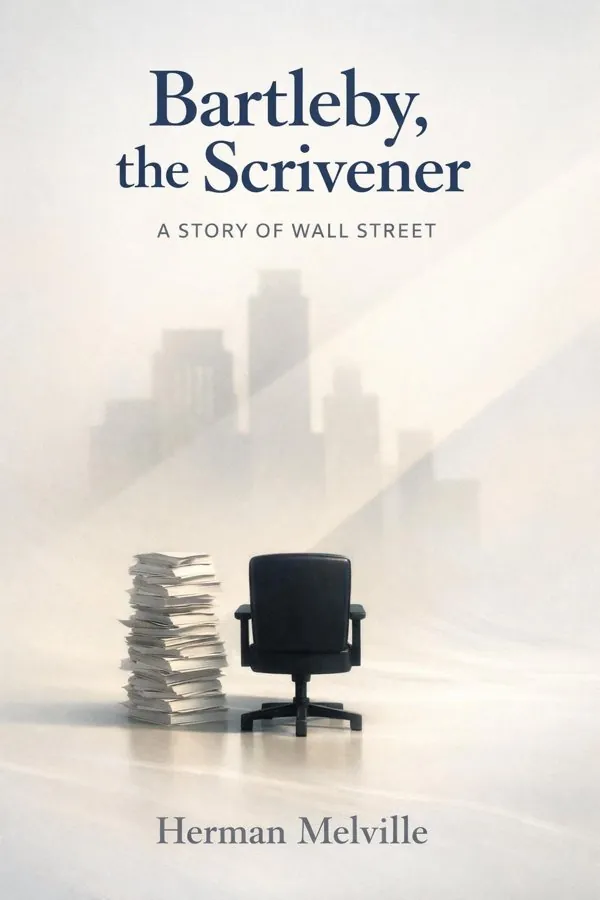
Bartleby, the Scrivener: A Story of Wall Street: Summary & Key Insights
 10 min9 chaptersAudio available
Key Takeaways from Bartleby, the Scrivener: A Story of Wall Street
Order can look like virtue, but sometimes it is merely comfort arranged into habit.
At first, the most troubling people are often the most useful ones.
A quiet refusal can be more disruptive than open rebellion.
When someone refuses to fit the system, the system first tries to reinterpret them.
The workplace in “Bartleby” is comic on the surface, but its comedy hides a grim truth: modern offices often sort people into useful fragments rather than seeing them whole.
What Is Bartleby, the Scrivener: A Story of Wall Street About?
Bartleby, the Scrivener: A Story of Wall Street by Herman Melville is a classics book spanning 6 pages. Herman Melville’s “Bartleby, the Scrivener: A Story of Wall Street,” first published in 1853, is a short work with an unusually large afterlife. Set inside a quiet law office in lower Manhattan, it begins as a realistic account of clerical routine and slowly turns into something stranger, sadder, and far more unsettling. The narrator, a cautious and respectable lawyer, hires Bartleby, a copyist whose calm competence soon gives way to a repeated refusal: “I would prefer not to.” That simple phrase becomes the center of the story’s moral, psychological, and social force. What makes the tale endure is not plot alone, but its uncanny relevance. Melville captures modern workplace alienation, emotional distance, bureaucratic cruelty, and the limits of charity in a system built on productivity. Bartleby is at once a mystery, a victim, and a quiet resistor; the lawyer is humane yet helpless, decent yet compromised. Melville, one of America’s greatest writers, uses this small office drama to ask enormous questions about work, dignity, responsibility, and the human cost of indifference. Few stories say so much with such restraint.
This FizzRead summary covers all 9 key chapters of Bartleby, the Scrivener: A Story of Wall Street in approximately 10 minutes, distilling the most important ideas, arguments, and takeaways from Herman Melville's work. Also available as an audio summary and Key Quotes Podcast.
Bartleby, the Scrivener: A Story of Wall Street
Herman Melville’s “Bartleby, the Scrivener: A Story of Wall Street,” first published in 1853, is a short work with an unusually large afterlife. Set inside a quiet law office in lower Manhattan, it begins as a realistic account of clerical routine and slowly turns into something stranger, sadder, and far more unsettling. The narrator, a cautious and respectable lawyer, hires Bartleby, a copyist whose calm competence soon gives way to a repeated refusal: “I would prefer not to.” That simple phrase becomes the center of the story’s moral, psychological, and social force.
What makes the tale endure is not plot alone, but its uncanny relevance. Melville captures modern workplace alienation, emotional distance, bureaucratic cruelty, and the limits of charity in a system built on productivity. Bartleby is at once a mystery, a victim, and a quiet resistor; the lawyer is humane yet helpless, decent yet compromised. Melville, one of America’s greatest writers, uses this small office drama to ask enormous questions about work, dignity, responsibility, and the human cost of indifference. Few stories say so much with such restraint.
Who Should Read Bartleby, the Scrivener: A Story of Wall Street?
This book is perfect for anyone interested in classics and looking to gain actionable insights in a short read. Whether you're a student, professional, or lifelong learner, the key ideas from Bartleby, the Scrivener: A Story of Wall Street by Herman Melville will help you think differently.
- ✓Readers who enjoy classics and want practical takeaways
- ✓Professionals looking to apply new ideas to their work and life
- ✓Anyone who wants the core insights of Bartleby, the Scrivener: A Story of Wall Street in just 10 minutes
Want the full summary?
Get instant access to this book summary and 100K+ more with Fizz Moment.
Get Free SummaryAvailable on App Store • Free to download
Key Chapters
Order can look like virtue, but sometimes it is merely comfort arranged into habit. The lawyer who narrates “Bartleby” prides himself on being safe, prudent, and moderate. He is not a courtroom hero or a fierce intellectual; he is a professional man who values calm, routine, and the absence of conflict. His Wall Street chambers run on predictable rhythms: papers are copied, documents are checked, and business proceeds with minimal disturbance. He believes this measured life is evidence of good judgment.
Melville uses this voice carefully. The lawyer is not malicious. In fact, his reasonableness makes him believable and, at first, sympathetic. Yet his self-image also reveals his limits. He sees the office primarily as a machine that should function smoothly. He tolerates eccentricities in his clerks—Turkey’s afternoon irritability, Nippers’s morning restlessness, Ginger Nut’s minor role—because each can still be fitted into a workable system. His idea of goodness is deeply tied to manageability.
This matters because many institutions still depend on similar personalities: leaders who prefer peace over truth, accommodation over confrontation, and efficiency over deeper understanding. Such people often think of themselves as humane simply because they avoid overt cruelty. But when a real human crisis appears—something that cannot be solved through minor adjustments—their moderation is exposed as morally thin.
In modern workplaces, this can look like a manager who is polite but emotionally absent, or a culture that values “professionalism�� while ignoring suffering. Stability has value, but only when it leaves room for attention, empathy, and moral courage.
Actionable takeaway: Examine where you confuse smooth operations with genuine care. Ask whether your routines serve people—or merely prevent inconvenience.
At first, the most troubling people are often the most useful ones. When Bartleby arrives, he appears to be the ideal employee: pale, quiet, sober, tireless, and astonishingly productive. He copies legal documents with mechanical consistency and without complaint. For the lawyer, this seems like a blessing. In an office already shaped by the predictable flaws of its staff, Bartleby’s stillness looks like perfect discipline.
But Melville makes that efficiency unsettling from the start. Bartleby does not merely work hard; he seems emptied into the work. He has no visible social life, no ordinary preferences, and no signs of inner vitality. He copies “silently, palely, mechanically.” His productivity is less a sign of flourishing than of erasure. In this way, Melville anticipates a modern problem: organizations often reward behavior that appears reliable while failing to ask what emotional or spiritual cost lies beneath it.
The lawyer initially reads Bartleby’s silence as professionalism. This is a common mistake. We often assume the least demanding people are the healthiest, when in fact they may be the most disconnected. The employee who never pushes back, never asks for help, and never reveals vulnerability may be praised precisely because their distress remains invisible.
In daily life, this idea extends beyond work. A student who always performs, a friend who “never causes trouble,” or a family member who withdraws into dutifulness can be mistaken for strong when they are simply unreachable.
Melville’s insight is sharp: efficiency can hide despair, and usefulness can make suffering easier to ignore. The office welcomes Bartleby most warmly when he seems most machine-like.
Actionable takeaway: Do not evaluate people only by output and compliance. Look for signs of personhood—connection, voice, agency, and the ability to participate as more than a function.
A quiet refusal can be more disruptive than open rebellion. The turning point of the story comes when Bartleby is asked to help compare a copied document and answers, calmly and without drama, “I would prefer not to.” The phrase is astonishing because it is neither aggressive nor apologetic. It does not argue. It does not explain. It simply declines cooperation while retaining a peculiar courtesy.
That wording gives Bartleby extraordinary power. If he had shouted, insulted his employer, or quit outright, the lawyer would know how to respond. But Bartleby’s refusal falls outside familiar categories. It is not exactly insubordination, not exactly madness, and not exactly resistance in any political sense. It is a withdrawal from the assumptions that make the office function. He refuses the script itself.
This is why the phrase has remained culturally alive. It speaks to anyone who has felt crushed by expectations but unable to stage a dramatic revolt. Bartleby does not seize freedom in a triumphant way; he creates a tiny pocket of noncompliance inside the system. Yet Melville does not romanticize this act. Bartleby’s refusal is powerful, but it is also tied to paralysis, isolation, and deep inward collapse.
In practical terms, the story invites reflection on boundaries and dissent. Not every “preference not to” is noble, but unquestioning compliance is not healthy either. In workplaces and institutions, people need language for humane limits. The challenge is to resist in ways that preserve dignity and communication rather than dissolve both.
Actionable takeaway: When something violates your values or capacity, practice respectful refusal. Name your limit clearly and calmly—but also stay engaged enough to seek alternatives, not only withdrawal.
When someone refuses to fit the system, the system first tries to reinterpret them. After Bartleby’s first refusal, the lawyer does not immediately dismiss him. Instead, he hesitates, rationalizes, and adapts. Bartleby continues copying for a time, then gradually refuses more tasks, then all tasks. He remains physically present in the office while becoming functionally absent from its life. This creates not just inconvenience but a crisis of interpretation.
The lawyer cycles through reactions: irritation, curiosity, pity, self-justification, and avoidance. He asks questions but not too deeply. He notices Bartleby’s oddity but delays decisive action. He wants to think well of himself without fully accepting responsibility. Melville captures a familiar moral pattern: people often respond to suffering by hovering near it, offering partial gestures that preserve their self-image while stopping short of true commitment.
Bartleby’s withdrawal becomes a mirror. Every character must decide how much reality to acknowledge. Is he sick? stubborn? broken? dangerous? pitiable? The uncertainty allows everyone to postpone the harder question: what is owed to a human being who no longer functions usefully?
This idea remains painfully relevant. Institutions often respond to burnout, depression, or disengagement by using procedural language rather than moral language. They ask whether a person is compliant, productive, or manageable, not whether they are collapsing. Even compassionate individuals may prefer ambiguity because certainty would require action.
The story warns that confusion can become a form of evasion. Not understanding everything about a person does not cancel our responsibility to respond humanely.
Actionable takeaway: When someone’s behavior becomes troubling or withdrawn, resist the urge to stay comfortably uncertain. Ask direct, compassionate questions and determine what real help—not symbolic concern—is possible.
The workplace in “Bartleby” is comic on the surface, but its comedy hides a grim truth: modern offices often sort people into useful fragments rather than seeing them whole. Before Bartleby dominates the story, Melville introduces the lawyer’s other employees. Turkey is productive in the morning but chaotic in the afternoon. Nippers is irritable and ambitious, struggling through the first part of the day before settling later on. Ginger Nut, the office boy, serves as a minor accessory to adult routine. Together they create a bizarre but functional ecosystem.
The lawyer manages them by treating their limitations as variables to be balanced. One clerk’s bad hours compensate for another’s good ones. Eccentricity is tolerated as long as the workflow continues. This arrangement feels practical, even clever, but it also reveals a dehumanizing logic. Each person is reduced to a pattern of utility.
Bartleby initially seems to fit perfectly because he appears free of troublesome variation. He is pure function—until he is not. Once he ceases to be useful, the office has no language for his humanity. In this sense, Bartleby exposes what was always true of the workplace: it was never built to know people deeply, only to use them effectively.
Readers can apply this insight broadly. Teams, schools, and even families can become systems of managed dysfunction where people are valued mainly for what role they play. Efficiency may improve, but understanding shrinks.
Melville’s office is not just a setting; it is a miniature model of industrial modernity, where personality is tolerated, suffering is privatized, and worth is measured by output.
Actionable takeaway: In any group you lead or belong to, ask whether people are known as individuals or merely as functions. Build moments for real conversation before crisis makes that impossible.
Sometimes the most revealing moral failure is not cruelty, but retreat. As Bartleby becomes impossible to manage, the lawyer tries various mild strategies: persuasion, offers of help, even relocation. Yet when Bartleby refuses to leave the office, the lawyer chooses an extraordinary solution—he moves his entire practice elsewhere. Rather than resolve the human problem, he sidesteps it. Bartleby is left behind like a lingering question no one wants to answer.
This decision is deeply revealing. The lawyer continues to see himself as compassionate, and in a narrow sense he is. He is more patient than many employers would be. But his kindness has limits defined by inconvenience. He will pity Bartleby, but he will not truly bind himself to him. Once the burden becomes too intimate, he withdraws under the cover of practicality.
Eventually Bartleby is arrested as a vagrant and sent to the Tombs, the city jail. There, the consequences of social abandonment become literal. A man who could not or would not participate in the demands of commercial life is transferred to the penal margins of society. Melville shows how quickly nonproductivity can be recoded as nuisance, then deviance, then disposability.
This pattern remains familiar. People who cannot keep pace with institutional expectations—because of mental illness, exhaustion, trauma, or poverty—are often shuffled from workplace to bureaucracy to punishment, with each step framed as procedural necessity.
The Tombs is not just a prison in the story; it is the final expression of a society that has no place for the unmanageable except exclusion.
Actionable takeaway: Notice when you are “solving” a difficult human problem by relocating it out of sight. Ask whether your solution addresses the person’s need or only removes your discomfort.
The story’s final revelation changes everything by changing nothing. Near the end, the lawyer hears a rumor that Bartleby once worked in the Dead Letter Office in Washington, where undeliverable mail is sorted and destroyed. Whether or not this detail explains Bartleby fully, it offers one of the most haunting symbols in American literature. Dead letters are messages meant to connect human beings that never reach their destination. They carry hope, love, money, forgiveness, news—then become waste.
The image transforms Bartleby from an eccentric employee into a figure shaped by failed communication itself. He becomes associated with messages that go nowhere, appeals that are never answered, human intentions that perish in transit. In that light, his passivity feels less like simple stubbornness than the afterimage of a world in which contact has lost meaning.
Melville links bureaucracy with spiritual desolation. The Dead Letter Office is an institution of missed connection, and Bartleby becomes its human embodiment: present but unreachable, alive but socially canceled, visible yet inaccessible. This is why readers often describe him as ghostly. He resembles someone already severed from the circuits of ordinary exchange.
The symbol remains powerful today. In an age of endless communication, people still experience emotional dead letters—messages unread, needs unanswered, grief unseen. Systems can transmit data while failing to carry care.
Melville does not provide a neat psychological diagnosis. Instead, he gives a metaphor large enough to hold loneliness, depression, bureaucratic numbness, and social abandonment all at once.
Actionable takeaway: Treat communication as more than information transfer. In your personal and professional life, make sure important messages—especially signs of need, vulnerability, or care—are truly received, not merely sent.
Good intentions are not the same as moral courage. One reason “Bartleby” remains so unsettling is that the lawyer is not a villain. He feels pity. He gives Bartleby chances. He even visits him in prison and arranges food. Yet none of this becomes meaningful rescue. Melville forces readers to confront an uncomfortable truth: compassion that never becomes committed action may soothe the helper more than it helps the suffering person.
The lawyer repeatedly frames his responses in terms that preserve his self-respect. He wants to be charitable, Christian, and benevolent. But he also wants order, distance, and plausible innocence. He does not know how to cross the threshold from sympathy to solidarity. That failure is not merely personal; it reflects a broader social condition in which people are encouraged to feel concern without accepting sustained obligation.
This dynamic appears everywhere. A company expresses concern for employee well-being but offers no structural support. Friends say they are “there for you” but disappear when the problem becomes chronic. Public sympathy rises for vulnerable groups, while institutions remain unchanged. The language of care circulates more easily than care itself.
Melville’s story therefore asks a hard question: what does it mean to encounter another person’s suffering when no efficient solution exists? Sometimes the answer is not eloquence or sentiment, but presence, patience, and costly involvement.
Bartleby may not be fully saveable within the world of the story. But the lawyer’s half-measures expose how often we settle for appearing humane rather than becoming responsible.
Actionable takeaway: When moved by someone’s struggle, translate sympathy into one concrete, sustained act—follow up, offer specific help, or change a condition contributing to the harm.
A nineteenth-century scrivener should feel remote, yet Bartleby feels uncannily contemporary. That is because Melville identified patterns that define modern life: work detached from meaning, institutions that confuse compliance with health, loneliness hidden inside professionalism, and a society that struggles to care for those who stop performing. Bartleby’s phrase, “I would prefer not to,” now echoes far beyond literature because it names a modern exhaustion with unusual precision.
The story speaks to office workers, managers, caregivers, students, and anyone who has felt numbed by repetitive systems. It also resonates in conversations about burnout, depression, passive resistance, and the ethics of work. Bartleby is not a tidy symbol of rebellion, but he is a powerful figure for refusal in a world that constantly demands productivity. At the same time, the story warns against romanticizing disengagement. Withdrawal may expose injustice, yet it can also deepen suffering when it cuts a person off from community and purpose.
What keeps the story alive is its refusal to simplify. Bartleby is neither hero nor mere problem. The lawyer is neither monster nor savior. Wall Street is not just a place, but a moral atmosphere in which every relationship risks becoming transactional.
In practical terms, the story invites readers to build more humane forms of work and attention. It asks leaders to look beyond output, peers to notice isolation, and individuals to question whether success purchased through emotional deadness is success at all.
Actionable takeaway: Use Bartleby as a lens on your own environment. Identify one way your workplace or daily system rewards detachment, and take one step to restore meaning, voice, or human connection.
All Chapters in Bartleby, the Scrivener: A Story of Wall Street
About the Author
Herman Melville (1819–1891) was an American novelist, short story writer, essayist, and poet whose work combined adventure, philosophy, symbolism, and penetrating social insight. He is best known for “Moby-Dick,” now regarded as one of the great novels in English, though much of his finest writing was underappreciated during his lifetime. Melville drew on his experiences at sea as well as a lifelong interest in religion, power, labor, and the mysteries of human behavior. His shorter fiction, including “Bartleby, the Scrivener” and “Benito Cereno,” reveals his extraordinary ability to turn specific situations into larger moral and existential dramas. Today, Melville is recognized as one of the most important figures in nineteenth-century American literature.
Get This Summary in Your Preferred Format
Read or listen to the Bartleby, the Scrivener: A Story of Wall Street summary by Herman Melville anytime, anywhere. FizzRead offers multiple formats so you can learn on your terms — all free.
Available formats: App · Audio · PDF · EPUB — All included free with FizzRead
Download Bartleby, the Scrivener: A Story of Wall Street PDF and EPUB Summary
Key Quotes from Bartleby, the Scrivener: A Story of Wall Street
“Order can look like virtue, but sometimes it is merely comfort arranged into habit.”
“At first, the most troubling people are often the most useful ones.”
“A quiet refusal can be more disruptive than open rebellion.”
“When someone refuses to fit the system, the system first tries to reinterpret them.”
“The workplace in “Bartleby” is comic on the surface, but its comedy hides a grim truth: modern offices often sort people into useful fragments rather than seeing them whole.”
Frequently Asked Questions about Bartleby, the Scrivener: A Story of Wall Street
Bartleby, the Scrivener: A Story of Wall Street by Herman Melville is a classics book that explores key ideas across 9 chapters. Herman Melville’s “Bartleby, the Scrivener: A Story of Wall Street,” first published in 1853, is a short work with an unusually large afterlife. Set inside a quiet law office in lower Manhattan, it begins as a realistic account of clerical routine and slowly turns into something stranger, sadder, and far more unsettling. The narrator, a cautious and respectable lawyer, hires Bartleby, a copyist whose calm competence soon gives way to a repeated refusal: “I would prefer not to.” That simple phrase becomes the center of the story’s moral, psychological, and social force. What makes the tale endure is not plot alone, but its uncanny relevance. Melville captures modern workplace alienation, emotional distance, bureaucratic cruelty, and the limits of charity in a system built on productivity. Bartleby is at once a mystery, a victim, and a quiet resistor; the lawyer is humane yet helpless, decent yet compromised. Melville, one of America’s greatest writers, uses this small office drama to ask enormous questions about work, dignity, responsibility, and the human cost of indifference. Few stories say so much with such restraint.
More by Herman Melville

You Might Also Like






Browse by Category
Ready to read Bartleby, the Scrivener: A Story of Wall Street?
Get the full summary and 100K+ more books with Fizz Moment.