
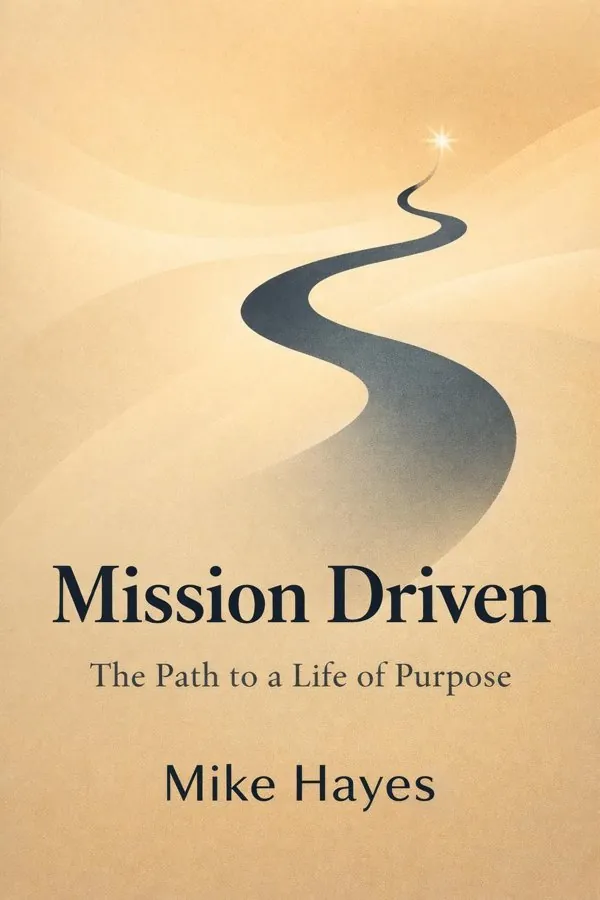
Mission Driven: The Path to a Life of Purpose: Summary & Key Insights
by Mike Hayes
 10 min9 chaptersAudio available
Key Takeaways from Mission Driven: The Path to a Life of Purpose
Most people imagine character as something they display when life is calm, but Hayes shows that pressure is where character is exposed.
In high-stakes environments, confusion is not just inconvenient; it is dangerous.
One of the most important parts of Mission Driven is Hayes’s discussion of life after elite service.
A meaningful life rarely begins with self-absorption.
When the stakes are high, instinct alone is not enough.
What Is Mission Driven: The Path to a Life of Purpose About?
Mission Driven: The Path to a Life of Purpose by Mike Hayes is a leadership book spanning 11 pages. Mission Driven: The Path to a Life of Purpose is a leadership book about what it takes to live and lead with clarity, courage, and service. Mike Hayes argues that purpose is not something reserved for heroic moments or elite professions. It is built through daily choices: how you respond under pressure, how you treat others, how you recover from setbacks, and how you align your work with values larger than personal ambition. Drawing on his experiences as a Navy SEAL commander, White House Fellow, and leader in business and nonprofit organizations, Hayes offers a practical framework for translating hard-earned lessons from extreme environments into ordinary life and leadership. What makes this book matter is its refusal to romanticize purpose. Hayes does not present purpose as a vague feeling or a motivational slogan. Instead, he shows that mission-driven living requires discipline, humility, resilience, and a willingness to serve beyond self-interest. For readers navigating career transitions, leadership challenges, or questions about meaning, Mission Driven provides both inspiration and concrete guidance. It is a field manual for people who want to make decisions with conviction and build a life that matters.
This FizzRead summary covers all 9 key chapters of Mission Driven: The Path to a Life of Purpose in approximately 10 minutes, distilling the most important ideas, arguments, and takeaways from Mike Hayes's work. Also available as an audio summary and Key Quotes Podcast.
Mission Driven: The Path to a Life of Purpose
Mission Driven: The Path to a Life of Purpose is a leadership book about what it takes to live and lead with clarity, courage, and service. Mike Hayes argues that purpose is not something reserved for heroic moments or elite professions. It is built through daily choices: how you respond under pressure, how you treat others, how you recover from setbacks, and how you align your work with values larger than personal ambition. Drawing on his experiences as a Navy SEAL commander, White House Fellow, and leader in business and nonprofit organizations, Hayes offers a practical framework for translating hard-earned lessons from extreme environments into ordinary life and leadership.
What makes this book matter is its refusal to romanticize purpose. Hayes does not present purpose as a vague feeling or a motivational slogan. Instead, he shows that mission-driven living requires discipline, humility, resilience, and a willingness to serve beyond self-interest. For readers navigating career transitions, leadership challenges, or questions about meaning, Mission Driven provides both inspiration and concrete guidance. It is a field manual for people who want to make decisions with conviction and build a life that matters.
Who Should Read Mission Driven: The Path to a Life of Purpose?
This book is perfect for anyone interested in leadership and looking to gain actionable insights in a short read. Whether you're a student, professional, or lifelong learner, the key ideas from Mission Driven: The Path to a Life of Purpose by Mike Hayes will help you think differently.
- ✓Readers who enjoy leadership and want practical takeaways
- ✓Professionals looking to apply new ideas to their work and life
- ✓Anyone who wants the core insights of Mission Driven: The Path to a Life of Purpose in just 10 minutes
Want the full summary?
Get instant access to this book summary and 100K+ more with Fizz Moment.
Get Free SummaryAvailable on App Store • Free to download
Key Chapters
Most people imagine character as something they display when life is calm, but Hayes shows that pressure is where character is exposed. His recollections from early SEAL training make this point unforgettable. The freezing surf, sleep deprivation, relentless physical strain, and constant uncertainty were not simply tests of strength. They were designed to strip away illusion. Under severe stress, talent matters less than preparation, mindset, and the habits you have built before the moment of crisis.
Hayes uses this lesson to challenge a common myth: that resilience is mostly innate. In reality, resilience is trained. SEAL candidates survive not because they enjoy suffering, but because they learn to break enormous challenges into manageable pieces, trust their teammates, and keep moving when quitting feels reasonable. This applies far beyond military selection. A founder facing a company downturn, a parent managing a family crisis, or a professional navigating burnout all benefit from the same discipline: focus on the next right action rather than the full weight of the problem.
Hayes also emphasizes the role of meaning. People can endure more than they think when hardship is tied to a worthy purpose. Endurance becomes easier when the pain serves something larger than ego.
A practical application is to build “stress habits” before you need them. Prepare routines for difficult moments: pause, assess, prioritize, and act. Train yourself in small discomforts, whether through disciplined exercise, difficult conversations, or committed follow-through. Actionable takeaway: do not wait for pressure to teach you who you are; use daily discipline to become the person pressure can trust.
In high-stakes environments, confusion is not just inconvenient; it is dangerous. Hayes’s combat leadership experiences illustrate that when conditions are uncertain and consequences are real, leaders cannot afford to be paralyzed by noise. The job is to create clarity quickly enough for people to move with confidence. That does not mean pretending to know everything. It means identifying what matters most, communicating it simply, and helping others act despite incomplete information.
One of Hayes’s most valuable insights is that clarity is a leadership responsibility, not a luxury. In battle, teams rely on leaders who can distinguish signal from distraction. In business or public service, the same need appears during mergers, layoffs, crises, political shifts, or market volatility. People do not expect leaders to have perfect foresight, but they do need a clear direction, a set of priorities, and a sense of what success looks like in the next phase.
Hayes encourages leaders to simplify aggressively. What is the mission? What are the constraints? What is the immediate priority? Who owns what? These questions reduce fear because they replace ambiguity with structure. He also stresses the importance of communicating calm without becoming detached. Teams take emotional cues from leaders, especially under stress.
In everyday practice, this might mean shortening meetings during a crisis, writing one-page plans instead of lengthy decks, or ending discussions with explicit decisions and owners. Actionable takeaway: when facing chaos, ask yourself and your team three questions—what matters now, what can wait, and what is the next move—and lead from those answers.
One of the most important parts of Mission Driven is Hayes’s discussion of life after elite service. Transitioning from military leadership into government, nonprofit work, and business forced him to confront a challenge many people face in different forms: what happens when the role that defined you changes or disappears? Hayes makes clear that transitions are not only logistical problems. They are identity problems.
Many capable people stumble during career shifts because they focus too much on external markers such as title, compensation, or prestige. Hayes argues that the deeper task is understanding which parts of your identity are enduring and which were tied to a specific environment. Skills transfer. Values transfer. Mission can transfer. But if your sense of worth depends entirely on one role, every transition feels like loss instead of possibility.
This insight is especially useful for professionals changing industries, entrepreneurs after selling a company, retirees, veterans, and even students leaving school. Hayes recommends reframing transition not as abandonment of the past, but as redeployment. The question is not “Who am I without this role?” but “Where can my strengths best serve now?” That shift preserves continuity while allowing growth.
Practically, Hayes’s perspective suggests making a transition inventory: list your core values, signature strengths, energizing tasks, and the causes you care about. Then identify environments where those qualities are needed. Networking becomes more meaningful when it is mission-based rather than status-based. Actionable takeaway: during any major transition, define yourself by your values and service, not your former title, and let that identity guide your next step.
A meaningful life rarely begins with self-absorption. Hayes argues that purpose becomes clearer when attention shifts away from personal advancement and toward contribution. This is one of the book’s central themes: service is not a sentimental add-on to success. It is often the most reliable path to discovering what success should mean.
Hayes’s own life across military, public service, and civilian leadership reinforces the point that purpose deepens when your work benefits others. Service creates perspective. It shrinks ego, sharpens responsibility, and turns abstract values into concrete behavior. This does not require joining the military or working in government. Service can be expressed through mentoring a colleague, building a values-driven company, supporting a community initiative, or leading a family with integrity and presence.
The book is especially helpful in showing that purpose is not always found in a dramatic calling. More often, it emerges through repeated acts of responsibility. You commit to something beyond yourself, you keep showing up, and over time your sense of mission strengthens. In that sense, purpose is discovered through action as much as reflection.
A practical example is to evaluate your current commitments through a service lens. Instead of asking only what you enjoy or what pays well, ask whom your work helps and how clearly that contribution is visible. If the answer is unclear, look for ways to increase your impact where you are.
Actionable takeaway: if you feel uncertain about your purpose, stop waiting for a perfect revelation and start serving a real need. Contribution often creates the clarity that introspection alone cannot.
When the stakes are high, instinct alone is not enough. Hayes emphasizes that strong leaders rely on decision-making frameworks so they can act with speed and consistency under pressure. A framework does not remove uncertainty, but it reduces avoidable confusion and helps people think clearly when emotions run high.
The core of Hayes’s approach is simple: anchor decisions in mission, values, facts, and consequences. First, define the objective. If the mission is vague, every option becomes harder to evaluate. Second, test choices against values. A fast decision that violates integrity creates long-term damage. Third, gather enough information to act, but avoid endless delay disguised as analysis. Finally, consider second-order effects: how will this choice affect the team, trust, culture, and future options?
This framework is highly transferable. A manager deciding whether to restructure a team can ask: what outcome are we trying to achieve, what principles must guide us, what facts do we actually know, and what unintended effects could follow? A student choosing between opportunities can use the same logic. Hayes is particularly strong on the idea that indecision is itself a decision. Waiting too long often narrows options and increases risk.
He also highlights the importance of after-action review. The quality of future decisions improves when leaders honestly examine what worked, what failed, and why. This transforms mistakes into training rather than shame.
Actionable takeaway: create a personal decision checklist built around mission, values, facts, and consequences, and use it consistently. In uncertain moments, a repeatable process can be more valuable than a perfect answer.
Leadership is not measured by how much authority you hold but by how much responsibility others are empowered to carry. Hayes makes a compelling case that strong teams are built on trust, humility, and shared ownership. In elite units, no mission succeeds because of one heroic individual. Success depends on people who know the goal, trust one another, and feel accountable for the outcome.
This idea matters because many leaders confuse control with competence. Hayes suggests the opposite: overcontrol weakens teams by reducing initiative and discouraging honest communication. Teams perform best when leaders set high standards, communicate intent clearly, and then allow capable people to execute. That requires humility. A leader must be willing to listen, invite dissent, and admit when someone else has the better answer.
The lesson applies across sectors. In a corporate setting, this might mean giving team members real decision rights rather than asking for input and then micromanaging the result. In a nonprofit, it could involve clarifying mission so volunteers and staff can act independently without drifting from purpose. In families, it may look like teaching children responsibility instead of solving every problem for them.
Hayes also stresses that trust is built before the crisis. People follow leaders in difficult moments when they have already seen consistency, competence, and care. Trust grows through small acts: keeping commitments, sharing credit, telling the truth, and correcting problems directly.
Actionable takeaway: strengthen your team by clarifying intent, distributing ownership, and practicing trust in ordinary moments. Ask yourself regularly: am I creating followers who wait, or teammates who can act?
A mission-driven life does not eliminate setbacks. It teaches you how to absorb them without losing direction. Hayes presents resilience not as relentless toughness alone, but as the capacity to recover, learn, and continue serving with wisdom. This is an important distinction. Many high performers know how to endure; fewer know how to reset before stress turns into burnout, cynicism, or poor judgment.
Hayes’s perspective is shaped by demanding environments where fatigue and adversity are constants. Yet the broader lesson is deeply practical: resilience requires both grit and renewal. People break down when they interpret setbacks as identity verdicts rather than temporary conditions. They also struggle when they ignore the physical, emotional, and relational foundations that sustain performance over time.
The book encourages readers to normalize failure as part of growth. A bad mission, a wrong call, or a difficult transition does not have to define the future if it is processed honestly. Reflection, feedback, and adaptation are central. Hayes’s approach echoes elite training principles: stress, recover, adapt, repeat. Growth occurs when challenge is paired with learning.
In daily life, this may mean conducting your own after-action review after a difficult week, seeking counsel rather than isolating, and protecting recovery habits such as sleep, exercise, time with family, and moments of reflection. Resilience is not passive survival; it is active maintenance of your ability to contribute.
Actionable takeaway: treat resilience as a cycle, not a trait. After every period of strain, ask what happened, what you learned, and what practices will help you return stronger and steadier.
It is easy to speak about values when the cost is low. Hayes argues that true leadership is revealed when ambition, pressure, and opportunity tempt you to compromise. Across military service, government, and business, he learned that ethical leadership is not abstract philosophy. It is operational. It determines whether people trust you, whether teams remain cohesive, and whether success can endure.
Hayes is especially persuasive in showing that ethical failures rarely begin as dramatic betrayals. They start with rationalizations: cutting a corner for speed, withholding bad news to protect morale, taking credit because the result was good, or ignoring warning signs because the mission feels urgent. Over time, these small compromises erode judgment and culture. A mission-driven leader must therefore be vigilant not only about outcomes but about the methods used to achieve them.
This becomes even more important during innovation and change. Organizations under pressure to evolve often justify questionable behavior in the name of necessity. Hayes rejects that logic. Adaptation is essential, but it should never require abandoning principles. In fact, values become more important when conditions are unstable because they provide continuity amid change.
For readers in leadership roles, this means making ethics visible. Discuss trade-offs openly. Reward integrity, not just results. Invite dissent when a decision feels misaligned with stated values. If you lead a company, nonprofit, or team, people watch what you tolerate more than what you declare.
Actionable takeaway: define your non-negotiables before the pressure comes. When facing a difficult choice, ask not only “Will this work?” but also “Can I defend this with integrity after the urgency passes?”
Purpose without discipline remains aspiration. In the closing themes of Mission Driven, Hayes connects personal discipline, balance, and service beyond self into a larger argument about sustainable leadership. A meaningful life is not built from occasional bursts of inspiration. It is maintained through routines, boundaries, and choices that keep your values active over time.
Hayes does not treat discipline as rigidity. Instead, he presents it as the structure that protects what matters most. If family, health, service, spiritual life, or long-term contribution truly matter, they must appear in the calendar and in daily habits. Otherwise, urgent demands will consume them. This is particularly important for leaders, whose responsibilities can expand endlessly if left unchecked.
Balance in Hayes’s framing does not mean perfect symmetry between all areas of life. It means intentional alignment. Some seasons demand more from work or mission, but sustained imbalance carries a cost. Leaders who neglect rest, relationships, or personal reflection eventually weaken the very people and causes they hope to serve.
The final extension of this idea is that the best leadership outlives personal gain. A mission-driven life asks what legacy you are building in others. Are you creating stronger institutions, more capable teammates, deeper trust, and a wider circle of service? That is how purpose moves beyond individual success.
Practical applications include setting recurring time for reflection, establishing non-negotiable health habits, mentoring someone with no direct benefit to you, and measuring success partly by who grows because of your presence.
Actionable takeaway: turn your values into calendar commitments and service habits. If a priority does not shape your routines, it is still an intention, not yet a mission.
All Chapters in Mission Driven: The Path to a Life of Purpose
About the Author
Mike Hayes is a former U.S. Navy SEAL commander whose career spans military service, public leadership, nonprofit work, and business. He served in one of the world’s most demanding leadership environments, where clarity, resilience, and trust were not theoretical ideals but operational necessities. After his military career, Hayes became a White House Fellow and went on to hold senior roles in both public and private sectors, giving him a rare perspective on leadership across radically different institutions. His work focuses on helping individuals and organizations lead with purpose, discipline, and service. In Mission Driven, Hayes draws on this wide-ranging experience to offer practical guidance on navigating transitions, building teams, making ethical decisions, and creating a life centered on meaning rather than status.
Get This Summary in Your Preferred Format
Read or listen to the Mission Driven: The Path to a Life of Purpose summary by Mike Hayes anytime, anywhere. FizzRead offers multiple formats so you can learn on your terms — all free.
Available formats: App · Audio · PDF · EPUB — All included free with FizzRead
Download Mission Driven: The Path to a Life of Purpose PDF and EPUB Summary
Key Quotes from Mission Driven: The Path to a Life of Purpose
“Most people imagine character as something they display when life is calm, but Hayes shows that pressure is where character is exposed.”
“In high-stakes environments, confusion is not just inconvenient; it is dangerous.”
“One of the most important parts of Mission Driven is Hayes’s discussion of life after elite service.”
“A meaningful life rarely begins with self-absorption.”
“When the stakes are high, instinct alone is not enough.”
Frequently Asked Questions about Mission Driven: The Path to a Life of Purpose
Mission Driven: The Path to a Life of Purpose by Mike Hayes is a leadership book that explores key ideas across 9 chapters. Mission Driven: The Path to a Life of Purpose is a leadership book about what it takes to live and lead with clarity, courage, and service. Mike Hayes argues that purpose is not something reserved for heroic moments or elite professions. It is built through daily choices: how you respond under pressure, how you treat others, how you recover from setbacks, and how you align your work with values larger than personal ambition. Drawing on his experiences as a Navy SEAL commander, White House Fellow, and leader in business and nonprofit organizations, Hayes offers a practical framework for translating hard-earned lessons from extreme environments into ordinary life and leadership. What makes this book matter is its refusal to romanticize purpose. Hayes does not present purpose as a vague feeling or a motivational slogan. Instead, he shows that mission-driven living requires discipline, humility, resilience, and a willingness to serve beyond self-interest. For readers navigating career transitions, leadership challenges, or questions about meaning, Mission Driven provides both inspiration and concrete guidance. It is a field manual for people who want to make decisions with conviction and build a life that matters.
You Might Also Like
Extreme Ownership
Jocko Willink
10 min
Dare to Lead
Brene Brown
10 min
Leaders Eat Last
Simon Sinek
10 min
The 21 Irrefutable Laws of Leadership
John Maxwell
10 min
Start With Why
Simon Sinek
10 min
How to Lead When You're Not in Charge
Clay Scroggins
10 minBrowse by Category
Ready to read Mission Driven: The Path to a Life of Purpose?
Get the full summary and 100K+ more books with Fizz Moment.