
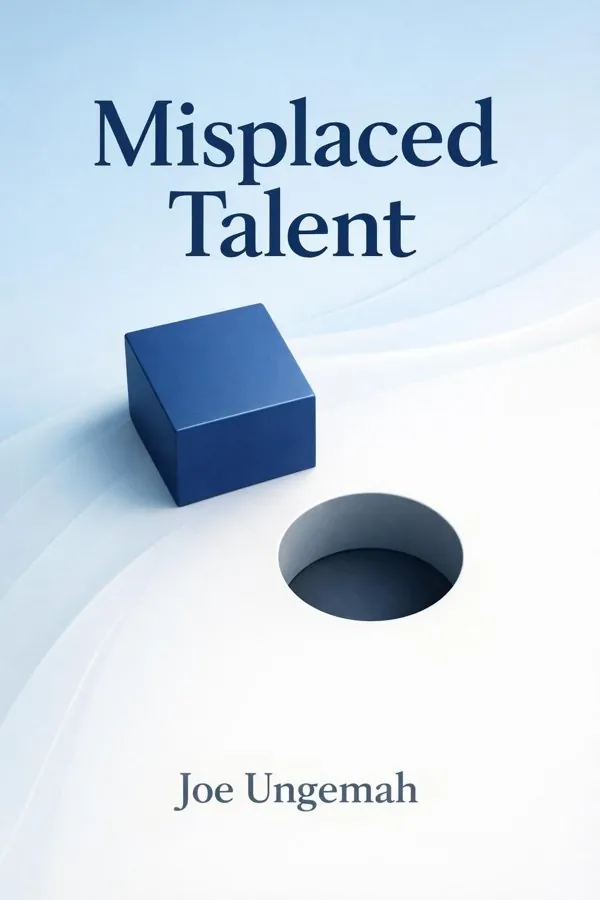
Misplaced Talent: A Guide to Making Better People Decisions: Summary & Key Insights
by Joe Ungemah
 10 min8 chaptersAudio available
Key Takeaways from Misplaced Talent: A Guide to Making Better People Decisions
One of the book’s most unsettling ideas is that many organizations still manage people with tools designed for a different economic era.
Every talent decision feels objective from the inside, but Ungemah reminds us that human judgment is never free from psychology.
A striking theme in Misplaced Talent is that organizations often claim to value people while making decisions about them with surprisingly little rigor.
One of the book’s most useful distinctions is the difference between observed performance and underlying capability.
Many organizations treat leadership development as a reward for visible success rather than a disciplined process of identifying who can actually lead.
What Is Misplaced Talent: A Guide to Making Better People Decisions About?
Misplaced Talent: A Guide to Making Better People Decisions by Joe Ungemah is a leadership book spanning 7 pages. Misplaced Talent: A Guide to Making Better People Decisions is a sharp, practical book about one of the most expensive and overlooked problems in modern organizations: putting the wrong people in the wrong roles, then wondering why performance stalls. Joe Ungemah argues that most companies do not fail at talent because they lack smart people or good intentions. They fail because their hiring, promotion, evaluation, and development systems are built on outdated assumptions, biased judgments, and fragmented HR practices. The result is wasted potential for individuals and weak execution for businesses. What makes this book especially valuable is its evidence-based approach. Ungemah, an organizational psychologist and talent management expert, draws on behavioral science, workplace assessment, and real organizational practice to show how better people decisions can be made systematically rather than intuitively. He challenges familiar rituals such as résumé screening, unstructured interviews, and annual reviews, and replaces them with more reliable methods for identifying capability and matching people to work. For leaders, managers, and HR professionals, this is a guide to building fairer systems, stronger teams, and organizations that actually know how to recognize and use talent well.
This FizzRead summary covers all 8 key chapters of Misplaced Talent: A Guide to Making Better People Decisions in approximately 10 minutes, distilling the most important ideas, arguments, and takeaways from Joe Ungemah's work. Also available as an audio summary and Key Quotes Podcast.
Misplaced Talent: A Guide to Making Better People Decisions
Misplaced Talent: A Guide to Making Better People Decisions is a sharp, practical book about one of the most expensive and overlooked problems in modern organizations: putting the wrong people in the wrong roles, then wondering why performance stalls. Joe Ungemah argues that most companies do not fail at talent because they lack smart people or good intentions. They fail because their hiring, promotion, evaluation, and development systems are built on outdated assumptions, biased judgments, and fragmented HR practices. The result is wasted potential for individuals and weak execution for businesses.
What makes this book especially valuable is its evidence-based approach. Ungemah, an organizational psychologist and talent management expert, draws on behavioral science, workplace assessment, and real organizational practice to show how better people decisions can be made systematically rather than intuitively. He challenges familiar rituals such as résumé screening, unstructured interviews, and annual reviews, and replaces them with more reliable methods for identifying capability and matching people to work. For leaders, managers, and HR professionals, this is a guide to building fairer systems, stronger teams, and organizations that actually know how to recognize and use talent well.
Who Should Read Misplaced Talent: A Guide to Making Better People Decisions?
This book is perfect for anyone interested in leadership and looking to gain actionable insights in a short read. Whether you're a student, professional, or lifelong learner, the key ideas from Misplaced Talent: A Guide to Making Better People Decisions by Joe Ungemah will help you think differently.
- ✓Readers who enjoy leadership and want practical takeaways
- ✓Professionals looking to apply new ideas to their work and life
- ✓Anyone who wants the core insights of Misplaced Talent: A Guide to Making Better People Decisions in just 10 minutes
Want the full summary?
Get instant access to this book summary and 100K+ more with Fizz Moment.
Get Free SummaryAvailable on App Store • Free to download
Key Chapters
One of the book’s most unsettling ideas is that many organizations still manage people with tools designed for a different economic era. Job descriptions, annual reviews, linear career ladders, and manager intuition may feel familiar, but familiarity is not the same as effectiveness. Ungemah argues that traditional HR practices were built for stable, standardized work environments. In today’s faster, more complex organizations, these methods often produce poor role fit, weak development decisions, and disengaged employees.
A central problem is that conventional systems overvalue static credentials and undervalue actual capability. A résumé may show experience, but it tells you little about judgment, learning agility, motivation, or fit with the demands of a specific role. Likewise, annual performance reviews often become backward-looking exercises shaped by recency bias, politics, or vague standards rather than useful assessments of performance and potential. Unstructured interviews are another example: they often reward confidence, similarity, and polished communication instead of true job-relevant competence.
Ungemah’s critique is not that every old practice is useless. It is that too many organizations treat inherited processes as truths instead of testing whether they predict success. A company may continue using manager-led promotions because that is “how we’ve always done it,” even when internal data shows promoted employees struggle in leadership roles. In such cases, process loyalty becomes a source of talent waste.
A better approach starts by redesigning systems around evidence, role requirements, and measurable outcomes. That might mean replacing generic job descriptions with success profiles, using structured interviews, or evaluating employees more continuously and contextually. The goal is not to modernize for appearance’s sake, but to improve the quality of people decisions. Actionable takeaway: audit one core talent process in your organization and ask a simple question—does this method actually predict performance, or is it just tradition in disguise?
Every talent decision feels objective from the inside, but Ungemah reminds us that human judgment is never free from psychology. Hiring, promoting, rating, and developing people are all acts of interpretation, and interpretation is shaped by bias, heuristics, emotion, and social context. This means that even experienced leaders can make poor people decisions while feeling completely confident they are being fair and rational.
The book highlights common psychological traps. Halo effects cause managers to let one impressive trait, such as confidence or eloquence, color their entire evaluation of a candidate. Similarity bias makes us favor people who resemble us in background, personality, or communication style. Recency bias distorts performance assessments by overweighting recent events and forgetting the full pattern of contribution. Confirmation bias leads interviewers to search for evidence that supports an early impression rather than testing it.
These distortions matter because talent systems often turn subjective impressions into organizational reality. A manager’s “gut feeling” can influence who gets hired, who is labeled high potential, and who is quietly overlooked. Ungemah does not argue that intuition has no place at work; rather, he argues that intuition should never stand alone when the stakes are high. Better systems make bias visible and reduce its influence through structure, criteria, and data.
For example, instead of asking interviewers for a general impression, organizations can require ratings on clearly defined competencies tied to the role. Instead of a manager nominating future leaders based on personal comfort, companies can compare multiple sources of evidence, including assessments, behavioral indicators, and observed performance under relevant conditions. Practical takeaway: when making an important people decision, separate your impression from your evidence by writing down the specific behaviors, capabilities, and results that support your conclusion.
A striking theme in Misplaced Talent is that organizations often claim to value people while making decisions about them with surprisingly little rigor. Ungemah champions evidence-based talent management as the antidote. This means using validated methods, relevant data, and clear criteria to improve how organizations hire, assess, promote, and develop employees. In short, if a process affects careers and business performance, it should be treated with the same seriousness as any other strategic decision.
Evidence-based talent management does not require turning humans into spreadsheets. It requires asking better questions. What does success in this role actually look like? Which qualities predict it? How can we measure those qualities fairly? Which steps in our process add predictive value, and which simply create noise? These questions push leaders away from assumptions and toward disciplined decision-making.
Ungemah emphasizes that not all data is equally useful. Organizations can drown in metrics while still missing what matters. The goal is to gather information that is job-relevant and decision-relevant. Structured interviews, work samples, validated assessments, behavioral data, and calibrated manager observations tend to outperform vague impressions or prestige markers. For instance, rather than hiring a sales leader based mainly on industry pedigree, a company might assess problem-solving, coaching skill, resilience, and the ability to lead through ambiguity.
An evidence-based approach also creates feedback loops. Companies should examine whether their selection and development systems actually work. Do top-rated candidates perform better after six or twelve months? Do promoted managers retain talent and improve team results? If not, the process needs revision. Practical takeaway: identify one high-stakes people decision in your organization and define the two or three strongest predictors of success before choosing methods to assess them.
One of the book’s most useful distinctions is the difference between observed performance and underlying capability. Organizations often assume that current performance tells them everything they need to know about an employee, but Ungemah argues that this is dangerously incomplete. Performance is influenced by role clarity, manager quality, team dynamics, incentives, resources, and timing. A strong person in a poor system may underperform, while a mediocre person in a favorable context may look stronger than they are.
This matters because companies frequently use narrow performance data to make broad decisions. Someone may be denied advancement because they struggled in an ill-fitting role, even though their core capabilities would flourish elsewhere. Another employee may be promoted because they excelled as an individual contributor, despite lacking the interpersonal or strategic skills needed for leadership. When organizations confuse local success with broader capability, they misplace talent and create avoidable failure.
Ungemah advocates more nuanced performance management: more frequent conversations, clearer expectations, and better distinction between results, behaviors, and future potential. Rather than relying on annual reviews filled with generalized comments, leaders should gather evidence over time and across contexts. What kinds of challenges energize this person? Where do they learn quickly? Do they show judgment under pressure? Can they influence others, adapt, and grow?
Consider a technically brilliant engineer who consistently misses cross-functional deadlines. A simplistic review might label them a low performer. A better analysis might reveal that their technical capability is exceptional, but the role requires coordination and stakeholder management they were never prepared for. Instead of discarding the person, the organization could redesign the role or provide targeted development. Actionable takeaway: in your next performance review, evaluate three separate things—results achieved, behaviors displayed, and capabilities that may matter for future roles.
Many organizations treat leadership development as a reward for visible success rather than a disciplined process of identifying who can actually lead. Ungemah argues that this is one of the most common sources of misplaced talent. Being a high performer in a technical or operational role does not automatically translate into leadership readiness. Yet companies repeatedly promote people based on tenure, credibility, or past results without carefully assessing whether they can manage complexity, influence others, and create conditions for team performance.
The book pushes leaders to separate leadership promise from leadership mythology. Charisma, decisiveness, and confidence often look like leadership, but they are unreliable proxies. Real leadership potential is more likely to show up in learning agility, self-awareness, judgment, emotional regulation, coaching capacity, and the ability to balance execution with people stewardship. These qualities are less theatrical, but far more predictive of sustained leadership effectiveness.
Ungemah also connects leadership development to culture. Organizations teach leadership not just through programs, but through what they reward. If promotions consistently favor heroic individual performers, then collaboration, mentoring, and ethical judgment will be undervalued. Conversely, if leadership systems define and measure people-building behaviors, culture becomes more aligned with long-term performance.
A practical example is succession planning. Instead of filling a slate with familiar names from senior managers’ networks, organizations can use talent reviews grounded in evidence: observed behaviors, developmental patterns, role simulations, and peer input. This broadens the pipeline and improves fairness while reducing promotion mistakes. Development should also be personalized. Not every future leader needs the same experiences, and stretch assignments should target real gaps rather than generic growth. Practical takeaway: before naming someone a high-potential leader, define the leadership capabilities your organization truly needs and test for those specifically.
A common organizational mistake is to treat hiring, performance management, leadership development, succession planning, and engagement as separate activities owned by different teams. Ungemah argues that this fragmentation creates inconsistency and confusion. When talent systems are disconnected, organizations send mixed messages about what they value, assess people against different standards at different stages, and lose the ability to make coherent long-term decisions.
An integrated talent system begins with a shared understanding of role success and organizational capability needs. The competencies used in recruitment should connect to those used in onboarding, development, and promotion. If collaboration and critical thinking are essential for success, they should not appear only in a hiring rubric and disappear from later decisions. Integration reduces waste because employees are measured and supported in ways that reinforce one another rather than contradict one another.
The book also shows how integration improves organizational learning. If a company notices that many external hires struggle after six months, that insight should inform recruiting criteria, onboarding design, manager support, and performance expectations. If leadership promotions fail at a high rate, the answer is not just a better training course; it may require changes in selection standards, assessment methods, and role definitions. Systems thinking reveals causes that isolated fixes miss.
For example, a company might complain about weak internal mobility while using rigid job descriptions, inconsistent manager ratings, and opaque promotion rules. Those are not separate problems. They are one broken talent architecture. An integrated model would create clearer skill frameworks, more portable evidence of employee strengths, and shared criteria across roles. Actionable takeaway: map your organization’s major talent processes and identify where criteria, data, or expectations change unnecessarily from one stage to the next.
A powerful idea running through the book is that talent is not an absolute quality; it is relational. A person is not simply talented or untalented in the abstract. They are more or less suited to a specific context, set of demands, and environment for success. This is why highly accomplished people can fail in one role and excel in another. Ungemah argues that organizations often chase pedigree and achievement while neglecting the deeper issue of fit.
Role fit includes several dimensions. There is capability fit: does the person have the problem-solving, interpersonal, and execution strengths the role requires? There is motivational fit: will the work energize or drain them? There is environmental fit: can they succeed within the pace, ambiguity, autonomy, and culture of the setting? Looking only at experience misses these factors. Someone may have held a similar title before, but the real demands of the new role may be entirely different.
This idea has practical significance for both hiring and internal mobility. A company hiring a customer success leader, for example, might be impressed by a candidate from a famous brand. But if the new role requires building systems from scratch rather than managing an established team, entrepreneurial design capability may matter more than prestige. Likewise, an employee struggling in a highly structured role might thrive in a more experimental one where initiative matters more than compliance.
Ungemah’s broader point is humane as well as strategic: poor fit should not automatically be interpreted as poor quality. Many careers stall because organizations label people instead of reexamining alignment. Actionable takeaway: when evaluating any candidate or employee, ask not “Is this person impressive?” but “Impressive for what exact demands, under what conditions, and for what kind of success?”
All Chapters in Misplaced Talent: A Guide to Making Better People Decisions
About the Author
Joe Ungemah is an organizational psychologist, consultant, and talent expert whose work focuses on helping organizations make smarter people decisions. He specializes in talent assessment, leadership development, performance management, and the design of evidence-based HR systems. Over the course of his career, he has worked with organizations seeking to improve how they hire, promote, develop, and retain talent in complex business environments. Ungemah is especially interested in the gap between potential and placement: why capable people are often misunderstood, misused, or mismatched to roles. In Misplaced Talent, he brings together behavioral science, workplace psychology, and practical consulting insight to show leaders how to reduce bias, improve role fit, and build more effective talent systems.
Get This Summary in Your Preferred Format
Read or listen to the Misplaced Talent: A Guide to Making Better People Decisions summary by Joe Ungemah anytime, anywhere. FizzRead offers multiple formats so you can learn on your terms — all free.
Available formats: App · Audio · PDF · EPUB — All included free with FizzRead
Download Misplaced Talent: A Guide to Making Better People Decisions PDF and EPUB Summary
Key Quotes from Misplaced Talent: A Guide to Making Better People Decisions
“One of the book’s most unsettling ideas is that many organizations still manage people with tools designed for a different economic era.”
“Every talent decision feels objective from the inside, but Ungemah reminds us that human judgment is never free from psychology.”
“A striking theme in Misplaced Talent is that organizations often claim to value people while making decisions about them with surprisingly little rigor.”
“One of the book’s most useful distinctions is the difference between observed performance and underlying capability.”
“Many organizations treat leadership development as a reward for visible success rather than a disciplined process of identifying who can actually lead.”
Frequently Asked Questions about Misplaced Talent: A Guide to Making Better People Decisions
Misplaced Talent: A Guide to Making Better People Decisions by Joe Ungemah is a leadership book that explores key ideas across 8 chapters. Misplaced Talent: A Guide to Making Better People Decisions is a sharp, practical book about one of the most expensive and overlooked problems in modern organizations: putting the wrong people in the wrong roles, then wondering why performance stalls. Joe Ungemah argues that most companies do not fail at talent because they lack smart people or good intentions. They fail because their hiring, promotion, evaluation, and development systems are built on outdated assumptions, biased judgments, and fragmented HR practices. The result is wasted potential for individuals and weak execution for businesses. What makes this book especially valuable is its evidence-based approach. Ungemah, an organizational psychologist and talent management expert, draws on behavioral science, workplace assessment, and real organizational practice to show how better people decisions can be made systematically rather than intuitively. He challenges familiar rituals such as résumé screening, unstructured interviews, and annual reviews, and replaces them with more reliable methods for identifying capability and matching people to work. For leaders, managers, and HR professionals, this is a guide to building fairer systems, stronger teams, and organizations that actually know how to recognize and use talent well.
You Might Also Like

Extreme Ownership
Jocko Willink
10 min
Dare to Lead
Brene Brown
10 min
Leaders Eat Last
Simon Sinek
10 min
The 21 Irrefutable Laws of Leadership
John Maxwell
10 min
Start With Why
Simon Sinek
10 min
How to Lead When You're Not in Charge
Clay Scroggins
10 minBrowse by Category
Ready to read Misplaced Talent: A Guide to Making Better People Decisions?
Get the full summary and 100K+ more books with Fizz Moment.