
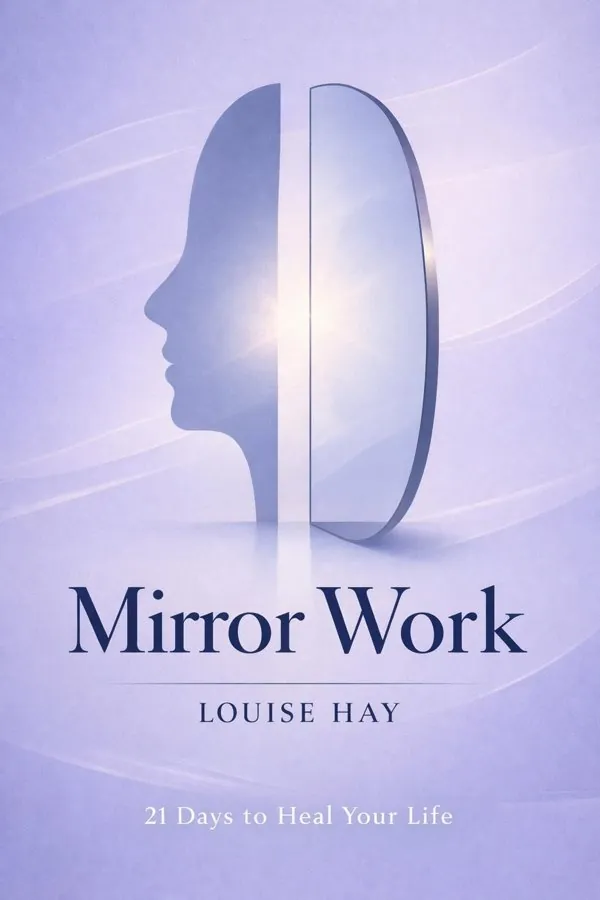
Mirror Work: 21 Days to Heal Your Life: Summary & Key Insights
by Louise Hay
 10 min9 chaptersAudio available
Key Takeaways from Mirror Work: 21 Days to Heal Your Life
Most people do not realize how often they reject themselves until they are asked to look directly into their own eyes.
Real self-love does not begin with grand declarations.
Once you stop running from yourself, a deeper question appears: can you accept all of who you are, not just the parts you find easy to like?
Many adult struggles are younger than they look.
A single loving statement rarely changes a lifetime of self-criticism, but repeated loving statements can slowly reshape the mind that speaks them.
What Is Mirror Work: 21 Days to Heal Your Life About?
Mirror Work: 21 Days to Heal Your Life by Louise Hay is a self_awareness book spanning 5 pages. Mirror Work: 21 Days to Heal Your Life is Louise Hay’s practical guide to one of her most recognizable healing methods: looking into a mirror and speaking to yourself with honesty, compassion, and love. Built as a 21-day program, the book helps readers interrupt harsh inner criticism, uncover emotional wounds, and replace old patterns with affirming beliefs that support confidence, peace, and self-worth. What sounds simple at first quickly becomes powerful, because the mirror exposes the exact relationship you have with yourself. The book matters because many people live from habit, shame, and self-rejection without fully realizing it. Hay argues that healing does not begin with external success but with the willingness to meet yourself kindly, especially in moments of discomfort. Her approach combines affirmations, reflection, emotional awareness, and daily practice in a format that feels accessible rather than abstract. Louise Hay brought unusual authority to this message through decades of teaching, counseling, and writing about self-love and personal transformation. As the author of You Can Heal Your Life and founder of Hay House, she helped millions see that changing the way you speak to yourself can change the way you live.
This FizzRead summary covers all 9 key chapters of Mirror Work: 21 Days to Heal Your Life in approximately 10 minutes, distilling the most important ideas, arguments, and takeaways from Louise Hay's work. Also available as an audio summary and Key Quotes Podcast.
Mirror Work: 21 Days to Heal Your Life
Mirror Work: 21 Days to Heal Your Life is Louise Hay’s practical guide to one of her most recognizable healing methods: looking into a mirror and speaking to yourself with honesty, compassion, and love. Built as a 21-day program, the book helps readers interrupt harsh inner criticism, uncover emotional wounds, and replace old patterns with affirming beliefs that support confidence, peace, and self-worth. What sounds simple at first quickly becomes powerful, because the mirror exposes the exact relationship you have with yourself.
The book matters because many people live from habit, shame, and self-rejection without fully realizing it. Hay argues that healing does not begin with external success but with the willingness to meet yourself kindly, especially in moments of discomfort. Her approach combines affirmations, reflection, emotional awareness, and daily practice in a format that feels accessible rather than abstract.
Louise Hay brought unusual authority to this message through decades of teaching, counseling, and writing about self-love and personal transformation. As the author of You Can Heal Your Life and founder of Hay House, she helped millions see that changing the way you speak to yourself can change the way you live.
Who Should Read Mirror Work: 21 Days to Heal Your Life?
This book is perfect for anyone interested in self_awareness and looking to gain actionable insights in a short read. Whether you're a student, professional, or lifelong learner, the key ideas from Mirror Work: 21 Days to Heal Your Life by Louise Hay will help you think differently.
- ✓Readers who enjoy self_awareness and want practical takeaways
- ✓Professionals looking to apply new ideas to their work and life
- ✓Anyone who wants the core insights of Mirror Work: 21 Days to Heal Your Life in just 10 minutes
Want the full summary?
Get instant access to this book summary and 100K+ more with Fizz Moment.
Get Free SummaryAvailable on App Store • Free to download
Key Chapters
Most people do not realize how often they reject themselves until they are asked to look directly into their own eyes. This is the central insight behind mirror work: the mirror is not merely a reflective surface, but a tool that reveals the tone, fear, resistance, and longing hidden inside your daily inner dialogue. Louise Hay shows that when you stand before a mirror and speak loving words, you immediately notice whether you believe them, resist them, or feel embarrassed by them. That reaction is useful. It tells you where healing is needed.
In ordinary life, self-criticism can remain automatic and invisible. You may say things like, “I’m so stupid,” “I always mess things up,” or “No one could really love me,” without pausing to question them. But saying “I love you” to your own reflection can feel surprisingly difficult. Hay treats this difficulty not as failure, but as a doorway. The discomfort is evidence that the exercise matters.
A practical way to begin is simple: every morning, look into the mirror and say, “I am willing to love you. I am willing to learn to accept you.” If saying “I love you” feels false, start with willingness. That small shift reduces pressure while still moving the heart toward change. You can also observe facial tension, tears, laughter, or avoidance as clues to your emotional state.
The goal is not performance. It is honesty. The mirror helps you stop pretending and start listening. Actionable takeaway: spend two minutes daily looking into your eyes in the mirror and say one supportive sentence, noticing your emotional reaction without judgment.
Real self-love does not begin with grand declarations. It begins with repeated, uncomfortable, ordinary moments of choosing kindness over criticism. In the first seven days of Hay’s program, the aim is to establish the emotional foundation for healing by creating a direct relationship with yourself. This first week asks you to meet your reflection, soften your resistance, and practice basic affirmations that begin to undo lifelong habits of self-rejection.
Hay understands that the earliest stage of mirror work can feel awkward or even painful. Some readers feel silly. Others feel sadness, anger, or numbness. That is normal. If you have spent years judging your body, your mistakes, or your worth, loving language may feel unnatural. The first week is not about forcing instant transformation; it is about making self-acceptance possible. Daily repetition matters more than emotional intensity.
Examples from this phase include saying, “I am willing to change,” “I deserve my own love,” or “I am learning to trust life.” You might practice while brushing your teeth, before leaving for work, or before bed. The consistency turns mirror work from a dramatic exercise into a new emotional habit. Hay also encourages readers to notice negative beliefs as they arise during the day and gently counter them with affirming statements.
This first week lays groundwork for everything that follows. Without a basic commitment to seeing yourself with compassion, deeper healing cannot hold. Actionable takeaway: choose one morning and one evening affirmation for the first seven days and repeat them at the same time daily to establish a stable self-love ritual.
Once you stop running from yourself, a deeper question appears: can you accept all of who you are, not just the parts you find easy to like? The second week of Mirror Work expands self-love into fuller self-acceptance. Louise Hay invites readers to move beyond introductory affirmations and explore their feelings about deservingness, body image, emotions, success, and personal value.
This stage matters because many people can speak kindly to themselves in theory but still carry hidden conditions for worthiness. They may believe, “I’ll accept myself when I lose weight,” “when I’m more productive,” “when I’m healed,” or “when others approve of me.” Hay challenges this conditional mindset. She teaches that healing begins when love is offered in the present, not postponed until after improvement.
In practical terms, this week may include mirror statements such as, “I approve of myself,” “I am enough as I am,” or “I lovingly care for my body.” Readers are encouraged to notice where they tense up. If body shame surfaces, mirror work can be used while applying lotion, getting dressed, or after a shower. If guilt appears, the practice may involve placing a hand on the heart and saying, “I release the need to punish myself.” The goal is not denial of growth, but acceptance as the basis for growth.
Hay’s method works by pairing emotional exposure with compassionate language. The mirror becomes a place where shame loses its authority. Actionable takeaway: during days 8–14, identify one area where your self-worth feels conditional and create a mirror affirmation that offers acceptance before achievement.
Many adult struggles are younger than they look. Behind perfectionism, people-pleasing, fear of rejection, and harsh self-judgment often stands an inner child who learned early that love had to be earned, safety was uncertain, or emotions were unwelcome. Hay’s mirror work approach repeatedly returns to this idea: part of healing is speaking to the younger self who still lives inside your present reactions.
When readers look in the mirror and feel sudden sadness, shame, or vulnerability, Hay interprets that moment with compassion. The mirror can awaken old pain because it bypasses intellectual defenses. Instead of arguing with those feelings, she encourages nurturing them. You might imagine the child you once were standing behind your adult face, waiting to hear words no one said often enough: “You are safe,” “You are wanted,” “You did the best you could,” “I will take care of you now.”
This practice can be especially powerful for people who grew up with criticism, neglect, instability, or emotional silence. For example, someone who panics after making a small mistake may discover that the reaction is rooted in childhood fear of punishment or humiliation. Mirror work offers re-parenting language that calms the nervous system and rewrites emotional expectation. Writing a letter to your younger self, placing childhood photos near your mirror, or using a softer tone of voice can deepen the exercise.
Hay does not suggest living in the past. She suggests healing the past by changing how you relate to yourself in the present. Actionable takeaway: choose one childhood photo, place it near your mirror, and speak one protective, loving sentence to your younger self each day for a week.
A single loving statement rarely changes a lifetime of self-criticism, but repeated loving statements can slowly reshape the mind that speaks them. Hay’s use of affirmations is often misunderstood as wishful thinking. In this book, affirmations are not magical formulas; they are deliberate verbal patterns designed to interrupt destructive beliefs and plant healthier ones. Their power comes from repetition, emotional sincerity, and consistent use in moments of resistance.
Most people already practice affirmations, only negatively. They affirm limitation every time they say, “I can’t handle this,” “I’m always unlucky,” or “Nothing ever changes for me.” Hay simply asks readers to become conscious of that process and choose better language. Mirror work intensifies affirmations because the spoken words are delivered face-to-face, making them harder to dismiss.
Practical applications are everywhere. If you fear change, try “Life supports me in every new step.” If you feel unlovable, try “I am worthy of love exactly as I am.” If you are overwhelmed, say, “I move through this moment with grace.” The important point is not to force phrases that feel absurdly distant. Hay often recommends using bridges like “I am willing to believe…” or “I am learning…” These forms feel more believable and help reduce inner argument.
Over time, affirmations become emotional training. They teach the mind a new default response. Actionable takeaway: write down three negative phrases you often say to yourself, then create one compassionate replacement affirmation for each and practice them aloud in the mirror every day.
Relationship problems often look external, but many are rooted in the way we relate to ourselves. In days 15 through 18, Hay turns mirror work toward interpersonal healing. Her insight is that the patterns we bring into love, family, friendship, and work frequently mirror our unresolved beliefs about worth, trust, abandonment, and deservingness. If you secretly believe you are not enough, you may tolerate mistreatment, crave constant reassurance, withdraw defensively, or attack before you feel hurt.
Hay does not promise that mirror work will instantly fix every relationship. Instead, she argues that changing your inner conversation changes the energy you bring to connection. Looking in the mirror and saying, “I deserve healthy, loving relationships,” “I release the past,” or “I forgive myself and others” can shift how you set boundaries, how you respond to conflict, and what treatment you accept.
A practical example: if someone is stuck in resentment toward a parent or former partner, the mirror can become a place to acknowledge both pain and release. You may say, “I am willing to let go of what no longer serves me,” even before full forgiveness feels possible. If you fear being alone, you might affirm, “I am my own safe companion.” This reduces dependence and strengthens self-respect. Hay also emphasizes that loving yourself does not mean pleasing everyone. It often means saying no more clearly.
The healing of relationships begins with inner honesty. When self-abandonment ends, healthier connection becomes possible. Actionable takeaway: identify one recurring relationship pattern in your life and create a mirror affirmation that addresses the belief beneath it rather than just the external behavior.
People often say they want a new life while clinging tightly to old emotional habits. In days 19 and 20, Hay addresses one of the deepest barriers to healing: fear of change. Even painful patterns can feel familiar, and familiarity is often mistaken for safety. Mirror work helps expose this contradiction by inviting readers to speak directly to the parts of themselves that fear growth, uncertainty, and surrender.
Hay’s message is that life is not working against you. Much of suffering comes from resisting the flow of change and assuming that uncertainty means danger. Through affirmations such as “I trust the process of life” and “Every change in my life is working for my highest good,” she encourages readers to build an internal sense of support. This matters especially during transitions such as ending a relationship, changing careers, aging, grieving, moving, or recovering from illness.
One practical way to use this section is during a major life decision. Stand before the mirror and say your fear plainly: “I am afraid of what comes next.” Then follow it with a grounding affirmation: “I am safe as I grow.” This combination of honesty and reassurance is more effective than pretending fear does not exist. Another method is to list areas where you are resisting life and then speak acceptance into each one.
Hay frames trust not as passivity, but as cooperation with life. You still act, decide, and respond, but you stop assuming that every unknown will harm you. Actionable takeaway: choose one change you are resisting and practice a two-part mirror statement daily: first name the fear, then affirm your safety and support through it.
The most important truth about a 21-day healing program is that it is not really about 21 days. By the final stage of the book, Hay makes clear that mirror work is not a short challenge to complete and forget. It is a way of living. Day 21 symbolizes integration: the point where self-love becomes less of an exercise and more of a daily orientation toward life.
This closing phase asks a crucial question: what would change if you consistently treated yourself as someone worthy of care? The answer extends beyond emotional comfort. It affects choices, habits, relationships, health, ambition, creativity, and resilience. A person who has learned to look into the mirror without hostility is less likely to abandon their needs, stay trapped in shame, or seek all validation from outside sources.
Hay encourages readers to continue using mirror work in ordinary moments, not just during crisis. You can use it before a difficult conversation, after making a mistake, while celebrating progress, or when facing an old trigger. In this sense, the mirror becomes a home base. It is where you return to reconnect, realign, and remember who you are becoming. Some readers may continue with journals, themed affirmations, or weekly emotional check-ins to keep the practice alive.
The final lesson is not perfection. It is return. You will still have hard days, but you now have a method for meeting them with compassion instead of attack. Actionable takeaway: create a personal mirror work routine for after the 21 days, including one daily affirmation, one weekly reflection, and one supportive response you will use whenever self-criticism returns.
One of the quiet strengths of Hay’s approach is that it gives readers their power back. Mirror work does not depend on external approval, ideal circumstances, or waiting for someone else to heal you first. Its underlying philosophy is radical self-responsibility: while you may not be responsible for everything that happened to you, you are responsible for how you care for yourself now.
This idea can be confronting. Many people understandably focus on what others did wrong, what life denied them, or why change feels difficult. Hay does not dismiss those realities. Instead, she asks a more empowering question: what can you begin changing today in the most intimate space of all, your relationship with yourself? The mirror becomes a place where blame gives way to agency. You stop rehearsing old powerlessness and start practicing present choice.
For example, someone may not be able to immediately leave a stressful job or repair a broken family dynamic, but they can stop calling themselves weak, broken, or hopeless. They can begin each day with, “I am on my own side.” That shift is small, but it changes how decisions are made. Self-responsibility in Hay’s framework is not harsh discipline. It is loving stewardship. It means choosing thoughts, words, and habits that support healing instead of deepening pain.
This perspective makes the book practical. It turns self-love into something active and available. Actionable takeaway: the next time you catch yourself blaming circumstances for your inner state, pause and ask, “What is one loving thing I can say or do for myself right now?”
All Chapters in Mirror Work: 21 Days to Heal Your Life
About the Author
Louise Hay (1926–2017) was an American self-help author, speaker, and publisher whose work helped popularize affirmations, emotional healing, and self-love as tools for personal transformation. She rose to international prominence with her landmark bestseller You Can Heal Your Life, a book that introduced millions of readers to her belief that changing thought patterns can support profound life change. Hay was also the founder of Hay House, one of the most influential publishers in the personal growth and spirituality space. Her teachings drew from her own difficult life experiences and focused on forgiveness, self-acceptance, and the healing power of compassionate inner dialogue. Through books, workshops, and lectures, she became one of the most recognizable voices in modern self-help.
Get This Summary in Your Preferred Format
Read or listen to the Mirror Work: 21 Days to Heal Your Life summary by Louise Hay anytime, anywhere. FizzRead offers multiple formats so you can learn on your terms — all free.
Available formats: App · Audio · PDF · EPUB — All included free with FizzRead
Download Mirror Work: 21 Days to Heal Your Life PDF and EPUB Summary
Key Quotes from Mirror Work: 21 Days to Heal Your Life
“Most people do not realize how often they reject themselves until they are asked to look directly into their own eyes.”
“Real self-love does not begin with grand declarations.”
“Once you stop running from yourself, a deeper question appears: can you accept all of who you are, not just the parts you find easy to like?”
“Many adult struggles are younger than they look.”
“A single loving statement rarely changes a lifetime of self-criticism, but repeated loving statements can slowly reshape the mind that speaks them.”
Frequently Asked Questions about Mirror Work: 21 Days to Heal Your Life
Mirror Work: 21 Days to Heal Your Life by Louise Hay is a self_awareness book that explores key ideas across 9 chapters. Mirror Work: 21 Days to Heal Your Life is Louise Hay’s practical guide to one of her most recognizable healing methods: looking into a mirror and speaking to yourself with honesty, compassion, and love. Built as a 21-day program, the book helps readers interrupt harsh inner criticism, uncover emotional wounds, and replace old patterns with affirming beliefs that support confidence, peace, and self-worth. What sounds simple at first quickly becomes powerful, because the mirror exposes the exact relationship you have with yourself. The book matters because many people live from habit, shame, and self-rejection without fully realizing it. Hay argues that healing does not begin with external success but with the willingness to meet yourself kindly, especially in moments of discomfort. Her approach combines affirmations, reflection, emotional awareness, and daily practice in a format that feels accessible rather than abstract. Louise Hay brought unusual authority to this message through decades of teaching, counseling, and writing about self-love and personal transformation. As the author of You Can Heal Your Life and founder of Hay House, she helped millions see that changing the way you speak to yourself can change the way you live.
More by Louise Hay
You Might Also Like

Rising Strong
Brené Brown
10 min
You Do You
Sarah Knight
10 min
Master Your Emotions: A Practical Guide to Overcome Negativity and Better Manage Your Feelings
Thibaut Meurisse
10 min
The Mountain Is You: Transforming Self-Sabotage Into Self-Mastery
Brianna Wiest
10 min
101 Essays That Will Change The Way You Think
Brianna Wiest
10 min
A Radical Awakening: Turn Pain into Power, Embrace Your Truth, Live Free
Shefali Tsabary
10 minBrowse by Category
Ready to read Mirror Work: 21 Days to Heal Your Life?
Get the full summary and 100K+ more books with Fizz Moment.