
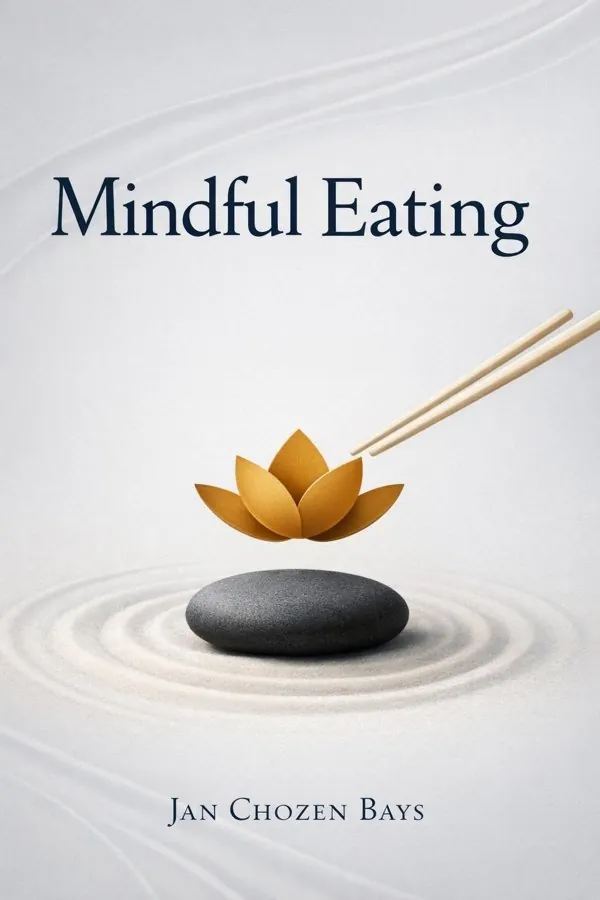
Mindful Eating: A Guide to Rediscovering a Healthy and Joyful Relationship with Food: Summary & Key Insights
 10 min6 chaptersAudio available
What Is Mindful Eating: A Guide to Rediscovering a Healthy and Joyful Relationship with Food About?
Mindful Eating: A Guide to Rediscovering a Healthy and Joyful Relationship with Food by Jan Chozen Bays is a wellness book spanning 6 pages. This book introduces the practice of mindful eating, helping readers reconnect with their natural cues for hunger and fullness. Drawing on Buddhist mindfulness principles, physician and Zen teacher Jan Chozen Bays offers practical exercises and meditations to cultivate awareness, reduce overeating, and restore a balanced relationship with food.
This FizzRead summary covers all 6 key chapters of Mindful Eating: A Guide to Rediscovering a Healthy and Joyful Relationship with Food in approximately 10 minutes, distilling the most important ideas, arguments, and takeaways from Jan Chozen Bays's work. Also available as an audio summary and Key Quotes Podcast.
Mindful Eating: A Guide to Rediscovering a Healthy and Joyful Relationship with Food
This book introduces the practice of mindful eating, helping readers reconnect with their natural cues for hunger and fullness. Drawing on Buddhist mindfulness principles, physician and Zen teacher Jan Chozen Bays offers practical exercises and meditations to cultivate awareness, reduce overeating, and restore a balanced relationship with food.
Who Should Read Mindful Eating: A Guide to Rediscovering a Healthy and Joyful Relationship with Food?
This book is perfect for anyone interested in wellness and looking to gain actionable insights in a short read. Whether you're a student, professional, or lifelong learner, the key ideas from Mindful Eating: A Guide to Rediscovering a Healthy and Joyful Relationship with Food by Jan Chozen Bays will help you think differently.
- ✓Readers who enjoy wellness and want practical takeaways
- ✓Professionals looking to apply new ideas to their work and life
- ✓Anyone who wants the core insights of Mindful Eating: A Guide to Rediscovering a Healthy and Joyful Relationship with Food in just 10 minutes
Want the full summary?
Get instant access to this book summary and 100K+ more with Fizz Moment.
Get Free SummaryAvailable on App Store • Free to download
Key Chapters
When we speak of mindfulness, we refer to a way of being that is rooted in awareness—a gentle noticing of what is happening in the present moment without judgment. In mindfulness practice, we train ourselves to observe sensations, thoughts, and emotions as they arise and pass, learning to respond with clarity rather than react out of habit. Eating, which touches every sense, offers a perfect laboratory for cultivating this awareness.
Most people approach food mechanically. We reach for snacks because they are available or eat entire meals while absorbed in conversation or television. The result is that we miss the experience itself—the colors, the aromas, the textures, and even the body’s signals. This disconnection deepens over time, becoming the seed of overeating, guilt, and dissatisfaction. When we apply mindfulness, the act of eating transforms. Awareness slows us down. It brings us face-to-face with the simple wonders of nourishment: the fragrance of an apple, the weight of a spoon, the warmth that spreads after the first sip of tea.
Practicing mindfulness while eating means taking time to breathe, to look, to taste, and to be curious. It means noticing the moment your body begins to want food and the moment it sighs with fullness. In doing so, you discover how the mind influences the body and vice versa. You’ll begin to see that many times hunger arises not from the stomach, but from emotional or mental restlessness. By cultivating presence, you learn to pause and ask: what am I truly hungry for right now? This question lies at the heart of healing your relationship with food.
As I share in the book, mindfulness can be practiced through meditation and daily awareness exercises: feeling the hands lift food to the mouth, observing the rhythm of chewing, sensing textures dissolve. It is not a rigid technique but a doorway into intimacy with life. When you begin to eat mindfully, meals turn from consumption into communion—between the body and the planet, between self and sustenance.
One of the most transformative insights in mindful eating is the understanding that hunger is not singular. We often assume that we eat purely because our stomach is empty, but in truth, the body and mind experience multiple forms of yearning. I call these the seven types of hunger: eye, nose, mouth, stomach, cellular, mind, and heart hunger. Each has its own unique voice, and part of the practice is learning to listen to them.
Eye hunger is awakened by the appearance of food. Beautiful colors and arrangements draw us in even when we are not physically hungry. You can notice this when you pass a bakery window or scroll through food photographs online. Nose hunger, on the other hand, is stirred by aroma—the smell of coffee brewing or bread toasting evokes strong desire. Mouth hunger relates to taste preferences, the yearning for textures or flavors that stimulate pleasure. These sensory hungers remind us that eating is a full-bodied experience involving sight, smell, and taste.
Stomach hunger is more subtle but deeply physical—the hollow sensation, the quiet contraction that signals your body’s need for nourishment. Cellular hunger operates on an even deeper level; it is the body’s innate wisdom calling for specific nutrients, sometimes expressed as cravings. Then there is mind hunger, born from thoughts and beliefs—ideas about what we should or shouldn’t eat, about dieting, health, or control. Finally, heart hunger expresses emotional needs—the longing for love, comfort, or connection that we sometimes try to fill with food.
Understanding these seven hungers offers freedom. It enables you to differentiate physical need from psychological desire. Instead of judging cravings, you can approach them with gentle curiosity. When you pause to ask, "Which hunger is speaking right now?" you begin to meet yourself with kindness. Perhaps you realize that eye hunger was stimulated by a glossy advertisement, or that heart hunger needs companionship rather than dessert. Such awareness transforms eating from automatic behavior into compassionate inquiry. The deeper your understanding of hunger’s many faces, the more naturally balance emerges.
+ 4 more chapters — available in the FizzRead app
All Chapters in Mindful Eating: A Guide to Rediscovering a Healthy and Joyful Relationship with Food
About the Author
Jan Chozen Bays, M.D., is a pediatrician and Zen teacher (Roshi) in the White Plum lineage. She co-founded the Great Vow Zen Monastery in Oregon and has written extensively on mindfulness in daily life, including mindful eating and compassionate awareness.
Get This Summary in Your Preferred Format
Read or listen to the Mindful Eating: A Guide to Rediscovering a Healthy and Joyful Relationship with Food summary by Jan Chozen Bays anytime, anywhere. FizzRead offers multiple formats so you can learn on your terms — all free.
Available formats: App · Audio · PDF · EPUB — All included free with FizzRead
Download Mindful Eating: A Guide to Rediscovering a Healthy and Joyful Relationship with Food PDF and EPUB Summary
Key Quotes from Mindful Eating: A Guide to Rediscovering a Healthy and Joyful Relationship with Food
“When we speak of mindfulness, we refer to a way of being that is rooted in awareness—a gentle noticing of what is happening in the present moment without judgment.”
“One of the most transformative insights in mindful eating is the understanding that hunger is not singular.”
Frequently Asked Questions about Mindful Eating: A Guide to Rediscovering a Healthy and Joyful Relationship with Food
Mindful Eating: A Guide to Rediscovering a Healthy and Joyful Relationship with Food by Jan Chozen Bays is a wellness book that explores key ideas across 6 chapters. This book introduces the practice of mindful eating, helping readers reconnect with their natural cues for hunger and fullness. Drawing on Buddhist mindfulness principles, physician and Zen teacher Jan Chozen Bays offers practical exercises and meditations to cultivate awareness, reduce overeating, and restore a balanced relationship with food.
You Might Also Like

How We Heal: Uncover Your Power and Set Yourself Free
Alexandra Elle
10 min
A Year of Self-Care: Daily Practices and Inspiration for Caring for Yourself
Zoe Shaw
10 min
Biohacker’s Handbook: Upgrade Your Life
Olli Sovijärvi, Teemu Arina, Jaakko Halmetoja
10 min
Bliss More: How to Succeed in Meditation Without Really Trying
Light Watkins
10 min
Body Kindness: Transform Your Health from the Inside Out—and Never Say Diet Again
Rebecca Scritchfield
10 min
Cook, Eat, Run: Cook Fast, Boost Performance with 75 Ultimate Recipes for Runners
Charlie Watson
10 minBrowse by Category
Ready to read Mindful Eating: A Guide to Rediscovering a Healthy and Joyful Relationship with Food?
Get the full summary and 100K+ more books with Fizz Moment.