
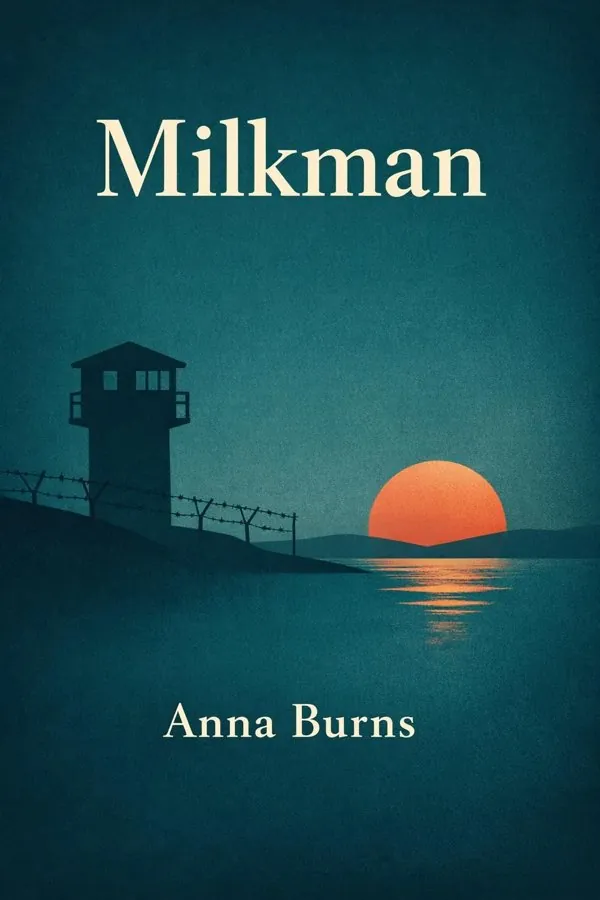
Milkman: Summary & Key Insights
by Anna Burns
 10 min9 chaptersAudio available
Key Takeaways from Milkman
One of the novel’s deepest insights is that in oppressive societies, identity itself can become dangerous.
Predators often gain power not by dramatic force at first, but by making their presence feel unavoidable.
In Milkman, gossip is not small talk.
The novel’s world is frightening not simply because it contains violence, but because observation has become continuous.
A crucial insight of Milkman is that danger for women often hides inside what others call normal.
What Is Milkman About?
Milkman by Anna Burns is a bestsellers book spanning 7 pages. Anna Burns’s Milkman is a novel about harassment, fear, and social control disguised as ordinary life. Set in an unnamed city in Northern Ireland during the Troubles, it follows an eighteen-year-old woman known only as middle sister, whose attempt to stay unnoticed collapses when an older paramilitary figure called Milkman begins pursuing her. What makes the book extraordinary is that the threat does not arrive through dramatic confrontations alone. It spreads through rumor, insinuation, surveillance, and the community’s habit of turning private vulnerability into public judgment. Burns shows how a society shaped by conflict teaches people to police one another, especially women, and how language itself becomes warped under pressure. Milkman matters because it captures what life feels like inside a culture of fear: the exhaustion, the absurdity, the self-censorship, and the way danger becomes normal. Burns, who was born in Belfast and has written powerfully about Northern Ireland’s social and psychological landscapes, brings unusual authority to this world. Winner of the 2018 Booker Prize, the novel is both politically specific and universally resonant, offering a sharp, unsettling portrait of what happens when communities confuse control with protection.
This FizzRead summary covers all 9 key chapters of Milkman in approximately 10 minutes, distilling the most important ideas, arguments, and takeaways from Anna Burns's work. Also available as an audio summary and Key Quotes Podcast.
Milkman
Anna Burns’s Milkman is a novel about harassment, fear, and social control disguised as ordinary life. Set in an unnamed city in Northern Ireland during the Troubles, it follows an eighteen-year-old woman known only as middle sister, whose attempt to stay unnoticed collapses when an older paramilitary figure called Milkman begins pursuing her. What makes the book extraordinary is that the threat does not arrive through dramatic confrontations alone. It spreads through rumor, insinuation, surveillance, and the community’s habit of turning private vulnerability into public judgment. Burns shows how a society shaped by conflict teaches people to police one another, especially women, and how language itself becomes warped under pressure.
Milkman matters because it captures what life feels like inside a culture of fear: the exhaustion, the absurdity, the self-censorship, and the way danger becomes normal. Burns, who was born in Belfast and has written powerfully about Northern Ireland’s social and psychological landscapes, brings unusual authority to this world. Winner of the 2018 Booker Prize, the novel is both politically specific and universally resonant, offering a sharp, unsettling portrait of what happens when communities confuse control with protection.
Who Should Read Milkman?
This book is perfect for anyone interested in bestsellers and looking to gain actionable insights in a short read. Whether you're a student, professional, or lifelong learner, the key ideas from Milkman by Anna Burns will help you think differently.
- ✓Readers who enjoy bestsellers and want practical takeaways
- ✓Professionals looking to apply new ideas to their work and life
- ✓Anyone who wants the core insights of Milkman in just 10 minutes
Want the full summary?
Get instant access to this book summary and 100K+ more with Fizz Moment.
Get Free SummaryAvailable on App Store • Free to download
Key Chapters
One of the novel’s deepest insights is that in oppressive societies, identity itself can become dangerous. Milkman begins with a young woman who avoids naming herself and lives among people who are rarely called by conventional names. Instead, they are labeled by roles, gossip, and social position: middle sister, maybe-boyfriend, third brother-in-law. This is not merely a stylistic quirk. It reveals a world where individuality has been flattened by politics, tribal loyalties, and constant scrutiny.
The narrator’s community is tightly bounded by rules that everyone knows but few openly discuss. A person’s street, religion, family, and routines all carry political meaning. Even harmless choices can be interpreted as declarations of allegiance. Middle sister tries to carve out a small private space for herself through reading while walking, avoiding local dramas, and refusing to show enthusiasm for the roles expected of her. But in such a world, withdrawal is not seen as independence. It is seen as suspicious.
Burns shows that social pressure does not always appear as formal law or direct violence. Often it is embedded in everyday assumptions: how a young woman should behave, whom she should notice, what counts as loyalty, and what forms of eccentricity are tolerated. The narrator’s “narrow world” is narrow not because she lacks intelligence, but because every avenue of self-definition is watched.
This idea has broad application beyond the novel. In workplaces, families, and online communities, people are often reduced to labels before they are understood. Once a label sticks, it shapes how everything they do is interpreted. Milkman asks us to notice how often social environments punish nuance.
Actionable takeaway: Pay attention to the labels your community assigns people, including yourself, and ask whether those labels reveal reality or merely enforce conformity.
Predators often gain power not by dramatic force at first, but by making their presence feel unavoidable. That is how Milkman enters the narrator’s life. He is older, influential, rumored to be dangerous, and connected to paramilitary power. He does not begin with a direct assault. Instead, he appears beside her while she walks, knows details about her life he should not know, and speaks with unnerving confidence about her future. His menace lies in his calm assumption of access.
What makes these encounters so disturbing is their ambiguity. Milkman does not need to state every threat aloud. The narrator understands that his knowledge, status, and persistence are enough. Burns brilliantly captures the psychology of coercion: the victim senses danger long before the surrounding world is willing to acknowledge it. Because the behavior has not yet become conventionally dramatic, others can dismiss it as misunderstanding, flattery, or gossip.
This pattern is painfully recognizable in real life. Harassment often begins with repeated appearances, implied intimacy, strategic familiarity, or comments that signal possession. The target may feel alarmed, but because the conduct exists in a gray area, she struggles to prove what is happening. Abusers benefit from that uncertainty.
Burns also exposes the extra burden placed on victims. Middle sister must not only manage Milkman’s advances, but also calculate how to avoid provoking him, how to describe him, and whether anyone will believe her without blaming her. The emotional labor of self-protection becomes relentless.
Actionable takeaway: Trust patterns, not just dramatic incidents. If someone repeatedly crosses boundaries, gathers personal knowledge without consent, or creates a climate of fear, take the behavior seriously early.
In Milkman, gossip is not small talk. It is a governing force. Once the community begins to suspect that middle sister is involved with Milkman, rumor transforms her reality faster than facts ever could. She has not chosen him, welcomed him, or encouraged him, yet the story others tell about her becomes more powerful than her own account. Burns shows how communities under strain often rely on speculation as a form of social order: rumor identifies insiders and outsiders, punishes deviation, and fills the gaps left by fear.
The narrator becomes trapped in a narrative she did not author. People look at her differently, relatives become tense, and ordinary actions take on scandalous meaning. This is one of the novel’s most chilling points: reputational violence can precede and amplify physical danger. A woman marked by rumor can become isolated, less credible, and more vulnerable precisely when she most needs support.
The community’s gaze also reveals how collective fear distorts moral judgment. Because Milkman is powerful and potentially violent, many people prefer to manage appearances rather than confront reality. It is easier to scrutinize the young woman than to challenge the dangerous man. That dynamic remains common in many settings, from schools to offices to public life. People often police the target’s behavior because addressing the source of harm feels risky.
Burns invites readers to ask how often we participate in similar systems. Sharing assumptions, interpreting silence as proof, or repeating unverified claims may seem trivial, yet such acts can reshape a person’s social standing and emotional safety.
Actionable takeaway: Refuse to amplify rumors, especially about vulnerable people. Ask what evidence exists, who benefits from the story, and whether your curiosity is contributing to someone else’s harm.
The novel’s world is frightening not simply because it contains violence, but because observation has become continuous. Milkman portrays a society in which everyone watches everyone else: neighbors monitor routines, communities notice affiliations, and political factions read private behavior for hidden meaning. Surveillance is not limited to the state or armed groups. It is woven into ordinary social life.
This matters because surveillance changes people from the inside. Middle sister does not just fear what others may do; she begins to manage how she walks, reads, speaks, and appears. Her mental space narrows as she anticipates interpretation. Burns demonstrates that constant observation creates self-censorship. People do not need to be punished every time. The possibility of punishment is enough to shape behavior.
The novel’s setting during the Troubles gives this theme political urgency, but its relevance extends far beyond that historical moment. Many modern readers will recognize similar pressures in digital culture, workplace monitoring, neighborhood scrutiny, and identity-based polarization. When every action can be recorded, interpreted, and judged, authenticity becomes risky. People begin living defensively.
Burns also highlights a paradox: surveillance is often justified as protection. Communities claim they are watching for safety, loyalty, or propriety. Yet the result is not security but suffocation. Real protection would require trust, accountability, and care. Surveillance produces suspicion instead.
In practical terms, this idea encourages us to think about the climates we create. Do we ask questions out of care or out of control? Do institutions build spaces where people can speak honestly, or do they reward performance and conformity? The answers shape how safe people feel.
Actionable takeaway: Examine where constant monitoring exists in your life and reduce unnecessary scrutiny. Privacy is not secrecy; it is a condition that allows dignity, trust, and independent thought.
A crucial insight of Milkman is that danger for women often hides inside what others call normal. Middle sister’s experience is not treated by her community as a straightforward case of stalking and coercion. Instead, it becomes entangled with judgments about femininity, desirability, reputation, and obedience. Burns shows how patriarchal cultures often interpret male pursuit as natural while treating female discomfort as overreaction, vanity, or guilt.
Milkman’s power is gendered in multiple ways. He benefits from age, political status, masculine authority, and the social expectation that women should manage male attention carefully rather than reject it openly. Middle sister, meanwhile, is forced into impossible calculations. If she resists too bluntly, she risks retaliation. If she remains silent, that silence can be misread as encouragement. If she tries to explain the situation, she may be blamed for attracting it.
This is one of the novel’s most enduring achievements: it depicts harassment not as an isolated personal problem, but as a social system supported by habits of thought. Women are expected to anticipate danger, preserve appearances, and absorb the emotional cost of male aggression. Communities often respond by asking whether a woman sent the wrong signals instead of asking why a man felt entitled to pursue her.
Readers can apply this insight widely. In professional settings, schools, and families, power imbalances often make boundary violations difficult to name. The person with less authority may appear passive from the outside while actually making constant survival decisions.
Burns asks for a more intelligent form of listening: one that understands coercion, context, and unequal risk. It is not enough to ask whether someone explicitly said no. We must ask what conditions made real refusal dangerous.
Actionable takeaway: When evaluating troubling behavior, focus less on whether the target resisted perfectly and more on the power imbalance that made resistance costly.
One of the novel’s subtler strengths is its attention to what happens after fear has altered a person’s life. Milkman is not a neat story of violation followed by triumph. Instead, Burns explores aftermath as a messy process of partial recognition. Middle sister begins to understand more clearly what has happened to her, but that understanding does not erase the confusion, shame, or social complexity surrounding it.
This matters because literature often compresses recovery into dramatic resolution. Burns does the opposite. She suggests that awakening is uneven. A person may recognize coercion intellectually before they can feel its full emotional meaning. They may leave one danger while still carrying its habits of caution and self-doubt. Communities, meanwhile, may move on without fully confronting their role.
Yet the novel is not hopeless. There are moments in which the narrator sees more sharply how power has operated around her. This shift matters. Naming a pattern, even imperfectly, is a step toward freedom. Awareness does not instantly transform conditions, but it changes the internal story from self-blame to clearer perception.
The idea is widely applicable. After difficult experiences, people often expect themselves to “be over it” once the worst has passed. Burns reminds us that recovery may instead involve learning to reinterpret the past, reclaiming one’s own account, and finding room for complexity. Growth can begin not with certainty, but with the refusal to accept the false narratives imposed by others.
For readers, this section of the novel offers a realistic framework for healing: not dramatic reinvention, but gradual reorientation. It values honesty over closure.
Actionable takeaway: After a harmful experience, give yourself permission to understand it in stages. Clarity often arrives gradually, and reclaiming your own narrative is part of recovery.
Milkman demonstrates that language is never neutral in a fearful society. The novel’s unusual style, with its long sentences, evasions, and refusal of many proper names, mirrors a world where direct speech is risky. People talk around things, imply rather than state, and rely on coded expressions shaped by politics and fear. Burns makes form carry meaning: the reader feels the strain of navigating reality without stable, honest language.
This stylistic choice reveals an important truth. When communities cannot speak plainly about power, violence, or desire, confusion becomes normal. Silence is not empty; it is structured by what people are afraid to name. In middle sister’s world, naming the wrong thing too directly could invite danger, judgment, or misunderstanding. As a result, language becomes both shield and prison.
The novel also shows how distorted language protects abuse. If harassment is described as attention, intimidation as interest, and coercion as rumor, then harm remains socially manageable rather than morally urgent. Many readers will recognize this pattern in modern euphemisms that soften exploitation or obscure responsibility.
At the same time, Burns does not present speech as simple liberation. Words can wound, mislead, and circulate falsehood. The challenge is not merely to speak more, but to speak more truthfully and courageously. Honest language requires conditions in which truth can be heard without immediate punishment.
In daily life, this theme encourages closer attention to the words used in tense situations. Are we clarifying reality or blurring it? Are our phrases protecting the vulnerable or preserving comfort for the powerful? Often the answer lies in what remains unsaid.
Actionable takeaway: Notice euphemisms that minimize harm. Replace vague, distorted language with clear descriptions that accurately name behavior, responsibility, and impact.
Perhaps the novel’s most universal question is how to protect an inner life when the outer world demands constant allegiance. Middle sister is not trying to become a hero or a rebel. She wants something both modest and radical: room to think, read, and exist without being consumed by the agendas around her. Milkman suggests that in polarized societies, even this desire for private freedom can be treated as suspicious.
Burns is especially sharp on the way conflict colonizes everyday life. Politics does not remain in speeches or armed struggle; it reaches into romance, exercise, reading habits, friendships, and family expectations. The narrator’s wish to stay outside communal dramas is interpreted not as neutrality, but as abnormality. This is a powerful insight for any era of polarization. When belonging depends on visible performance, independent thought can look like betrayal.
The novel therefore offers a defense of interiority. Private interests, solitary reflection, and refusal to participate in social frenzy are not signs of disengagement. They can be forms of survival and resistance. To preserve an inner self amid ideological pressure is to maintain a zone not fully captured by fear.
This idea has practical relevance today. In workplaces, online discourse, and politicized social environments, people are often pushed to display immediate positions, react publicly, and join collective moods. Milkman reminds us that not every silence is complicity and not every refusal is indifference. Sometimes the most important work is protecting the mental space required for judgment.
Still, the novel also warns that private freedom is fragile unless communities make room for it. Solitude should not require secrecy.
Actionable takeaway: Deliberately protect spaces in your life for reading, reflection, and unperformed thought. Inner freedom is easier to lose than we think, and worth defending.
All Chapters in Milkman
About the Author
Anna Burns is a Northern Irish writer born in Belfast in 1962. She grew up during the Troubles, an experience that deeply informs her fiction’s attention to fear, sectarian pressure, and the psychological texture of everyday life under conflict. Burns is known for her daring narrative style, dark wit, and ability to portray how politics enters the most intimate parts of human experience. Before achieving international fame with Milkman, she published novels including No Bones, Little Constructions, and Mostly Hero. Milkman won the 2018 Booker Prize and established her as one of the most distinctive voices in contemporary literature. Her work is widely praised for blending formal originality with sharp social observation, especially around gender, violence, class, and communal control.
Get This Summary in Your Preferred Format
Read or listen to the Milkman summary by Anna Burns anytime, anywhere. FizzRead offers multiple formats so you can learn on your terms — all free.
Available formats: App · Audio · PDF · EPUB — All included free with FizzRead
Download Milkman PDF and EPUB Summary
Key Quotes from Milkman
“One of the novel’s deepest insights is that in oppressive societies, identity itself can become dangerous.”
“Predators often gain power not by dramatic force at first, but by making their presence feel unavoidable.”
“The novel’s world is frightening not simply because it contains violence, but because observation has become continuous.”
“A crucial insight of Milkman is that danger for women often hides inside what others call normal.”
“Psychological harm often becomes visible only after it has already reshaped a person’s life.”
Frequently Asked Questions about Milkman
Milkman by Anna Burns is a bestsellers book that explores key ideas across 9 chapters. Anna Burns’s Milkman is a novel about harassment, fear, and social control disguised as ordinary life. Set in an unnamed city in Northern Ireland during the Troubles, it follows an eighteen-year-old woman known only as middle sister, whose attempt to stay unnoticed collapses when an older paramilitary figure called Milkman begins pursuing her. What makes the book extraordinary is that the threat does not arrive through dramatic confrontations alone. It spreads through rumor, insinuation, surveillance, and the community’s habit of turning private vulnerability into public judgment. Burns shows how a society shaped by conflict teaches people to police one another, especially women, and how language itself becomes warped under pressure. Milkman matters because it captures what life feels like inside a culture of fear: the exhaustion, the absurdity, the self-censorship, and the way danger becomes normal. Burns, who was born in Belfast and has written powerfully about Northern Ireland’s social and psychological landscapes, brings unusual authority to this world. Winner of the 2018 Booker Prize, the novel is both politically specific and universally resonant, offering a sharp, unsettling portrait of what happens when communities confuse control with protection.
You Might Also Like

The Godfather
Mario Puzo
10 min
The Handmaid's Tale
Margaret Atwood
10 min
The Hunger Games
Suzanne Collins
10 min
The Nightingale
Kristin Hannah
10 min
The Seven Husbands of Evelyn Hugo
Taylor Jenkins Reid
10 min
Backwater Justice
Fern Michaels
10 minBrowse by Category
Ready to read Milkman?
Get the full summary and 100K+ more books with Fizz Moment.