
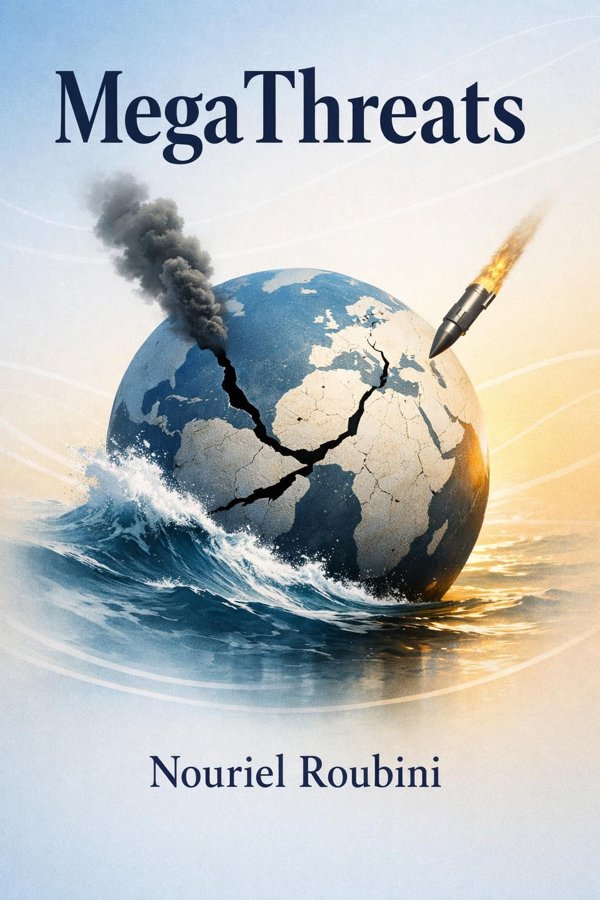
MegaThreats: Ten Dangerous Trends That Imperil Our Future, and How to Survive Them: Summary & Key Insights
 10 min12 chaptersAudio available
What Is MegaThreats: Ten Dangerous Trends That Imperil Our Future, and How to Survive Them About?
MegaThreats: Ten Dangerous Trends That Imperil Our Future, and How to Survive Them by Nouriel Roubini is a economics book spanning 12 pages. MegaThreats is an urgent and incisive analysis of the ten most serious global risks threatening the world economy and society, written by economist Nouriel Roubini. Drawing on decades of experience predicting financial crises, Roubini explores interconnected dangers such as debt crises, inflation, climate change, geopolitical conflict, and technological disruption. The book offers a sobering look at how these forces could converge to destabilize global prosperity and suggests strategies for resilience and survival.
This FizzRead summary covers all 12 key chapters of MegaThreats: Ten Dangerous Trends That Imperil Our Future, and How to Survive Them in approximately 10 minutes, distilling the most important ideas, arguments, and takeaways from Nouriel Roubini's work. Also available as an audio summary and Key Quotes Podcast.
MegaThreats: Ten Dangerous Trends That Imperil Our Future, and How to Survive Them
MegaThreats is an urgent and incisive analysis of the ten most serious global risks threatening the world economy and society, written by economist Nouriel Roubini. Drawing on decades of experience predicting financial crises, Roubini explores interconnected dangers such as debt crises, inflation, climate change, geopolitical conflict, and technological disruption. The book offers a sobering look at how these forces could converge to destabilize global prosperity and suggests strategies for resilience and survival.
Who Should Read MegaThreats: Ten Dangerous Trends That Imperil Our Future, and How to Survive Them?
This book is perfect for anyone interested in economics and looking to gain actionable insights in a short read. Whether you're a student, professional, or lifelong learner, the key ideas from MegaThreats: Ten Dangerous Trends That Imperil Our Future, and How to Survive Them by Nouriel Roubini will help you think differently.
- ✓Readers who enjoy economics and want practical takeaways
- ✓Professionals looking to apply new ideas to their work and life
- ✓Anyone who wants the core insights of MegaThreats: Ten Dangerous Trends That Imperil Our Future, and How to Survive Them in just 10 minutes
Want the full summary?
Get instant access to this book summary and 100K+ more with Fizz Moment.
Get Free SummaryAvailable on App Store • Free to download
Key Chapters
Few turning points reveal mankind’s economic fragility as powerfully as 2008. I watched that crisis build over years of debt expansion, speculative exuberance, and political denial. When the collapse came, it was not a surprise to anyone truly examining the data—it was a symptom of deeper disorders in the global financial architecture. History matters because crises rarely arrive unexplained; they accumulate from incentives that reward short-term gain and ignore long-term consequence. From the Great Depression to the Asian financial meltdown and the debt shocks of emerging markets, each era carries lessons that we repeatedly fail to heed.
My reflections on these past events are not nostalgia. They are diagnostic tools. In each instance, liquidity disguised insolvency, policy makers mistook leverage for prosperity, and societies confused financial innovation with real productivity. The resulting pattern—overindebtedness, moral hazard, inadequate regulation—remains intact today, only amplified by the scale of globalization. Our economic models often assume self-correcting markets, yet history shows markets magnify excess until external constraints intervene. Understanding these precedents reveals why the present mix of high debt, climate risk, political nationalism, and technological disruption is not an aberration but the logical evolution of old mistakes in a new environment.
If there is a core structural fault in today’s world economy, it is overindebtedness. Global debt—public and private—has surpassed levels once deemed unthinkable. After 2008, the medicine for collapse was more debt, administered through quantitative easing, fiscal stimulus, and record-low interest rates. What began as stabilization soon became dependence. Governments grew accustomed to borrowing against the future; corporations leveraged cheap credit for buybacks rather than innovation; households enjoyed consumption subsidized by artificial liquidity.
But debt accumulation has a biological quality—it grows silently until a threshold is crossed, and then systemic failure unfolds swiftly. We now stand at that threshold. Inflation has returned, forcing central banks to raise rates, thereby increasing the debt servicing cost for sovereigns, businesses, and homeowners alike. This dynamic is self-reinforcing: higher rates expose insolvency, lower growth worsens fiscal balances, and fiscal fragility erodes trust in global markets. Emerging economies face capital flight, while advanced nations struggle under entitlement obligations tied to aging populations.
In *MegaThreats*, I argue that our obsession with 'easy money' masked structural rot. Debt is not evil, but without productive investment it becomes parasitic. Financial instability does not arise because numbers are large; it arises because political will is small. Unless we rebuild fiscal responsibility, diversify real growth sources, and recognize the limits of monetary policy, the next debt crisis may eclipse 2008 not in drama but in scale.
+ 10 more chapters — available in the FizzRead app
All Chapters in MegaThreats: Ten Dangerous Trends That Imperil Our Future, and How to Survive Them
About the Author
Nouriel Roubini is an Iranian-American economist and professor emeritus at New York University’s Stern School of Business. Known as 'Dr. Doom' for his accurate prediction of the 2008 financial crisis, he has advised international institutions and governments on macroeconomic policy and global risk management.
Get This Summary in Your Preferred Format
Read or listen to the MegaThreats: Ten Dangerous Trends That Imperil Our Future, and How to Survive Them summary by Nouriel Roubini anytime, anywhere. FizzRead offers multiple formats so you can learn on your terms — all free.
Available formats: App · Audio · PDF · EPUB — All included free with FizzRead
Download MegaThreats: Ten Dangerous Trends That Imperil Our Future, and How to Survive Them PDF and EPUB Summary
Key Quotes from MegaThreats: Ten Dangerous Trends That Imperil Our Future, and How to Survive Them
“Few turning points reveal mankind’s economic fragility as powerfully as 2008.”
“If there is a core structural fault in today’s world economy, it is overindebtedness.”
Frequently Asked Questions about MegaThreats: Ten Dangerous Trends That Imperil Our Future, and How to Survive Them
MegaThreats: Ten Dangerous Trends That Imperil Our Future, and How to Survive Them by Nouriel Roubini is a economics book that explores key ideas across 12 chapters. MegaThreats is an urgent and incisive analysis of the ten most serious global risks threatening the world economy and society, written by economist Nouriel Roubini. Drawing on decades of experience predicting financial crises, Roubini explores interconnected dangers such as debt crises, inflation, climate change, geopolitical conflict, and technological disruption. The book offers a sobering look at how these forces could converge to destabilize global prosperity and suggests strategies for resilience and survival.
You Might Also Like
Business Adventures
John Brooks
10 min
Nudge
Richard H. Thaler, Cass R. Sunstein
10 min
The Hitchhiker"s Guide to the Galaxy
Douglas Adams
10 minThe Muqaddimah
Ibn Khaldun
10 minThe Outsiders
William N. Thorndike
10 min
A Little History of Economics
Niall Kishtainy
10 minBrowse by Category
Ready to read MegaThreats: Ten Dangerous Trends That Imperil Our Future, and How to Survive Them?
Get the full summary and 100K+ more books with Fizz Moment.