
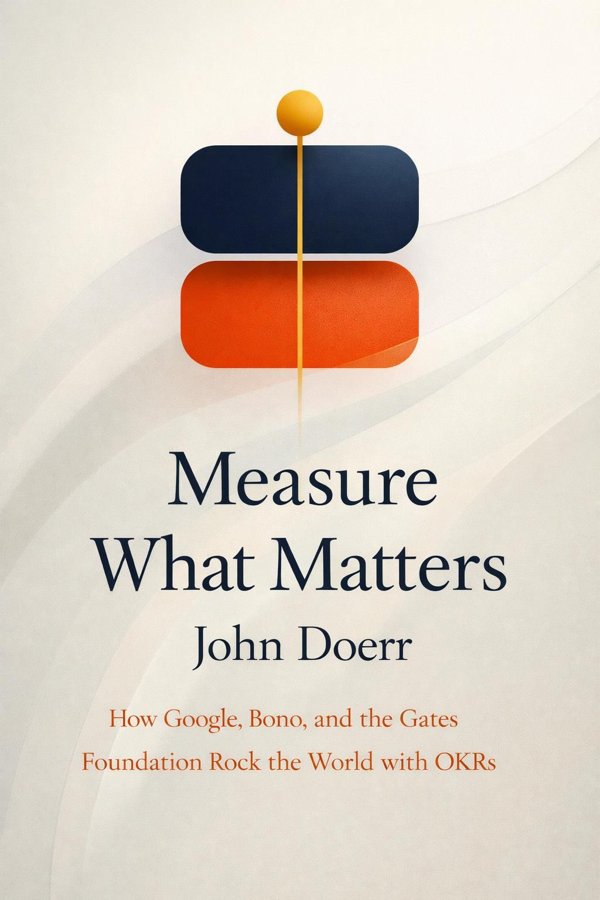
Measure What Matters: Summary & Key Insights
by John Doerr
 10 min8 chaptersAudio available
Key Takeaways from Measure What Matters
Ambition alone is not a strategy.
What you choose not to do often matters more than what you do.
People perform better when they can see how their work fits into the larger mission.
Great organizations do not only manage for predictability; they also create room for possibility.
A goal reviewed once a quarter is often a goal forgotten for most of the quarter.
What Is Measure What Matters About?
Measure What Matters by John Doerr is a business book. Measure What Matters by John Doerr is a practical guide to one of the most influential performance systems in modern business: Objectives and Key Results, better known as OKRs. The book explains how organizations can turn big ambitions into focused, measurable action by setting clear goals and tracking the outcomes that matter most. Rather than drowning teams in vague priorities, endless tasks, or vanity metrics, Doerr shows how OKRs create alignment, accountability, transparency, and momentum. What makes this book especially powerful is that it is not just theory. Doerr draws on his own experience as a legendary venture capitalist at Kleiner Perkins and as one of the early champions of OKRs in companies such as Google. Through case studies from startups, nonprofits, and major global organizations, he demonstrates how this simple framework can sharpen execution without crushing innovation. This book matters because many teams work hard without working toward the right things. Measure What Matters offers a disciplined way to connect ambition with results, helping leaders and individuals focus on what truly drives progress. It is a foundational read for anyone who wants to build a more effective, accountable, and purpose-driven organization.
This FizzRead summary covers all 8 key chapters of Measure What Matters in approximately 10 minutes, distilling the most important ideas, arguments, and takeaways from John Doerr's work. Also available as an audio summary and Key Quotes Podcast.
Measure What Matters
Measure What Matters by John Doerr is a practical guide to one of the most influential performance systems in modern business: Objectives and Key Results, better known as OKRs. The book explains how organizations can turn big ambitions into focused, measurable action by setting clear goals and tracking the outcomes that matter most. Rather than drowning teams in vague priorities, endless tasks, or vanity metrics, Doerr shows how OKRs create alignment, accountability, transparency, and momentum.
What makes this book especially powerful is that it is not just theory. Doerr draws on his own experience as a legendary venture capitalist at Kleiner Perkins and as one of the early champions of OKRs in companies such as Google. Through case studies from startups, nonprofits, and major global organizations, he demonstrates how this simple framework can sharpen execution without crushing innovation.
This book matters because many teams work hard without working toward the right things. Measure What Matters offers a disciplined way to connect ambition with results, helping leaders and individuals focus on what truly drives progress. It is a foundational read for anyone who wants to build a more effective, accountable, and purpose-driven organization.
Who Should Read Measure What Matters?
This book is perfect for anyone interested in business and looking to gain actionable insights in a short read. Whether you're a student, professional, or lifelong learner, the key ideas from Measure What Matters by John Doerr will help you think differently.
- ✓Readers who enjoy business and want practical takeaways
- ✓Professionals looking to apply new ideas to their work and life
- ✓Anyone who wants the core insights of Measure What Matters in just 10 minutes
Want the full summary?
Get instant access to this book summary and 100K+ more with Fizz Moment.
Get Free SummaryAvailable on App Store • Free to download
Key Chapters
Ambition alone is not a strategy. One of the central insights of Measure What Matters is that many organizations mistake aspiration for execution. They talk about becoming the best, growing faster, or serving customers better, but they do not define what success actually looks like. As a result, teams stay busy, yet progress remains unclear. John Doerr argues that goals must be paired with measurable outcomes if they are to drive meaningful change.
This is where OKRs become powerful. An Objective defines what you want to achieve. It should be clear, significant, and motivating. Key Results define how you will know you are getting there. They are specific, time-bound, and measurable. For example, a company objective might be to improve customer loyalty. The key results could include raising renewal rates from 70 percent to 82 percent, reducing customer response time to under two hours, and increasing Net Promoter Score by ten points. The objective inspires action; the key results create discipline.
Doerr shows that this distinction solves a common leadership problem. People often commit to broad goals, but without measurable checkpoints, they cannot make good decisions, prioritize effectively, or learn from failure. Measurable key results turn strategy into a living system. Teams can quickly see what is working, where they are off track, and what needs adjustment.
The concept also applies beyond large companies. A manager could set an objective to build a stronger team culture, then define key results around retention, employee survey scores, and completion of one-on-one meetings. A student could aim to improve academic performance, then track grades, study hours, and assignment completion.
Actionable takeaway: For every important goal, write one inspiring objective and two to five measurable key results that clearly prove whether progress is happening.
What you choose not to do often matters more than what you do. Doerr emphasizes that OKRs are not meant to produce longer wish lists. Their purpose is to force focus. In a world of constant distractions, competing priorities, and overflowing calendars, the organizations that win are often the ones that concentrate their energy on a few critical outcomes.
A well-designed OKR system limits the number of objectives and key results. This constraint is not a weakness; it is the source of its strength. When leaders try to prioritize everything, they end up prioritizing nothing. Teams become overwhelmed, execution slows down, and people lose sight of what really matters. By contrast, a handful of carefully selected OKRs creates clarity. Everyone understands the top goals and can align daily work around them.
Doerr points to companies like Google, where OKRs helped fast-growing teams stay coherent while scaling. Instead of chasing dozens of disconnected initiatives, teams focused on a small set of outcomes tied to the company’s larger mission. This made decision-making faster and trade-offs easier. If a new project did not support the quarter’s OKRs, it likely did not deserve resources.
This idea is equally valuable for small teams and individuals. A marketing department, for example, might be tempted to improve social media, email, branding, events, advertising, and analytics all at once. OKRs would force the team to identify the two or three outcomes that would create the greatest impact now. An individual professional can use the same approach by choosing one career objective and a few measurable milestones rather than scattering effort across too many ambitions.
Actionable takeaway: Cut your current priorities down to the few outcomes that would make the biggest difference this quarter, and let those goals guide what receives time, money, and attention.
People perform better when they can see how their work fits into the larger mission. A major idea in Measure What Matters is that OKRs are most effective when they are transparent across the organization. Instead of goals being hidden inside executive meetings or private performance documents, they are shared openly so that teams can understand one another’s priorities and connect their efforts.
Transparency solves several common organizational problems. First, it reduces duplication. When teams can see what others are trying to accomplish, they are less likely to work on overlapping or conflicting initiatives. Second, it improves collaboration. If engineering sees the sales team’s goals, or operations understands marketing’s priorities, they can coordinate earlier and better. Third, transparency boosts accountability. Public goals are harder to ignore, and progress becomes easier to discuss honestly.
Doerr argues that alignment should not mean top-down control. In a healthy OKR system, some goals come from leadership to express strategic direction, while others are created by teams and individuals closer to the work. This balance allows organizations to stay coordinated without becoming rigid. Employees are not merely following orders; they are contributing visibly to shared outcomes.
Consider a product company launching a new feature. If the product team’s objective is visible to customer support, sales, and marketing, each team can set complementary key results. Support prepares training materials, sales develops messaging, and marketing plans adoption campaigns. Visibility turns separate departments into one coordinated effort.
This principle also helps in smaller environments. Even a five-person team benefits when everyone knows the weekly and quarterly goals of every other member. Clarity reduces assumptions and strengthens trust.
Actionable takeaway: Make goals visible across your team or organization, and regularly discuss how each person’s OKRs connect to broader company priorities.
Great organizations do not only manage for predictability; they also create room for possibility. Doerr highlights the role of stretch goals in pushing teams beyond incremental improvement. While some targets are committed and must be achieved, others are aspirational. These are ambitious OKRs designed to challenge assumptions, inspire innovation, and encourage people to pursue results they might otherwise consider unrealistic.
The value of stretch goals lies in how they change behavior. When goals are too easy, people optimize around comfort and routine. When goals are demanding but meaningful, they think differently. They question old processes, seek new tools, and collaborate more creatively. A team asked to improve conversion rates by 2 percent might make minor tweaks. A team challenged to double conversion rates is more likely to redesign the customer journey entirely.
Doerr is careful to note that stretch goals require context. If every target is treated as a must-hit commitment, ambitious goals can create fear, distortion, or burnout. Teams may game the numbers or avoid bold ideas. That is why leaders must distinguish clearly between committed OKRs and aspirational OKRs. Missing a stretch target is not necessarily failure if it drives learning, innovation, or major progress.
This distinction matters in practice. A startup might set a committed OKR to maintain service uptime above 99.9 percent while also setting a stretch OKR to reduce customer onboarding time by 80 percent. The first protects the business. The second pushes transformation. Individuals can do this too, such as maintaining current client relationships while ambitiously expanding into a new market segment.
Actionable takeaway: Pair essential operational goals with one or two ambitious stretch OKRs that encourage your team to think bigger, experiment more, and pursue breakthrough results.
A goal reviewed once a quarter is often a goal forgotten for most of the quarter. One of Doerr’s most practical lessons is that OKRs work only when they are actively tracked. Setting objectives is the beginning, not the system itself. Real performance improvement comes from frequent check-ins, visible scorekeeping, and honest conversations about progress.
Doerr introduces the idea of regular OKR reviews, often weekly or biweekly, to keep goals alive. These check-ins are not meant to become bureaucratic reporting exercises. Their purpose is to help teams learn quickly, remove obstacles, and make adjustments while there is still time to improve outcomes. If a key result is off track, the team should ask why. Is the metric wrong? Is the strategy ineffective? Are resources missing? Progress tracking turns goals into a management rhythm rather than a yearly ritual.
The emphasis on measurable scorekeeping is especially important. Vague updates such as “making progress” or “doing well” hide reality. Numeric indicators reveal whether momentum is real. For example, if a recruiting team’s key result is to reduce time-to-hire from 45 days to 30 days, weekly tracking quickly shows whether the process is improving or stalling. That enables intervention before the quarter is lost.
This habit also changes culture. Teams become more data-informed, more responsive, and more open to learning. Instead of defending effort, they discuss outcomes. Instead of waiting for annual reviews, they solve problems in real time.
Even individuals can use this principle by reviewing goals every week. A writer tracking chapters completed, submissions sent, or hours spent in focused work will improve faster than one who relies on intention alone.
Actionable takeaway: Build a recurring review cadence for your goals, use visible metrics, and treat every check-in as a chance to diagnose obstacles and improve execution.
No goal system succeeds in a toxic culture. Measure What Matters makes clear that OKRs are not a mechanical tool that can fix deeper organizational dysfunction on their own. They work best in environments where trust, candor, and purpose already exist or are actively being built. In fact, OKRs can expose cultural weaknesses by making commitments, collaboration, and results more visible.
Doerr connects OKRs to what he calls continuous performance management and broader organizational health. If employees fear punishment, they may hide problems instead of surfacing them early. If leaders hoard information, transparency will feel unsafe. If the culture prizes activity over outcomes, key results will be reduced to superficial reporting. For OKRs to drive high performance, the workplace must encourage open dialogue, shared learning, and mutual accountability.
The book’s examples show that strong cultures use goals to reinforce values. A mission-driven nonprofit may use OKRs to ensure limited resources stay aligned with impact. A growing tech company may use them to preserve agility as teams expand. In both cases, the framework supports culture by clarifying what matters and making progress visible.
Managers play a key role here. They should use OKRs not as weapons, but as conversation tools. A leader reviewing a missed key result should ask what was learned and what support is needed, not simply who is to blame. That approach builds trust and encourages honest reporting.
This lesson matters for teams of any size. A small business with transparent goals and respectful dialogue will often outperform a larger company trapped in politics and confusion.
Actionable takeaway: Before implementing or refining OKRs, strengthen the cultural conditions that support them: trust, openness, learning, and a shared commitment to outcomes over appearances.
When every metric becomes a pay negotiation, honest goal-setting disappears. One of Doerr’s important warnings is that OKRs should not be tightly tied to compensation. If bonuses, promotions, or job security depend too directly on hitting every key result, people will naturally lower ambition, sandbag targets, or manipulate data. The system then rewards caution instead of progress.
Doerr argues that OKRs are fundamentally a tool for focus, learning, and alignment. Their power comes from helping teams set meaningful goals and track what matters. If employees fear punishment for missing ambitious targets, they are likely to choose safe numbers rather than stretch goals. This undermines one of the framework’s greatest strengths: encouraging breakthrough thinking.
That does not mean performance should be ignored. Organizations still need evaluation systems. But those systems should consider a broader range of factors, including judgment, collaboration, initiative, and context. OKR outcomes can inform performance conversations, but they should not dictate them mechanically. A team that reaches 70 percent of a bold, strategically valuable target may have contributed more than one that reaches 100 percent of an easy one.
A practical example is a sales organization. If representatives know their OKRs will determine compensation directly, they may focus only on low-risk accounts or understate future potential to improve apparent success rates. If OKRs are used more as a developmental and strategic tool, they are more likely to pursue genuinely valuable growth.
For managers, this requires discipline. They must communicate clearly that OKRs are meant to support ambition and learning, not just judgment. That creates the psychological safety needed for honest reporting and creative effort.
Actionable takeaway: Use OKRs to guide focus and learning, but evaluate people through a broader performance lens so they feel safe setting ambitious, truthful goals.
A good management system should travel well. Although Measure What Matters includes famous examples from technology companies such as Google, one of its most useful messages is that OKRs are not limited to startups or Silicon Valley. The framework can work in nonprofits, schools, governments, manufacturing firms, and personal development, as long as goals are meaningful and metrics are chosen wisely.
Doerr shares stories that illustrate this range. Mission-driven organizations have used OKRs to sharpen social impact. Growth-stage companies have used them to scale without losing focus. Large enterprises have used them to reconnect strategy with execution. The reason the system adapts so broadly is simple: every organization needs clarity about what it is trying to achieve and how success will be measured.
The exact form of an OKR may vary by context. In a nonprofit, an objective might be to expand access to services for underserved communities, with key results tied to people reached, program completion rates, and funding secured. In a hospital, an objective might be to improve patient experience, with key results around wait times, satisfaction scores, and discharge follow-up. In education, a school leader could use OKRs to improve student literacy with measurable milestones tied to assessment outcomes and intervention participation.
Even individuals can benefit. A freelancer might set an objective to build a more resilient business, then track recurring clients, monthly revenue stability, and lead conversion. A family could even use simplified OKRs to align around shared savings or health goals.
The lesson is that OKRs are not about trendiness. They are about disciplined clarity. The framework succeeds when people identify what matters most and commit to measuring it honestly.
Actionable takeaway: Adapt OKRs to your own environment by defining one meaningful objective and a few measurable indicators that reflect real success in your context.
All Chapters in Measure What Matters
About the Author
John Doerr is an American venture capitalist, author, and former engineer best known for helping popularize the Objectives and Key Results framework. He began his career at Intel, where he was influenced by legendary CEO Andy Grove and the company’s disciplined approach to goal-setting and execution. Doerr later joined Kleiner Perkins, becoming one of Silicon Valley’s most respected investors. Over the years, he backed and advised major companies including Google, Amazon, and others that shaped the modern technology landscape. His experience working closely with founders and leadership teams gave him a front-row view of how clear goals can accelerate growth. In Measure What Matters, he combines investor insight, operating discipline, and practical storytelling to explain how OKRs can improve focus, accountability, and organizational performance.
Get This Summary in Your Preferred Format
Read or listen to the Measure What Matters summary by John Doerr anytime, anywhere. FizzRead offers multiple formats so you can learn on your terms — all free.
Available formats: App · Audio · PDF · EPUB — All included free with FizzRead
Download Measure What Matters PDF and EPUB Summary
Key Quotes from Measure What Matters
“One of the central insights of Measure What Matters is that many organizations mistake aspiration for execution.”
“What you choose not to do often matters more than what you do.”
“People perform better when they can see how their work fits into the larger mission.”
“Great organizations do not only manage for predictability; they also create room for possibility.”
“A goal reviewed once a quarter is often a goal forgotten for most of the quarter.”
Frequently Asked Questions about Measure What Matters
Measure What Matters by John Doerr is a business book that explores key ideas across 8 chapters. Measure What Matters by John Doerr is a practical guide to one of the most influential performance systems in modern business: Objectives and Key Results, better known as OKRs. The book explains how organizations can turn big ambitions into focused, measurable action by setting clear goals and tracking the outcomes that matter most. Rather than drowning teams in vague priorities, endless tasks, or vanity metrics, Doerr shows how OKRs create alignment, accountability, transparency, and momentum. What makes this book especially powerful is that it is not just theory. Doerr draws on his own experience as a legendary venture capitalist at Kleiner Perkins and as one of the early champions of OKRs in companies such as Google. Through case studies from startups, nonprofits, and major global organizations, he demonstrates how this simple framework can sharpen execution without crushing innovation. This book matters because many teams work hard without working toward the right things. Measure What Matters offers a disciplined way to connect ambition with results, helping leaders and individuals focus on what truly drives progress. It is a foundational read for anyone who wants to build a more effective, accountable, and purpose-driven organization.
Compare Measure What Matters

You Might Also Like





Browse by Category
Ready to read Measure What Matters?
Get the full summary and 100K+ more books with Fizz Moment.