
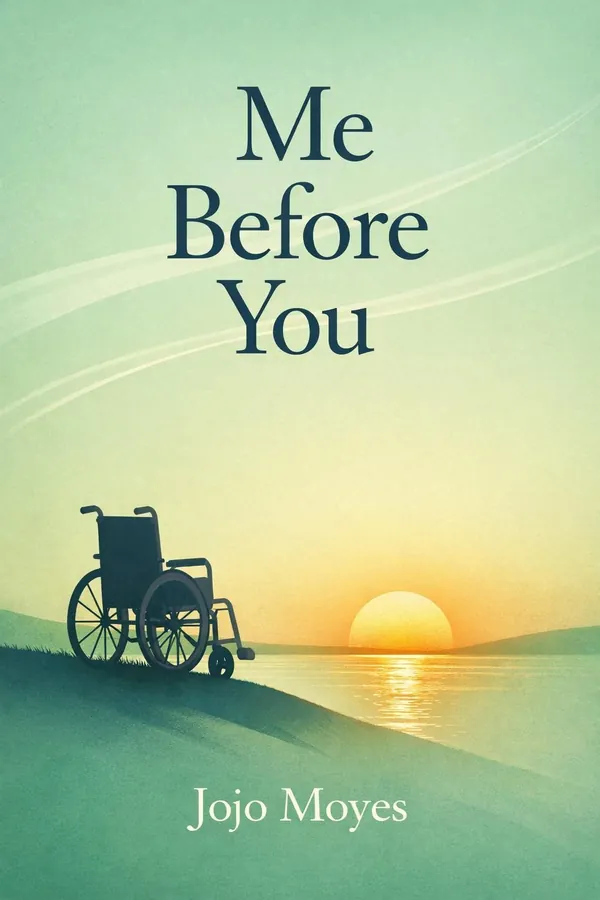
Me Before You: Summary & Key Insights
by Jojo Moyes
 10 min9 chaptersAudio available
Key Takeaways from Me Before You
Some love stories are built on fantasy, but Me Before You is built on a much more unsettling truth: love does not always solve the central problem.
Transformation often begins when two people from completely different worlds are forced into close contact.
One of the novel’s most painful questions is whether life can still feel worth living after it has been radically altered.
Caregiving is often spoken about as a practical role, but Me Before You reveals that it is also an emotional, relational, and moral undertaking.
A quiet but essential thread in Me Before You is that Louisa’s life is constrained long before she meets Will.
What Is Me Before You About?
Me Before You by Jojo Moyes is a romance book. Me Before You by Jojo Moyes is a contemporary romance that becomes something far richer: a searching, emotionally complex novel about love, dignity, responsibility, and the painful limits of what one person can do for another. At its center are Louisa Clark, a warm, quirky young woman whose life has rarely stretched beyond her family, job, and small-town routines, and Will Traynor, a once-adventurous, high-achieving man left quadriplegic after a catastrophic accident. When Louisa becomes Will’s caregiver, their relationship begins with tension and misunderstanding, then deepens into something transformative for them both. What makes the book so powerful is that it refuses easy answers. It asks whether love means holding on, letting go, changing someone’s mind, or helping them live on their own terms. Moyes, a bestselling British novelist and former journalist, brings both compassion and sharp observation to these moral questions. The result is a novel that resonates long after the final page, not simply because it is heartbreaking, but because it challenges readers to think about how we live, how we love, and what it means to truly see another person.
This FizzRead summary covers all 9 key chapters of Me Before You in approximately 10 minutes, distilling the most important ideas, arguments, and takeaways from Jojo Moyes's work. Also available as an audio summary and Key Quotes Podcast.
Me Before You
Me Before You by Jojo Moyes is a contemporary romance that becomes something far richer: a searching, emotionally complex novel about love, dignity, responsibility, and the painful limits of what one person can do for another. At its center are Louisa Clark, a warm, quirky young woman whose life has rarely stretched beyond her family, job, and small-town routines, and Will Traynor, a once-adventurous, high-achieving man left quadriplegic after a catastrophic accident. When Louisa becomes Will’s caregiver, their relationship begins with tension and misunderstanding, then deepens into something transformative for them both. What makes the book so powerful is that it refuses easy answers. It asks whether love means holding on, letting go, changing someone’s mind, or helping them live on their own terms. Moyes, a bestselling British novelist and former journalist, brings both compassion and sharp observation to these moral questions. The result is a novel that resonates long after the final page, not simply because it is heartbreaking, but because it challenges readers to think about how we live, how we love, and what it means to truly see another person.
Who Should Read Me Before You?
This book is perfect for anyone interested in romance and looking to gain actionable insights in a short read. Whether you're a student, professional, or lifelong learner, the key ideas from Me Before You by Jojo Moyes will help you think differently.
- ✓Readers who enjoy romance and want practical takeaways
- ✓Professionals looking to apply new ideas to their work and life
- ✓Anyone who wants the core insights of Me Before You in just 10 minutes
Want the full summary?
Get instant access to this book summary and 100K+ more with Fizz Moment.
Get Free SummaryAvailable on App Store • Free to download
Key Chapters
Some love stories are built on fantasy, but Me Before You is built on a much more unsettling truth: love does not always solve the central problem. Jojo Moyes frames the novel around the difficult intersection of compassion and personal autonomy, asking what happens when caring deeply for someone does not grant you the right to decide for them. Louisa enters Will Traynor’s life expecting a job; instead, she is pulled into an emotional and ethical struggle over how a life marked by profound loss should be lived. The novel’s power comes from its refusal to turn this into a simple argument. Will’s suffering is real, but so is Louisa’s hope. His desire for control over his future is sincere, but so is her belief that life can still hold meaning, pleasure, and intimacy.
This tension matters because it mirrors dilemmas many people face outside fiction. Families, partners, and caregivers often want to protect those they love, yet support can easily slip into control. Moyes shows that empathy is not the same as agreement. To care for someone fully, you may need to acknowledge a choice that breaks your heart. At the same time, the novel argues that love should still make a genuine effort: Louisa refuses passive acceptance and instead tries to open Will back up to experience, connection, and possibility.
In practical terms, the book encourages readers to approach hard personal decisions with humility. Listen before persuading. Ask what dignity means to the other person, not only to yourself. Offer hope, but do not erase pain. Actionable takeaway: when someone you love faces a life-altering decision, begin with deep listening and honest conversation before assuming what is best for them.
Transformation often begins when two people from completely different worlds are forced into close contact. Louisa Clark and Will Traynor embody this idea with striking clarity. Louisa is ordinary in the best sense: loyal, funny, underambitious, and shaped by practical obligations. Her life is constrained by money, family dependence, and a lack of confidence in her own horizons. Will, by contrast, once lived expansively. He was wealthy, cosmopolitan, physically fearless, and used to making choices from a position of power. After his accident, those contrasts become even sharper. Louisa sees him as privileged and arrogant; Will sees her as inexperienced and small-minded. Their early interactions are marked by discomfort because each represents what the other does not understand.
Yet this clash is exactly what allows the relationship to matter. Louisa brings warmth, spontaneity, and emotional persistence into Will’s heavily medicalized world. Will, despite his bitterness, challenges Louisa to see how limited her life has become. Neither is reduced to a stereotype. Louisa is not naive simply because she is untraveled, and Will is not defined only by injury. Through conversation, conflict, humor, and care, they begin to revise each other’s assumptions.
This dynamic has broad application. In real life, growth rarely comes from staying among people who mirror us perfectly. Class differences, educational differences, and contrasting life experiences can create friction, but they can also generate insight. Relationships become transformative when curiosity replaces judgment. Instead of asking, “Why is this person so difficult?” we can ask, “What reality has shaped them?” Actionable takeaway: seek one conversation this week with someone whose life experience differs sharply from your own, and focus on understanding before evaluating.
One of the novel’s most painful questions is whether life can still feel worth living after it has been radically altered. Through Louisa’s growing understanding of Will’s past, Moyes creates a stark contrast between the man he was and the life he now inhabits. Before the accident, Will was dynamic, physically adventurous, professionally successful, and deeply self-directed. After becoming quadriplegic, he experiences not only bodily limitation but the collapse of identity. He is no longer merely adjusting to inconvenience; he is confronting a self he no longer recognizes. The book insists that recovery is not simply a matter of cheerful thinking. Grief for a former life is real, complex, and often ongoing.
At the same time, Louisa’s presence introduces another possibility: that meaning can be rebuilt, even if it cannot be restored in the exact old form. She arranges outings, pushes against routine, and tries to remind Will that pleasure, intimacy, and surprise still exist. Importantly, the book does not suggest that one good relationship erases chronic pain or existential despair. Instead, it portrays the effort to re-engage with life as fragile and partial. That realism is why the story resonates.
Readers can apply this idea beyond disability. Many people mourn versions of themselves lost to illness, divorce, failure, aging, or financial collapse. The temptation is to believe that if the old self cannot return, nothing valuable remains. Moyes challenges that assumption by showing that a changed life may still contain connection, beauty, and purpose. Actionable takeaway: if you are grieving a lost version of your life, identify one meaningful experience you can still pursue now, even in a different form than before.
Caregiving is often spoken about as a practical role, but Me Before You reveals that it is also an emotional, relational, and moral undertaking. Louisa is hired to assist Will, yet the work soon proves to be far more than performing tasks or keeping him company. She must navigate his anger, his humiliation, his intelligence, and his resistance to pity. She also has to manage her own discomfort, fear, and uncertainty. Moyes portrays caregiving not as saintly self-sacrifice but as labor that demands patience, adaptability, humor, and emotional resilience.
A key insight of the novel is that good care preserves personhood. Will does not want to be treated as a problem to be managed or a tragedy to be softened. What gradually distinguishes Louisa is not technical expertise but her growing ability to engage him as a whole person with opinions, desires, and dignity. She argues with him, teases him, and refuses to reduce him to his condition. This is what makes her care meaningful.
The lesson extends to many settings: caring for aging parents, supporting a depressed friend, parenting a struggling teenager, or helping a partner through illness. Effective care is not only about doing things for someone; it is about remaining in relationship with them. That means asking what support feels respectful, noticing when help becomes smothering, and protecting your own emotional stamina so resentment does not quietly grow.
In practice, caregiving improves when communication is explicit. Ask: What do you want help with? What do you want to do yourself? How can I support you without taking over? Actionable takeaway: if you are caring for someone, have one direct conversation about what support feels most helpful and what unintentionally undermines their sense of independence.
A quiet but essential thread in Me Before You is that Louisa’s life is constrained long before she meets Will. She is affectionate, capable, and observant, yet she has accepted a version of herself built around caution. Her ambitions are modest not because she lacks intelligence, but because she has absorbed the belief that her role is to endure, contribute, and not ask for too much. Will recognizes this almost immediately. Even in his own despair, he is struck by how little Louisa expects from life and how thoroughly she has mistaken limitation for security.
This becomes one of the novel’s most inspiring ideas: sometimes love changes us by refusing to let us remain too small. Will does not merely receive care from Louisa; he pushes her to claim a broader life. He encourages her to read more widely, travel, dress boldly because she likes it, and imagine a future not dictated by family need or fear. His challenge is not “be someone else,” but “be more fully yourself.”
That message applies strongly in everyday life. Many people live inside inherited ceilings. They stay in jobs that diminish them, relationships that flatten them, or routines that keep them from discovering their own capabilities. Growth often begins when someone mirrors back a larger version of who we could be. But we do not have to wait for another person to do this. We can begin by questioning our own assumptions about what is realistic, deserved, or possible.
Actionable takeaway: write down one area where you have been settling for a smaller life than you truly want, then choose one concrete expansion step, such as applying, traveling, learning, or speaking up.
Emotional depth in Me Before You does not come from relentless sadness alone. One reason the novel works so well is that Moyes uses humor, wit, and awkwardness to make the characters feel alive. Louisa’s bright clothes, quick observations, and sometimes chaotic social instincts create moments of levity that keep the story from becoming purely solemn. These lighter moments do not trivialize Will’s suffering; instead, they make the relationship believable. Real people facing grief, illness, or fear often laugh, tease, and stumble through embarrassment. Humor becomes not an escape from pain but a way of carrying it.
This is especially important in relationships marked by illness or trauma. Constant seriousness can flatten a person into their hardest experience, while humor can briefly restore mutuality and normalcy. Louisa’s banter with Will is part of how she reaches him. She does not force cheerfulness, but she brings color and unpredictability into a life narrowed by routines, treatments, and dependency. That emotional texture helps both characters connect in a more human way.
There is a practical lesson here for anyone supporting someone in distress. Being respectful does not always mean being solemn. Sometimes the most compassionate response is to allow room for jokes, ordinary conversation, and personality to survive. The key is sensitivity: humor should invite connection, not dismiss pain. It should say, “You are still yourself,” not “Your struggle is not serious.”
Actionable takeaway: when supporting someone through difficulty, look for natural opportunities to bring warmth, normalcy, or gentle humor into the relationship, while staying alert to their emotional cues.
Love inside families is often treated as unquestionably good, but Me Before You shows that family bonds can comfort and confine at the same time. Louisa’s family depends on her emotionally and financially, and that dependence shapes her sense of self. She is needed, and being needed gives her identity. Yet it also limits her. Her choices are filtered through what the household requires, what seems practical, and what will avoid destabilizing an already pressured home. Moyes captures a truth many readers recognize: families may love us deeply while still reinforcing fear, guilt, and low expectations.
This tension is not presented as villainy. Louisa’s family is not cruel; they are struggling. Their concerns are rooted in economics, routine, and survival. That nuance matters because harmful limitation often arrives in ordinary forms: discouraging risk, minimizing dreams, assuming sacrifice is maturity, or treating change as selfishness. The novel asks readers to consider when loyalty becomes self-erasure.
Will’s family offers a different version of the same problem. Wealth and access do not eliminate emotional complexity. Their love for him is real, but so are the tensions between care, control, grief, and helplessness. Across both households, Moyes shows that family members do not always know how to respond to suffering without imposing their own fear onto the person at the center.
In practical life, emotional adulthood sometimes means loving family while resisting the roles they assigned us long ago. We can appreciate support without letting it define our entire future. Actionable takeaway: identify one expectation from family that no longer fits who you are, and practice expressing a boundary or a new choice with clarity and kindness.
At the heart of the novel lies a difficult idea many readers wrestle with long after finishing it: dignity is deeply personal. For Louisa, dignity is tied to connection, adaptation, and the possibility that a meaningful life can continue despite terrible loss. For Will, dignity is closely bound to autonomy, self-determination, and the unbearable distance between his former identity and his current existence. The emotional force of the novel comes from the fact that both positions are understandable. Me Before You does not ask readers to choose a simplistic hero and villain. Instead, it invites us to sit inside a conflict where love and principle do not align neatly.
This matters because public conversations about disability, quality of life, and end-of-life decisions are often flattened into slogans. Moyes instead emphasizes subjectivity. Two people can endure similar circumstances and interpret them very differently. One may find new meaning; another may experience only diminishing selfhood. Recognizing this does not require abandoning moral debate, but it does require humility.
In everyday terms, we frequently project our own thresholds, values, and fears onto others. We assume that what would sustain us would sustain them, or that what terrifies us must terrify them. The novel pushes against that reflex. True respect involves taking another person’s inner world seriously, even when it unsettles our own convictions.
Actionable takeaway: the next time you disagree with someone’s deeply personal life decision, pause before persuading and ask what values, losses, and fears are shaping their definition of dignity.
Many stories equate successful love with lasting union, but Me Before You proposes a more bittersweet idea: a relationship can be profoundly meaningful even if it does not end in conventional permanence. Louisa and Will change each other in ways that endure beyond the practical limits of their time together. She gives him companionship, intensity, honesty, and moments of renewed aliveness. He gives her courage, expanded vision, and permission to imagine a life larger than the one she has accepted. Their bond matters not because it fixes every problem, but because it awakens dormant parts of each person.
This is one of the novel’s most mature contributions to the romance genre. It suggests that the value of love is not measured only by duration, marriage, or shared future. Sometimes love’s greatest gift is the self it calls forth in us. This does not make loss easier, but it gives heartbreak meaning. A relationship can end and still leave behind increased bravery, deeper self-knowledge, and a changed orientation toward life.
Readers can apply this insight broadly. Not every important relationship will last forever. Friendships fade, mentors disappear, breakups happen, and deaths interrupt what we hoped would continue. Yet these relationships may still be successful in the deepest sense if they helped us become more alive, compassionate, or capable.
Actionable takeaway: reflect on one past relationship that changed you, and instead of defining it only by how it ended, identify the strengths, values, or possibilities it awakened that you can continue carrying forward.
All Chapters in Me Before You
About the Author
Jojo Moyes is a British novelist born in London in 1969 and one of the most widely read contemporary authors of emotional fiction. Before turning fully to novels, she worked as a journalist, including for The Independent, a background that helped shape her clear, observant prose and strong sense of character. Moyes has written numerous bestselling books that blend romance, family tension, humor, and moral complexity. She is especially known for Me Before You, which became an international phenomenon and introduced her work to a global audience. The novel’s success led to sequels and a 2016 film adaptation. Moyes is admired for writing stories that are accessible yet emotionally searching, often focusing on women at turning points in their lives and the relationships that force them to grow.
Get This Summary in Your Preferred Format
Read or listen to the Me Before You summary by Jojo Moyes anytime, anywhere. FizzRead offers multiple formats so you can learn on your terms — all free.
Available formats: App · Audio · PDF · EPUB — All included free with FizzRead
Download Me Before You PDF and EPUB Summary
Key Quotes from Me Before You
“Some love stories are built on fantasy, but Me Before You is built on a much more unsettling truth: love does not always solve the central problem.”
“Transformation often begins when two people from completely different worlds are forced into close contact.”
“One of the novel’s most painful questions is whether life can still feel worth living after it has been radically altered.”
“Caregiving is often spoken about as a practical role, but Me Before You reveals that it is also an emotional, relational, and moral undertaking.”
“A quiet but essential thread in Me Before You is that Louisa’s life is constrained long before she meets Will.”
Frequently Asked Questions about Me Before You
Me Before You by Jojo Moyes is a romance book that explores key ideas across 9 chapters. Me Before You by Jojo Moyes is a contemporary romance that becomes something far richer: a searching, emotionally complex novel about love, dignity, responsibility, and the painful limits of what one person can do for another. At its center are Louisa Clark, a warm, quirky young woman whose life has rarely stretched beyond her family, job, and small-town routines, and Will Traynor, a once-adventurous, high-achieving man left quadriplegic after a catastrophic accident. When Louisa becomes Will’s caregiver, their relationship begins with tension and misunderstanding, then deepens into something transformative for them both. What makes the book so powerful is that it refuses easy answers. It asks whether love means holding on, letting go, changing someone’s mind, or helping them live on their own terms. Moyes, a bestselling British novelist and former journalist, brings both compassion and sharp observation to these moral questions. The result is a novel that resonates long after the final page, not simply because it is heartbreaking, but because it challenges readers to think about how we live, how we love, and what it means to truly see another person.
You Might Also Like






Browse by Category
Ready to read Me Before You?
Get the full summary and 100K+ more books with Fizz Moment.