
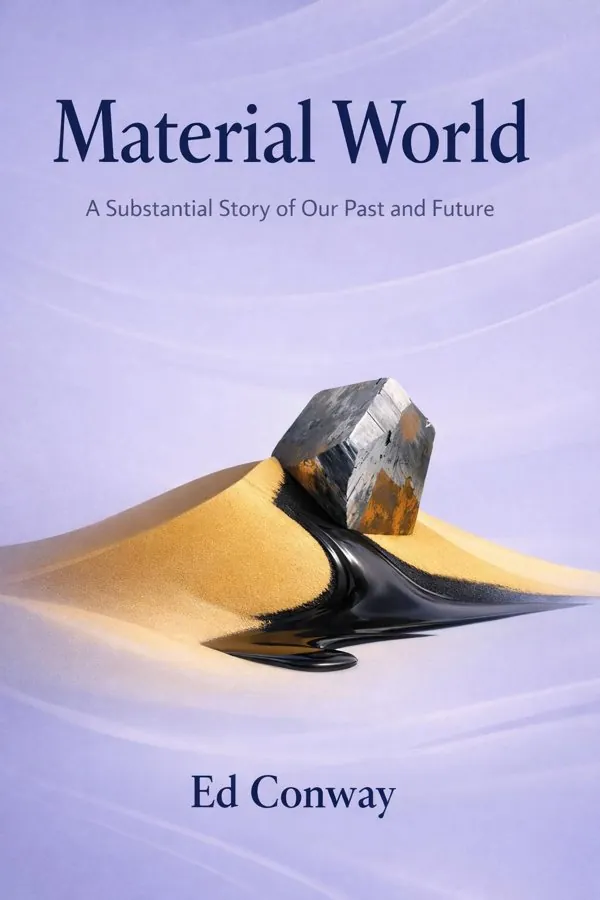
Material World: A Substantial Story of Our Past and Future: Summary & Key Insights
by Ed Conway
 10 min9 chaptersAudio available
What Is Material World: A Substantial Story of Our Past and Future About?
Material World: A Substantial Story of Our Past and Future by Ed Conway is a economics book spanning 9 pages. Material World is a nonfiction exploration of the six essential materials—sand, salt, iron, copper, oil, and lithium—that underpin modern civilization. Ed Conway traces how these substances shape economies, geopolitics, and daily life, revealing the hidden physical foundations of the digital age and the environmental and ethical challenges tied to their extraction and use.
This FizzRead summary covers all 9 key chapters of Material World: A Substantial Story of Our Past and Future in approximately 10 minutes, distilling the most important ideas, arguments, and takeaways from Ed Conway's work. Also available as an audio summary and Key Quotes Podcast.
Material World: A Substantial Story of Our Past and Future
Material World is a nonfiction exploration of the six essential materials—sand, salt, iron, copper, oil, and lithium—that underpin modern civilization. Ed Conway traces how these substances shape economies, geopolitics, and daily life, revealing the hidden physical foundations of the digital age and the environmental and ethical challenges tied to their extraction and use.
Who Should Read Material World: A Substantial Story of Our Past and Future?
This book is perfect for anyone interested in economics and looking to gain actionable insights in a short read. Whether you're a student, professional, or lifelong learner, the key ideas from Material World: A Substantial Story of Our Past and Future by Ed Conway will help you think differently.
- ✓Readers who enjoy economics and want practical takeaways
- ✓Professionals looking to apply new ideas to their work and life
- ✓Anyone who wants the core insights of Material World: A Substantial Story of Our Past and Future in just 10 minutes
Want the full summary?
Get instant access to this book summary and 100K+ more with Fizz Moment.
Get Free SummaryAvailable on App Store • Free to download
Key Chapters
Sand
When I stand at the edge of a desert or a construction site, I see more than lifeless dunes or heaps of aggregate—I see civilization’s most humble architect. Sand is the silent foundation of our modern world. Its ubiquity conceals the drama of transformation, for within each grain lies the promise of cities, glass, and silicon—the building blocks of both the urban and digital universe.
The story of sand begins with erosion and ends with innovation. Each granule is the product of geological patience, ground down over millions of years, yet when amassed and melted, it becomes the backbone of modernity. We build our homes, skyscrapers, and bridges with concrete, and concrete devours sand in quantities so vast they defy imagination. Every kilometer of highway, every tower that touches the sky, depends on these grains. But the same dunes that once symbolized emptiness are now being mined relentlessly, creating what might be the least discussed environmental crisis on Earth.
My fascination grew when I realized that sand is not only structural but also digital. Silicon, derived from sand, is the substrate of invention. The microchip—the tiny brain of the digital age—is a shimmering wafer of refined quartz, pulsing with microscopic pathways that transmit the world’s information. How ironic that the same substance reflecting sunlight off a desert ridge is what enables artificial intelligence and virtual reality.
Yet our dependence on sand has a dark side. Illegal sand mining devastates rivers and coastal ecosystems, while the frantic pace of urbanization turns sand into a commodity fought over by nations and cartels. In truth, the modern skyline is shadowed by the unseen scars of extraction. This humble material both empowers and endangers us.
When you next scroll through a touchscreen or gaze at a glass pyramid, remember that it’s not magic—it’s geology made visible. Sand teaches humility. It reminds us that the most advanced human creations originate in dust, and that progress involves not escaping the Earth but reshaping it, grain by grain.
Salt
Salt is not merely seasoning; it is civilization crystallized. From the moment humanity discovered its ability to preserve food, salt became synonymous with survival. It conquered decay, bridged seasons, and allowed communities to settle rather than roam. Long before the digital economy, salt was a global currency—it built empires, financed wars, and mapped trade routes.
I see salt as the first great industrial chemical. It birthed the alchemy of preservation and transformation. Through pickling and curing, our ancestors learned to manipulate nature’s limits, crafting permanence in a transient world. The Roman word for salary derives from ‘salarium,’ payments once made in salt. Its crystals glistened on the tables of kings and in the sweat of laborers digging underground.
As industry matured, salt found new forms of power. It became the cornerstone of chemical manufacturing, enabling processes that produced glass, soap, and chlorine. Every factory that synthesized matter owed a quiet debt to salt’s reactive spirit. Even today, through electrolysis and desalination, salt continues to link the economies of chemistry and life.
There’s also a moral lesson veined through its story. Salt has been the agent of both flourishing and exploitation. Where it was abundant, cities thrived; where monopolized, revolutions brewed. In China, Venice, and the Sahara, salt shaped not only geography but governance. Its trails reveal how the control of matter becomes the control of people.
Today we see salt in the hidden corners of sustainability—the saline wastewater from mining, the brine ponds in battery production, the fragile balance of our oceans. Our technological momentum still depends on maintaining the delicate chemistry of salt. Its persistence mirrors our own: essential, adaptable, sometimes corrosive.
For me, salt is a reminder that the simplest substances often have the most complex consequences. It encapsulates the long human struggle to tame nature without poisoning it. In the glitter of each crystal, one can glimpse the tension between necessity and restraint that defines our material story.
+ 7 more chapters — available in the FizzRead app
All Chapters in Material World: A Substantial Story of Our Past and Future
About the Author
Get This Summary in Your Preferred Format
Read or listen to the Material World: A Substantial Story of Our Past and Future summary by Ed Conway anytime, anywhere. FizzRead offers multiple formats so you can learn on your terms — all free.
Available formats: App · Audio · PDF · EPUB — All included free with FizzRead
Download Material World: A Substantial Story of Our Past and Future PDF and EPUB Summary
Key Quotes from Material World: A Substantial Story of Our Past and Future
“When I stand at the edge of a desert or a construction site, I see more than lifeless dunes or heaps of aggregate—I see civilization’s most humble architect.”
“Salt is not merely seasoning; it is civilization crystallized.”
Frequently Asked Questions about Material World: A Substantial Story of Our Past and Future
Material World: A Substantial Story of Our Past and Future by Ed Conway is a economics book that explores key ideas across 9 chapters. Material World is a nonfiction exploration of the six essential materials—sand, salt, iron, copper, oil, and lithium—that underpin modern civilization. Ed Conway traces how these substances shape economies, geopolitics, and daily life, revealing the hidden physical foundations of the digital age and the environmental and ethical challenges tied to their extraction and use.
You Might Also Like
Business Adventures
John Brooks
10 min
Nudge
Richard H. Thaler, Cass R. Sunstein
10 min
The Hitchhiker"s Guide to the Galaxy
Douglas Adams
10 minThe Muqaddimah
Ibn Khaldun
10 minThe Outsiders
William N. Thorndike
10 min
A Little History of Economics
Niall Kishtainy
10 minBrowse by Category
Ready to read Material World: A Substantial Story of Our Past and Future?
Get the full summary and 100K+ more books with Fizz Moment.