
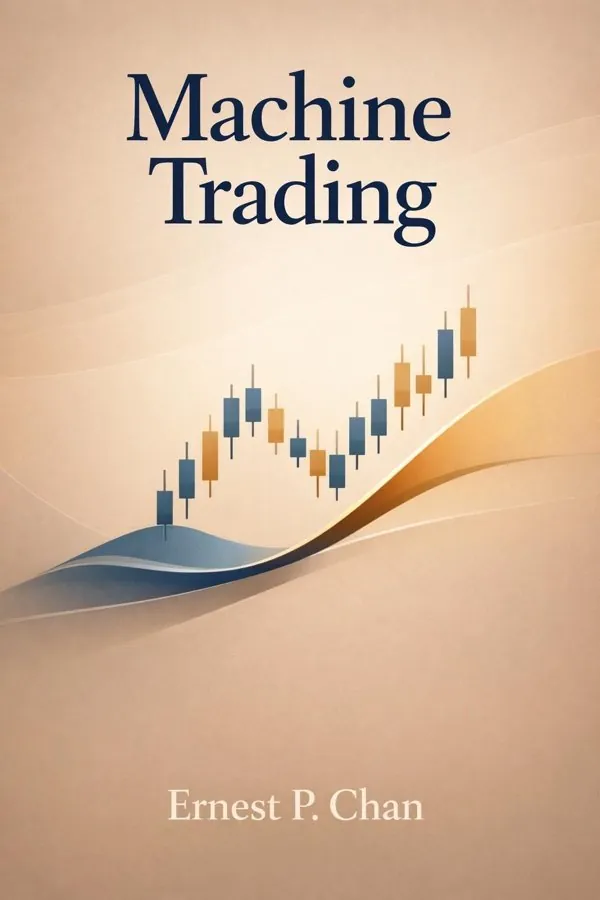
Machine Trading: Deploying Computer Algorithms to Conquer the Markets: Summary & Key Insights
 10 min5 chaptersAudio available
What Is Machine Trading: Deploying Computer Algorithms to Conquer the Markets About?
Machine Trading: Deploying Computer Algorithms to Conquer the Markets by Ernest P. Chan is a finance book spanning 5 pages. Machine Trading is a comprehensive guide to algorithmic trading strategies, focusing on how to design, test, and implement automated systems for financial markets. Ernest P. Chan explains quantitative methods, risk management, and execution techniques, providing practical insights for traders seeking to leverage machine learning and statistical models in trading.
This FizzRead summary covers all 5 key chapters of Machine Trading: Deploying Computer Algorithms to Conquer the Markets in approximately 10 minutes, distilling the most important ideas, arguments, and takeaways from Ernest P. Chan's work. Also available as an audio summary and Key Quotes Podcast.
Machine Trading: Deploying Computer Algorithms to Conquer the Markets
Machine Trading is a comprehensive guide to algorithmic trading strategies, focusing on how to design, test, and implement automated systems for financial markets. Ernest P. Chan explains quantitative methods, risk management, and execution techniques, providing practical insights for traders seeking to leverage machine learning and statistical models in trading.
Who Should Read Machine Trading: Deploying Computer Algorithms to Conquer the Markets?
This book is perfect for anyone interested in finance and looking to gain actionable insights in a short read. Whether you're a student, professional, or lifelong learner, the key ideas from Machine Trading: Deploying Computer Algorithms to Conquer the Markets by Ernest P. Chan will help you think differently.
- ✓Readers who enjoy finance and want practical takeaways
- ✓Professionals looking to apply new ideas to their work and life
- ✓Anyone who wants the core insights of Machine Trading: Deploying Computer Algorithms to Conquer the Markets in just 10 minutes
Want the full summary?
Get instant access to this book summary and 100K+ more with Fizz Moment.
Get Free SummaryAvailable on App Store • Free to download
Key Chapters
In the early decades of modern trading, success often depended on a trader’s intuition—the ability to read patterns, understand the pulse of the market, and act swiftly. But as computing power expanded and data became abundant, intuition was gradually replaced by code. The machine, once a tool for record-keeping, became the analyst and executor. I witnessed this transformation firsthand: the realization that what once took hours of observation could be computed and automated in microseconds.
The first step in this evolution is understanding data. Data is the oxygen of algorithmic strategies. Without clean, timely, and reliable data, even the most elegant model collapses. That’s why I emphasize the infrastructure of automated trading: data acquisition, maintenance, and efficient storage. Traders must set up data pipelines, historical archives, and fast retrieval systems capable of handling massive tick-level datasets. The architecture may include databases such as MongoDB or SQL servers optimized for time-series queries, and the computational layer often relies on languages like Python, MATLAB, or C++.
This infrastructure forms the backbone for backtesting and simulation, where we ask: How would this strategy have behaved in the past? Many practitioners fall into the trap of naive testing—using the same data for calibration and evaluation. I stressed repeatedly that realistic simulations must mimic the imperfections of live trading: slippage, latency, bid-ask spreads, and transaction costs. A system that performs well only under idealized conditions is no system at all.
What emerged over the decades is an ecosystem where algorithms continuously scan the market for tiny inefficiencies—price dislocations, mean reversions, or statistical anomalies. Human judgment is no longer about whether prices will rise or fall tomorrow; it’s about designing machines that decide that question thousands of times a day with measured confidence.
Once your infrastructure is in place, the intellectual heart of machine trading begins: designing and testing strategies. Every algorithm starts as a hypothesis—often a simple observation of market behavior. For example, perhaps a stock that drops sharply tends to rebound within a few days, or perhaps assets with recent strong performance continue trending. The goal is to translate such intuition into a statistically testable model.
This translation requires a rigorous workflow. First, formulate hypotheses in a way that can be quantified. Then, conduct exploratory data analysis to understand whether the pattern is persistent or random. If it seems significant, design a set of trading rules and backtest them. But backtesting is where caution matters most. I always emphasize out-of-sample testing and walk-forward analysis. A strategy that shines on historical data may fail in live deployment due to overfitting—where the algorithm learns the random quirks of the past rather than authentic signals.
Backtesting should also include realistic frictions. Never assume perfect fills or instantaneous execution. Incorporate transaction costs, simulate latency, and test different market conditions. This realism saves traders from painful surprises when the system goes live.
Beyond traditional testing, machine trading today leverages statistical and machine learning models. Linear regression helps understand directional relationships; logistic regression can model event probabilities; and models like random forests or support vector machines uncover nonlinear dynamics. Yet, even the most sophisticated models must obey a simple principle: interpretability matters. Without understanding why a model performs, one cannot trust it with real capital.
In the end, successful validation combines technical insight with humility. Every test is an opportunity to falsify your assumptions. The process does not seek to confirm brilliance but to expose weaknesses early—because markets are relentless teachers.
+ 3 more chapters — available in the FizzRead app
All Chapters in Machine Trading: Deploying Computer Algorithms to Conquer the Markets
About the Author
Ernest P. Chan is a quantitative trading expert and founder of QTS Capital Management. He holds a Ph.D. in physics from Cornell University and has worked at IBM Research, Morgan Stanley, and other financial institutions. Chan is known for his books on algorithmic trading and quantitative finance.
Get This Summary in Your Preferred Format
Read or listen to the Machine Trading: Deploying Computer Algorithms to Conquer the Markets summary by Ernest P. Chan anytime, anywhere. FizzRead offers multiple formats so you can learn on your terms — all free.
Available formats: App · Audio · PDF · EPUB — All included free with FizzRead
Download Machine Trading: Deploying Computer Algorithms to Conquer the Markets PDF and EPUB Summary
Key Quotes from Machine Trading: Deploying Computer Algorithms to Conquer the Markets
“In the early decades of modern trading, success often depended on a trader’s intuition—the ability to read patterns, understand the pulse of the market, and act swiftly.”
“Once your infrastructure is in place, the intellectual heart of machine trading begins: designing and testing strategies.”
Frequently Asked Questions about Machine Trading: Deploying Computer Algorithms to Conquer the Markets
Machine Trading: Deploying Computer Algorithms to Conquer the Markets by Ernest P. Chan is a finance book that explores key ideas across 5 chapters. Machine Trading is a comprehensive guide to algorithmic trading strategies, focusing on how to design, test, and implement automated systems for financial markets. Ernest P. Chan explains quantitative methods, risk management, and execution techniques, providing practical insights for traders seeking to leverage machine learning and statistical models in trading.
More by Ernest P. Chan
You Might Also Like





Browse by Category
Ready to read Machine Trading: Deploying Computer Algorithms to Conquer the Markets?
Get the full summary and 100K+ more books with Fizz Moment.