
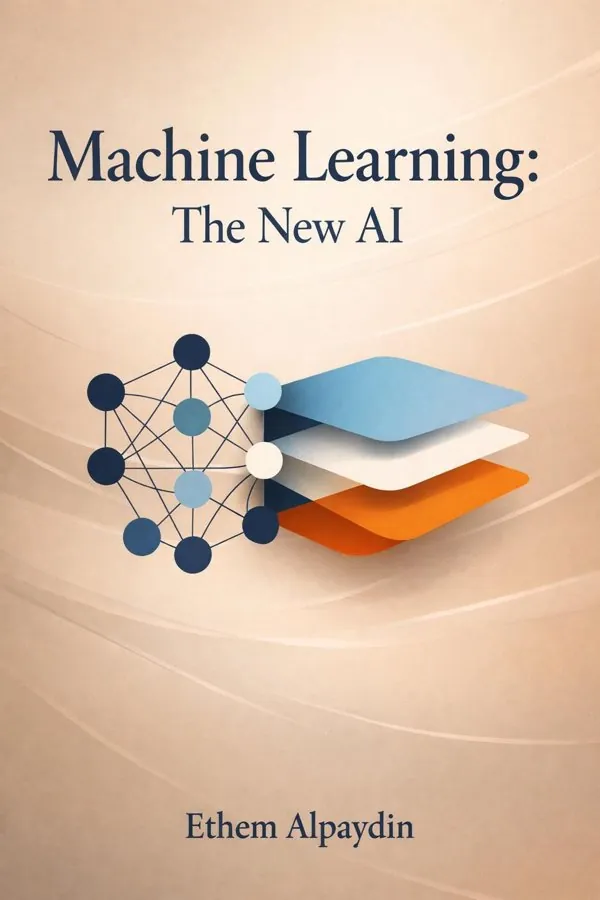
Machine Learning: The New AI: Summary & Key Insights
 10 min10 chaptersAudio available
What Is Machine Learning: The New AI About?
Machine Learning: The New AI by Ethem Alpaydin is a ai_ml book spanning 10 pages. This concise introduction explains how machine learning enables computers to learn from data and improve their performance without explicit programming. It covers the fundamental concepts, algorithms, and applications of machine learning, including supervised and unsupervised learning, neural networks, and deep learning, while also discussing ethical and societal implications.
This FizzRead summary covers all 10 key chapters of Machine Learning: The New AI in approximately 10 minutes, distilling the most important ideas, arguments, and takeaways from Ethem Alpaydin's work. Also available as an audio summary and Key Quotes Podcast.
Machine Learning: The New AI
This concise introduction explains how machine learning enables computers to learn from data and improve their performance without explicit programming. It covers the fundamental concepts, algorithms, and applications of machine learning, including supervised and unsupervised learning, neural networks, and deep learning, while also discussing ethical and societal implications.
Who Should Read Machine Learning: The New AI?
This book is perfect for anyone interested in ai_ml and looking to gain actionable insights in a short read. Whether you're a student, professional, or lifelong learner, the key ideas from Machine Learning: The New AI by Ethem Alpaydin will help you think differently.
- ✓Readers who enjoy ai_ml and want practical takeaways
- ✓Professionals looking to apply new ideas to their work and life
- ✓Anyone who wants the core insights of Machine Learning: The New AI in just 10 minutes
Want the full summary?
Get instant access to this book summary and 100K+ more with Fizz Moment.
Get Free SummaryAvailable on App Store • Free to download
Key Chapters
The roots of machine learning extend deep into the early history of artificial intelligence. In the mid-twentieth century, pioneers like Alan Turing asked whether machines could think. The first approaches to artificial intelligence were largely symbolic: researchers built systems that reasoned using explicit rules and logic, hoping to encode human intelligence directly into code. These systems were powerful in structured environments, yet brittle when faced with the messiness of the real world.
Machine learning arose out of the recognition that intelligent behavior is not entirely rule-based. Humans and animals learn through experience, adjusting behavior based on feedback. In the 1950s and 60s, this idea inspired computational models such as the perceptron, an early neural network that attempted to mimic the adaptability of biological neurons. Although these efforts were limited by computational power and data availability, they established a foundation: learning required data and the ability to generalize from it.
By the 1990s, as computing power grew and digital data proliferated, the field transformed. Instead of programming intelligence, researchers began designing algorithms that could learn from examples. Statistical learning theory, developed by Vladimir Vapnik and others, offered rigorous frameworks for understanding how well a model trained on data might perform on unseen cases. At the same time, practical algorithms — decision trees, nearest neighbors, support vector machines — gave the field both theoretical and applied strength.
Today, we live in the age of data-driven learning. Neural networks, once overshadowed, have reemerged as deep learning, fueled by massive datasets and parallel computation. But behind these advances lies a continuity — a shared pursuit: to let computers evolve and adapt, learning from experience as we do.
Imagine teaching a child to recognize cats. You show examples, label them 'cat' or 'not cat,' and with each example the child becomes better at identifying the correct label. This is supervised learning — the process of learning a function from labeled examples. In formal terms, we seek a mapping from input data to output targets, inferring an underlying relationship from observed pairs.
Supervised learning takes two principal forms: classification, where outputs are discrete (like 'spam' or 'not spam'), and regression, where outputs are continuous (such as predicting the temperature tomorrow). The essence lies in minimizing errors between predicted and true outputs. Different algorithms instantiate this in different ways. Linear regression finds the best linear fit; decision trees partition the data into interpretable rules; Bayesian methods use probabilities to express belief under uncertainty.
Supervised learning’s success depends on several key factors: the quality of the training data, the expressiveness of the model, and how well we avoid overfitting — that is, memorizing examples instead of learning patterns. Cross-validation, regularization, and careful model selection become essential safeguards against such pitfalls.
Every time you receive a product recommendation or your phone recognizes your speech, supervised learning is at work. It is the most direct and intuitive form of learning — experience molded by explicit guidance — and remains the backbone of machine intelligence.
+ 8 more chapters — available in the FizzRead app
All Chapters in Machine Learning: The New AI
About the Author
Ethem Alpaydin is a professor of computer engineering at Boğaziçi University, Istanbul, and a leading researcher in machine learning. He is the author of several influential books on the subject, including 'Introduction to Machine Learning'.
Get This Summary in Your Preferred Format
Read or listen to the Machine Learning: The New AI summary by Ethem Alpaydin anytime, anywhere. FizzRead offers multiple formats so you can learn on your terms — all free.
Available formats: App · Audio · PDF · EPUB — All included free with FizzRead
Download Machine Learning: The New AI PDF and EPUB Summary
Key Quotes from Machine Learning: The New AI
“The roots of machine learning extend deep into the early history of artificial intelligence.”
“Imagine teaching a child to recognize cats.”
Frequently Asked Questions about Machine Learning: The New AI
Machine Learning: The New AI by Ethem Alpaydin is a ai_ml book that explores key ideas across 10 chapters. This concise introduction explains how machine learning enables computers to learn from data and improve their performance without explicit programming. It covers the fundamental concepts, algorithms, and applications of machine learning, including supervised and unsupervised learning, neural networks, and deep learning, while also discussing ethical and societal implications.
You Might Also Like
Life 3.0
Max Tegmark
10 min
Superintelligence
Nick Bostrom
10 min
TensorFlow in Action
Thushan Ganegedara
10 min
AI Made Simple: A Beginner’s Guide to Generative AI, ChatGPT, and the Future of Work
Rajeev Kapur
10 min
AI Snake Oil
Arvind Narayanan, Sayash Kapoor
10 min
AI Superpowers: China, Silicon Valley, and the New World Order
Kai-Fu Lee
10 minBrowse by Category
Ready to read Machine Learning: The New AI?
Get the full summary and 100K+ more books with Fizz Moment.