
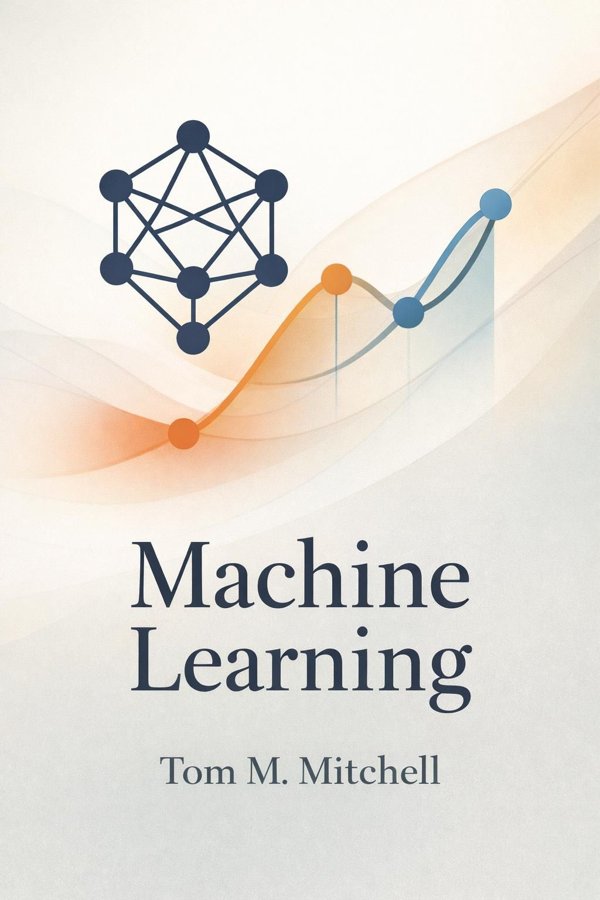
Machine Learning: Summary & Key Insights
 10 min8 chaptersAudio available
What Is Machine Learning About?
Machine Learning by Tom M. Mitchell is a ai_ml book spanning 8 pages. This book provides a comprehensive introduction to the field of machine learning, focusing on algorithms that enable computer programs to improve automatically through experience. It covers key theoretical foundations, learning paradigms, and practical applications, serving as a foundational text for students and researchers in artificial intelligence and data science.
This FizzRead summary covers all 8 key chapters of Machine Learning in approximately 10 minutes, distilling the most important ideas, arguments, and takeaways from Tom M. Mitchell's work. Also available as an audio summary and Key Quotes Podcast.
Machine Learning
This book provides a comprehensive introduction to the field of machine learning, focusing on algorithms that enable computer programs to improve automatically through experience. It covers key theoretical foundations, learning paradigms, and practical applications, serving as a foundational text for students and researchers in artificial intelligence and data science.
Who Should Read Machine Learning?
This book is perfect for anyone interested in ai_ml and looking to gain actionable insights in a short read. Whether you're a student, professional, or lifelong learner, the key ideas from Machine Learning by Tom M. Mitchell will help you think differently.
- ✓Readers who enjoy ai_ml and want practical takeaways
- ✓Professionals looking to apply new ideas to their work and life
- ✓Anyone who wants the core insights of Machine Learning in just 10 minutes
Want the full summary?
Get instant access to this book summary and 100K+ more with Fizz Moment.
Get Free SummaryAvailable on App Store • Free to download
Key Chapters
To learn means to improve through experience. I formalize this through the core definition: a program learns from experience E with respect to a task T and a performance measure P if its performance at T, measured by P, improves with E. This deceptively simple statement is the cornerstone of the entire field. It forces us to think carefully—what constitutes experience for a computer? Often it is data: records, examples, interactions. The task could be predicting a value, classifying an image, or controlling a robot. The performance measure might be accuracy, error rate, or reward accumulated. Together, these define a learning problem in precise terms.
This framework also introduces the notion of representation and hypothesis space. Each learning algorithm implicitly searches a space of possible mappings from inputs to outputs, guided by data. Take decision tree learning: its hypothesis space consists of trees defined by attribute tests. Or consider a neural network: its space is defined by weights connecting neurons. What we choose to represent and how we constrain those representations determines the power of learning.
But every learner must embody a bias. Without some form of preference, learning is impossible—a program could fit infinitely many explanations to finite data. Bias directs the search toward plausible solutions, whether through simplicity (as in Occam’s razor) or probabilistic priors (as in Bayesian learning). The real art lies in finding the right balance between bias and flexibility. The framework outlined here becomes the intellectual foundation for all subsequent chapters, showing how algorithms implement these abstract ideas in specific ways.
Decision tree learning offers one of the most intuitive pathways into machine learning. Imagine dividing the world by asking questions—each internal node splits data based on an attribute, each leaf represents a final decision. The algorithm ID3, which I describe in detail, builds such trees by selecting attributes that maximize information gain, a measure derived from entropy. Entropy captures impurity: a perfectly pure node (where all examples share the same label) has zero entropy.
As the algorithm recursively partitions data, it produces a hierarchy of decisions that approximates the target concept. But practical data are noisy, incomplete, or ambiguous. To handle this, I introduce mechanisms for pruning trees—removing branches that do not improve predictive accuracy—and methods for dealing with missing or uncertain values. Each of these techniques reflects a real challenge in empirical learning.
Decision trees represent learning as structured reasoning based on symbols and attributes. What makes them powerful is their interpretability—each decision path can be read and understood by humans. They also illustrate a critical principle: learning is essentially an optimization under uncertainty. Even the simplest trees embody a complex balancing act between fitting training data and generalizing to unseen cases. Through examples in medical diagnosis and game playing, I demonstrate both the elegance and the limitations of decision-tree approaches.
+ 6 more chapters — available in the FizzRead app
All Chapters in Machine Learning
About the Author
Tom M. Mitchell is an American computer scientist and professor known for his pioneering work in machine learning and artificial intelligence. He has served as the founding chair of the Machine Learning Department at Carnegie Mellon University and authored influential research and textbooks in the field.
Get This Summary in Your Preferred Format
Read or listen to the Machine Learning summary by Tom M. Mitchell anytime, anywhere. FizzRead offers multiple formats so you can learn on your terms — all free.
Available formats: App · Audio · PDF · EPUB — All included free with FizzRead
Download Machine Learning PDF and EPUB Summary
Key Quotes from Machine Learning
“To learn means to improve through experience.”
“Decision tree learning offers one of the most intuitive pathways into machine learning.”
Frequently Asked Questions about Machine Learning
Machine Learning by Tom M. Mitchell is a ai_ml book that explores key ideas across 8 chapters. This book provides a comprehensive introduction to the field of machine learning, focusing on algorithms that enable computer programs to improve automatically through experience. It covers key theoretical foundations, learning paradigms, and practical applications, serving as a foundational text for students and researchers in artificial intelligence and data science.
You Might Also Like
Life 3.0
Max Tegmark
10 min
Superintelligence
Nick Bostrom
10 min
TensorFlow in Action
Thushan Ganegedara
10 min
AI Made Simple: A Beginner’s Guide to Generative AI, ChatGPT, and the Future of Work
Rajeev Kapur
10 min
AI Snake Oil
Arvind Narayanan, Sayash Kapoor
10 min
AI Superpowers: China, Silicon Valley, and the New World Order
Kai-Fu Lee
10 minBrowse by Category
Ready to read Machine Learning?
Get the full summary and 100K+ more books with Fizz Moment.