
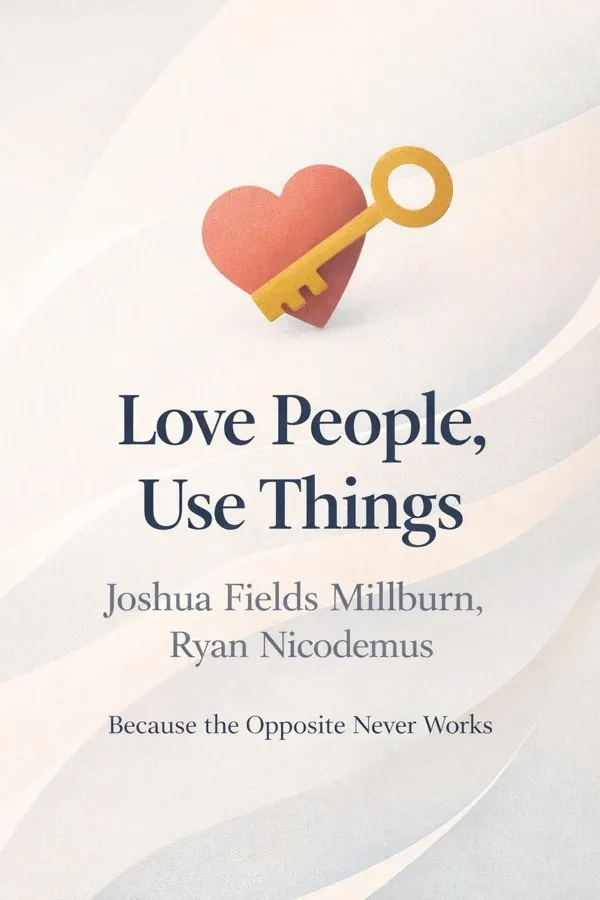
Love People, Use Things: Because the Opposite Never Works: Summary & Key Insights
by Joshua Fields Millburn, Ryan Nicodemus
 10 min9 chaptersAudio available
Key Takeaways from Love People, Use Things: Because the Opposite Never Works
A possession becomes dangerous the moment it stops being useful and starts becoming part of your identity.
The most expensive things in life are often the ones we never see on a receipt.
Clutter is rarely just a storage problem.
Some of the heaviest things we carry cannot be placed in a box.
A crowded life can still be an empty life if it lacks real connection.
What Is Love People, Use Things: Because the Opposite Never Works About?
Love People, Use Things: Because the Opposite Never Works by Joshua Fields Millburn, Ryan Nicodemus is a mindset book spanning 8 pages. Love People, Use Things is a practical and deeply personal argument against a culture that teaches us to seek identity, status, and happiness through accumulation. In this book, Joshua Fields Millburn and Ryan Nicodemus, widely known as The Minimalists, challenge the modern habit of treating possessions as sources of meaning while unintentionally treating people as secondary. Their central claim is simple but powerful: things are meant to be used, not loved, and people are meant to be loved, not used. When we reverse that order, our lives become cluttered, distracted, and emotionally thin. Drawing on their own experiences of professional success, consumer excess, personal loss, and eventual reinvention, the authors show that minimalism is not about owning as little as possible. It is about removing what gets in the way of a meaningful life. They connect physical clutter with emotional baggage, overwork, shallow relationships, and a loss of purpose. The result is a mindset book that is both reflective and practical. For anyone feeling overwhelmed, disconnected, or trapped in the cycle of more, this book offers a clear invitation to live with greater intention, freedom, and human connection.
This FizzRead summary covers all 9 key chapters of Love People, Use Things: Because the Opposite Never Works in approximately 10 minutes, distilling the most important ideas, arguments, and takeaways from Joshua Fields Millburn, Ryan Nicodemus's work. Also available as an audio summary and Key Quotes Podcast.
Love People, Use Things: Because the Opposite Never Works
Love People, Use Things is a practical and deeply personal argument against a culture that teaches us to seek identity, status, and happiness through accumulation. In this book, Joshua Fields Millburn and Ryan Nicodemus, widely known as The Minimalists, challenge the modern habit of treating possessions as sources of meaning while unintentionally treating people as secondary. Their central claim is simple but powerful: things are meant to be used, not loved, and people are meant to be loved, not used. When we reverse that order, our lives become cluttered, distracted, and emotionally thin.
Drawing on their own experiences of professional success, consumer excess, personal loss, and eventual reinvention, the authors show that minimalism is not about owning as little as possible. It is about removing what gets in the way of a meaningful life. They connect physical clutter with emotional baggage, overwork, shallow relationships, and a loss of purpose. The result is a mindset book that is both reflective and practical. For anyone feeling overwhelmed, disconnected, or trapped in the cycle of more, this book offers a clear invitation to live with greater intention, freedom, and human connection.
Who Should Read Love People, Use Things: Because the Opposite Never Works?
This book is perfect for anyone interested in mindset and looking to gain actionable insights in a short read. Whether you're a student, professional, or lifelong learner, the key ideas from Love People, Use Things: Because the Opposite Never Works by Joshua Fields Millburn, Ryan Nicodemus will help you think differently.
- ✓Readers who enjoy mindset and want practical takeaways
- ✓Professionals looking to apply new ideas to their work and life
- ✓Anyone who wants the core insights of Love People, Use Things: Because the Opposite Never Works in just 10 minutes
Want the full summary?
Get instant access to this book summary and 100K+ more with Fizz Moment.
Get Free SummaryAvailable on App Store • Free to download
Key Chapters
A possession becomes dangerous the moment it stops being useful and starts becoming part of your identity. That is one of the book’s clearest insights. Millburn and Nicodemus argue that the problem is not ownership itself, but attachment. A car can be transportation, a phone can be a communication device, and a home can be shelter. But when these things become proof of worth, symbols of success, or emotional substitutes, we stop using them and start serving them.
The authors write from lived experience. They had careers, salaries, wardrobes, gadgets, and status markers that looked impressive from the outside. Yet all that acquisition did not create peace. It created pressure. More possessions meant more organizing, more debt, more cleaning, more comparison, and more anxiety about losing what they had accumulated. The emotional burden of stuff often outweighs its practical benefit.
This insight extends beyond objects. We can become attached to titles, routines, opinions, and versions of ourselves that no longer fit. Attachment keeps us stuck because it confuses familiarity with meaning. We cling to what is comfortable, even when it quietly drains us.
A practical way to test attachment is to ask: Does this item support my life, or does my life revolve around it? Consider a closet full of clothes you rarely wear but feel unable to let go of because they represent a past identity. Or a large house that demands time, money, and stress far beyond the joy it provides. In both cases, the thing is no longer a tool.
Actionable takeaway: Choose one area of your life this week, such as your wardrobe, digital devices, or schedule, and identify what you are maintaining out of attachment rather than usefulness. Remove one thing that no longer serves your present life.
Clutter is rarely just a storage problem. More often, it is a reflection of delayed decisions, unresolved aspirations, and fear of letting go. In Love People, Use Things, physical decluttering is presented not as a cosmetic home project but as a way to reclaim clarity and energy. When our spaces are overcrowded, our minds often are too.
The authors encourage readers to see belongings as tools that should justify their place in our lives. If an object is not useful, meaningful, or genuinely supportive, its presence may be costing more than it contributes. This does not mean every room must look empty or aesthetic. Minimalism is not a design style. It is intentionality applied to possessions.
One reason decluttering feels difficult is that objects hold stories. We keep books we will never read because they represent the person we wish we were. We hold onto duplicate kitchen gadgets, boxes in the garage, and old electronics because discarding them feels wasteful or final. Yet these objects often create friction in daily life. They crowd surfaces, consume closet space, and generate low-grade stress every time we see them.
The practical power of decluttering lies in what it returns: ease. A simplified kitchen makes cooking easier. A calmer bedroom improves rest. An organized workspace supports focus. Even a smaller wardrobe can reduce decision fatigue each morning.
The authors favor experimentation over perfection. You do not need to discard everything at once. Start with a single drawer, shelf, or category. Notice which items actually support your life and which simply occupy it.
Actionable takeaway: Pick one small physical area today and remove everything that is broken, unused, or forgotten. Keep only what serves a clear purpose or brings real value, then observe how that one cleared space changes your mood and behavior.
Some of the heaviest things we carry cannot be placed in a box. The book makes an important move beyond physical possessions by arguing that emotional clutter can be even more suffocating than material clutter. Resentment, guilt, shame, comparison, people-pleasing, and old narratives can quietly dominate a life, even after the closet is clean.
Millburn and Nicodemus suggest that many external habits are fueled by internal discomfort. We shop to soothe insecurity. We stay busy to avoid grief. We maintain crowded schedules so we never have to sit alone with our thoughts. In that sense, physical clutter is sometimes a symptom. Emotional clutter is the deeper issue.
Decluttering emotionally begins with honesty. What feelings are you trying not to feel? What roles are you performing to gain approval? What past identity are you preserving because change feels risky? These questions matter because a simpler life requires more than getting rid of objects. It requires releasing self-defeating patterns.
Practical examples include stepping back from a one-sided friendship that survives only through obligation, letting go of guilt tied to an old career path, or noticing how social media triggers comparison and dissatisfaction. Emotional decluttering may also involve boundaries, therapy, journaling, quiet reflection, or uncomfortable conversations.
The goal is not emotional numbness. It is emotional freedom. When you stop carrying every old wound and expectation into the present, you become more available to reality. You can respond instead of react. You can choose instead of compulsively coping.
Actionable takeaway: Set aside 15 minutes to write down the emotions, relationships, or obligations that currently feel draining. Circle one that is within your control and take a specific step to lighten it, such as setting a boundary, deleting an app, or having an overdue conversation.
A crowded life can still be an empty life if it lacks real connection. At the heart of this book is the belief that human relationships, not possessions, create meaning. The title itself is a moral and practical guideline: love people, use things. When that order is reversed, relationships become transactional and objects become sacred.
The authors challenge a common modern distortion. Many people say they value family, friendship, and community, but their calendars, spending patterns, and attention often tell a different story. Work expands to support a lifestyle. Screens absorb evenings. Shopping and entertainment substitute for intimacy. We may be physically near others while mentally elsewhere.
Meaningful relationships require presence, and presence is impossible when attention is fragmented. Minimalism helps by removing distractions that compete with connection. A simpler schedule leaves room for unhurried conversations. Fewer possessions mean less maintenance and more availability. Lower financial pressure can mean less overwork and more time with loved ones.
The book also stresses quality over quantity. Just as not every possession deserves space, not every relationship deserves equal emotional investment. Some connections nourish growth, honesty, and mutual care. Others are based on convenience, image, or exhaustion. Loving people well includes choosing relationships rooted in respect rather than obligation.
Practical applications include putting phones away during meals, replacing expensive gift habits with intentional time together, or rethinking commitments that keep you busy but disconnected. A parent may discover that children remember attention more than toys. A friend may realize that listening deeply matters more than appearing impressive.
Actionable takeaway: Identify one relationship that matters deeply to you and give it undivided attention this week. Schedule time, remove distractions, and be fully present without multitasking, performing, or trying to fix anything.
Many people do not lack talent or opportunity. They lack space to hear what matters. One of the book’s strongest contributions is its link between minimalism and purpose. The authors argue that purpose is often buried beneath noise: overcommitment, endless consumption, social expectations, and fear-driven busyness. When we remove the excess, we make room for contribution.
Minimalism is not an end in itself. Owning less is not the goal. The goal is to direct your time, energy, and resources toward something more meaningful than maintenance and accumulation. Purpose can take many forms: raising children with presence, creating art, serving a community, building a mission-driven business, mentoring others, or simply living with integrity and care.
The authors push back against the idea that purpose must be grand or externally impressive. A purposeful life is not necessarily a famous life. It is a life aligned with values. Someone who earns less but has more freedom to contribute may be living more richly than someone with status but no sense of meaning.
A useful application is to examine where your energy goes each week. Does your schedule reflect what you claim to care about? If you say health, relationships, creativity, or service matter, but nearly all your attention goes to work, shopping, and recovery from stress, there is misalignment. Simplifying possessions and obligations can create room for the work only you can do.
Purpose is often discovered through subtraction. Remove what is trivial, and what is essential becomes easier to see.
Actionable takeaway: Write down your top three values, then review your calendar and spending from the past two weeks. Identify one recurring activity or expense that does not support those values and replace it with something that does.
You cannot become who you need to be while clinging tightly to who you used to be. This idea runs throughout the book. Growth requires release. Whether the attachment is to possessions, status, resentment, outdated goals, or self-image, holding on too long prevents renewal.
The authors describe minimalism as a process of continual editing. Life changes, and what once served you may no longer fit. A career identity can become a prison. A social role can become a performance. Even a dream can become dead weight if it no longer reflects your values. Letting go is difficult because it feels like losing part of yourself. Yet in many cases, what feels like loss is actually liberation.
This insight matters because people often approach self-improvement by adding more: more routines, more goals, more books, more systems. But transformation frequently comes through subtraction. You stop numbing. You stop pretending. You stop keeping things that represent a life you no longer want. By removing the false, you make space for the true.
Examples include leaving a prestigious but draining job, donating sentimental items that preserve an identity from ten years ago, or ending patterns of constant approval-seeking. Growth may also mean accepting that some chapters are complete. Not every possession, friendship, or ambition is meant to last forever.
The book does not romanticize change. Letting go can bring grief, uncertainty, and discomfort. But it also opens the possibility of becoming lighter, more honest, and more responsive to the present.
Actionable takeaway: Ask yourself what you are afraid to release because it once defined you. Choose one outdated object, commitment, or identity marker and consciously let it go as an act of growth rather than deprivation.
Minimalism fails when it becomes another rigid ideal to perform. The authors are clear that practical minimalism is personal, flexible, and rooted in utility. There is no universal item count, perfect capsule wardrobe, or single correct way to simplify. A meaningful life is not built by copying someone else’s rules. It is built by understanding what adds value to your own.
This is an important corrective because minimalism can easily be misunderstood as aesthetic austerity or competitive self-denial. The book rejects that. If a thing is useful, beautiful, or deeply supportive, it can belong in your life. The question is not how little can I survive with? The better question is what is enough for me to live intentionally?
Practical minimalism also recognizes seasons. A parent of young children, a traveling consultant, an artist, and a student will not own the same things or structure life the same way. The principle remains constant while the application changes: remove what distracts from meaning and keep what serves it.
Examples include simplifying finances through fewer subscriptions and automatic savings, streamlining digital clutter by unsubscribing from unwanted emails, or limiting social commitments that produce exhaustion instead of connection. Even small adjustments can create significant relief because they reduce friction in everyday life.
The authors encourage experimentation. Try living with less in one category and observe the effects. Box up kitchen gadgets for a month. Reduce app notifications. Commit to a no-buy period. If your life becomes easier, that is useful information. Practical minimalism is discovered through lived evidence, not ideology.
Actionable takeaway: Choose one system to simplify this week, such as your inbox, budget, closet, or social calendar. Make a temporary change for seven days and evaluate whether it increases freedom, focus, or peace.
The word enough may be one of the most powerful and least practiced words in modern life. Love People, Use Things ultimately points readers toward sufficiency. The authors suggest that much of our dissatisfaction comes from the assumption that we are always one purchase, promotion, upgrade, or external validation away from finally arriving. But if enough never arrives, neither does peace.
Declaring enough is radical because it resists the economic and cultural systems built on dissatisfaction. Advertising depends on making people feel incomplete. Social comparison trains us to measure ourselves against curated images of other lives. Ambition, when untethered from values, can become a bottomless appetite. The result is perpetual striving without contentment.
Enough does not mean settling for mediocrity or refusing growth. It means recognizing the point at which more stops adding value and starts subtracting from well-being. A larger income may be useful up to a point, but not if it costs your health and relationships. A bigger home may be pleasant, but not if it creates debt and maintenance that dominate your life. More options may seem liberating, but too many can create confusion and fatigue.
Practically, embracing enough helps people make better decisions. They choose work that supports life instead of consuming it. They buy for utility and joy rather than image. They stop comparing their behind-the-scenes existence to someone else’s highlight reel.
Enough is freedom because it restores agency. Once you stop chasing endless more, you can finally ask what is actually worth your one life.
Actionable takeaway: Define your personal version of enough in one area, such as income, clothing, screen time, or commitments. Write a clear boundary for that area and use it to guide your decisions for the next month.
All Chapters in Love People, Use Things: Because the Opposite Never Works
About the Authors
Joshua Fields Millburn and Ryan Nicodemus are American authors and public speakers known globally as The Minimalists. After experiencing personal loss, dissatisfaction with corporate success, and the emptiness of consumer-driven living, they began sharing their journey toward a simpler, more intentional life. Their work explores how reducing excess can create more room for relationships, purpose, health, and freedom. Through bestselling books, essays, documentaries, live events, and a widely followed podcast, they have helped popularize modern minimalism for a broad audience. Rather than promoting minimalism as aesthetic perfection or extreme self-denial, they frame it as a practical tool for removing distractions and focusing on what truly matters. Their message has resonated with millions seeking clarity in an increasingly crowded world.
Get This Summary in Your Preferred Format
Read or listen to the Love People, Use Things: Because the Opposite Never Works summary by Joshua Fields Millburn, Ryan Nicodemus anytime, anywhere. FizzRead offers multiple formats so you can learn on your terms — all free.
Available formats: App · Audio · PDF · EPUB — All included free with FizzRead
Download Love People, Use Things: Because the Opposite Never Works PDF and EPUB Summary
Key Quotes from Love People, Use Things: Because the Opposite Never Works
“A possession becomes dangerous the moment it stops being useful and starts becoming part of your identity.”
“The most expensive things in life are often the ones we never see on a receipt.”
“Clutter is rarely just a storage problem.”
“Some of the heaviest things we carry cannot be placed in a box.”
“A crowded life can still be an empty life if it lacks real connection.”
Frequently Asked Questions about Love People, Use Things: Because the Opposite Never Works
Love People, Use Things: Because the Opposite Never Works by Joshua Fields Millburn, Ryan Nicodemus is a mindset book that explores key ideas across 9 chapters. Love People, Use Things is a practical and deeply personal argument against a culture that teaches us to seek identity, status, and happiness through accumulation. In this book, Joshua Fields Millburn and Ryan Nicodemus, widely known as The Minimalists, challenge the modern habit of treating possessions as sources of meaning while unintentionally treating people as secondary. Their central claim is simple but powerful: things are meant to be used, not loved, and people are meant to be loved, not used. When we reverse that order, our lives become cluttered, distracted, and emotionally thin. Drawing on their own experiences of professional success, consumer excess, personal loss, and eventual reinvention, the authors show that minimalism is not about owning as little as possible. It is about removing what gets in the way of a meaningful life. They connect physical clutter with emotional baggage, overwork, shallow relationships, and a loss of purpose. The result is a mindset book that is both reflective and practical. For anyone feeling overwhelmed, disconnected, or trapped in the cycle of more, this book offers a clear invitation to live with greater intention, freedom, and human connection.
More by Joshua Fields Millburn, Ryan Nicodemus
You Might Also Like
Browse by Category
Ready to read Love People, Use Things: Because the Opposite Never Works?
Get the full summary and 100K+ more books with Fizz Moment.