
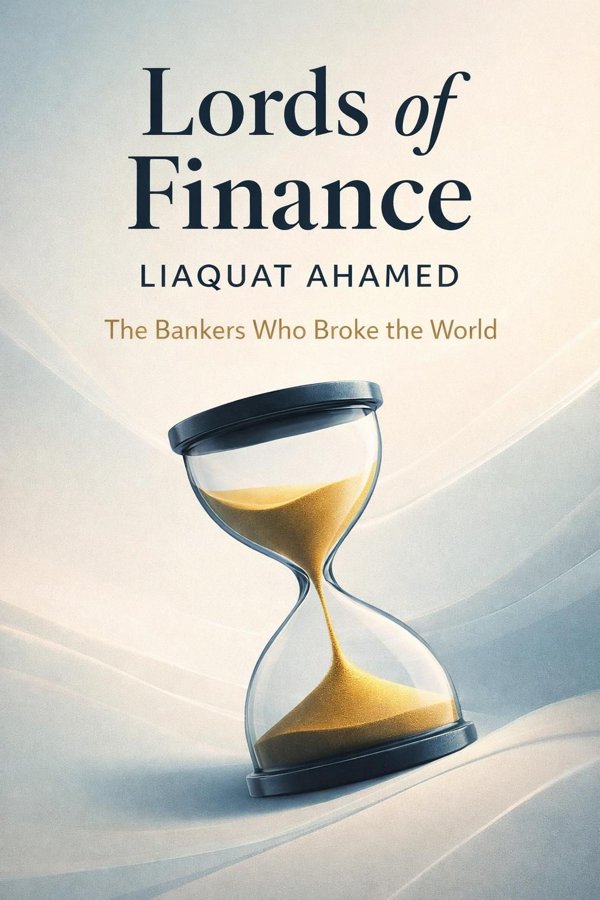
Lords of Finance: The Bankers Who Broke the World: Summary & Key Insights
 10 min9 chaptersAudio available
Key Takeaways from Lords of Finance: The Bankers Who Broke the World
Montagu Norman, Benjamin Strong, Émile Moreau, and Hjalmar Schacht were not merely technicians managing money.
Europe emerged physically damaged, politically shaken, and economically exhausted.
Ahamed shows that one of the interwar era’s greatest mistakes was treating the gold standard as a symbol of civilization rather than a tool of monetary management.
Not all of the so-called lords of finance were equally blind.
Economic crises are rarely caused by one country alone, and Ahamed carefully shows how France and Germany made choices that intensified global imbalance.
What Is Lords of Finance: The Bankers Who Broke the World About?
Lords of Finance: The Bankers Who Broke the World by Liaquat Ahamed is a economics book spanning 6 pages. What if the Great Depression was not simply an unavoidable catastrophe, but the result of a handful of powerful men making deeply flawed decisions under extraordinary pressure? In Lords of Finance, Liaquat Ahamed tells the gripping story of four central bankers—Montagu Norman of Britain, Émile Moreau of France, Hjalmar Schacht of Germany, and Benjamin Strong of the United States—whose choices helped shape the global economy in the turbulent years between World War I and the 1930s collapse. Far from being a dry history of interest rates and exchange systems, the book is a vivid account of ego, ideology, rivalry, and misplaced faith in old financial rules. Ahamed shows how war debts, reparations, gold-standard orthodoxy, and weak international cooperation combined to turn instability into disaster. The book matters because its central lesson remains urgent: monetary policy is never just technical; it is political, human, and world-changing. Ahamed brings unusual authority to the subject through his background in investment management, international finance, and economic history, making this Pulitzer Prize-winning work both intellectually rich and highly readable.
This FizzRead summary covers all 9 key chapters of Lords of Finance: The Bankers Who Broke the World in approximately 10 minutes, distilling the most important ideas, arguments, and takeaways from Liaquat Ahamed's work. Also available as an audio summary and Key Quotes Podcast.
Lords of Finance: The Bankers Who Broke the World
What if the Great Depression was not simply an unavoidable catastrophe, but the result of a handful of powerful men making deeply flawed decisions under extraordinary pressure? In Lords of Finance, Liaquat Ahamed tells the gripping story of four central bankers—Montagu Norman of Britain, Émile Moreau of France, Hjalmar Schacht of Germany, and Benjamin Strong of the United States—whose choices helped shape the global economy in the turbulent years between World War I and the 1930s collapse. Far from being a dry history of interest rates and exchange systems, the book is a vivid account of ego, ideology, rivalry, and misplaced faith in old financial rules. Ahamed shows how war debts, reparations, gold-standard orthodoxy, and weak international cooperation combined to turn instability into disaster. The book matters because its central lesson remains urgent: monetary policy is never just technical; it is political, human, and world-changing. Ahamed brings unusual authority to the subject through his background in investment management, international finance, and economic history, making this Pulitzer Prize-winning work both intellectually rich and highly readable.
Who Should Read Lords of Finance: The Bankers Who Broke the World?
This book is perfect for anyone interested in economics and looking to gain actionable insights in a short read. Whether you're a student, professional, or lifelong learner, the key ideas from Lords of Finance: The Bankers Who Broke the World by Liaquat Ahamed will help you think differently.
- ✓Readers who enjoy economics and want practical takeaways
- ✓Professionals looking to apply new ideas to their work and life
- ✓Anyone who wants the core insights of Lords of Finance: The Bankers Who Broke the World in just 10 minutes
Want the full summary?
Get instant access to this book summary and 100K+ more with Fizz Moment.
Get Free SummaryAvailable on App Store • Free to download
Key Chapters
History often turns on people whose names are barely remembered, and Ahamed’s first great insight is that modern capitalism was shaped by four central bankers whose personalities mattered as much as their policies. Montagu Norman, Benjamin Strong, Émile Moreau, and Hjalmar Schacht were not merely technicians managing money. They were architects of a fragile international system trying to restore order after the devastation of World War I. Each brought his own temperament: Norman was mystical and erratic, Strong was pragmatic and influential, Moreau was suspicious and nationalistic, and Schacht was brilliant, combative, and politically dangerous. Together, they influenced exchange rates, interest rates, debt settlements, and the confidence of governments and markets.
Ahamed’s point is not that individuals control history completely, but that in moments of extreme uncertainty, character shapes outcomes. These men interpreted the same facts differently because they had different loyalties, fears, and assumptions. Strong understood the need for international flexibility; Norman was obsessed with restoring Britain’s old financial prestige; Moreau prioritized French security and gold accumulation; Schacht fought Germany’s burdens with aggression and resentment. Their cooperation was partial, personal, and often unstable.
This matters beyond economic history. In any institution, from a central bank to a company board, decision-making is influenced by relationships, prestige, and emotional blind spots as much as by data. A team may appear rational on paper while quietly being driven by pride, mistrust, or nostalgia.
A practical way to use this idea is to look at leadership decisions in your own world and ask not just, “What are the numbers saying?” but also, “Who are the decision-makers, what do they believe, and what are they trying to protect?” Actionable takeaway: when assessing any major policy or strategy, analyze the people behind it as carefully as the system itself.
The end of war does not guarantee the return of stability, and one of Ahamed’s most important lessons is that World War I left behind a peace settlement built on financial contradictions. Europe emerged physically damaged, politically shaken, and economically exhausted. Britain and France owed huge sums to the United States. Germany was expected to pay reparations to the Allies. The Allies, in turn, hoped to use those reparations to pay their own American debts. On paper, this looked like a system of obligation. In reality, it was a circular fantasy dependent on growth, trust, and political cooperation that did not exist.
Germany lacked the capacity and willingness to pay what was demanded without severe internal strain. France insisted on payment because it needed money and security. Britain wanted moderation but also needed debt relief. The United States, now the world’s leading creditor, insisted that war loans be repaid while remaining reluctant to assume broader responsibility for stabilizing Europe. The result was a deeply unbalanced global economy where every country was waiting for another to solve the problem.
Ahamed shows that financial burdens are never merely accounting entries. They alter domestic politics, fuel resentment, and narrow policy choices. Germany’s crisis contributed to inflation, social breakdown, and radicalization. France’s insecurity hardened its demands. America’s distance encouraged moral rigidity instead of pragmatic leadership.
The broader application is clear: when systems become dependent on unrealistic chains of payment or performance, they are vulnerable to collapse. Whether in sovereign debt, business finance, or household budgeting, obligations must reflect real productive capacity, not political wishful thinking.
Actionable takeaway: whenever evaluating a financial arrangement, test whether the obligations are realistically payable under stress—not just in ideal conditions.
Ahamed shows that one of the interwar era’s greatest mistakes was treating the gold standard as a symbol of civilization rather than a tool of monetary management. Before World War I, the gold standard had helped anchor exchange rates and encourage international trade. To many bankers and politicians, it represented discipline, predictability, and credibility. After the war, restoring it became a moral mission. But the world to which it had once been suited no longer existed. Economies were distorted by inflation, debt, political instability, and uneven productivity. Returning to gold at prewar assumptions meant forcing a damaged world into an outdated framework.
Britain’s decision to return sterling to gold at the old parity is one of the book’s defining examples. It was intended to restore London’s financial prestige, but in practice it overvalued the pound, hurt exports, weakened industry, and imposed deflationary pressure on workers and businesses. Other countries faced similar tradeoffs. To remain on gold, central banks often raised interest rates, tightened credit, and tolerated unemployment. The mechanism that was supposed to produce confidence instead transmitted pain.
The deeper lesson is that institutions and rules can survive long after the conditions that made them useful have disappeared. Leaders often cling to familiar frameworks because abandoning them feels like weakness. Yet rigid commitment to old systems can make adaptation impossible.
In business and public policy alike, the equivalent mistake is preserving a once-successful model long after markets, technologies, or customer behavior have changed. Stability matters, but flexibility matters more when the environment has shifted dramatically.
Actionable takeaway: treat every rule, benchmark, or tradition as a tool to be re-evaluated—not a sacred principle to be defended at any cost.
Not all of the so-called lords of finance were equally blind. Ahamed presents Benjamin Strong, the powerful head of the Federal Reserve Bank of New York, as the most pragmatic and internationally minded of the four. Strong understood that the postwar financial system was too fragile to survive on automatic rules alone. He recognized that the United States, as the major creditor nation, had a special responsibility to provide liquidity and support international adjustment. While others clung to doctrine, Strong was more willing to experiment.
He worked closely with Montagu Norman and understood that Britain’s return to gold required support from the United States. Through lower interest rates and open-market operations, Strong tried to ease pressure on Britain and maintain global monetary balance. Critics later argued that these policies may have contributed to excessive speculation in American markets. Ahamed does not deny the complexity, but he emphasizes Strong’s larger significance: he grasped that monetary systems require active management, international coordination, and realism.
Strong’s death in 1928 left a major leadership vacuum. The Federal Reserve lost a figure capable of combining technical skill with strategic vision. Without him, American monetary policy became more hesitant, fragmented, and domestically focused just as the world economy was becoming more unstable.
The practical lesson is that institutions often depend more heavily on capable individuals than outsiders realize. Succession planning, intellectual diversity, and strong governance matter because systems become vulnerable when wisdom is concentrated in one person.
Actionable takeaway: in any organization, identify where critical judgment is overly dependent on a single leader, and build processes that preserve adaptability after that person is gone.
Economic crises are rarely caused by one country alone, and Ahamed carefully shows how France and Germany made choices that intensified global imbalance. In France, Émile Moreau pursued policies shaped by caution, memory, and mistrust. Having seen the destruction of war and the weakness of the franc, French policymakers prioritized monetary stability and national safety. Once the franc was stabilized at a competitive level, France began accumulating large quantities of gold. This strengthened French finances, but it also drained liquidity from the international system. Gold that flowed into France was not always recycled in ways that supported global recovery.
In Germany, Hjalmar Schacht emerged from the trauma of hyperinflation with a fierce determination to restore monetary order and resist foreign pressure. He helped stabilize the currency, but Germany’s apparent recovery remained dependent on foreign capital, especially short-term American loans. The economy looked repaired, yet underneath it was highly exposed. Schacht’s nationalism and resentment also reflected a broader German mood: economic hardship had fused with political grievance.
Ahamed’s larger point is that national strategies that appear rational in isolation can be destructive in a connected system. France acted defensively. Germany acted reactively. Yet the combined effect was a more brittle world economy, with fewer shock absorbers and more political tension.
This insight applies to today’s organizations and nations alike. When every participant optimizes for self-protection without considering systemwide consequences, collective instability rises. Supply chains, banking networks, and even workplace teams fail this way.
Actionable takeaway: when making defensive decisions, ask not only how they protect your position, but also how they affect the wider system you depend on.
Booms are most dangerous when they convince people that underlying problems have been solved. During the 1920s, the United States appeared to embody a new era of growth, innovation, and financial sophistication. Production surged, consumer credit expanded, and stock prices climbed. To many observers, this prosperity seemed to prove that modern finance had become more stable and that the postwar dislocations were fading. Ahamed shows the opposite: beneath the optimism lay unresolved global imbalances, speculative excess, and central banks pulling in conflicting directions.
Cheap money and abundant confidence fueled risk-taking in American markets. At the same time, Europe remained dependent on American lending to sustain reparations and debt payments. This created an unstable loop: U.S. capital supported Europe, Europe used funds to manage obligations, and global confidence relied on uninterrupted flows. Once the cycle weakened, the entire structure became vulnerable. The Wall Street crash in 1929 was dramatic, but Ahamed insists it was not the sole cause of the Depression. It was the moment that exposed a system already weakened by poor coordination and rigid thinking.
This is a timeless warning. Healthy-looking performance metrics can conceal dependence on fragile assumptions—cheap credit, investor enthusiasm, or favorable external conditions. Companies can show strong growth while relying on one major client. Households can feel secure while carrying risky debt. Economies can look dynamic while ignoring leverage and concentration.
The practical habit here is to separate surface success from structural resilience. Ask what would happen if funding dried up, demand slowed, or confidence reversed.
Actionable takeaway: during periods of strong performance, conduct stress tests against downside scenarios instead of assuming recent success proves long-term stability.
Ahamed’s account makes clear that the Depression deepened not only because economies were weak, but because the people in charge could not coordinate an effective response. Central banking in the interwar period depended heavily on personal trust and informal cooperation, especially among the major financial powers. That was difficult even in calm times. Once crisis struck, fear, domestic politics, and mutual suspicion overwhelmed the fragile spirit of collaboration.
As banking stresses grew and capital flows reversed, countries increasingly acted alone. They raised rates to defend currencies, imposed pressure on debtors, and protected national reserves rather than stabilizing the broader system. Britain’s departure from gold in 1931 was a decisive turning point, followed by further fragmentation. Instead of coordinated reflation or debt restructuring, governments often chose contraction, austerity, and financial defensiveness. These measures may have looked prudent from a narrow national perspective, but together they intensified collapse.
Ahamed’s larger argument is that crises in interconnected systems demand collective action before panic hardens into policy paralysis. Once trust breaks, even sensible measures become politically difficult. The tragedy of the 1930s was not simply a lack of intelligence; it was a lack of timely cooperation.
This lesson remains highly practical. In organizations, teams under pressure often hoard information, protect budgets, and shift blame. In markets, banks or firms retreat into self-preservation. Yet this behavior can worsen the very crisis everyone fears.
Actionable takeaway: build channels of communication and pre-agreed crisis responses before trouble arrives, because cooperation is easiest to promise in peace and hardest to create in panic.
One of the most powerful messages in Lords of Finance is that bad outcomes often come from respectable ideas applied too rigidly. The central bankers of the interwar period were not fools. Many were intelligent, experienced, and committed to restoring stability. Their failure came from excessive devotion to orthodoxy: balanced budgets, hard money, debt repayment, and gold convertibility. These principles had logic behind them, but in extraordinary conditions they became destructive because they prevented adaptation.
Deflation was tolerated as the price of credibility. Unemployment was treated as unfortunate but necessary. Relief for debtors was delayed because it appeared morally compromising. The result was not renewed confidence but worsening contraction and social anger. Ahamed shows how economic doctrine can become self-defeating when leaders care more about preserving the legitimacy of a framework than about the human and political consequences of applying it.
This idea reaches far beyond central banking. Organizations often keep enforcing policies that once worked but now damage morale, growth, or resilience. Schools, companies, and governments all risk confusing consistency with wisdom. A process can be technically coherent and still be strategically wrong.
The practical discipline is intellectual humility. Good decision-makers ask, “Under what conditions would this rule fail?” rather than assuming discipline is always virtuous. They look for feedback from the real world, especially when results are worsening.
Actionable takeaway: whenever a policy imposes repeated pain without producing improvement, pause and question the framework itself—not just the quality of execution.
Ahamed’s title is deliberately provocative, but his deepest insight is not simply that bankers made mistakes. It is that economic disasters are human failures before they are statistical events. The Depression was shaped by pride, fear, denial, rivalry, and the inability to imagine alternatives. Leaders mistook prestige for stability, legality for justice, and discipline for wisdom. They underestimated how quickly financial strain could become social and political collapse.
By focusing on biography as well as policy, Ahamed restores the human dimension to macroeconomics. Montagu Norman’s obsession with restoring Britain’s financial standing, Moreau’s suspicion of Anglo-American influence, Schacht’s nationalist fury, and the void left by Strong’s death all mattered because institutions are run by imperfect people. Once those people misread events or became trapped by their own assumptions, millions suffered.
That is why the book continues to resonate. It reminds readers that economic management is never neutral. Interest-rate decisions, exchange-rate targets, and debt settlements affect jobs, political legitimacy, and the survival of democratic institutions. The Depression helped create conditions in which extremism could flourish. Financial error was not isolated from history; it redirected it.
For modern readers, the application is sobering but useful. Behind every system are incentives, personalities, and moral choices. Better outcomes require not only technical competence but courage, flexibility, and empathy.
Actionable takeaway: judge economic and strategic decisions not only by whether they protect institutions, but by whether they preserve social stability and human dignity.
All Chapters in Lords of Finance: The Bankers Who Broke the World
About the Author
Liaquat Ahamed is a British-American author, financier, and historian of global economics. Educated at Cambridge University and Harvard, he began his career at the World Bank before moving into investment management, where he held senior roles in hedge funds and financial firms. That practical experience in markets and policy gave him a distinctive perspective on the history of money, banking, and international crisis. He is best known for Lords of Finance: The Bankers Who Broke the World, which won the 2010 Pulitzer Prize for History. Ahamed is widely admired for making complex financial history vivid, readable, and relevant to contemporary readers. His writing connects technical monetary issues with the personalities, political pressures, and human consequences behind major economic events.
Get This Summary in Your Preferred Format
Read or listen to the Lords of Finance: The Bankers Who Broke the World summary by Liaquat Ahamed anytime, anywhere. FizzRead offers multiple formats so you can learn on your terms — all free.
Available formats: App · Audio · PDF · EPUB — All included free with FizzRead
Download Lords of Finance: The Bankers Who Broke the World PDF and EPUB Summary
Key Quotes from Lords of Finance: The Bankers Who Broke the World
“Montagu Norman, Benjamin Strong, Émile Moreau, and Hjalmar Schacht were not merely technicians managing money.”
“The end of war does not guarantee the return of stability, and one of Ahamed’s most important lessons is that World War I left behind a peace settlement built on financial contradictions.”
“Ahamed shows that one of the interwar era’s greatest mistakes was treating the gold standard as a symbol of civilization rather than a tool of monetary management.”
“Not all of the so-called lords of finance were equally blind.”
“Economic crises are rarely caused by one country alone, and Ahamed carefully shows how France and Germany made choices that intensified global imbalance.”
Frequently Asked Questions about Lords of Finance: The Bankers Who Broke the World
Lords of Finance: The Bankers Who Broke the World by Liaquat Ahamed is a economics book that explores key ideas across 9 chapters. What if the Great Depression was not simply an unavoidable catastrophe, but the result of a handful of powerful men making deeply flawed decisions under extraordinary pressure? In Lords of Finance, Liaquat Ahamed tells the gripping story of four central bankers—Montagu Norman of Britain, Émile Moreau of France, Hjalmar Schacht of Germany, and Benjamin Strong of the United States—whose choices helped shape the global economy in the turbulent years between World War I and the 1930s collapse. Far from being a dry history of interest rates and exchange systems, the book is a vivid account of ego, ideology, rivalry, and misplaced faith in old financial rules. Ahamed shows how war debts, reparations, gold-standard orthodoxy, and weak international cooperation combined to turn instability into disaster. The book matters because its central lesson remains urgent: monetary policy is never just technical; it is political, human, and world-changing. Ahamed brings unusual authority to the subject through his background in investment management, international finance, and economic history, making this Pulitzer Prize-winning work both intellectually rich and highly readable.
You Might Also Like

Business Adventures
John Brooks
10 min
Nudge
Richard H. Thaler, Cass R. Sunstein
10 min
The Hitchhiker"s Guide to the Galaxy
Douglas Adams
10 minThe Muqaddimah
Ibn Khaldun
10 minThe Outsiders
William N. Thorndike
10 min
A Little History of Economics
Niall Kishtainy
10 minBrowse by Category
Ready to read Lords of Finance: The Bankers Who Broke the World?
Get the full summary and 100K+ more books with Fizz Moment.