
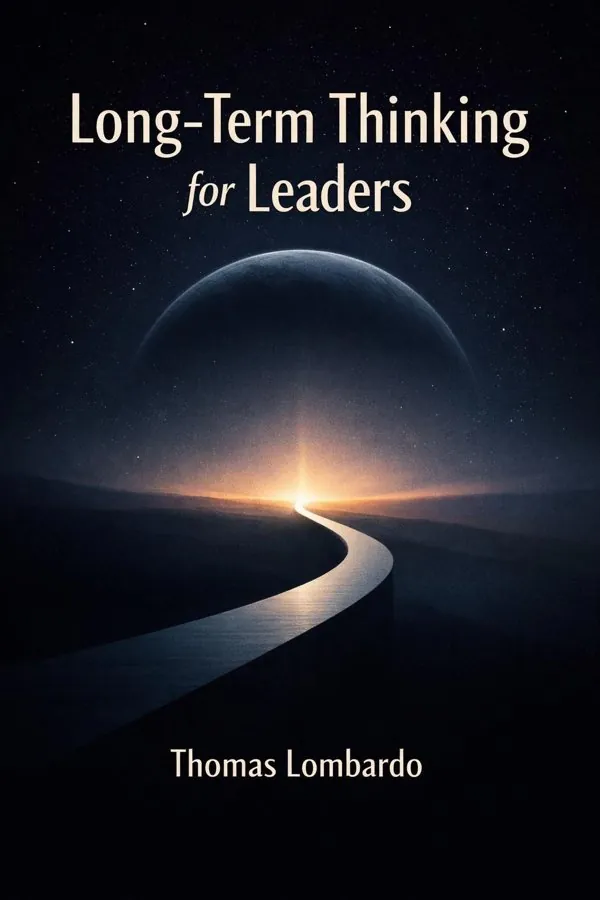
Long-Term Thinking for Leaders: Leveraging the Future to Transform Yourself and Your World: Summary & Key Insights
 10 min9 chaptersAudio available
What Is Long-Term Thinking for Leaders: Leveraging the Future to Transform Yourself and Your World About?
Long-Term Thinking for Leaders: Leveraging the Future to Transform Yourself and Your World by Thomas Lombardo is a leadership book spanning 9 pages. This book explores how leaders can cultivate long-term thinking to guide their organizations and societies toward sustainable futures. Drawing on psychology, philosophy, and futures studies, Lombardo presents frameworks for developing foresight, wisdom, and visionary leadership in an age of rapid change.
This FizzRead summary covers all 9 key chapters of Long-Term Thinking for Leaders: Leveraging the Future to Transform Yourself and Your World in approximately 10 minutes, distilling the most important ideas, arguments, and takeaways from Thomas Lombardo's work. Also available as an audio summary and Key Quotes Podcast.
Long-Term Thinking for Leaders: Leveraging the Future to Transform Yourself and Your World
This book explores how leaders can cultivate long-term thinking to guide their organizations and societies toward sustainable futures. Drawing on psychology, philosophy, and futures studies, Lombardo presents frameworks for developing foresight, wisdom, and visionary leadership in an age of rapid change.
Who Should Read Long-Term Thinking for Leaders: Leveraging the Future to Transform Yourself and Your World?
This book is perfect for anyone interested in leadership and looking to gain actionable insights in a short read. Whether you're a student, professional, or lifelong learner, the key ideas from Long-Term Thinking for Leaders: Leveraging the Future to Transform Yourself and Your World by Thomas Lombardo will help you think differently.
- ✓Readers who enjoy leadership and want practical takeaways
- ✓Professionals looking to apply new ideas to their work and life
- ✓Anyone who wants the core insights of Long-Term Thinking for Leaders: Leveraging the Future to Transform Yourself and Your World in just 10 minutes
Want the full summary?
Get instant access to this book summary and 100K+ more with Fizz Moment.
Get Free SummaryAvailable on App Store • Free to download
Key Chapters
At the heart of long-term leadership lies a psychological and philosophical awakening I call future consciousness. This capacity entails more than imagining tomorrow; it represents an integrated way of being that unites cognition, emotion, and purpose around the unfolding of time. To think clearly about the future, we must understand the forces that blind us—the cognitive biases that anchor us in short-term gratification, the emotional impulses that crave immediacy, the cultural habits that reward busyness over depth.
Future consciousness is cultivated through awareness and intention. Psychologically, it involves the development of reflective self-control and the ability to balance ambition with patience. Philosophically, it requires a belief that humanity can evolve through reasoned choice—that our consciousness participates actively in shaping destiny. When leaders awaken to this truth, they escape the reactive mode and step into a creative partnership with time itself.
To illustrate this, consider the archetype of the wise leader in civilizations across history—from Confucius to Marcus Aurelius, from indigenous elders to modern social visionaries. In each case, genuine leadership arises not from domination or expediency but from the ability to see into the horizon of consequences and possibilities. As a futurist, I have found that this cultivated foresight is teachable, provided one is willing to engage in disciplined mental training: continuous learning, open-minded curiosity, mindful anticipation of change.
Future consciousness thus becomes both a moral and cognitive framework. It calls leaders to nurture within themselves not prediction, but imagination guided by ethical ideals. Only through this integration can long-term thinking move beyond strategy to wisdom.
Modern leadership often suffers from temporal myopia: the inability to look past immediate outcomes. In politics, business, and social life, short-term gains dominate the narrative. Yet the paradox is clear—the more we privilege the present moment, the less stable our futures become. The psychological roots of this short-termism are evolutionary: immediate survival has always seemed paramount. But in a world whose challenges—climate change, technological disruption, social polarization—extend across generations, such myopia becomes not adaptive but self-destructive.
Leaders driven by short-term metrics often face burnout, ethical compromise, and a narrowing of imagination. By contrast, long-term thinkers cultivate patience as a strategic resource. They design systems that outlast their tenure, invest in cultures of learning, and resist the illusion of quick fixes. In practical terms, long-term decision-making entails asking different questions: not just 'What works now?' but 'What nurtures growth a decade hence?' It means thinking of profits in conjunction with sustainability, innovation alongside human flourishing.
I encourage leaders to experiment with temporal reframing—mentally placing themselves five, ten, fifty years into the future and reflecting on how today’s choices will be judged. This exercise often reveals that true success is continuous alignment with evolving values rather than accumulation of transient power. In this way, long-term thinking transforms leadership from management to stewardship.
+ 7 more chapters — available in the FizzRead app
All Chapters in Long-Term Thinking for Leaders: Leveraging the Future to Transform Yourself and Your World
About the Author
Thomas Lombardo, Ph.D., is a futurist, psychologist, and educator known for his work on the psychology of the future and wisdom-based leadership. He has authored several books on future consciousness and directs the Center for Future Consciousness.
Get This Summary in Your Preferred Format
Read or listen to the Long-Term Thinking for Leaders: Leveraging the Future to Transform Yourself and Your World summary by Thomas Lombardo anytime, anywhere. FizzRead offers multiple formats so you can learn on your terms — all free.
Available formats: App · Audio · PDF · EPUB — All included free with FizzRead
Download Long-Term Thinking for Leaders: Leveraging the Future to Transform Yourself and Your World PDF and EPUB Summary
Key Quotes from Long-Term Thinking for Leaders: Leveraging the Future to Transform Yourself and Your World
“At the heart of long-term leadership lies a psychological and philosophical awakening I call future consciousness.”
“Modern leadership often suffers from temporal myopia: the inability to look past immediate outcomes.”
Frequently Asked Questions about Long-Term Thinking for Leaders: Leveraging the Future to Transform Yourself and Your World
Long-Term Thinking for Leaders: Leveraging the Future to Transform Yourself and Your World by Thomas Lombardo is a leadership book that explores key ideas across 9 chapters. This book explores how leaders can cultivate long-term thinking to guide their organizations and societies toward sustainable futures. Drawing on psychology, philosophy, and futures studies, Lombardo presents frameworks for developing foresight, wisdom, and visionary leadership in an age of rapid change.
More by Thomas Lombardo

You Might Also Like

Extreme Ownership
Jocko Willink
10 min
Dare to Lead
Brene Brown
10 min
Leaders Eat Last
Simon Sinek
10 min
The 21 Irrefutable Laws of Leadership
John Maxwell
10 min
Start With Why
Simon Sinek
10 min
How to Lead When You're Not in Charge
Clay Scroggins
10 minBrowse by Category
Ready to read Long-Term Thinking for Leaders: Leveraging the Future to Transform Yourself and Your World?
Get the full summary and 100K+ more books with Fizz Moment.