
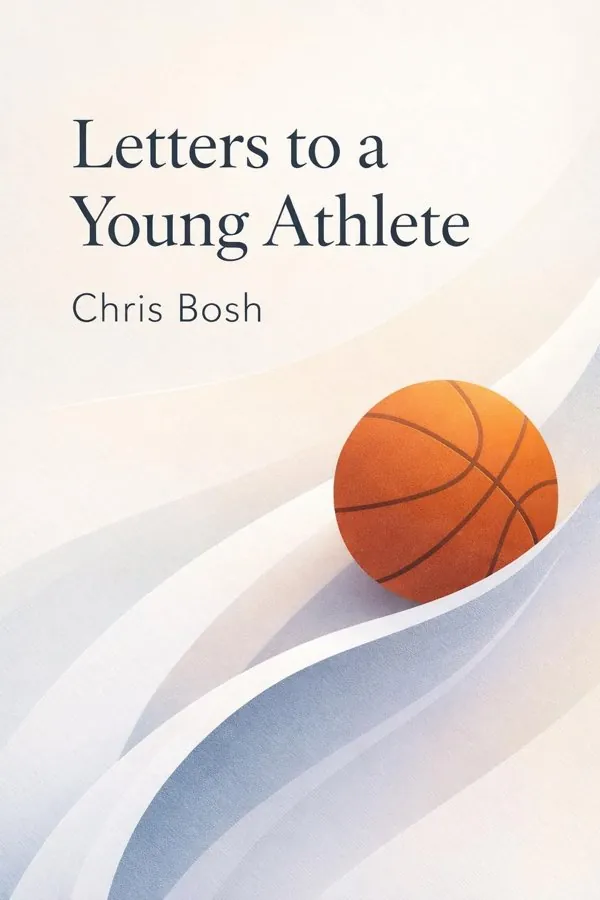
Letters to a Young Athlete: Summary & Key Insights
by Chris Bosh
 10 min10 chaptersAudio available
Key Takeaways from Letters to a Young Athlete
Talent may get attention, but discipline is what turns early promise into lasting achievement.
No serious competitor rises alone.
Pressure does not create character from nothing; it exposes what is already being built underneath.
Being talented is valuable, but being useful to a team is what wins at the highest level.
Greatness is usually discussed as a destination, but Chris Bosh treats it as a standard of behavior.
What Is Letters to a Young Athlete About?
Letters to a Young Athlete by Chris Bosh is a leadership book spanning 10 pages. Letters to a Young Athlete is a warm, reflective, and practical guide from former NBA champion Chris Bosh to anyone chasing excellence under pressure. Framed as a series of personal letters, the book goes far beyond basketball. Bosh uses his journey from a driven kid in Texas to an NBA All-Star and two-time champion with the Miami Heat to explore discipline, confidence, setbacks, teamwork, leadership, identity, and personal growth. His tone is not preachy or distant. Instead, he writes like a mentor who understands the emotional highs and lows of ambition because he has lived them. What makes the book especially valuable is Bosh’s credibility and honesty. He does not present success as a straight path built only on talent. He shows how progress depends on preparation, coachability, humility, resilience, and the ability to keep evolving. He also writes with unusual depth about what happens when sports cannot define you forever, including the challenge of retirement and reinvention after serious health issues ended his career. For young athletes, coaches, parents, and readers interested in leadership, this book offers a grounded reminder that greatness is not just about winning. It is about becoming a stronger, wiser, more complete person.
This FizzRead summary covers all 10 key chapters of Letters to a Young Athlete in approximately 10 minutes, distilling the most important ideas, arguments, and takeaways from Chris Bosh's work. Also available as an audio summary and Key Quotes Podcast.
Letters to a Young Athlete
Letters to a Young Athlete is a warm, reflective, and practical guide from former NBA champion Chris Bosh to anyone chasing excellence under pressure. Framed as a series of personal letters, the book goes far beyond basketball. Bosh uses his journey from a driven kid in Texas to an NBA All-Star and two-time champion with the Miami Heat to explore discipline, confidence, setbacks, teamwork, leadership, identity, and personal growth. His tone is not preachy or distant. Instead, he writes like a mentor who understands the emotional highs and lows of ambition because he has lived them.
What makes the book especially valuable is Bosh’s credibility and honesty. He does not present success as a straight path built only on talent. He shows how progress depends on preparation, coachability, humility, resilience, and the ability to keep evolving. He also writes with unusual depth about what happens when sports cannot define you forever, including the challenge of retirement and reinvention after serious health issues ended his career. For young athletes, coaches, parents, and readers interested in leadership, this book offers a grounded reminder that greatness is not just about winning. It is about becoming a stronger, wiser, more complete person.
Who Should Read Letters to a Young Athlete?
This book is perfect for anyone interested in leadership and looking to gain actionable insights in a short read. Whether you're a student, professional, or lifelong learner, the key ideas from Letters to a Young Athlete by Chris Bosh will help you think differently.
- ✓Readers who enjoy leadership and want practical takeaways
- ✓Professionals looking to apply new ideas to their work and life
- ✓Anyone who wants the core insights of Letters to a Young Athlete in just 10 minutes
Want the full summary?
Get instant access to this book summary and 100K+ more with Fizz Moment.
Get Free SummaryAvailable on App Store • Free to download
Key Chapters
Talent may get attention, but discipline is what turns early promise into lasting achievement. One of the clearest lessons in Chris Bosh’s story is that loving the game is only the beginning. As a child in Texas, basketball was not simply entertainment for him. It was a calling that pulled him toward repetition, focus, and self-improvement. The hours in the driveway mattered not because they were glamorous, but because they built habits before anyone was watching.
Bosh shows that many young athletes misunderstand passion. They think passion means intense emotion, big dreams, or excitement on game day. Real passion is quieter and more durable. It appears in the willingness to practice footwork when nobody applauds, to study fundamentals after a bad performance, and to stay committed when progress feels slow. The best competitors learn to enjoy the process, not just the outcome.
This idea applies beyond sports. A student who wants academic success must learn to revise, review, and prepare consistently. A musician improves through scales and repetition. A leader earns trust through reliable daily actions, not occasional bursts of inspiration. Bosh’s journey makes clear that excellence is never accidental. It is built through routines that often look ordinary from the outside.
A practical way to apply this lesson is to replace vague goals with visible habits. Instead of saying, “I want to be great,” define what greatness looks like each day: thirty minutes of skill work, film study twice a week, proper sleep, and honest self-assessment after practice. Passion without structure fades quickly. Passion with discipline becomes progress.
Actionable takeaway: Create a simple daily system that supports your goal, and judge yourself by consistency of effort, not just by results.
No serious competitor rises alone. Chris Bosh repeatedly emphasizes that every stage of development is influenced by people who challenge, guide, and steady you. Family members teach values, coaches sharpen discipline, teammates expand perspective, and role models show what professionalism looks like in action. Mentorship is not a luxury for elite performers. It is one of the foundations of growth.
Bosh’s reflections suggest that a great mentor does more than improve technical skill. The right guide helps a young athlete learn accountability, emotional control, patience, and self-respect. A coach may correct defensive positioning, but also teach the larger lesson that details matter. A parent may insist on responsibility at home, which later becomes mental toughness under pressure. These influences are cumulative. They shape character as much as performance.
Importantly, Bosh also implies that mentorship requires humility from the learner. Advice is only useful if you are willing to hear it without defensiveness. Young athletes often want independence, but growth usually accelerates when they learn to listen, ask questions, and accept correction. Mentorship is a partnership between wisdom and openness.
In everyday practice, this can mean building a small circle of trusted voices. A player might rely on a coach for tactical guidance, a veteran teammate for locker-room advice, and a family member for emotional grounding. Outside sports, the same principle applies to careers and leadership. People who seek feedback thoughtfully tend to avoid preventable mistakes and develop faster.
At the same time, not every voice deserves equal weight. Bosh’s perspective encourages discernment. Choose mentors whose actions match their words, whose standards are high, and whose interest in your future is genuine rather than self-serving.
Actionable takeaway: Identify two or three mentors you trust, ask them one specific question about your growth, and apply their feedback with discipline.
Pressure does not create character from nothing; it exposes what is already being built underneath. One of the most powerful themes in Letters to a Young Athlete is that setbacks are not detours from the journey. They are part of the journey itself. Bosh writes from the perspective of someone who experienced high expectations, public scrutiny, difficult transitions, criticism, and eventually the career-ending health challenges that forced him to rethink his future.
His message is not that adversity is enjoyable or easy. It is that hardship can refine you if you choose not to let it define you. In sports, failure arrives constantly: missed shots, reduced playing time, injuries, bad coaching decisions, painful losses. Young athletes often treat these moments as evidence that they are not good enough. Bosh offers a different interpretation. Setbacks can become information. They show where you must improve, where your mindset is fragile, and what kind of person you are becoming.
This outlook is practical because it shifts attention from self-pity to response. An athlete cut from a team can train smarter, ask for honest feedback, and return more prepared. A student who performs poorly on an exam can study patterns of weakness rather than conclude they are incapable. Resilience is not blind optimism. It is the disciplined choice to keep moving with purpose.
Bosh’s own life gives this idea real weight. When health issues ended his playing career, he had to grieve a dream while refusing to collapse into bitterness. That kind of adversity asks a deeper question: Who are you when your plan is taken away? His answer is that strength comes from values and perspective, not from circumstances alone.
Actionable takeaway: The next time you face a setback, write down what happened, what it taught you, and the one response that is fully within your control.
Being talented is valuable, but being useful to a team is what wins at the highest level. Chris Bosh’s career, especially his championship years in Miami, gives him a strong platform to discuss the real meaning of teamwork and leadership. He makes clear that teams do not succeed because everyone gets equal spotlight. They succeed because individuals commit to a shared purpose and understand when sacrifice is necessary.
This is a difficult lesson for ambitious people. Young athletes are often rewarded for standing out, scoring more, or proving themselves. But as competition rises, pure self-expression is not enough. You must read what the group needs. Sometimes leadership means taking the shot. Other times it means setting the screen, rotating on defense, communicating on the bench, or accepting a smaller role without letting your effort drop.
Bosh’s insight is especially meaningful because he adjusted his own game to fit alongside other superstars. That kind of adaptation requires maturity. It means separating self-worth from statistics and understanding that contribution takes many forms. In leadership terms, this is emotional intelligence in action. A strong leader does not insist on being the center of every story. They strengthen the system around them.
This applies in workplaces, classrooms, and families as well. A team project fails when each person defends status instead of solving problems. An organization improves when people focus on the mission rather than personal credit. Collaboration becomes more effective when ego is managed, communication is clear, and trust is built through reliable action.
A practical habit is to ask before each performance or meeting, “What does the team need from me today?” The answer may differ from what would make you look best. Over time, people who make teams stronger become indispensable.
Actionable takeaway: In your next group setting, choose one unglamorous action that helps the whole team and do it with full commitment.
Greatness is usually discussed as a destination, but Chris Bosh treats it as a standard of behavior. The pursuit of excellence in his book is not about chasing perfection or obsessing over image. It is about honoring the small details that, over time, separate serious performers from inconsistent ones. Film study, nutrition, conditioning, recovery, footwork, emotional control, and preparation all matter because excellence is cumulative.
This idea is liberating because it makes improvement measurable. You do not need to control public recognition, future opportunities, or the opinions of critics. You can control your preparation. Bosh’s experience in elite basketball shows that when everyone is talented, details become decisive. A single extra rotation on defense, one more sprint in training, or one better decision under pressure can change outcomes.
The principle extends beyond athletics. In leadership, excellence means showing up prepared, listening closely, following through, and communicating clearly. In creative work, it means revising until your thinking is sharp. In personal development, it means treating sleep, health, and focus as serious performance tools rather than afterthoughts.
Bosh also implies that excellence is not occasional intensity. It is repeatability. Many people can have one strong day when motivation is high. Fewer can maintain standards when they are tired, frustrated, or unnoticed. That is why routines matter. Systems reduce the need to negotiate with your feelings every day.
To apply this, identify the hidden fundamentals in your field. If you are an athlete, perhaps it is stretching, defensive awareness, or hydration. If you are leading others, perhaps it is preparation for meetings, timely responses, and calm communication under stress. Improvement often comes from strengthening what seems basic.
Actionable takeaway: Pick three daily fundamentals in your craft and commit to performing them well for the next two weeks without exception.
One of the most mature and necessary lessons in Letters to a Young Athlete is that identity cannot rest entirely on performance. Sports can offer meaning, structure, status, and belonging, but they can also become dangerous when they become your only source of self-worth. Chris Bosh writes with unusual insight about this tension because he lived the intensity of professional athletics and also faced the painful reality that no athletic career lasts forever.
For young athletes, this message may sound uncomfortable. If you care deeply about your sport, you may fear that developing other interests will dilute your commitment. Bosh argues the opposite. A broader identity makes you healthier, wiser, and more resilient. When you know yourself as a learner, friend, family member, creative person, or citizen, you are less likely to collapse emotionally after a bad game, an injury, or a career transition.
This does not mean caring less about competition. It means placing competition in a larger human context. Athletes who cultivate perspective often handle pressure better because every performance no longer feels like a verdict on their entire existence. They can compete with intensity while keeping emotional balance.
In practical terms, this might mean reading widely, developing hobbies, learning a new skill, investing in relationships, or engaging with causes that matter to you. These pursuits are not distractions from excellence. They can deepen your maturity and sustain you in periods when sports are uncertain or unavailable.
Bosh’s own path after retirement highlights why this matters. When one chapter closes, people with a fuller sense of self are better prepared to begin another. Identity built only on applause is fragile. Identity rooted in character can adapt.
Actionable takeaway: Spend at least one hour each week developing an interest or relationship that has nothing to do with your sport or main performance role.
Many ambitious people treat their bodies as tools to be pushed until they fail. Chris Bosh offers a wiser view: health is not separate from performance or leadership. It is one of its foundations. His own career was dramatically shaped by serious blood clot issues, a life-threatening condition that forced him to confront limits no amount of willpower could overcome. That experience gives his message unusual urgency.
For athletes, the temptation to ignore warning signs is strong. Pain is normalized, rest is underestimated, and toughness is often confused with denial. Bosh challenges that mindset by showing that long-term success depends on respecting the body, listening to experts, and understanding that recovery, nutrition, sleep, and medical care are not signs of weakness. They are forms of responsibility.
The leadership dimension of this lesson is important. People who care for themselves are often better able to care for others. A captain who is exhausted, reckless, or emotionally depleted cannot model sustainable excellence. In workplaces and schools, the same pattern appears. Burnout reduces decision quality, patience, and judgment. Health supports consistency.
This principle is practical in everyday life. An athlete can track sleep and hydration with the same seriousness used for workouts. A coach can create a culture where speaking up about injuries is encouraged rather than shamed. A student balancing heavy demands can protect recovery time instead of glorifying constant strain. Health should be treated as strategic, not optional.
Bosh’s story reminds readers that the body is not invincible, and pretending otherwise can have severe consequences. True strength includes self-awareness, restraint, and the courage to prioritize well-being even when external pressure says otherwise.
Actionable takeaway: Choose one recovery habit you have neglected, such as sleep, hydration, stretching, or medical follow-up, and treat it as a non-negotiable part of your training.
High performers are often told to specialize narrowly, but Chris Bosh makes a compelling case that creativity and curiosity strengthen rather than weaken excellence. He presents learning, exploration, and artistic interest as ways to expand the mind, refresh motivation, and deepen self-understanding. This is especially valuable in a culture that can reduce athletes to statistics, routines, and roles.
Creativity matters because it teaches flexibility. In sports, rigid thinkers struggle when the game changes, when defenses adjust, or when their role evolves. Curious people adapt more easily because they are used to experimenting, observing, and seeing patterns from different angles. Off the court, creativity supports emotional expression, problem-solving, and resilience during transition.
Bosh’s broader message is that education never stops. Reading, asking questions, exploring new ideas, and engaging with art or technology are not side hobbies for the serious athlete. They are ways of becoming a more complete human being. A person who learns beyond one domain becomes more thoughtful in every domain.
This idea can be applied simply. A young athlete might keep a journal, read biographies, learn a musical instrument, study public speaking, or explore entrepreneurship. These activities sharpen attention and develop dimensions of identity that sports alone cannot provide. They may also improve performance indirectly by reducing mental fatigue and strengthening confidence in other settings.
For leaders, creativity is especially useful because new challenges rarely yield to old habits alone. The ability to reframe problems, communicate imaginatively, and stay mentally engaged gives an edge over those who rely only on routine. Bosh shows that curiosity is not a distraction from ambition. It is part of what keeps ambition healthy and sustainable.
Actionable takeaway: Add one creative or educational practice to your week, and treat it as training for your mind, not as time away from your goals.
Every ambitious life eventually reaches a moment when the old version of success no longer fits. Chris Bosh’s reflections on transition and reinvention are among the most valuable parts of the book because they speak to a universal challenge: what do you do when a major identity, goal, or season ends? His retirement from basketball, forced by health realities rather than choice, made this question deeply personal.
Bosh does not romanticize reinvention. He shows that it begins with grief, humility, and honesty. You cannot build a meaningful next chapter while pretending the previous one is still available. Acceptance is painful because it asks you to release control, but it also creates the space for new purpose. Reinvention is not about replacing loss instantly. It is about learning to move forward without denying what mattered.
This lesson applies to far more than retired athletes. Students graduate. Professionals change careers. Parents enter new life stages. Injuries alter plans. Companies evolve. In each case, people often delay growth by clinging to an expired identity. Bosh’s example suggests that transition becomes easier when you ask not only, “What am I losing?” but also, “What strengths can I carry forward?” Discipline, communication, courage, and experience still matter even when the arena changes.
Practically, reinvention often starts small. It might involve learning a new skill, speaking with people in a different field, mentoring others, or testing new forms of contribution. The key is to stay open while respecting the emotional reality of change. Reinvention is not betrayal of the past. It is an extension of your capacity to grow.
Actionable takeaway: If you are in a period of transition, list three strengths from your previous chapter that can help you build your next one.
The final measure of success is not only what you achieved, but what you leave behind in other people. Chris Bosh frames legacy as something larger than trophies, headlines, or personal records. Those things matter, but they fade quickly if they are disconnected from service, mentorship, and contribution. A meaningful life creates value that continues after the spotlight moves on.
This view changes the purpose of leadership. Instead of asking only how to maximize your own performance, you begin asking how your knowledge, example, and resources can help others grow. For experienced athletes, this may mean mentoring younger teammates, modeling professionalism, or giving honest encouragement at the right time. For anyone in a position of influence, it means understanding that people remember how you made them stronger, not just how successful you appeared.
Bosh’s career and post-retirement advocacy reflect this perspective. By sharing what he learned, he turns private experience into public guidance. That is a form of generosity. It suggests that wisdom gains value when it is passed on.
This principle works in everyday settings. A student can help a younger peer navigate pressure. A manager can develop team members rather than hoard authority. A parent can create habits and values that outlast any single conversation. Legacy is built in repeated acts of investment.
There is also a moral dimension here. Leadership without concern for others easily becomes vanity. Lasting influence requires empathy, responsibility, and a willingness to think beyond immediate reward. Legacy grows when success becomes communal rather than purely individual.
Actionable takeaway: This week, share one lesson, introduction, or act of support that could genuinely help someone a few steps behind you.
All Chapters in Letters to a Young Athlete
About the Author
Chris Bosh is an American former professional basketball player, author, and public speaker. He played 13 seasons in the NBA, first with the Toronto Raptors and later with the Miami Heat, where he won two championships and became known for his versatility, intelligence, and team-first approach. An 11-time NBA All-Star, Bosh successfully evolved his game as basketball changed, making him one of the most adaptable stars of his era. His career ended prematurely after serious blood clot complications, a challenge that reshaped his path and deepened his perspective on health, identity, and life beyond sports. Since retiring, Bosh has focused on writing, mentoring, and advocating for athlete development, creativity, education, and lifelong learning.
Get This Summary in Your Preferred Format
Read or listen to the Letters to a Young Athlete summary by Chris Bosh anytime, anywhere. FizzRead offers multiple formats so you can learn on your terms — all free.
Available formats: App · Audio · PDF · EPUB — All included free with FizzRead
Download Letters to a Young Athlete PDF and EPUB Summary
Key Quotes from Letters to a Young Athlete
“Talent may get attention, but discipline is what turns early promise into lasting achievement.”
“Chris Bosh repeatedly emphasizes that every stage of development is influenced by people who challenge, guide, and steady you.”
“Pressure does not create character from nothing; it exposes what is already being built underneath.”
“Being talented is valuable, but being useful to a team is what wins at the highest level.”
“Greatness is usually discussed as a destination, but Chris Bosh treats it as a standard of behavior.”
Frequently Asked Questions about Letters to a Young Athlete
Letters to a Young Athlete by Chris Bosh is a leadership book that explores key ideas across 10 chapters. Letters to a Young Athlete is a warm, reflective, and practical guide from former NBA champion Chris Bosh to anyone chasing excellence under pressure. Framed as a series of personal letters, the book goes far beyond basketball. Bosh uses his journey from a driven kid in Texas to an NBA All-Star and two-time champion with the Miami Heat to explore discipline, confidence, setbacks, teamwork, leadership, identity, and personal growth. His tone is not preachy or distant. Instead, he writes like a mentor who understands the emotional highs and lows of ambition because he has lived them. What makes the book especially valuable is Bosh’s credibility and honesty. He does not present success as a straight path built only on talent. He shows how progress depends on preparation, coachability, humility, resilience, and the ability to keep evolving. He also writes with unusual depth about what happens when sports cannot define you forever, including the challenge of retirement and reinvention after serious health issues ended his career. For young athletes, coaches, parents, and readers interested in leadership, this book offers a grounded reminder that greatness is not just about winning. It is about becoming a stronger, wiser, more complete person.
You Might Also Like

Extreme Ownership
Jocko Willink
10 min
Dare to Lead
Brene Brown
10 min
Leaders Eat Last
Simon Sinek
10 min
The 21 Irrefutable Laws of Leadership
John Maxwell
10 min
Start With Why
Simon Sinek
10 min
How to Lead When You're Not in Charge
Clay Scroggins
10 minBrowse by Category
Ready to read Letters to a Young Athlete?
Get the full summary and 100K+ more books with Fizz Moment.