
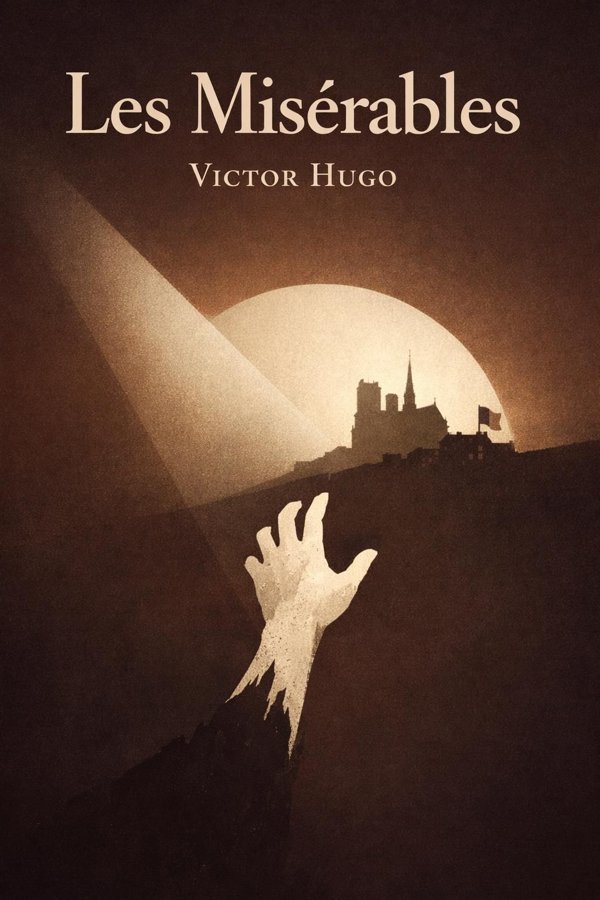
Les Misérables: Summary & Key Insights
by Victor Hugo
 10 min9 chaptersAudio available
Key Takeaways from Les Misérables
A single act of compassion can do what years of punishment never could.
When rules become more important than people, justice can turn into cruelty.
A society reveals its moral condition by what happens to its poorest members.
Love is most convincing when it takes the form of duty freely embraced.
You can change your name, status, and surroundings, but you cannot escape the inner court of conscience.
What Is Les Misérables About?
Les Misérables by Victor Hugo is a classics book spanning 5 pages. Few novels attempt to hold an entire society inside their pages; Les Misérables does exactly that. First published in 1862, Victor Hugo’s masterpiece is at once a sweeping historical epic, a moral drama, a political critique, and a deeply intimate story of human suffering and grace. Set in post-revolutionary France, it follows Jean Valjean, a former convict whose life is transformed by an act of mercy, and Inspector Javert, the relentless officer who believes justice must be absolute. Around them move unforgettable figures—Fantine, Cosette, Marius, Gavroche, and the scheming Thénardiers—each revealing another face of poverty, law, love, and sacrifice. What makes Les Misérables endure is not only its plot, but its conviction that people are more than their worst mistakes and that society is judged by how it treats its most vulnerable. Hugo writes with unusual moral authority because he was not merely a novelist, but a public intellectual and humanitarian deeply engaged with the political struggles of his time. The result is a book that still feels urgent: a passionate argument that compassion can be more transformative than punishment, and that redemption remains possible even in a broken world.
This FizzRead summary covers all 9 key chapters of Les Misérables in approximately 10 minutes, distilling the most important ideas, arguments, and takeaways from Victor Hugo's work. Also available as an audio summary and Key Quotes Podcast.
Les Misérables
Few novels attempt to hold an entire society inside their pages; Les Misérables does exactly that. First published in 1862, Victor Hugo’s masterpiece is at once a sweeping historical epic, a moral drama, a political critique, and a deeply intimate story of human suffering and grace. Set in post-revolutionary France, it follows Jean Valjean, a former convict whose life is transformed by an act of mercy, and Inspector Javert, the relentless officer who believes justice must be absolute. Around them move unforgettable figures—Fantine, Cosette, Marius, Gavroche, and the scheming Thénardiers—each revealing another face of poverty, law, love, and sacrifice.
What makes Les Misérables endure is not only its plot, but its conviction that people are more than their worst mistakes and that society is judged by how it treats its most vulnerable. Hugo writes with unusual moral authority because he was not merely a novelist, but a public intellectual and humanitarian deeply engaged with the political struggles of his time. The result is a book that still feels urgent: a passionate argument that compassion can be more transformative than punishment, and that redemption remains possible even in a broken world.
Who Should Read Les Misérables?
This book is perfect for anyone interested in classics and looking to gain actionable insights in a short read. Whether you're a student, professional, or lifelong learner, the key ideas from Les Misérables by Victor Hugo will help you think differently.
- ✓Readers who enjoy classics and want practical takeaways
- ✓Professionals looking to apply new ideas to their work and life
- ✓Anyone who wants the core insights of Les Misérables in just 10 minutes
Want the full summary?
Get instant access to this book summary and 100K+ more with Fizz Moment.
Get Free SummaryAvailable on App Store • Free to download
Key Chapters
A single act of compassion can do what years of punishment never could. Les Misérables begins with Jean Valjean as a hardened ex-convict, imprisoned for stealing bread and brutalized by a system that turns survival into crime. When he is released, society continues his sentence in another form: no one trusts him, no one welcomes him, and the law’s mark follows him everywhere. Then Bishop Myriel offers him food, shelter, dignity, and, after Valjean steals his silver, an even greater gift: forgiveness. Instead of denouncing him, the bishop tells the authorities the silver was given freely and adds the candlesticks besides.
This moment is the moral engine of the entire novel. Hugo suggests that people do not become good merely because rules demand it; they change when someone treats them as worthy of change. Valjean’s transformation into a charitable factory owner and protector of the vulnerable grows directly from the bishop’s refusal to reduce him to his crime.
The idea has practical force beyond literature. In daily life, people often become trapped inside labels: failure, addict, criminal, dropout, difficult employee. Hugo challenges the instinct to define others by their lowest point. A teacher who gives a struggling student another chance, a manager who mentors rather than humiliates, or a friend who responds to betrayal with truth and boundaries instead of pure condemnation can interrupt destructive cycles.
This does not mean ignoring harm or abandoning accountability. It means recognizing that justice without humanity can deepen the very misery it claims to solve. The bishop’s example shows that mercy is not weakness; it is a disciplined belief in human possibility.
Actionable takeaway: Look for one person you have mentally reduced to a mistake, and ask what practical act of dignity or second-chance support might help them become more than that story.
When rules become more important than people, justice can turn into cruelty. No character embodies this tension more sharply than Inspector Javert. He is not a cartoon villain; he is disciplined, sincere, and devoted to order. But Hugo uses him to expose a dangerous moral error: the belief that legality and righteousness are always the same. Javert cannot imagine that a convicted man can become virtuous, nor that mercy might be morally superior to punishment. To him, Jean Valjean must remain what the law once named him.
Through their conflict, Hugo asks a timeless question: What happens when institutions lose sight of the human beings they govern? Valjean breaks parole and adopts false identities, but he does so to build a life of usefulness and to protect others. Fantine, pushed into desperation, breaks social codes because society gives her no honorable path to survival. In each case, technical wrongdoing exists beside deeper innocence.
This tension appears everywhere today. Workplaces may follow policies that are formally fair yet blind to personal realities. Courts may apply penalties consistently while ignoring structural inequality. Families may enforce principles so rigidly that compassion disappears. Hugo does not argue for chaos or the abolition of law; he argues that law must be guided by conscience.
Javert’s tragedy is that he cannot survive moral complexity. When Valjean spares his life, the rigid system inside Javert collapses. He has no framework for a world in which a criminal can be noble and an officer of the law can be morally limited. Hugo’s warning is clear: any ideology that leaves no room for mercy eventually breaks under the weight of reality.
Actionable takeaway: The next time you judge a situation by rules alone, pause and ask a second question: What outcome would be not only legal or correct, but genuinely humane?
Love is most convincing when it takes the form of duty freely embraced. Jean Valjean’s devotion to Cosette is one of the emotional centers of Les Misérables, and it shows how redemption matures through care. At first, Valjean’s moral rebirth is inward: he struggles with his conscience, his past, and the meaning of the bishop’s mercy. But when he rescues Cosette from the abuse of the Thénardiers, goodness becomes active. He does not merely feel compassion; he reorganizes his life around another person’s safety.
Hugo portrays parenthood here less as biology than as sacrificial stewardship. Cosette is not Valjean’s daughter by blood, yet his love is no less real. He protects her, educates her, uproots his life for her, and risks capture to keep her secure. In doing so, Hugo suggests that true love is not possession. It is patient labor on behalf of another person’s flourishing.
This insight applies broadly. We often equate love with intensity of feeling, dramatic expression, or personal fulfillment. Hugo offers a stricter test: Does your love make you more dependable, more honest, more willing to inconvenience yourself for another’s good? This matters in families, friendships, mentorships, and communities. Caring for a child, checking in on an aging parent, showing up consistently for a friend in crisis, or creating a stable home environment are less theatrical than declarations of devotion, but morally greater.
Valjean also learns one of love’s hardest lessons: to let go. His care for Cosette eventually demands that he release control and allow her life to widen beyond him. Love protects, but it must not imprison.
Actionable takeaway: Identify one relationship you value and ask not “How strongly do I feel?” but “What consistent responsibility can I take on that would make this person safer, stronger, or more free?”
You can change your name, status, and surroundings, but you cannot escape the inner court of conscience. After rebuilding his life as Monsieur Madeleine, a respected mayor and industrialist, Jean Valjean appears to have outrun his past. Yet when another man is mistaken for him and faces conviction, Valjean confronts a severe moral crisis: protect the life he has built, or reveal himself and save an innocent person.
This is one of the novel’s greatest tests of character because Hugo removes easy answers. Valjean is doing genuine good in his community. Exposing himself could destroy the factory, abandon those who depend on him, and end his ability to protect Cosette. Remaining silent would preserve much good—but at the cost of one innocent man’s freedom. Hugo uses this dilemma to show that conscience often demands sacrifice precisely when self-justification is easiest.
In modern life, such moments may appear less dramatic but are common in structure. A professional knows a colleague is being blamed unfairly but fears speaking up. A leader benefits from a narrative they know is incomplete. A family member avoids telling a painful truth because silence is convenient. In each case, the temptation is to rationalize: too much will be lost, the situation is complicated, someone else will intervene. Hugo insists that moral seriousness means acting before comfort rewrites truth.
Valjean’s choice reveals that redemption is not a one-time conversion. It must be renewed under pressure. We become who we are through repeated acts of honesty, especially when honesty threatens our security.
Actionable takeaway: Notice one area where silence protects your image at someone else’s expense, and take one concrete step toward truthful accountability before convenience hardens into character.
No life unfolds outside history. One of Hugo’s great achievements is his refusal to separate personal drama from political upheaval. The lives of Valjean, Marius, Gavroche, and countless others are shaped by revolution, class conflict, failed governments, and the hopes that linger after national disappointment. The Paris barricades are not just a thrilling backdrop; they represent the collision between youthful idealism and entrenched social misery.
Marius and his friends, especially the members of the Friends of the ABC, believe that a more just society can be built through political struggle. Hugo portrays their courage sympathetically, but not sentimentally. The uprising is brave, tragic, and limited. It reveals both the nobility of collective action and the painful fact that history does not bend quickly simply because people deserve better.
This matters because readers often treat politics as distant and private life as personal. Hugo insists they are intertwined. Employment, housing, education, policing, public morality, and the possibility of social mobility are all political questions with intimate consequences. Fantine’s decline, Gavroche’s street survival, and Valjean’s persecution are not random events; they emerge from a society organized in unequal ways.
At the same time, Hugo avoids the simplification that politics alone can save humanity. Structural change matters, but so do character, loyalty, courage, and compassion. The barricade scenes teach that ideals need institutions, but institutions also need moral people.
For readers today, the lesson is to resist both cynicism and passivity. Social conditions are made by human choices, and therefore can be changed by them, though never without cost.
Actionable takeaway: Connect one personal frustration—housing, safety, schooling, wages, healthcare—to its broader social context, and engage in one civic act that moves beyond complaint into participation.
If adults create the world, children are the ones forced to live inside its failures. Hugo returns again and again to vulnerable children to measure the ethics of society. Cosette, neglected and abused by the Thénardiers, becomes the image of innocence exploited. Gavroche, witty and resilient on the streets of Paris, exposes the absurdity of a world that admires courage in children only after abandoning them. Through these figures, Hugo argues that childhood suffering is never merely unfortunate; it is evidence of collective neglect.
This theme deepens the novel’s emotional and political force. Adults often speak about values—religion, law, patriotism, honor—but Hugo asks a simpler, harsher question: What do those values produce for children? If a social order leaves them hungry, frightened, uneducated, or disposable, then its ideals ring hollow.
The point remains urgently practical. Communities often respond to children’s needs after damage is visible—when behavior problems appear, when schooling fails, when trauma has already hardened. Hugo’s vision encourages earlier attention: stable homes, safe environments, literacy, emotional care, and institutions designed around protection rather than punishment.
Cosette’s transformation under Valjean’s care also shows the long-term power of safety. Once removed from cruelty, she begins to grow into trust, tenderness, and hope. Gavroche, by contrast, demonstrates how brilliance and bravery can be squandered when society treats abandonment as normal.
For parents, teachers, leaders, and citizens, Hugo’s challenge is direct. A culture cannot call itself civilized if children must become heroic simply to survive.
Actionable takeaway: Invest time, money, or advocacy in one child-centered effort—whether tutoring, mentoring, family support, or local services—because protecting children is one of the clearest ways to practice justice before repair becomes rescue.
Moral greatness is most visible in how we treat those who have power to harm us. One of the most remarkable moments in Les Misérables comes when Jean Valjean has the opportunity to kill Javert during the barricade uprising and instead chooses to spare him. This decision is not naive. Valjean knows Javert has hunted him relentlessly and will likely continue to do so. Yet he refuses to answer dehumanization with dehumanization.
Hugo’s insight here is subtle but profound. If suffering automatically justified revenge, then every wounded person would become licensed to wound others. Valjean breaks that chain. He recognizes Javert as morally mistaken, but still as human. This act becomes spiritually devastating for Javert because it introduces a category he cannot manage: grace offered to an enemy.
In ordinary life, this theme is intensely practical. Most people will not confront life-and-death enemies, but they will face rivals, critics, betrayers, and people who operate in bad faith. The instinct is often to caricature them, expose them, humiliate them, or fantasize about their downfall. Hugo does not require trust without wisdom or reconciliation without truth. He does suggest that refusing contempt preserves our own humanity.
To recognize an enemy’s humanity is not to excuse their actions. It is to reject the corrosive belief that some people are beneath moral consideration. In workplaces, families, and public life, this can mean criticizing behavior without denying dignity, setting boundaries without cruelty, and refusing to let conflict define identity.
Valjean’s mercy does not save Javert in the immediate psychological sense, but it reveals the higher law by which Valjean now lives. That is the real victory.
Actionable takeaway: In your next conflict, separate the person from the offense and choose one response that is firm but not degrading, proving that integrity is possible without contempt.
Redemption is complete only when it costs something. Across Les Misérables, Hugo presents sacrifice not as melodrama, but as the deepest proof of love and moral renewal. Valjean repeatedly gives up safety, status, anonymity, and eventually even closeness to Cosette so that others may live more freely. Fantine sacrifices everything for her child, though society never honors her for it. Gavroche gives his life with heartbreaking courage. Even Marius is forced to learn that love requires humility, not only passion.
What unites these stories is Hugo’s conviction that a meaningful life is measured less by possession than by what one is willing to surrender for the good of another. This idea runs against modern habits of self-protection and self-maximization. We are often encouraged to ask what serves our growth, our peace, our advancement. Hugo asks a harder question: What are you prepared to lose in order to be faithful, truthful, and loving?
Importantly, sacrifice in the novel is not mere suffering for its own sake. It becomes noble only when directed toward life, dignity, and freedom. Valjean’s final acts are powerful because they are voluntary and purposeful. He does not cling to being needed; he chooses the painful honesty that allows Cosette and Marius to build their future.
In practical terms, sacrifice may look like staying present in difficulty, giving time to care for another, surrendering pride in order to reconcile, or foregoing personal advantage to protect someone vulnerable. Hugo teaches that such losses are not wasted. They become the substance of character.
Actionable takeaway: Choose one area where comfort is preventing courage, and make one deliberate sacrifice—of time, ego, convenience, or control—in service of someone else’s genuine good.
All Chapters in Les Misérables
About the Author
Victor Hugo (1802–1885) was a French novelist, poet, playwright, and statesman, widely regarded as one of the greatest writers of the 19th century. A leading figure of French Romanticism, he produced major works across multiple genres, including The Hunchback of Notre-Dame and Les Misérables. Hugo was not only a literary giant but also a committed public intellectual. He spoke forcefully against the death penalty, defended freedom and democracy, and advocated for the poor, the excluded, and the oppressed. His political views led to years of exile after he opposed Napoleon III, and that period deepened the moral and social concerns that shaped his later writing. Hugo’s work endures because it combines epic storytelling with passionate ethical vision, making literature a vehicle for empathy, reform, and human dignity.
Get This Summary in Your Preferred Format
Read or listen to the Les Misérables summary by Victor Hugo anytime, anywhere. FizzRead offers multiple formats so you can learn on your terms — all free.
Available formats: App · Audio · PDF · EPUB — All included free with FizzRead
Download Les Misérables PDF and EPUB Summary
Key Quotes from Les Misérables
“A single act of compassion can do what years of punishment never could.”
“When rules become more important than people, justice can turn into cruelty.”
“A society reveals its moral condition by what happens to its poorest members.”
“Love is most convincing when it takes the form of duty freely embraced.”
“You can change your name, status, and surroundings, but you cannot escape the inner court of conscience.”
Frequently Asked Questions about Les Misérables
Les Misérables by Victor Hugo is a classics book that explores key ideas across 9 chapters. Few novels attempt to hold an entire society inside their pages; Les Misérables does exactly that. First published in 1862, Victor Hugo’s masterpiece is at once a sweeping historical epic, a moral drama, a political critique, and a deeply intimate story of human suffering and grace. Set in post-revolutionary France, it follows Jean Valjean, a former convict whose life is transformed by an act of mercy, and Inspector Javert, the relentless officer who believes justice must be absolute. Around them move unforgettable figures—Fantine, Cosette, Marius, Gavroche, and the scheming Thénardiers—each revealing another face of poverty, law, love, and sacrifice. What makes Les Misérables endure is not only its plot, but its conviction that people are more than their worst mistakes and that society is judged by how it treats its most vulnerable. Hugo writes with unusual moral authority because he was not merely a novelist, but a public intellectual and humanitarian deeply engaged with the political struggles of his time. The result is a book that still feels urgent: a passionate argument that compassion can be more transformative than punishment, and that redemption remains possible even in a broken world.
More by Victor Hugo
You Might Also Like






Browse by Category
Ready to read Les Misérables?
Get the full summary and 100K+ more books with Fizz Moment.