
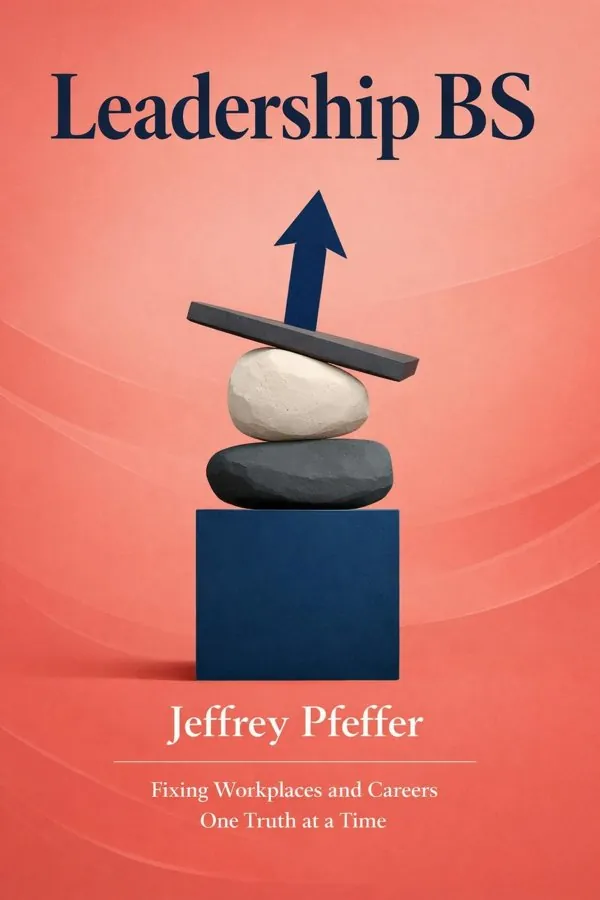
Leadership BS: Fixing Workplaces and Careers One Truth at a Time: Summary & Key Insights
 10 min9 chaptersAudio available
What Is Leadership BS: Fixing Workplaces and Careers One Truth at a Time About?
Leadership BS: Fixing Workplaces and Careers One Truth at a Time by Jeffrey Pfeffer is a leadership book spanning 9 pages. In Leadership BS, Jeffrey Pfeffer exposes the shortcomings of the modern leadership industry, arguing that much of what is taught about leadership is disconnected from reality. Drawing on research and examples from business and academia, Pfeffer challenges conventional wisdom and calls for a more evidence-based approach to leadership that acknowledges human behavior and organizational dynamics.
This FizzRead summary covers all 9 key chapters of Leadership BS: Fixing Workplaces and Careers One Truth at a Time in approximately 10 minutes, distilling the most important ideas, arguments, and takeaways from Jeffrey Pfeffer's work. Also available as an audio summary and Key Quotes Podcast.
Leadership BS: Fixing Workplaces and Careers One Truth at a Time
In Leadership BS, Jeffrey Pfeffer exposes the shortcomings of the modern leadership industry, arguing that much of what is taught about leadership is disconnected from reality. Drawing on research and examples from business and academia, Pfeffer challenges conventional wisdom and calls for a more evidence-based approach to leadership that acknowledges human behavior and organizational dynamics.
Who Should Read Leadership BS: Fixing Workplaces and Careers One Truth at a Time?
This book is perfect for anyone interested in leadership and looking to gain actionable insights in a short read. Whether you're a student, professional, or lifelong learner, the key ideas from Leadership BS: Fixing Workplaces and Careers One Truth at a Time by Jeffrey Pfeffer will help you think differently.
- ✓Readers who enjoy leadership and want practical takeaways
- ✓Professionals looking to apply new ideas to their work and life
- ✓Anyone who wants the core insights of Leadership BS: Fixing Workplaces and Careers One Truth at a Time in just 10 minutes
Want the full summary?
Get instant access to this book summary and 100K+ more with Fizz Moment.
Get Free SummaryAvailable on App Store • Free to download
Key Chapters
When people think about leadership development today, they often picture charismatic speakers, glossy corporate retreats, and programs that promise to make participants more empathetic, visionary, and inspirational. This industry thrives on the idea that there are universally virtuous attributes that, if cultivated, will automatically produce moral and effective leaders. Billions are spent annually on leadership training, yet surprisingly little evidence shows that these efforts actually improve workplace performance or individual behavior.
In my research and consulting across decades, I’ve seen that the leadership industry is built on a commercial model that rewards optimism more than truth. People don’t want to hear that success often involves political skill, strategic self-promotion, or managing impressions — concepts that seem manipulative or uncomfortable. So instead, leadership programs preach kindness, authenticity, and humility. These ideals are noble, but they are not always functional in competitive, power-driven environments.
The promises of leadership training are emotionally appealing because they tell us who we wish to be, not who we are. But in the real world, leaders are constrained by structures, incentives, and human psychology. The resulting mismatch between theory and practice breeds disillusionment and cynicism. True progress starts when we give up the fantasy that good intentions and inspirational stories can substitute for evidence-based practices.
The leadership discourse often speaks of transformation and purpose, yet workplaces across sectors remain filled with disengagement, fear, and politics. This contradiction forms what I call the reality gap — the distance between how leadership is described and how it is lived.
Empirical studies repeatedly show that organizational trust is declining, employee engagement remains stagnant, and misconduct at the top is common. If leadership teaching were effective, we would see measurable improvements in these metrics. Instead, we find decades of stagnation. Leaders attend seminars about empathy and listening — then return to organizations that reward short-term results over long-term relationships.
The reason for this gap is simple: leadership doesn’t exist in a vacuum. It’s embedded in incentive systems and institutional structures that often discourage the behaviors we claim to value. When a leader is praised for being authentic but penalized for expressing unpopular opinions, authenticity becomes a liability. The rhetoric of virtue is meaningless unless the underlying systems support virtuous behavior.
Confronting the reality gap requires embracing discomfort. It means moving away from moralizing and toward social science — understanding how people actually behave under pressure rather than how they ought to behave in ideal conditions.
+ 7 more chapters — available in the FizzRead app
All Chapters in Leadership BS: Fixing Workplaces and Careers One Truth at a Time
About the Author
Jeffrey Pfeffer is a professor of organizational behavior at Stanford Graduate School of Business. He is known for his research on power, leadership, and workplace dynamics, and has authored several influential books on management and organizational theory.
Get This Summary in Your Preferred Format
Read or listen to the Leadership BS: Fixing Workplaces and Careers One Truth at a Time summary by Jeffrey Pfeffer anytime, anywhere. FizzRead offers multiple formats so you can learn on your terms — all free.
Available formats: App · Audio · PDF · EPUB — All included free with FizzRead
Download Leadership BS: Fixing Workplaces and Careers One Truth at a Time PDF and EPUB Summary
Key Quotes from Leadership BS: Fixing Workplaces and Careers One Truth at a Time
“This industry thrives on the idea that there are universally virtuous attributes that, if cultivated, will automatically produce moral and effective leaders.”
“The leadership discourse often speaks of transformation and purpose, yet workplaces across sectors remain filled with disengagement, fear, and politics.”
Frequently Asked Questions about Leadership BS: Fixing Workplaces and Careers One Truth at a Time
Leadership BS: Fixing Workplaces and Careers One Truth at a Time by Jeffrey Pfeffer is a leadership book that explores key ideas across 9 chapters. In Leadership BS, Jeffrey Pfeffer exposes the shortcomings of the modern leadership industry, arguing that much of what is taught about leadership is disconnected from reality. Drawing on research and examples from business and academia, Pfeffer challenges conventional wisdom and calls for a more evidence-based approach to leadership that acknowledges human behavior and organizational dynamics.
More by Jeffrey Pfeffer

7 Rules of Power: Surprising—but True—Advice on How to Get Things Done and Advance Your Career
Jeffrey Pfeffer
10 min
Hard Facts, Dangerous Half-Truths, and Total Nonsense: Profiting from Evidence-Based Management
Jeffrey Pfeffer, Robert I. Sutton
10 min
Dying For A Paycheck: How Modern Management Harms Employee Health And Company Performance—And What We Can Do About It
Jeffrey Pfeffer
10 min
Power: Why Some People Have It and Others Don't
Jeffrey Pfeffer
10 minYou Might Also Like

Extreme Ownership
Jocko Willink
10 min
Dare to Lead
Brene Brown
10 min
Leaders Eat Last
Simon Sinek
10 min
The 21 Irrefutable Laws of Leadership
John Maxwell
10 min
Start With Why
Simon Sinek
10 min
How to Lead When You're Not in Charge
Clay Scroggins
10 minBrowse by Category
Ready to read Leadership BS: Fixing Workplaces and Careers One Truth at a Time?
Get the full summary and 100K+ more books with Fizz Moment.