
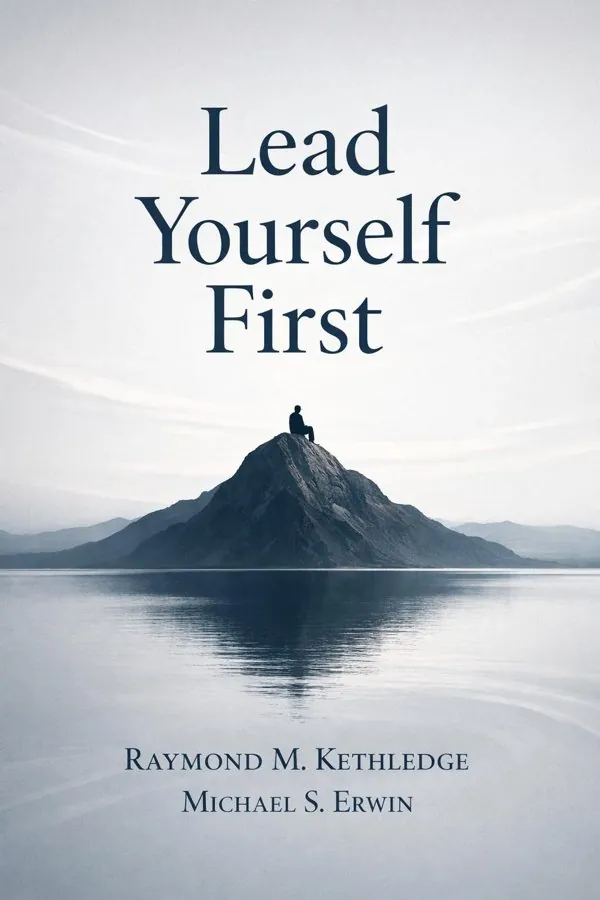
Lead Yourself First: Inspiring Leadership Through Solitude: Summary & Key Insights
by Raymond M. Kethledge, Michael S. Erwin
 10 min8 chaptersAudio available
What Is Lead Yourself First: Inspiring Leadership Through Solitude About?
Lead Yourself First: Inspiring Leadership Through Solitude by Raymond M. Kethledge, Michael S. Erwin is a leadership book spanning 8 pages. Lead Yourself First argues that solitude is essential for effective leadership. Drawing on historical examples from figures such as Dwight D. Eisenhower, Martin Luther King Jr., and Jane Goodall, the authors show how time alone helps leaders clarify their values, make better decisions, and strengthen their moral courage. The book combines research, interviews, and practical insights to demonstrate how solitude fosters focus, creativity, and emotional balance in a world of constant distraction.
This FizzRead summary covers all 8 key chapters of Lead Yourself First: Inspiring Leadership Through Solitude in approximately 10 minutes, distilling the most important ideas, arguments, and takeaways from Raymond M. Kethledge, Michael S. Erwin's work. Also available as an audio summary and Key Quotes Podcast.
Lead Yourself First: Inspiring Leadership Through Solitude
Lead Yourself First argues that solitude is essential for effective leadership. Drawing on historical examples from figures such as Dwight D. Eisenhower, Martin Luther King Jr., and Jane Goodall, the authors show how time alone helps leaders clarify their values, make better decisions, and strengthen their moral courage. The book combines research, interviews, and practical insights to demonstrate how solitude fosters focus, creativity, and emotional balance in a world of constant distraction.
Who Should Read Lead Yourself First: Inspiring Leadership Through Solitude?
This book is perfect for anyone interested in leadership and looking to gain actionable insights in a short read. Whether you're a student, professional, or lifelong learner, the key ideas from Lead Yourself First: Inspiring Leadership Through Solitude by Raymond M. Kethledge, Michael S. Erwin will help you think differently.
- ✓Readers who enjoy leadership and want practical takeaways
- ✓Professionals looking to apply new ideas to their work and life
- ✓Anyone who wants the core insights of Lead Yourself First: Inspiring Leadership Through Solitude in just 10 minutes
Want the full summary?
Get instant access to this book summary and 100K+ more with Fizz Moment.
Get Free SummaryAvailable on App Store • Free to download
Key Chapters
Every era presents its own challenges to leadership, but ours is defined by relentless connectivity. We are plugged into a network that never sleeps, responding to a thousand small urgencies while the great questions of purpose and integrity languish. When General Eisenhower led his command, his thoughts were not interrupted every minute by an influx of alerts or commentary. Today, however, the digital world fragments the leader’s mental space. And with fragmentation comes superficiality of judgment.
In our research, we found that constant distraction erodes the brain’s capacity for sustained thinking. Leaders lose the ability to listen to their own conscience or analyze complex situations because they are conditioned to respond instantly rather than reflect profoundly. The result is reactive leadership, guided by impulses and external pressures rather than principle or clarity.
In solitude, this tide of distraction can be reversed. When leaders make a deliberate choice to disconnect—to turn off devices, separate from chatter, and refocus attention—they begin to reclaim what modern life has stolen: the quietness that breeds insight. Solitude allows space for discernment; it enables the mind to process rather than merely perform. In stillness, leaders rediscover autonomy, separating what is important from what is urgent.
This crisis of distraction, we realized, is not technological but spiritual. It is the loss of the inner voice, the drowning of conviction under a flood of input. To lead effectively, one must therefore choose silence as resistance—to preserve clarity amid chaos, to protect moral independence amid the noise of consensus.
If we want to understand solitude’s power, we need only look to those who wielded it with mastery. Consider Dwight D. Eisenhower in the tense months before D-Day. He knew the decision to launch the invasion could determine the fate of millions. Faced with conflicting counsel from advisors and allies, Eisenhower withdrew—walking alone through Normandy’s fields to think without interruption. In that solitude, he confronted uncertainty, wrestled with responsibility, and ultimately found the clarity to act.
Martin Luther King Jr. experienced solitude of a very different kind. His solitude was imposed, the product of imprisonment and persecution. Yet within his cell, he discovered inner liberty. Deprived of contact, he reflected deeply on justice, faith, and courage, articulating ideas that would transform a nation. His solitude was an incubator of conviction, the crucible of moral vision.
Jane Goodall, observing chimpanzees in the forests of Gombe, found solitude not as isolation but communion—time alone within nature that sharpened her perception and empathy. T. E. Lawrence, navigating the desert’s vast silence, learned that distance from the world often reveals its true patterns.
Each of these leaders faced immense external pressures, yet their greatest clarity emerged from moments of withdrawal. These stories illustrate solitude not as a retreat from responsibility but as preparation for it. History reveals solitude as the birthplace of decisive thought and moral courage. The pattern repeats: when leaders step away from the world’s noise, they return to it transformed.
+ 6 more chapters — available in the FizzRead app
All Chapters in Lead Yourself First: Inspiring Leadership Through Solitude
About the Authors
Raymond M. Kethledge is a judge on the U.S. Court of Appeals for the Sixth Circuit. Michael S. Erwin is a U.S. Army veteran and leadership consultant. Together, they explore the intersection of solitude and leadership through historical and contemporary examples.
Get This Summary in Your Preferred Format
Read or listen to the Lead Yourself First: Inspiring Leadership Through Solitude summary by Raymond M. Kethledge, Michael S. Erwin anytime, anywhere. FizzRead offers multiple formats so you can learn on your terms — all free.
Available formats: App · Audio · PDF · EPUB — All included free with FizzRead
Download Lead Yourself First: Inspiring Leadership Through Solitude PDF and EPUB Summary
Key Quotes from Lead Yourself First: Inspiring Leadership Through Solitude
“Every era presents its own challenges to leadership, but ours is defined by relentless connectivity.”
“If we want to understand solitude’s power, we need only look to those who wielded it with mastery.”
Frequently Asked Questions about Lead Yourself First: Inspiring Leadership Through Solitude
Lead Yourself First: Inspiring Leadership Through Solitude by Raymond M. Kethledge, Michael S. Erwin is a leadership book that explores key ideas across 8 chapters. Lead Yourself First argues that solitude is essential for effective leadership. Drawing on historical examples from figures such as Dwight D. Eisenhower, Martin Luther King Jr., and Jane Goodall, the authors show how time alone helps leaders clarify their values, make better decisions, and strengthen their moral courage. The book combines research, interviews, and practical insights to demonstrate how solitude fosters focus, creativity, and emotional balance in a world of constant distraction.
You Might Also Like

Extreme Ownership
Jocko Willink
10 min
Dare to Lead
Brene Brown
10 min
Leaders Eat Last
Simon Sinek
10 min
The 21 Irrefutable Laws of Leadership
John Maxwell
10 min
Start With Why
Simon Sinek
10 min
How to Lead When You're Not in Charge
Clay Scroggins
10 minBrowse by Category
Ready to read Lead Yourself First: Inspiring Leadership Through Solitude?
Get the full summary and 100K+ more books with Fizz Moment.