
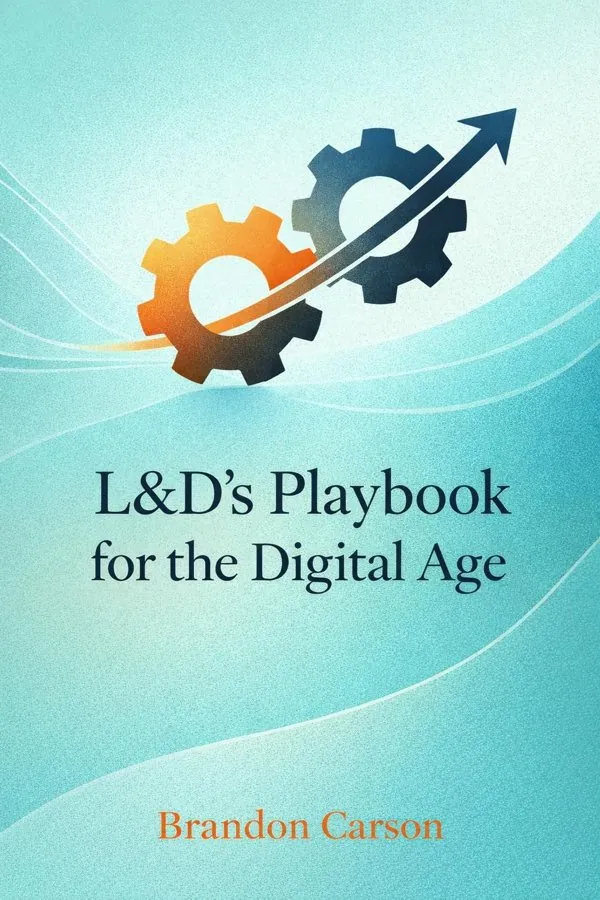
L&D's Playbook for the Digital Age: Summary & Key Insights
 10 min3 chaptersAudio available
What Is L&D's Playbook for the Digital Age About?
L&D's Playbook for the Digital Age by Brandon Carson is a leadership book spanning 3 pages. L&D's Playbook for the Digital Age offers a strategic guide for learning and development professionals navigating the challenges of digital transformation. Brandon Carson outlines how organizations can reorient their L&D functions to proactively enable workforce agility, align learning strategies with business goals, and leverage technology to drive performance and innovation.
This FizzRead summary covers all 3 key chapters of L&D's Playbook for the Digital Age in approximately 10 minutes, distilling the most important ideas, arguments, and takeaways from Brandon Carson's work. Also available as an audio summary and Key Quotes Podcast.
L&D's Playbook for the Digital Age
L&D's Playbook for the Digital Age offers a strategic guide for learning and development professionals navigating the challenges of digital transformation. Brandon Carson outlines how organizations can reorient their L&D functions to proactively enable workforce agility, align learning strategies with business goals, and leverage technology to drive performance and innovation.
Who Should Read L&D's Playbook for the Digital Age?
This book is perfect for anyone interested in leadership and looking to gain actionable insights in a short read. Whether you're a student, professional, or lifelong learner, the key ideas from L&D's Playbook for the Digital Age by Brandon Carson will help you think differently.
- ✓Readers who enjoy leadership and want practical takeaways
- ✓Professionals looking to apply new ideas to their work and life
- ✓Anyone who wants the core insights of L&D's Playbook for the Digital Age in just 10 minutes
Want the full summary?
Get instant access to this book summary and 100K+ more with Fizz Moment.
Get Free SummaryAvailable on App Store • Free to download
Key Chapters
To understand why L&D must transform, we first have to comprehend the magnitude of digital disruption. Technology has not simply introduced new tools—it has altered the expectations of employees, customers, and leaders alike. In every industry, automation and artificial intelligence are reshaping roles faster than organizations can redesign their learning systems. The shelf life of skills is shrinking, and employees are no longer content to receive information passively; they expect tailored experiences that match the pace of their professional lives.
As I explain in the book, digital disruption should not be viewed as a threat but as an opportunity—a catalyst for reinvention. What’s fundamentally shifting is the organization’s cognitive core: data-driven decisions, cross-functional collaboration, and continuous learning have become the engines of performance. L&D’s challenge is to keep learning relevant amidst this whirlwind of change. The ultimate goal is not to chase technology trends but to master their human implications. Cloud-based learning platforms, virtual collaboration tools, and AI-powered content recommendations are valuable only when they serve a clear purpose—to empower the workforce.
One practical insight I share is that technology is not the destination; it’s the enabler. L&D professionals must move from being training providers to becoming architects of learning ecosystems. When disruption accelerates, learning must become seamless, embedded in the workflow, and orchestrated through multiple channels. I’ve watched organizations struggle because they cling to outdated classroom models, while their employees learn from peer networks and digital platforms outside formal systems. This shift demands humility and curiosity; it requires L&D leaders to think less like educators and more like experience designers.
Reframing disruption as a strategic trigger rebalances the narrative. The transformation journey is not about controlling technology—it’s about learning to adapt continuously. And that is precisely where L&D finds its renewed purpose.
Once we understand the nature of disruption, we must reimagine how L&D’s strategy connects with business strategy. In the past, learning programs were measured by completion rates and satisfaction scores. But in the digital economy, those metrics are inadequate. What determines success now is impact: does learning drive better decision-making, faster innovation, and stronger business outcomes?
In this section, I guide readers through a fundamental pivot—from reactive training delivery toward proactive workforce enablement. The reframing process begins with alignment. As I emphasize throughout the book, L&D leaders must earn their seat at the table where business priorities are set. Digital transformation is, at its heart, a human transformation. It changes processes, but it depends on whether people can develop the mindset and capabilities to operate in a continuously evolving ecosystem. That’s where learning strategy becomes indispensable.
I recount observations from my work with corporate teams that successfully bridge this gap. One company, for example, redesigned its learning vision around performance ecosystems. Instead of cataloguing courses, it defined key moments of learning that mapped directly to business challenges—product launches, customer engagement shifts, or technology adoption cycles. This alignment created measurable momentum: employees didn’t just accumulate knowledge, they continuously applied it.
What I found is that effective L&D strategy in the digital age requires ruthless clarity of purpose. We have to stop measuring activities and start measuring transformation. The language of the business—customer experience metrics, innovation cycle times, productivity gains—must become the language of learning professionals. By synchronizing L&D strategy with the organization’s digital vision, learning becomes a dynamic resource, directly tied to performance outcomes.
The mindset shift here is critical: L&D is part of the value chain, not a peripheral support. When learning aligns with strategy, it ceases to be a cost center and becomes an accelerator of competitiveness.
+ 1 more chapters — available in the FizzRead app
All Chapters in L&D's Playbook for the Digital Age
About the Author
Brandon Carson is a learning and development executive known for his expertise in digital transformation and workforce enablement. He has led L&D initiatives at major corporations and is recognized for his thought leadership in modern learning strategies.
Get This Summary in Your Preferred Format
Read or listen to the L&D's Playbook for the Digital Age summary by Brandon Carson anytime, anywhere. FizzRead offers multiple formats so you can learn on your terms — all free.
Available formats: App · Audio · PDF · EPUB — All included free with FizzRead
Download L&D's Playbook for the Digital Age PDF and EPUB Summary
Key Quotes from L&D's Playbook for the Digital Age
“To understand why L&D must transform, we first have to comprehend the magnitude of digital disruption.”
“Once we understand the nature of disruption, we must reimagine how L&D’s strategy connects with business strategy.”
Frequently Asked Questions about L&D's Playbook for the Digital Age
L&D's Playbook for the Digital Age by Brandon Carson is a leadership book that explores key ideas across 3 chapters. L&D's Playbook for the Digital Age offers a strategic guide for learning and development professionals navigating the challenges of digital transformation. Brandon Carson outlines how organizations can reorient their L&D functions to proactively enable workforce agility, align learning strategies with business goals, and leverage technology to drive performance and innovation.
You Might Also Like

Extreme Ownership
Jocko Willink
10 min
Dare to Lead
Brene Brown
10 min
Leaders Eat Last
Simon Sinek
10 min
The 21 Irrefutable Laws of Leadership
John Maxwell
10 min
Start With Why
Simon Sinek
10 min
How to Lead When You're Not in Charge
Clay Scroggins
10 minBrowse by Category
Ready to read L&D's Playbook for the Digital Age?
Get the full summary and 100K+ more books with Fizz Moment.