
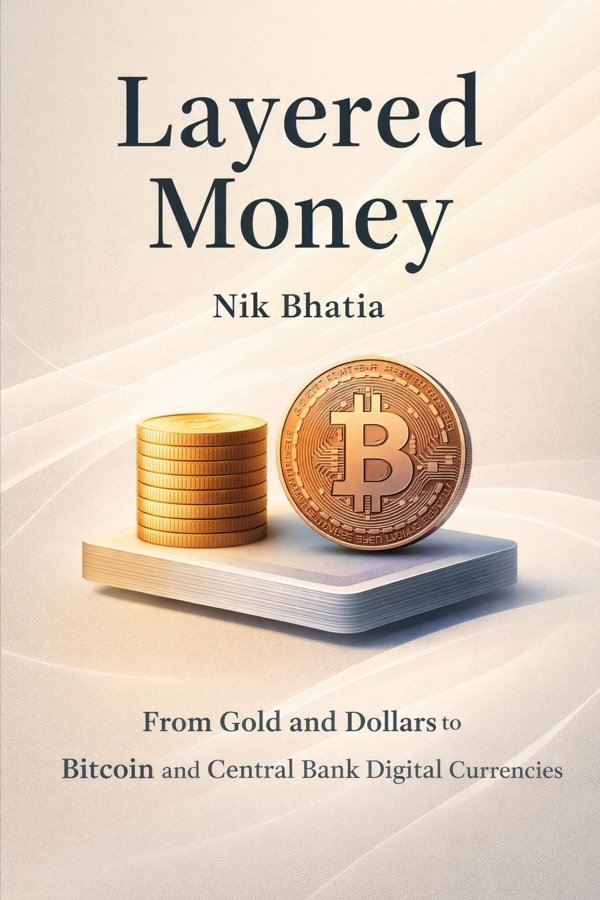
Layered Money: From Gold and Dollars to Bitcoin and Central Bank Digital Currencies: Summary & Key Insights
by Nik Bhatia
 10 min7 chaptersAudio available
What Is Layered Money: From Gold and Dollars to Bitcoin and Central Bank Digital Currencies About?
Layered Money: From Gold and Dollars to Bitcoin and Central Bank Digital Currencies by Nik Bhatia is a finance book spanning 7 pages. Layered Money explores the evolution of monetary systems from gold to modern digital currencies. Nik Bhatia explains how money has developed in layers—each representing a new form of trust and technology—from physical gold to paper dollars, and now to cryptocurrencies and central bank digital currencies. The book provides a clear framework for understanding how Bitcoin fits into the global financial hierarchy and how future monetary innovations may reshape the world economy.
This FizzRead summary covers all 7 key chapters of Layered Money: From Gold and Dollars to Bitcoin and Central Bank Digital Currencies in approximately 10 minutes, distilling the most important ideas, arguments, and takeaways from Nik Bhatia's work. Also available as an audio summary and Key Quotes Podcast.
Layered Money: From Gold and Dollars to Bitcoin and Central Bank Digital Currencies
Layered Money explores the evolution of monetary systems from gold to modern digital currencies. Nik Bhatia explains how money has developed in layers—each representing a new form of trust and technology—from physical gold to paper dollars, and now to cryptocurrencies and central bank digital currencies. The book provides a clear framework for understanding how Bitcoin fits into the global financial hierarchy and how future monetary innovations may reshape the world economy.
Who Should Read Layered Money: From Gold and Dollars to Bitcoin and Central Bank Digital Currencies?
This book is perfect for anyone interested in finance and looking to gain actionable insights in a short read. Whether you're a student, professional, or lifelong learner, the key ideas from Layered Money: From Gold and Dollars to Bitcoin and Central Bank Digital Currencies by Nik Bhatia will help you think differently.
- ✓Readers who enjoy finance and want practical takeaways
- ✓Professionals looking to apply new ideas to their work and life
- ✓Anyone who wants the core insights of Layered Money: From Gold and Dollars to Bitcoin and Central Bank Digital Currencies in just 10 minutes
Want the full summary?
Get instant access to this book summary and 100K+ more with Fizz Moment.
Get Free SummaryAvailable on App Store • Free to download
Key Chapters
The story of money begins with gold—not just as a precious metal, but as the ultimate trust anchor. For millennia, human societies selected gold because its physical properties—durability, divisibility, scarcity, and universal recognition—made it the perfect foundation for value exchange. Gold functioned as the first layer of money because it required no promise. To hold gold was to hold value itself, free from counterparty risk.
Yet, as commerce expanded, the limitations of gold became evident. Transporting it was cumbersome, and verifying its purity took time. So societies began issuing receipts for gold deposits. These paper claims represented a second layer—money created on top of gold, where institutions, such as goldsmiths and eventually banks, promised redemption of these notes for physical gold. It was the birth of a layered monetary system: tangible wealth at the base, and credit-based abstractions above it.
History shows that weakness or corruption in these second layers can erode trust even when the base layer remains sound. Bank runs and the collapse of overleveraged issuers revealed that every higher layer depends on the perception of stability below it. This tension between convenience and risk has defined every subsequent evolution of money. The durability of gold as a foundation lay in its independence; yet human ingenuity—and greed—ensured that new instruments would continually test the boundaries of trust.
By the eighteenth and nineteenth centuries, paper money had evolved from private banknotes to sovereign currencies. Governments began establishing central banks to manage these layers more systematically. Britain’s Bank of England became the prototype, issuing notes that were claims on its gold reserves and supervising the banking system built above it. Within this structure, commercial banks created deposits—third-layer money—by extending credit, while the central bank’s liabilities formed the second layer.
This hierarchy institutionalized the concept of layered trust. Gold anchored everything, but daily transactions rarely touched the base layer. Instead, commerce ran on layered abstractions—a network of ledger entries and promises ultimately redeemable in gold held at the top. The creation of the Federal Reserve in 1913 extended this logic to the United States, formalizing a national hierarchy where the Fed’s reserves backed commercial bank deposits and the U.S. dollar linked to gold.
However, centralized control introduced new dynamics. Central banks could manipulate interest rates and reserve requirements, influencing credit creation and economic cycles. This arrangement amplified the power of state monetary authorities but still maintained the illusion of gold-based stability. The system thrived so long as the promise to redeem paper for gold held. History would soon test that promise under the pressures of war, global trade, and expanding fiscal ambitions.
+ 5 more chapters — available in the FizzRead app
All Chapters in Layered Money: From Gold and Dollars to Bitcoin and Central Bank Digital Currencies
About the Author
Nik Bhatia is an adjunct professor of finance and business economics at the University of Southern California Marshall School of Business. He is a former trader on Wall Street and an expert in monetary economics and blockchain technology.
Get This Summary in Your Preferred Format
Read or listen to the Layered Money: From Gold and Dollars to Bitcoin and Central Bank Digital Currencies summary by Nik Bhatia anytime, anywhere. FizzRead offers multiple formats so you can learn on your terms — all free.
Available formats: App · Audio · PDF · EPUB — All included free with FizzRead
Download Layered Money: From Gold and Dollars to Bitcoin and Central Bank Digital Currencies PDF and EPUB Summary
Key Quotes from Layered Money: From Gold and Dollars to Bitcoin and Central Bank Digital Currencies
“The story of money begins with gold—not just as a precious metal, but as the ultimate trust anchor.”
“By the eighteenth and nineteenth centuries, paper money had evolved from private banknotes to sovereign currencies.”
Frequently Asked Questions about Layered Money: From Gold and Dollars to Bitcoin and Central Bank Digital Currencies
Layered Money: From Gold and Dollars to Bitcoin and Central Bank Digital Currencies by Nik Bhatia is a finance book that explores key ideas across 7 chapters. Layered Money explores the evolution of monetary systems from gold to modern digital currencies. Nik Bhatia explains how money has developed in layers—each representing a new form of trust and technology—from physical gold to paper dollars, and now to cryptocurrencies and central bank digital currencies. The book provides a clear framework for understanding how Bitcoin fits into the global financial hierarchy and how future monetary innovations may reshape the world economy.
You Might Also Like




Browse by Category
Ready to read Layered Money: From Gold and Dollars to Bitcoin and Central Bank Digital Currencies?
Get the full summary and 100K+ more books with Fizz Moment.