
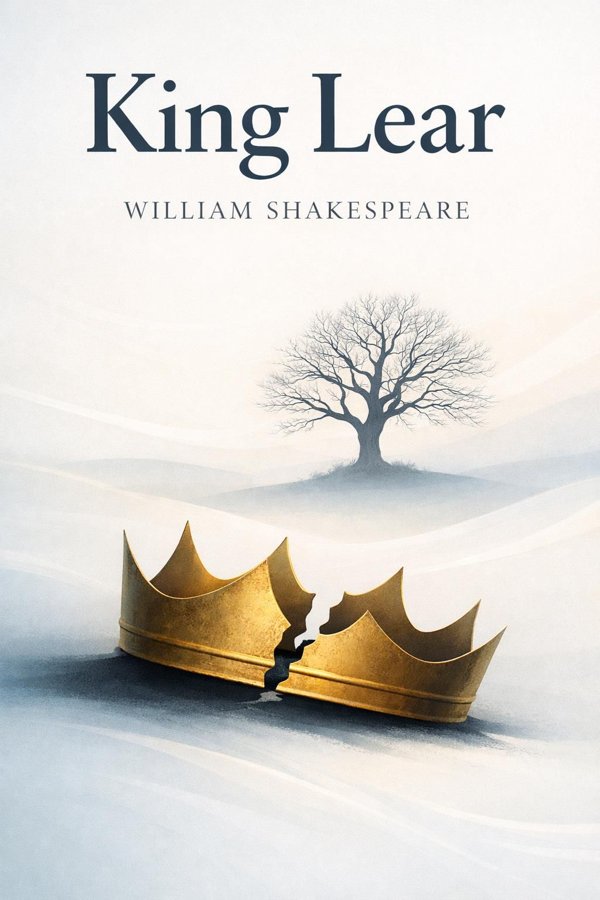
King Lear: Summary & Key Insights
 10 min3 chaptersAudio available
What Is King Lear About?
King Lear by William Shakespeare is a classics book spanning 3 pages. King Lear is a tragedy by William Shakespeare that tells the story of an aging monarch who divides his kingdom among his daughters based on their professions of love for him. The play explores themes of loyalty, betrayal, madness, and the nature of authority, culminating in Lear’s descent into despair and the tragic consequences of his decisions.
This FizzRead summary covers all 3 key chapters of King Lear in approximately 10 minutes, distilling the most important ideas, arguments, and takeaways from William Shakespeare's work. Also available as an audio summary and Key Quotes Podcast.
King Lear
King Lear is a tragedy by William Shakespeare that tells the story of an aging monarch who divides his kingdom among his daughters based on their professions of love for him. The play explores themes of loyalty, betrayal, madness, and the nature of authority, culminating in Lear’s descent into despair and the tragic consequences of his decisions.
Who Should Read King Lear?
This book is perfect for anyone interested in classics and looking to gain actionable insights in a short read. Whether you're a student, professional, or lifelong learner, the key ideas from King Lear by William Shakespeare will help you think differently.
- ✓Readers who enjoy classics and want practical takeaways
- ✓Professionals looking to apply new ideas to their work and life
- ✓Anyone who wants the core insights of King Lear in just 10 minutes
Want the full summary?
Get instant access to this book summary and 100K+ more with Fizz Moment.
Get Free SummaryAvailable on App Store • Free to download
Key Chapters
When Lear enters, he does so in the full glare of his majesty — a king ready to relinquish his crown but unwilling to relinquish his need for affirmation. His plan to divide Britain among his daughters is not a gesture of familial generosity, but a perilous test of affection. He demands that Goneril, Regan, and Cordelia affirm their love in speech, as if words alone could measure faith.
The tragedy begins with a refusal — Cordelia’s silence. She loves deeply, but cannot clothe that love in false rhetoric. Her words, 'nothing,' are not a void but a moral stance: love, she insists, should not be coerced or performed. Lear interprets her integrity as defiance and disinherits her, handing power to Goneril and Regan, whose honeyed words mask deceit. In that instant, he exiles truth and enthrones flattery.
Kent, his loyal servant, pleads with him to see reason. Kent’s defiance is the voice of conscience, but Lear, blinded by wounded pride, banishes even that voice. His kingdom is divided along the same fault line as his heart — between genuine affection and corrosive ego.
In the aftermath, Lear begins his slow unmaking. He has given away his authority, but not his expectations. He seeks honor without power, love without humility. Goneril, now possessed of land and title, quickly chafes at her father’s presence. The old man, demanding his hundred knights and his ceremonious respect, discovers that the appearance of royalty cannot substitute the substance of reverence.
Here, I wanted you to see how authority without insight becomes tyranny, and how pride disguised as paternal care corrupts both ruler and family. Lear’s choice echoes through every scene that follows — an error of judgment born from emotional blindness. The division of the kingdom is not merely political; it is the severing of a spirit from truth. Lear, in giving away his crown, begins to lose his mind.
Cast out by Goneril and later by Regan, Lear begins his descent into storm and madness. His daughters’ cruelty does not arrive suddenly; it grows from the same soil that nourished his vanity. Each moment of rejection peels away the layers that once shielded him — robes of command, words of authority — until only the man remains.
In the raging storm on the heath, the play reveals its true face. Lear, stripped of everything, speaks to the thunder as if it were his judge. The tempest becomes his conscience, each bolt of lightning a flash of recognition. Madness, here, is not mere chaos but awakening. Lear begins to perceive the world not as a king, but as one of the ‘poor naked wretches’ he never saw — those cold and homeless souls whom his reign ignored.
At his side stand two figures who embody fidelity and human compassion. Kent, disguised to remain near the king he loves, and the Fool, whose riddles pierce the fog of Lear’s delusions. Through their banter and devotion, the play reminds us that truth often wears the mask of folly. Lear’s madness is paralleled by Gloucester’s physical blindness — two arcs converging toward revelation. When Lear encounters Edgar, hidden beneath the guise of Poor Tom, he sees for the first time what unadorned humanity looks like — suffering without pretense, existence without rank.
The storm is not only external weather but inner reckoning. I wanted the elements to act as mirrors of conscience — wind tearing away illusion, rain cleansing pride, thunder demanding confession. Lear raves about justice, the deceit of appearances, the cruelty of man, yet within his madness glimmers a fragile wisdom. He begins to understand that power isolates, that mercy redeems, and that love, unspoken and steadfast, is the only truth strong enough to survive betrayal.
Through this transformation, the madness of Lear becomes the soul’s trial — necessary for clarity. He who once demanded words of love now learns to feel love’s silence. Madness teaches him understanding; suffering teaches him grace.
+ 1 more chapters — available in the FizzRead app
All Chapters in King Lear
About the Author
William Shakespeare (1564–1616) was an English playwright, poet, and actor, widely regarded as the greatest writer in the English language. His works include tragedies, comedies, and histories that have profoundly influenced literature and theater worldwide.
Get This Summary in Your Preferred Format
Read or listen to the King Lear summary by William Shakespeare anytime, anywhere. FizzRead offers multiple formats so you can learn on your terms — all free.
Available formats: App · Audio · PDF · EPUB — All included free with FizzRead
Download King Lear PDF and EPUB Summary
Key Quotes from King Lear
“When Lear enters, he does so in the full glare of his majesty — a king ready to relinquish his crown but unwilling to relinquish his need for affirmation.”
“Cast out by Goneril and later by Regan, Lear begins his descent into storm and madness.”
Frequently Asked Questions about King Lear
King Lear by William Shakespeare is a classics book that explores key ideas across 3 chapters. King Lear is a tragedy by William Shakespeare that tells the story of an aging monarch who divides his kingdom among his daughters based on their professions of love for him. The play explores themes of loyalty, betrayal, madness, and the nature of authority, culminating in Lear’s descent into despair and the tragic consequences of his decisions.
More by William Shakespeare

You Might Also Like






Browse by Category
Ready to read King Lear?
Get the full summary and 100K+ more books with Fizz Moment.