
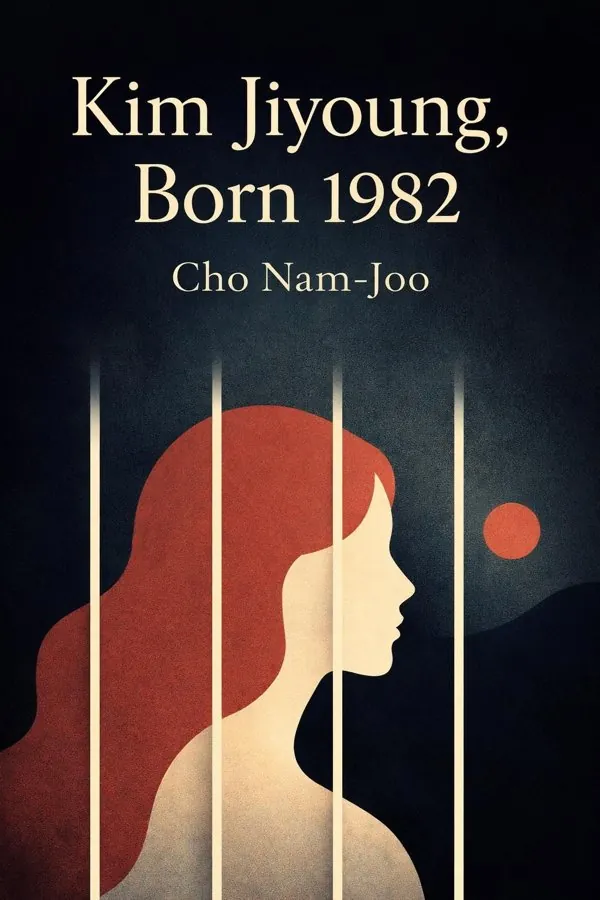
Kim Jiyoung, Born 1982: Summary & Key Insights
by Cho Nam-Joo
 10 min9 chaptersAudio available
Key Takeaways from Kim Jiyoung, Born 1982
Inequality often begins long before a person has words for it.
Institutions do not merely reflect society; they train people to accept its hierarchy.
Freedom can exist in theory while remaining constrained in practice.
A workplace can praise merit while quietly rewarding gender conformity.
Some of the deepest losses in life happen gradually, under the name of duty.
What Is Kim Jiyoung, Born 1982 About?
Kim Jiyoung, Born 1982 by Cho Nam-Joo is a bestsellers book spanning 7 pages. Kim Jiyoung, Born 1982 is a quiet novel with explosive force. On the surface, it tells the life story of one ordinary South Korean woman, from her birth in the 1980s through childhood, education, work, marriage, and motherhood. Yet the deeper power of the book lies in how ordinary that story feels. Kim Jiyoung is not portrayed as exceptional or tragic in a dramatic sense; instead, she becomes a representative figure through whom readers see the cumulative weight of everyday sexism, social expectation, and institutional inequality. The novel begins with signs of a psychological breakdown, then moves backward through the experiences that shaped her, revealing how a life can be constrained not only by major injustices but by countless normalized slights. Cho Nam-Joo, a South Korean novelist and screenwriter known for her attention to social realities, writes with clarity, restraint, and precision. Her achievement is to turn one woman’s personal story into a broader social diagnosis. The result is a modern classic that sparked debate far beyond Korea, inviting readers everywhere to examine how gender roles are built, enforced, and too often accepted as natural.
This FizzRead summary covers all 9 key chapters of Kim Jiyoung, Born 1982 in approximately 10 minutes, distilling the most important ideas, arguments, and takeaways from Cho Nam-Joo's work. Also available as an audio summary and Key Quotes Podcast.
Kim Jiyoung, Born 1982
Kim Jiyoung, Born 1982 is a quiet novel with explosive force. On the surface, it tells the life story of one ordinary South Korean woman, from her birth in the 1980s through childhood, education, work, marriage, and motherhood. Yet the deeper power of the book lies in how ordinary that story feels. Kim Jiyoung is not portrayed as exceptional or tragic in a dramatic sense; instead, she becomes a representative figure through whom readers see the cumulative weight of everyday sexism, social expectation, and institutional inequality. The novel begins with signs of a psychological breakdown, then moves backward through the experiences that shaped her, revealing how a life can be constrained not only by major injustices but by countless normalized slights. Cho Nam-Joo, a South Korean novelist and screenwriter known for her attention to social realities, writes with clarity, restraint, and precision. Her achievement is to turn one woman’s personal story into a broader social diagnosis. The result is a modern classic that sparked debate far beyond Korea, inviting readers everywhere to examine how gender roles are built, enforced, and too often accepted as natural.
Who Should Read Kim Jiyoung, Born 1982?
This book is perfect for anyone interested in bestsellers and looking to gain actionable insights in a short read. Whether you're a student, professional, or lifelong learner, the key ideas from Kim Jiyoung, Born 1982 by Cho Nam-Joo will help you think differently.
- ✓Readers who enjoy bestsellers and want practical takeaways
- ✓Professionals looking to apply new ideas to their work and life
- ✓Anyone who wants the core insights of Kim Jiyoung, Born 1982 in just 10 minutes
Want the full summary?
Get instant access to this book summary and 100K+ more with Fizz Moment.
Get Free SummaryAvailable on App Store • Free to download
Key Chapters
Inequality often begins long before a person has words for it. In Kim Jiyoung, Born 1982, Jiyoung’s childhood reveals how gender bias is taught not through grand speeches, but through daily routines, expectations, and small acts of preference. Her family is not presented as cruel or monstrous. In fact, they are familiar, affectionate, and believable. That is exactly what makes the story unsettling. Resources, attention, and sacrifice are distributed unevenly, and those differences are treated as practical, normal, or even loving. Boys are subtly positioned as the future of the family, while girls are expected to adjust, endure, and help.
Cho Nam-Joo shows that children learn social value by observing whose needs matter first. A son may receive extra care, better opportunities, or more freedom, while daughters are taught to be considerate and self-denying. These lessons do not appear dramatic in isolation. But over time, they shape self-esteem, ambition, and the sense of what one is allowed to ask for.
This dynamic is not limited to one culture. In many families around the world, boys are still excused for behavior girls are punished for, or daughters are expected to carry emotional and domestic responsibilities earlier than sons. The novel invites readers to notice these patterns in ordinary life: who gets protected, who gets disciplined, who gets encouraged, and who gets told to compromise.
The actionable takeaway is simple: examine the everyday messages children receive about gender. Fairness is not only about equal love; it is also about equal expectation, equal investment, and equal permission to imagine a full future.
Institutions do not merely reflect society; they train people to accept its hierarchy. In Jiyoung’s school years, Cho Nam-Joo shows how formal education reproduces the same gender assumptions that begin at home. Boys are often treated as naturally disruptive but fundamentally important, while girls are expected to be obedient, diligent, and accommodating. Teachers may praise girls for being quiet and responsible, yet that praise can become another form of limitation. It rewards compliance more than confidence.
At school, Jiyoung learns that harassment, discomfort, and unfairness are often reframed as things girls should manage. A girl’s safety becomes her own responsibility. If boys misbehave, girls are told to be careful. If a girl feels threatened, she is told to adjust her route, her clothes, or her attitude. This teaches a dangerous lesson: that social order depends on female self-policing rather than male accountability.
The brilliance of this section is its familiarity. Many readers will recognize classrooms where boys dominate attention and girls are valued for discipline rather than leadership. Even outside school, similar patterns emerge in extracurricular settings, sports, and family expectations about academic fields or future careers.
A practical application is to rethink what we reward in young people. Are girls encouraged to speak, challenge, and take up space? Are boys taught responsibility for their own behavior? Schools, parents, and mentors can interrupt inequality by treating confidence, safety, and opportunity as shared rights rather than gendered privileges.
The actionable takeaway: pay attention to how authority figures respond to boys and girls differently. Correcting those patterns early can prevent the normalization of inequality later in life.
Freedom can exist in theory while remaining constrained in practice. University life appears to offer Jiyoung a wider world: more independence, more education, more choices, and exposure to broader possibilities. Yet Cho Nam-Joo reveals that even in this supposedly modern, merit-based environment, women encounter invisible barriers. They may study alongside men, earn strong grades, and imagine ambitious futures, but they still move through a culture that questions their seriousness, judges their behavior more harshly, and frames their adulthood around marriageability as much as achievement.
This is one of the book’s most powerful insights: formal access is not the same as genuine equality. A woman can enter the room and still be treated as less authoritative, less safe, or less permanent within it. Casual sexism, predatory behavior, and social expectations operate like an invisible cage. They do not always stop women from participating, but they narrow the terms on which participation happens.
Jiyoung’s experiences speak to a common modern contradiction. Societies celebrate women’s educational advancement while continuing to impose old assumptions about femininity, family duty, and acceptable ambition. Young women are told they can do anything, yet are quietly punished when they act as if that is true.
In practical terms, this idea applies to universities, internships, and early professional networks everywhere. Institutions should not only count how many women are present, but also ask: Do they feel safe? Are they mentored equally? Are they allowed to be assertive without backlash?
The actionable takeaway is to distinguish between access and inclusion. Real equality requires more than opening doors; it requires changing the culture inside them.
Some of the deepest losses in life happen gradually, under the name of duty. In the novel’s portrayal of marriage and motherhood, Jiyoung’s life narrows not because she stops caring or stops trying, but because the structure around her makes self-erasure feel inevitable. The demands placed on her multiply: she must be a loving wife, attentive mother, responsible daughter, and socially acceptable woman, all while carrying a mental load that others barely acknowledge.
Cho Nam-Joo is especially sharp in showing how unpaid care work disappears into the background. It is constant, exhausting, and essential, yet rarely treated as labor worthy of respect or support. Jiyoung’s departure from paid employment is not framed as a purely personal choice detached from social pressure. It is shaped by weak structural support, rigid expectations, and the assumption that a mother’s sacrifice is natural.
This section resonates globally because many women experience a similar shrinking after motherhood. Their identities become fused with caregiving, while their ambitions are treated as secondary, indulgent, or selfish. Even sympathetic partners may benefit from systems they do not fully see.
Practically, the novel pushes readers to redefine family fairness. Sharing responsibilities is not simply “helping” a mother; it means recognizing caregiving as collective work. Workplaces, governments, and households all play a role through parental leave, childcare support, flexible scheduling, and genuine division of domestic labor.
The actionable takeaway is to make invisible labor visible. In any household or partnership, name the tasks, count the time, and redistribute responsibilities before one person’s identity quietly disappears.
Power often survives by sounding reasonable. One of the novel’s subtler strengths is its attention to the language that surrounds Jiyoung’s life: phrases about practicality, safety, duty, modesty, and good womanhood. These words rarely sound violent. In fact, they often sound caring. Yet they function as tools that justify unequal expectations. A daughter should understand. A wife should support. A mother should naturally sacrifice. A woman should be careful. Through such language, inequality becomes emotionally disguised.
Cho Nam-Joo shows that sexism is sustained not only by laws or institutions, but by ordinary speech that frames women’s adjustment as common sense. This matters because language shapes what people perceive as possible. If self-denial is described as maturity, then resistance can be branded selfishness. If male privilege is described as responsibility or inevitability, then it becomes harder to challenge.
This insight applies broadly in homes, workplaces, media, and politics. We can listen for terms that soften unequal arrangements: “helping” instead of co-parenting, “protecting” instead of restricting, “natural” instead of socially enforced. Once these terms are examined, many supposedly neutral customs begin to look ideological.
A practical habit is to question the emotional framing of everyday statements. Who benefits from this expectation? Why is one person’s limitation described as virtue? What alternatives are never named?
The actionable takeaway: audit the language around gender in your own environment. When words make inequality sound harmless or honorable, translate them into their actual effects. Clarity is a form of resistance.
A story rooted in one society can reveal truths far beyond it. Although Kim Jiyoung, Born 1982 is deeply grounded in South Korean social structures, its international impact comes from how recognizable its patterns are elsewhere. Readers across cultures see versions of Jiyoung in debates about childcare, promotion, safety, beauty standards, emotional labor, reproductive expectations, and the pressure to be agreeable while carrying impossible burdens.
The novel matters because it closes the gap between “their problem” and “our problem.” It reminds readers that gender inequality does not only exist in obviously oppressive forms. It thrives in modern, educated, economically advanced societies too, often hidden beneath the language of progress and personal choice. This makes the book especially valuable for readers who assume that legal gains automatically produce lived equality.
Another reason the novel travels so well is that it does not demand prior expertise in feminist theory. Its argument is built through accumulation. Event by event, compromise by compromise, the reader feels how a system works. That makes it useful not only for committed readers of social criticism but also for people just beginning to question how gender norms shape everyday life.
A practical application is to use the novel as a conversation starter. It can open discussion in classrooms, book clubs, workplaces, and families about invisible labor, bias, and the costs of so-called normal arrangements.
The actionable takeaway: read Jiyoung not as a distant case study, but as an invitation to inspect your own society. The details may differ, but the structures may be closer than you think.
All Chapters in Kim Jiyoung, Born 1982
About the Author
Cho Nam-Joo is a South Korean novelist and screenwriter whose work focuses on contemporary social realities, especially gender inequality and the pressures placed on women in modern society. Before gaining major literary recognition, she worked as a television scriptwriter, a background that helped shape her clear, observational style and strong sense of narrative structure. She became internationally known through Kim Jiyoung, Born 1982, a bestselling novel that sparked intense public debate in South Korea and resonated with readers around the world. Her writing is notable for turning everyday experiences into powerful social critique without losing emotional precision. Cho is widely recognized as an important contemporary literary voice, particularly in conversations about feminism, labor, family roles, and the hidden costs of ordinary social expectations.
Get This Summary in Your Preferred Format
Read or listen to the Kim Jiyoung, Born 1982 summary by Cho Nam-Joo anytime, anywhere. FizzRead offers multiple formats so you can learn on your terms — all free.
Available formats: App · Audio · PDF · EPUB — All included free with FizzRead
Download Kim Jiyoung, Born 1982 PDF and EPUB Summary
Key Quotes from Kim Jiyoung, Born 1982
“Inequality often begins long before a person has words for it.”
“Institutions do not merely reflect society; they train people to accept its hierarchy.”
“Freedom can exist in theory while remaining constrained in practice.”
“A workplace can praise merit while quietly rewarding gender conformity.”
“Some of the deepest losses in life happen gradually, under the name of duty.”
Frequently Asked Questions about Kim Jiyoung, Born 1982
Kim Jiyoung, Born 1982 by Cho Nam-Joo is a bestsellers book that explores key ideas across 9 chapters. Kim Jiyoung, Born 1982 is a quiet novel with explosive force. On the surface, it tells the life story of one ordinary South Korean woman, from her birth in the 1980s through childhood, education, work, marriage, and motherhood. Yet the deeper power of the book lies in how ordinary that story feels. Kim Jiyoung is not portrayed as exceptional or tragic in a dramatic sense; instead, she becomes a representative figure through whom readers see the cumulative weight of everyday sexism, social expectation, and institutional inequality. The novel begins with signs of a psychological breakdown, then moves backward through the experiences that shaped her, revealing how a life can be constrained not only by major injustices but by countless normalized slights. Cho Nam-Joo, a South Korean novelist and screenwriter known for her attention to social realities, writes with clarity, restraint, and precision. Her achievement is to turn one woman’s personal story into a broader social diagnosis. The result is a modern classic that sparked debate far beyond Korea, inviting readers everywhere to examine how gender roles are built, enforced, and too often accepted as natural.
You Might Also Like

The Godfather
Mario Puzo
10 min
The Handmaid's Tale
Margaret Atwood
10 min
The Hunger Games
Suzanne Collins
10 min
The Nightingale
Kristin Hannah
10 min
The Seven Husbands of Evelyn Hugo
Taylor Jenkins Reid
10 min
Backwater Justice
Fern Michaels
10 minBrowse by Category
Ready to read Kim Jiyoung, Born 1982?
Get the full summary and 100K+ more books with Fizz Moment.