
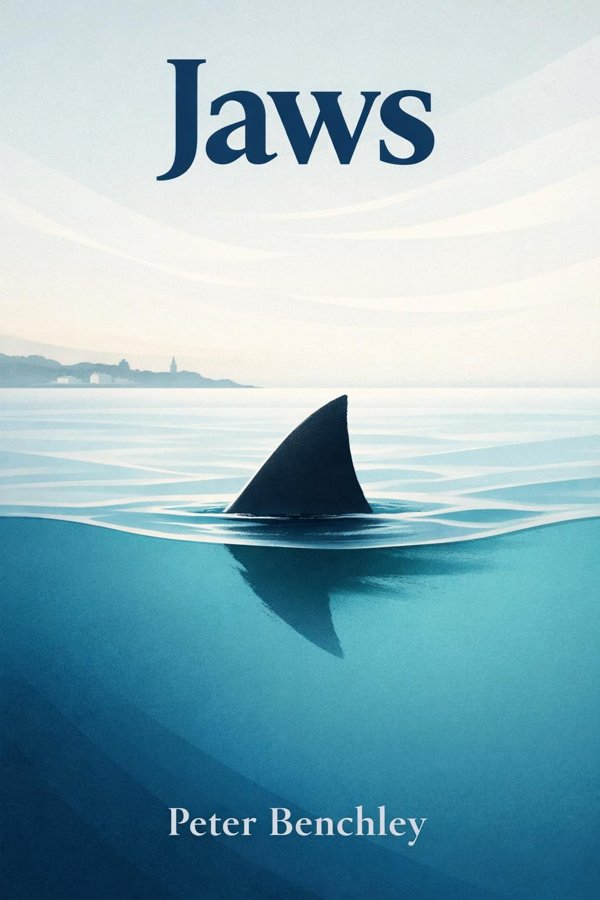
Jaws: Summary & Key Insights
 10 min9 chaptersAudio available
Key Takeaways from Jaws
Fear rarely arrives all at once; it enters through one undeniable event and then spreads through every weak point in a system.
A crisis tests character by forcing decisions before certainty is available.
Knowledge can illuminate danger, but it can also complicate the people who possess it.
Some people do not fight danger merely to remove it; they fight it to prove something about themselves.
Communities often depend on stories they tell about themselves, and those stories can become liabilities when reality changes.
What Is Jaws About?
Jaws by Peter Benchley is a bestsellers book spanning 3 pages. Peter Benchley’s Jaws is far more than a thriller about a killer shark. Set in the fictional beach town of Amity, the novel begins with a shocking attack and quickly grows into a tense portrait of a community under pressure. As summer crowds descend and fear spreads through the town, Police Chief Martin Brody, marine biologist Matt Hooper, and shark hunter Quint are drawn into a conflict that is as much about politics, pride, greed, and class as it is about survival. The shark is the visible threat, but Benchley’s deeper subject is how people behave when safety, money, reputation, and power collide. What makes Jaws endure is its layered understanding of fear. Benchley shows how danger is often made worse by denial, ego, and the human need to preserve normalcy even when reality has changed. The novel blends suspense with social observation, exposing the hidden tensions beneath a seemingly idyllic resort town. Benchley, who came from a family of writers and later became deeply involved in ocean and shark conservation, brought both narrative drive and vivid marine detail to the story. The result is a bestseller that remains gripping, unsettling, and unexpectedly rich in psychological and moral insight.
This FizzRead summary covers all 9 key chapters of Jaws in approximately 10 minutes, distilling the most important ideas, arguments, and takeaways from Peter Benchley's work. Also available as an audio summary and Key Quotes Podcast.
Jaws
Peter Benchley’s Jaws is far more than a thriller about a killer shark. Set in the fictional beach town of Amity, the novel begins with a shocking attack and quickly grows into a tense portrait of a community under pressure. As summer crowds descend and fear spreads through the town, Police Chief Martin Brody, marine biologist Matt Hooper, and shark hunter Quint are drawn into a conflict that is as much about politics, pride, greed, and class as it is about survival. The shark is the visible threat, but Benchley’s deeper subject is how people behave when safety, money, reputation, and power collide.
What makes Jaws endure is its layered understanding of fear. Benchley shows how danger is often made worse by denial, ego, and the human need to preserve normalcy even when reality has changed. The novel blends suspense with social observation, exposing the hidden tensions beneath a seemingly idyllic resort town. Benchley, who came from a family of writers and later became deeply involved in ocean and shark conservation, brought both narrative drive and vivid marine detail to the story. The result is a bestseller that remains gripping, unsettling, and unexpectedly rich in psychological and moral insight.
Who Should Read Jaws?
This book is perfect for anyone interested in bestsellers and looking to gain actionable insights in a short read. Whether you're a student, professional, or lifelong learner, the key ideas from Jaws by Peter Benchley will help you think differently.
- ✓Readers who enjoy bestsellers and want practical takeaways
- ✓Professionals looking to apply new ideas to their work and life
- ✓Anyone who wants the core insights of Jaws in just 10 minutes
Want the full summary?
Get instant access to this book summary and 100K+ more with Fizz Moment.
Get Free SummaryAvailable on App Store • Free to download
Key Chapters
Fear rarely arrives all at once; it enters through one undeniable event and then spreads through every weak point in a system. Jaws begins with exactly that kind of rupture. A young woman goes for a midnight swim, the sea appears calm, and then violence erupts from below. Her death is not only the novel’s first shock but the moment Amity’s illusion of safety begins to crack. Police Chief Martin Brody immediately senses what the attack means: if a predator is close to shore, the town is in danger. Yet his duty to protect the public is quickly tangled in another force—pressure from officials and business interests who cannot afford bad publicity at the start of tourist season.
Benchley uses this dilemma to show how communities often respond to danger with hesitation, euphemism, and wishful thinking. The issue is not merely whether the shark exists; it is whether people are willing to act on uncomfortable knowledge. Brody is caught between evidence and expectation, responsibility and conformity. That tension feels familiar in many real-world settings: a company ignoring a product flaw during a critical launch, a school downplaying a safety issue to avoid panic, or a town delaying evacuation before a storm because officials fear economic disruption.
The first attack matters because it reveals the cost of denial. Once leaders start minimizing risk, every later decision becomes harder, more political, and more dangerous. Benchley suggests that fear itself is not the true enemy. Fear can clarify priorities. The real threat is the refusal to acknowledge it honestly.
Actionable takeaway: When a serious warning sign appears, resist the impulse to protect appearances first. Name the risk clearly, gather facts quickly, and make decisions based on safety rather than short-term comfort.
A crisis tests character by forcing decisions before certainty is available. In Jaws, Martin Brody embodies this pressure. He is not a glamorous hero or a fearless adventurer; he is a local police chief trying to do his job in a town where public order depends on commerce, routine, and trust. That makes him an effective protagonist. Benchley turns Brody into a study of reluctant leadership: a man who understands the danger but lacks the power, prestige, and confidence to impose his judgment easily.
Brody’s challenge is not simply catching a shark. It is managing conflicting responsibilities while everyone around him wants something different. The mayor and town leaders want beaches open. Residents want reassurance. Visitors want pleasure without fear. Experts want to be heard. Brody himself wants to protect his family and preserve his authority. This mix creates a familiar leadership trap: everyone agrees safety matters in theory, but when the necessary action carries a cost, support disappears.
Benchley is especially sharp in showing how leadership can become lonely. Brody must absorb doubt, criticism, and second-guessing while acting with incomplete information. He worries about overreacting, yet he knows underreacting could be fatal. This reflects real life in fields from medicine to business to public administration. A hospital administrator may need to suspend operations over a contamination concern before full results are in. A manager may have to recall a product while executives argue over optics. Effective leadership often means tolerating temporary unpopularity in service of a larger responsibility.
Brody’s arc reminds readers that courage is often procedural rather than dramatic. It looks like making the hard call, repeating the truth when others evade it, and continuing despite uncertainty.
Actionable takeaway: In any high-stakes situation, define your primary responsibility early. When pressure mounts, let that responsibility—not consensus or convenience—guide your decisions.
Knowledge can illuminate danger, but it can also complicate the people who possess it. When Matt Hooper arrives in Amity, he brings expertise, confidence, and a sharper understanding of what the town is facing. As a marine biologist, he validates Brody’s fears and gives the shark a scientific reality that local officials would rather blur. Yet Benchley does not use Hooper merely as the voice of reason. He also becomes part of the novel’s emotional turbulence, particularly through his relationship with Brody’s wife, Ellen.
This strand of the novel broadens Jaws beyond survival suspense. Benchley uses Hooper and Ellen to expose dissatisfaction, status anxiety, and longing beneath suburban stability. Hooper represents education, money, sophistication, and mobility—the larger world beyond Amity. Ellen’s attraction is not only personal; it reflects her own unresolved relationship with class and identity. Meanwhile, Brody is left to confront not just external threat but internal vulnerability. The shark may stalk the shoreline, but human desire is already destabilizing the household.
What makes this effective is that Benchley links public crisis with private strain. Under pressure, hidden emotions surface. In real life, emergencies often do the same. Financial stress reveals cracks in a marriage. A workplace crisis brings out rivalries and insecurities that were previously manageable. Expertise, too, can create friction: specialists may be admired for their knowledge while resented for what their presence implies about others’ inadequacy.
Hooper’s role therefore carries a double lesson. Expertise is essential in confronting complex threats, but experts are not abstract instruments. They bring ego, history, and desire with them. Institutions and relationships must account for that human complexity.
Actionable takeaway: When solving a serious problem, value expertise—but also pay attention to the emotional dynamics around it. Facts matter most when the people using them are understood clearly.
Some people do not fight danger merely to remove it; they fight it to prove something about themselves. That is the role Quint plays in Jaws. Introduced as a hardened professional shark hunter, Quint initially appears to be the rugged answer to Amity’s problem—the man who can do what bureaucrats, tourists, and scientists cannot. But as the hunt unfolds, he becomes something more troubling. Benchley gradually reveals that Quint is not just pursuing the shark for money or duty. He is engaged in a personal contest with the sea, with mortality, and with his own identity.
This shift matters because it changes the tone of the narrative. The final pursuit is not simply strategic; it is psychological. Quint represents a style of masculinity built on domination, experience, and contempt for weakness. He distrusts institutions and mocks intellectualism, especially Hooper’s. Yet his confidence shades into rigidity, and rigidity becomes obsession. Instead of adapting to the danger, he wants to conquer it on his own terms. That makes him both formidable and dangerous.
Benchley’s portrayal offers a broader warning about expertise untethered from self-awareness. The most experienced person in a room can still become the least flexible. In business, a veteran founder may refuse to pivot because past success has fused with ego. In emergency management, a seasoned operator may dismiss new data because it threatens his authority. Skill is invaluable, but when identity becomes inseparable from being right, judgment suffers.
Quint also dramatizes how fear can masquerade as bravado. He appears fearless because he has converted vulnerability into aggression. The hunt then becomes a stage on which old wounds and compulsions drive decisions more than reason does.
Actionable takeaway: Respect experience, but do not confuse intensity with wisdom. In high-pressure situations, ask whether confidence is serving the mission—or serving the ego of the person in charge.
Communities often depend on stories they tell about themselves, and those stories can become liabilities when reality changes. Amity presents itself as a pleasant coastal escape: safe beaches, family recreation, summer money, and local harmony. But Benchley carefully strips away this image to reveal a fragile town whose prosperity depends on suppressing disruption. The shark is terrifying partly because it attacks not just bodies but the local narrative. If the water is dangerous, then Amity’s identity—and income—are in danger too.
This is why the town’s response is so revealing. Leaders are tempted to frame the threat as temporary, uncertain, or manageable long after evidence suggests otherwise. Residents divide according to temperament, class, and self-interest. Some want action, some want reassurance, and some simply want business to continue. Benchley shows how an external threat exposes the fault lines already running through a place. The shark is the catalyst, not the sole cause of disorder.
Amity can be read as a model of any institution that depends on confidence: a tourist economy, a luxury brand, a school district, a startup, even a political movement. Such systems are especially vulnerable to denial because perception is part of their product. When warning signs emerge, leaders may focus on preserving trust through messaging rather than preserving trust through truth. Yet once people sense that reality is being hidden, confidence collapses faster.
Benchley’s insight is that appearances are never enough to sustain a community under stress. What matters is whether the underlying structure can absorb honesty. A strong institution can survive bad news if it responds credibly. A weak one delays, spins, and fractures.
Actionable takeaway: If your team, organization, or community relies heavily on public confidence, build credibility before a crisis by making transparency a habit. People forgive danger more readily than deception.
One of the most enduring powers of Jaws is that its central force is terrifying without being moral. The shark does not hate Amity, seek revenge, or symbolize villainy in any simple sense. It acts according to instinct. That indifference is precisely what makes it so frightening. Human beings prefer conflicts they can personalize because motives can be negotiated, condemned, or understood. But nature offers no such comfort. A predator does not care about innocence, fairness, schedules, tourism revenue, or family plans.
Benchley uses this fact to challenge the human assumption of control. Beaches, resorts, boats, and police structures create the impression that the shoreline has been domesticated. Yet the sea remains its own realm, governed by forces larger than human convenience. The shark’s attacks expose the limits of civilization’s protective frame. This theme resonates far beyond the novel. Wildfire, disease, floods, and ecological disruption all remind modern societies that planning reduces risk but never abolishes uncertainty.
Importantly, Benchley does not sentimentalize nature, nor does he reduce it to a monster. The ocean in Jaws is beautiful, economically vital, and deeply dangerous. This complexity invites a more mature response to the natural world—one based on respect rather than fantasy. In daily life, that might mean taking weather warnings seriously, learning the actual risks of outdoor environments, or designing policies that recognize ecological realities instead of assuming humans can override them indefinitely.
The novel’s lasting tension comes from this collision between human expectation and natural indifference. It is not evil that emerges from the water, but a reminder that our categories do not govern the world.
Actionable takeaway: Replace the desire to feel in control with the practice of being prepared. Respect systems larger than yourself, whether natural, financial, or social, and plan around their realities rather than your wishes.
When people are removed from ordinary routines, their deeper selves often emerge. The final hunt in Jaws does exactly that. Once Brody, Hooper, and Quint leave shore, the novel narrows into a floating chamber of pressure. The town’s politics fade, and what remains are skill, temperament, fear, and the ability—or inability—to work together. This shift gives the climax its force. The hunt is not just about tracking a predator; it is about whether three very different men can align their strengths before the sea strips away their illusions.
Brody brings duty and persistence. Hooper brings analysis and specialized knowledge. Quint brings practical skill and ferocity. In theory, this combination should be ideal. In practice, their differences in class, method, and ego create instability. Benchley shows how teams often fail not because talent is absent, but because integration is poor. A strategist, an operator, and a leader may all be present, yet if they cannot respect one another’s roles, their collective advantage erodes.
This pattern appears in many high-stakes environments. A startup with a visionary founder, technical expert, and operations manager can still collapse if rivalry overrides coordination. A medical emergency team can suffer when hierarchy blocks the flow of critical information. A family under stress can fracture when everyone tries to solve the problem alone rather than in complementary ways.
The hunt also reveals that courage is plural. There is physical courage, intellectual courage, and moral courage, and no one character possesses all of them equally. Benchley invites readers to consider which kind they rely on and which kind they lack.
Actionable takeaway: In any team facing danger or uncertainty, define roles clearly and respect different forms of competence. Survival often depends less on raw talent than on disciplined cooperation.
Fear itself is not the villain of Jaws; mismanaged fear is. Throughout the novel, Benchley shows multiple dysfunctional responses to danger: denial, panic, bravado, political calculation, voyeuristic excitement, and private escapism. Each response distorts reality in its own way. Some characters minimize the threat to preserve business. Others overreact without discipline. Some become obsessed. Others retreat into fantasy or resentment. The shark is lethal, but the social chaos surrounding it magnifies its impact.
This is one reason the novel remains relevant. Most modern crises involve not only the primary threat but also the collective emotional response to it. During a health scare, misinformation spreads faster than facts. In financial downturns, fear can create runs, hoarding, and rash decisions. In organizations, rumors may do more damage to morale than the original problem. Benchley captures this dynamic before the term "risk communication" became common: people need truthful information, credible leadership, and meaningful action. Without those, fear mutates.
Jaws also suggests that the right relationship to fear is neither suppression nor surrender. Brody is effective when he lets fear sharpen responsibility. Hooper is useful when curiosity serves reality rather than ego. Quint becomes dangerous when fear transforms into domination and obsession. The lesson is not to become fearless, but to become functional under fear.
That has practical value in everyday life. A parent responding to a child’s medical emergency, a manager handling layoffs, or a student facing a major setback all benefit from the same sequence: acknowledge the emotion, gather facts, communicate clearly, and choose the next necessary step.
Actionable takeaway: When fear rises, do not ask how to eliminate it immediately. Ask how to organize it. Turn anxiety into a checklist, a conversation, and a plan before it hardens into denial or panic.
All Chapters in Jaws
About the Author
Peter Benchley (1940–2006) was an American novelist, screenwriter, and conservation advocate best known for Jaws, the 1974 thriller that became an international publishing sensation. Born into a prominent literary family, he developed an early interest in writing and later worked as a journalist and speechwriter before turning to fiction. The enormous success of Jaws led to the landmark 1975 film adaptation directed by Steven Spielberg, for which Benchley contributed to the screenplay. In later years, he became increasingly concerned about the negative image sharks had acquired and dedicated much of his career to ocean education and marine conservation. He wrote several other sea-themed novels and nonfiction works, but Jaws remains his defining achievement—a cultural phenomenon that combined suspense, social tension, and the raw power of the natural world.
Get This Summary in Your Preferred Format
Read or listen to the Jaws summary by Peter Benchley anytime, anywhere. FizzRead offers multiple formats so you can learn on your terms — all free.
Available formats: App · Audio · PDF · EPUB — All included free with FizzRead
Download Jaws PDF and EPUB Summary
Key Quotes from Jaws
“Fear rarely arrives all at once; it enters through one undeniable event and then spreads through every weak point in a system.”
“A crisis tests character by forcing decisions before certainty is available.”
“Knowledge can illuminate danger, but it can also complicate the people who possess it.”
“Some people do not fight danger merely to remove it; they fight it to prove something about themselves.”
“Communities often depend on stories they tell about themselves, and those stories can become liabilities when reality changes.”
Frequently Asked Questions about Jaws
Jaws by Peter Benchley is a bestsellers book that explores key ideas across 9 chapters. Peter Benchley’s Jaws is far more than a thriller about a killer shark. Set in the fictional beach town of Amity, the novel begins with a shocking attack and quickly grows into a tense portrait of a community under pressure. As summer crowds descend and fear spreads through the town, Police Chief Martin Brody, marine biologist Matt Hooper, and shark hunter Quint are drawn into a conflict that is as much about politics, pride, greed, and class as it is about survival. The shark is the visible threat, but Benchley’s deeper subject is how people behave when safety, money, reputation, and power collide. What makes Jaws endure is its layered understanding of fear. Benchley shows how danger is often made worse by denial, ego, and the human need to preserve normalcy even when reality has changed. The novel blends suspense with social observation, exposing the hidden tensions beneath a seemingly idyllic resort town. Benchley, who came from a family of writers and later became deeply involved in ocean and shark conservation, brought both narrative drive and vivid marine detail to the story. The result is a bestseller that remains gripping, unsettling, and unexpectedly rich in psychological and moral insight.
You Might Also Like

The Godfather
Mario Puzo
10 min
The Handmaid's Tale
Margaret Atwood
10 min
The Hunger Games
Suzanne Collins
10 min
The Nightingale
Kristin Hannah
10 min
The Seven Husbands of Evelyn Hugo
Taylor Jenkins Reid
10 min
Backwater Justice
Fern Michaels
10 minBrowse by Category
Ready to read Jaws?
Get the full summary and 100K+ more books with Fizz Moment.