
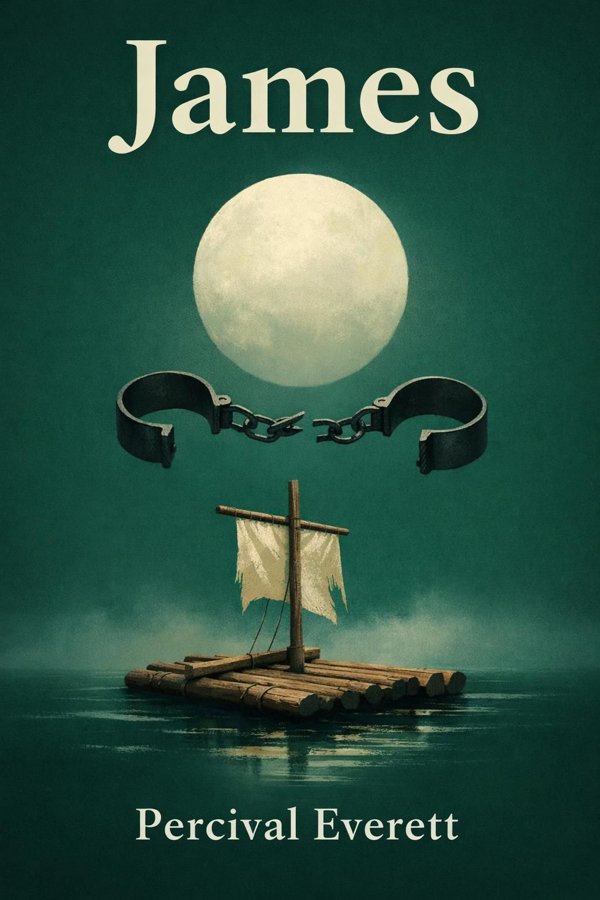
James: A Novel: Summary & Key Insights
 10 min4 chaptersAudio available
What Is James: A Novel About?
James: A Novel by Percival Everett is a bestsellers book spanning 4 pages. A reimagining of Mark Twain’s 'Adventures of Huckleberry Finn' told from the perspective of the enslaved Jim, Percival Everett’s 'James' explores race, identity, and freedom in antebellum America. The novel combines biting humor and profound insight to challenge the narratives of American history and literature.
This FizzRead summary covers all 4 key chapters of James: A Novel in approximately 10 minutes, distilling the most important ideas, arguments, and takeaways from Percival Everett's work. Also available as an audio summary and Key Quotes Podcast.
James: A Novel
A reimagining of Mark Twain’s 'Adventures of Huckleberry Finn' told from the perspective of the enslaved Jim, Percival Everett’s 'James' explores race, identity, and freedom in antebellum America. The novel combines biting humor and profound insight to challenge the narratives of American history and literature.
Who Should Read James: A Novel?
This book is perfect for anyone interested in bestsellers and looking to gain actionable insights in a short read. Whether you're a student, professional, or lifelong learner, the key ideas from James: A Novel by Percival Everett will help you think differently.
- ✓Readers who enjoy bestsellers and want practical takeaways
- ✓Professionals looking to apply new ideas to their work and life
- ✓Anyone who wants the core insights of James: A Novel in just 10 minutes
Want the full summary?
Get instant access to this book summary and 100K+ more with Fizz Moment.
Get Free SummaryAvailable on App Store • Free to download
Key Chapters
When I first imagined James on the Phelps plantation, I saw a man who moves through the world watched, measured, and underestimated. On the surface, he plays his part: compliant, submissive, harmless. But beneath that mask lives a man of intellect, memory, and longing. In secret, James teaches himself to read and write, knowing full well that this act—so mundane for some—is a deadly rebellion for him. To read is to own one’s mind; to write is to name one’s world. This hidden literacy becomes his silent resistance. Each word he learns pulls him closer to an inner freedom, a world of thought that cannot be whipped or chained.
Learning to read also exposes the great irony of his world. The Bible, the founding documents, the sermons of men who call themselves civilized—all proclaim freedom and righteousness, yet justify ownership of human beings. Through James’s eyes, every printed page becomes a paradox: the same language that imprisons him also offers tools for liberation. He understands early that knowledge cannot be neutral—it comes with its own freight of hypocrisy and promise.
That secret talent, that forbidden language, sets the foundation for everything that follows. When James overhears that he will be sold away from his wife and daughter, his knowledge of words transforms into a weapon of survival. He can now read the lies of his oppressors, interpret the contracts that define his fate, and ultimately plot his escape. In a land where keeping a man ignorant is key to controlling him, James uses literacy as his quiet insurrection.
The decision to flee is born not of adventure but of necessity. When James runs, he runs from the violence of separation, from a system that claims ownership not only of his body but of his family’s future. The Mississippi becomes his bid for life and an unpredictable mirror of his condition—beautiful, dangerous, uncertain. His path crosses with that of a familiar fugitive: Huckleberry Finn, a white boy fleeing from his own abusive father and a society that demands his conformity.
Together, they drift—a black man and a white child, two runaways on the same river but from different worlds. Huck narrates ignorance and innocence in Twain’s version; here, I let James bear witness with clear eyes. He must code-switch constantly, speaking one way for Huck and another inside his head. Language divides yet connects them; James calls on its dual nature to survive. It’s in this double speech that the novel unpacks the psychology of race—the way an enslaved person learns to perform safety through words, to play a script that hides his intellect. The white world only hears the caricature; the reader is invited behind the curtain.
Their journey encounters tricksters, con men, and slave catchers—figures swelling with self-importance and moral blindness. Through them, James sees the absurd theater of antebellum America, where cruelty parades as virtue and ignorance masquerades as faith. Each episode peels back the rhetoric of freedom to expose its contradictions. Amid farce and peril, humor becomes James’s shield. Irony is his weapon; laughter his rebellion. The river flows relentlessly on, indifferent to man’s injustices, but within James, a new understanding forms: that freedom cannot simply be a physical state of escape. It must be an act of creation.
+ 2 more chapters — available in the FizzRead app
All Chapters in James: A Novel
About the Author
Percival Everett is an American novelist and professor of English at the University of Southern California. Known for his genre-defying works and sharp social commentary, Everett has written numerous acclaimed novels including 'Erasure', 'The Trees', and 'So Much Blue'. His writing often interrogates race, language, and the boundaries of storytelling.
Get This Summary in Your Preferred Format
Read or listen to the James: A Novel summary by Percival Everett anytime, anywhere. FizzRead offers multiple formats so you can learn on your terms — all free.
Available formats: App · Audio · PDF · EPUB — All included free with FizzRead
Download James: A Novel PDF and EPUB Summary
Key Quotes from James: A Novel
“When I first imagined James on the Phelps plantation, I saw a man who moves through the world watched, measured, and underestimated.”
“The decision to flee is born not of adventure but of necessity.”
Frequently Asked Questions about James: A Novel
James: A Novel by Percival Everett is a bestsellers book that explores key ideas across 4 chapters. A reimagining of Mark Twain’s 'Adventures of Huckleberry Finn' told from the perspective of the enslaved Jim, Percival Everett’s 'James' explores race, identity, and freedom in antebellum America. The novel combines biting humor and profound insight to challenge the narratives of American history and literature.
You Might Also Like
The Godfather
Mario Puzo
10 min
The Handmaid's Tale
Margaret Atwood
10 min
The Hunger Games
Suzanne Collins
10 min
The Nightingale
Kristin Hannah
10 min
The Seven Husbands of Evelyn Hugo
Taylor Jenkins Reid
10 min
Backwater Justice
Fern Michaels
10 minBrowse by Category
Ready to read James: A Novel?
Get the full summary and 100K+ more books with Fizz Moment.