
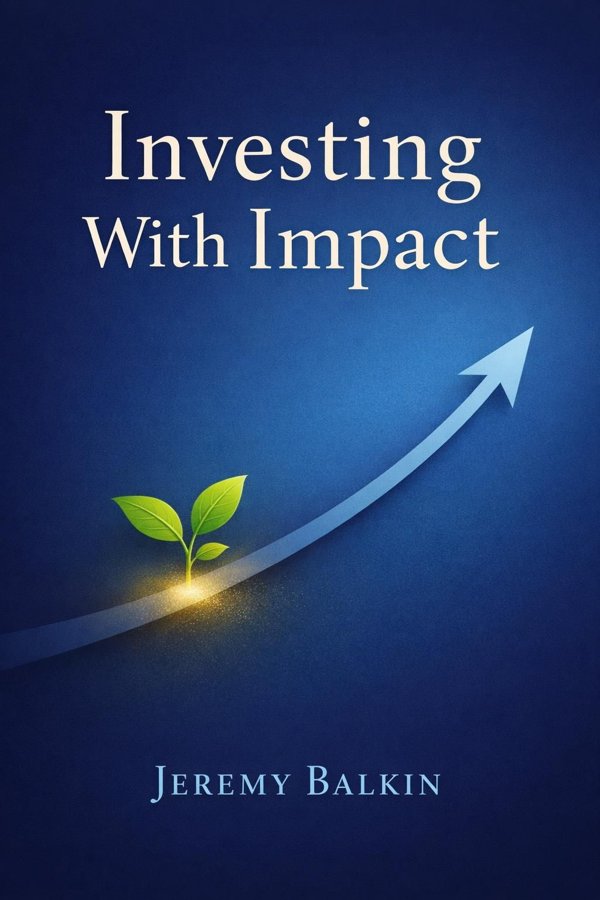
Investing With Impact: Why Finance Is a Force for Good: Summary & Key Insights
 10 min12 chaptersAudio available
What Is Investing With Impact: Why Finance Is a Force for Good About?
Investing With Impact: Why Finance Is a Force for Good by Jeremy Balkin is a finance book spanning 12 pages. In 'Investing With Impact: Why Finance Is a Force for Good', Jeremy Balkin argues that the finance industry can be a powerful driver of positive change. The book explores how capital allocation can be aligned with ethical and sustainable goals, demonstrating that financial success and social good are not mutually exclusive. Balkin provides insights into the emerging field of impact investing and offers practical guidance for investors seeking to make a difference while achieving returns.
This FizzRead summary covers all 12 key chapters of Investing With Impact: Why Finance Is a Force for Good in approximately 10 minutes, distilling the most important ideas, arguments, and takeaways from Jeremy Balkin's work. Also available as an audio summary and Key Quotes Podcast.
Investing With Impact: Why Finance Is a Force for Good
In 'Investing With Impact: Why Finance Is a Force for Good', Jeremy Balkin argues that the finance industry can be a powerful driver of positive change. The book explores how capital allocation can be aligned with ethical and sustainable goals, demonstrating that financial success and social good are not mutually exclusive. Balkin provides insights into the emerging field of impact investing and offers practical guidance for investors seeking to make a difference while achieving returns.
Who Should Read Investing With Impact: Why Finance Is a Force for Good?
This book is perfect for anyone interested in finance and looking to gain actionable insights in a short read. Whether you're a student, professional, or lifelong learner, the key ideas from Investing With Impact: Why Finance Is a Force for Good by Jeremy Balkin will help you think differently.
- ✓Readers who enjoy finance and want practical takeaways
- ✓Professionals looking to apply new ideas to their work and life
- ✓Anyone who wants the core insights of Investing With Impact: Why Finance Is a Force for Good in just 10 minutes
Want the full summary?
Get instant access to this book summary and 100K+ more with Fizz Moment.
Get Free SummaryAvailable on App Store • Free to download
Key Chapters
To understand why impact investing matters, we must first understand how finance became what it is today. The story of capitalism is one of extraordinary progress — lifting billions out of poverty, financing innovation, and creating industries that transformed human possibility. Yet it also carries a darker legacy of inequality, exploitation, and environmental depletion.
From the rise of merchant banking in the Renaissance to the advent of modern stock exchanges, every financial milestone came with moral consequences. Capital sought return, but rarely paused to ask about responsibility. The industrial revolution, fueled by finance, brought unprecedented wealth but also child labor and pollution. The globalization era expanded markets but widened the gap between those who benefitted and those who were left behind.
When the global financial crisis of 2008 struck, the world witnessed what happens when finance divorces itself from ethics. The collapse was not merely economic; it was moral. Trust evaporated. Ordinary citizens realized that while profits had been privatized, losses were socialized. And yet, out of that crisis emerged a yearning for a better way — a desire to rebuild finance around values that sustain rather than erode the social fabric.
Impact investing arose from that moral awakening. It traces back to early socially responsible investing (SRI) movements of the 1970s and 1980s, where activists began screening portfolios based on environmental, labor, and governance criteria. But while SRI often focused on exclusion — avoiding 'bad' companies — impact investing is proactive. It seeks to invest in entities that generate measurable social and environmental benefits. It represents the evolution of capitalism toward conscientious stewardship of resources.
In essence, the financial system’s history has always oscillated between self-interest and public interest. Our challenge now is to reconcile the two. Progress need not depend on exploitation; profit need not preclude purpose. Understanding where we’ve come from allows us to shape where we go next.
Finance is not simply a numbers game. Each transaction contains a moral choice — a reflection of what we value as a society. I argue that investors and institutions are not passive players responding to market forces; they are architects of the world that capital builds.
Money, when viewed through an ethical lens, has agency. It can heal communities or harm them. A loan issued to a small business creates livelihood and dignity; a speculative bet on toxic assets erodes trust and destabilizes economies. Recognizing the moral weight of these decisions is fundamental to reclaiming finance as a public good.
The concept of stewardship lies at the heart of ethical finance. A financial professional is not merely a custodian of capital but a steward of human futures. The crises of recent decades have exposed the cost of neglecting that duty. When financial decisions become disconnected from human outcomes, the system loses legitimacy.
In *Investing With Impact*, I emphasize that moral accountability does not hinder efficiency — it enhances it. Ethical alignment strengthens brand reputation, investor confidence, and long-term sustainability. Moreover, younger generations are demanding that their money reflect their values. This shift isn’t sentimental; it’s structural. Millennials and Gen Z investors are poised to control trillions in assets, and their priorities — climate action, diversity, social justice — are reshaping investment norms. Finance must evolve to reflect their worldviews.
The moral dimension of money ultimately compels institutions to ask not just, 'How much can we earn?' but 'What kind of world are we financing?' When that question becomes central to every investment decision, finance transforms from an extractive process into an act of creation — one that builds value measured both in profit and in progress.
+ 10 more chapters — available in the FizzRead app
All Chapters in Investing With Impact: Why Finance Is a Force for Good
About the Author
Jeremy Balkin is an Australian-born banker, author, and thought leader in the field of ethical finance and innovation. Recognized by the World Economic Forum as a Young Global Leader, he has worked extensively in sustainable finance and corporate responsibility, advocating for the integration of moral purpose into financial systems.
Get This Summary in Your Preferred Format
Read or listen to the Investing With Impact: Why Finance Is a Force for Good summary by Jeremy Balkin anytime, anywhere. FizzRead offers multiple formats so you can learn on your terms — all free.
Available formats: App · Audio · PDF · EPUB — All included free with FizzRead
Download Investing With Impact: Why Finance Is a Force for Good PDF and EPUB Summary
Key Quotes from Investing With Impact: Why Finance Is a Force for Good
“To understand why impact investing matters, we must first understand how finance became what it is today.”
“Each transaction contains a moral choice — a reflection of what we value as a society.”
Frequently Asked Questions about Investing With Impact: Why Finance Is a Force for Good
Investing With Impact: Why Finance Is a Force for Good by Jeremy Balkin is a finance book that explores key ideas across 12 chapters. In 'Investing With Impact: Why Finance Is a Force for Good', Jeremy Balkin argues that the finance industry can be a powerful driver of positive change. The book explores how capital allocation can be aligned with ethical and sustainable goals, demonstrating that financial success and social good are not mutually exclusive. Balkin provides insights into the emerging field of impact investing and offers practical guidance for investors seeking to make a difference while achieving returns.
You Might Also Like




Browse by Category
Ready to read Investing With Impact: Why Finance Is a Force for Good?
Get the full summary and 100K+ more books with Fizz Moment.