
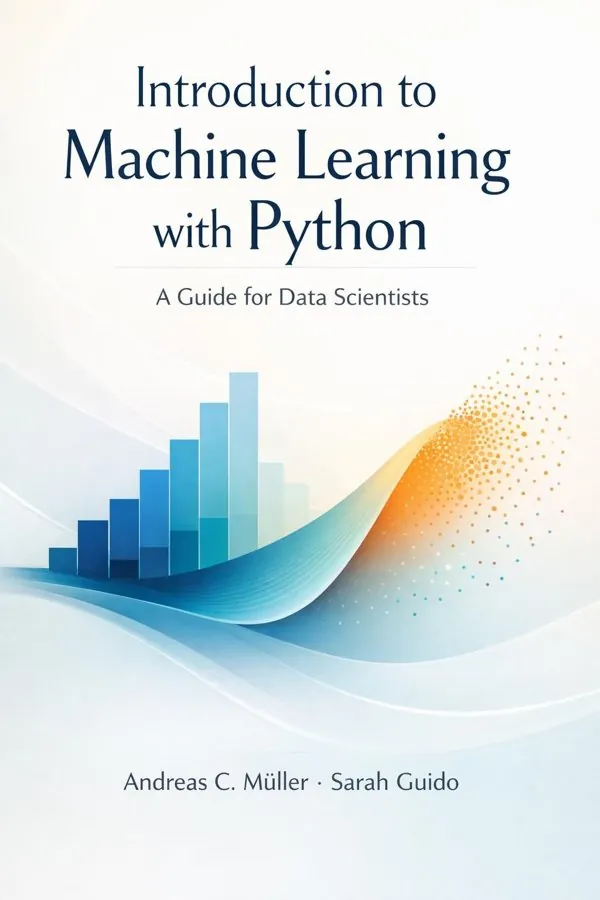
Introduction to Machine Learning with Python: A Guide for Data Scientists: Summary & Key Insights
by Andreas C. Müller, Sarah Guido
 10 min9 chaptersAudio available
What Is Introduction to Machine Learning with Python: A Guide for Data Scientists About?
Introduction to Machine Learning with Python: A Guide for Data Scientists by Andreas C. Müller, Sarah Guido is a ai_ml book spanning 9 pages. This book provides a practical introduction to machine learning using Python and the scikit-learn library. It covers fundamental concepts such as supervised and unsupervised learning, model evaluation, preprocessing, and pipelines. The authors emphasize hands-on examples and real-world applications, making it accessible to data scientists and developers who want to build intelligent systems without deep mathematical background.
This FizzRead summary covers all 9 key chapters of Introduction to Machine Learning with Python: A Guide for Data Scientists in approximately 10 minutes, distilling the most important ideas, arguments, and takeaways from Andreas C. Müller, Sarah Guido's work. Also available as an audio summary and Key Quotes Podcast.
Introduction to Machine Learning with Python: A Guide for Data Scientists
This book provides a practical introduction to machine learning using Python and the scikit-learn library. It covers fundamental concepts such as supervised and unsupervised learning, model evaluation, preprocessing, and pipelines. The authors emphasize hands-on examples and real-world applications, making it accessible to data scientists and developers who want to build intelligent systems without deep mathematical background.
Who Should Read Introduction to Machine Learning with Python: A Guide for Data Scientists?
This book is perfect for anyone interested in ai_ml and looking to gain actionable insights in a short read. Whether you're a student, professional, or lifelong learner, the key ideas from Introduction to Machine Learning with Python: A Guide for Data Scientists by Andreas C. Müller, Sarah Guido will help you think differently.
- ✓Readers who enjoy ai_ml and want practical takeaways
- ✓Professionals looking to apply new ideas to their work and life
- ✓Anyone who wants the core insights of Introduction to Machine Learning with Python: A Guide for Data Scientists in just 10 minutes
Want the full summary?
Get instant access to this book summary and 100K+ more with Fizz Moment.
Get Free SummaryAvailable on App Store • Free to download
Key Chapters
When newcomers first approach machine learning, the landscape can feel vast and abstract: algorithms, models, data pipelines, metrics—all swirling around in jargon. In our book, I begin by grounding those ideas in an approachable, intuitive foundation. Machine learning, at its heart, is about learning patterns from examples. We tell the computer, 'Here’s some data and what it represents,' and the computer learns how to generalize from it.
Python plays a transformative role in making this process approachable. The language’s readability ensures that you can focus on modeling concepts, not syntactic quirks. Combined with libraries such as NumPy, pandas, and matplotlib, Python becomes a full ecosystem for data exploration and algorithmic experimentation. But scikit-learn is what ties the entire narrative together: It’s a library designed to implement machine learning algorithms and workflows in a unified, simple API. With scikit-learn, every model—from logistic regression to decision trees—follows the same pattern: instantiate, fit, predict. This consistency is not trivial; it enables reproducible research and easy experimentation.
In this opening chapter, I also emphasize a mindset shift. Machine learning isn’t about coding clever tricks—it’s about understanding your data. You should begin every project by asking: What is the question I want answered? What is the nature of the data? What does 'success' mean in measurable terms? Once those foundations are laid, Python becomes not just a programming language but a partner in exploration. You learn to visualize, to test hypotheses, and to build models iteratively, learning from mistakes along the way.
This chapter establishes the tone for the rest of the book: machine learning as a craft, Python as the brush, and curiosity as the canvas.
Supervised learning is where most journeys into machine learning truly begin. Here, we provide examples—known as labeled data—that pair inputs with desired outputs. The model’s task is to uncover a mapping from inputs to outputs so it can make predictions on unseen examples. Within this domain, two fundamental tasks emerge: classification, where outputs are discrete categories, and regression, where outputs are continuous values.
In the book, I walk readers through intuitive examples first—like classifying iris flowers or predicting housing prices—before diving deeper into specific algorithms. The k-nearest neighbors algorithm (k-NN) serves as the perfect introduction. It requires no mathematical parameter estimation; it simply memorizes the training data and predicts based on similarity. While simple, the algorithm exposes crucial trade-offs between simplicity, computational cost, and accuracy.
We then move into linear models such as logistic regression and linear regression, which embody the idea of learning a weighted combination of input features. These models are interpretable, fast, and powerful for many real-world problems. I explain how coefficients represent feature importance and how regularization can prevent overfitting—a recurring theme that every practitioner must master.
Readers also encounter other supervised methods later in the text: support vector machines, decision trees, random forests, and gradient boosting. But this chapter’s intent is foundational: to make you comfortable with the relationship between data, features, targets, and the model’s generalization capacity. By understanding how supervised learning learns from labeled examples, you build intuition that later informs every other type of learning.
+ 7 more chapters — available in the FizzRead app
All Chapters in Introduction to Machine Learning with Python: A Guide for Data Scientists
About the Authors
Andreas C. Müller is a machine learning researcher and core developer of scikit-learn. Sarah Guido is a data scientist specializing in Python-based data analysis and machine learning applications.
Get This Summary in Your Preferred Format
Read or listen to the Introduction to Machine Learning with Python: A Guide for Data Scientists summary by Andreas C. Müller, Sarah Guido anytime, anywhere. FizzRead offers multiple formats so you can learn on your terms — all free.
Available formats: App · Audio · PDF · EPUB — All included free with FizzRead
Download Introduction to Machine Learning with Python: A Guide for Data Scientists PDF and EPUB Summary
Key Quotes from Introduction to Machine Learning with Python: A Guide for Data Scientists
“When newcomers first approach machine learning, the landscape can feel vast and abstract: algorithms, models, data pipelines, metrics—all swirling around in jargon.”
“Supervised learning is where most journeys into machine learning truly begin.”
Frequently Asked Questions about Introduction to Machine Learning with Python: A Guide for Data Scientists
Introduction to Machine Learning with Python: A Guide for Data Scientists by Andreas C. Müller, Sarah Guido is a ai_ml book that explores key ideas across 9 chapters. This book provides a practical introduction to machine learning using Python and the scikit-learn library. It covers fundamental concepts such as supervised and unsupervised learning, model evaluation, preprocessing, and pipelines. The authors emphasize hands-on examples and real-world applications, making it accessible to data scientists and developers who want to build intelligent systems without deep mathematical background.
You Might Also Like
Life 3.0
Max Tegmark
10 min
Superintelligence
Nick Bostrom
10 min
TensorFlow in Action
Thushan Ganegedara
10 min
AI Made Simple: A Beginner’s Guide to Generative AI, ChatGPT, and the Future of Work
Rajeev Kapur
10 min
AI Snake Oil
Arvind Narayanan, Sayash Kapoor
10 min
AI Superpowers: China, Silicon Valley, and the New World Order
Kai-Fu Lee
10 minBrowse by Category
Ready to read Introduction to Machine Learning with Python: A Guide for Data Scientists?
Get the full summary and 100K+ more books with Fizz Moment.