
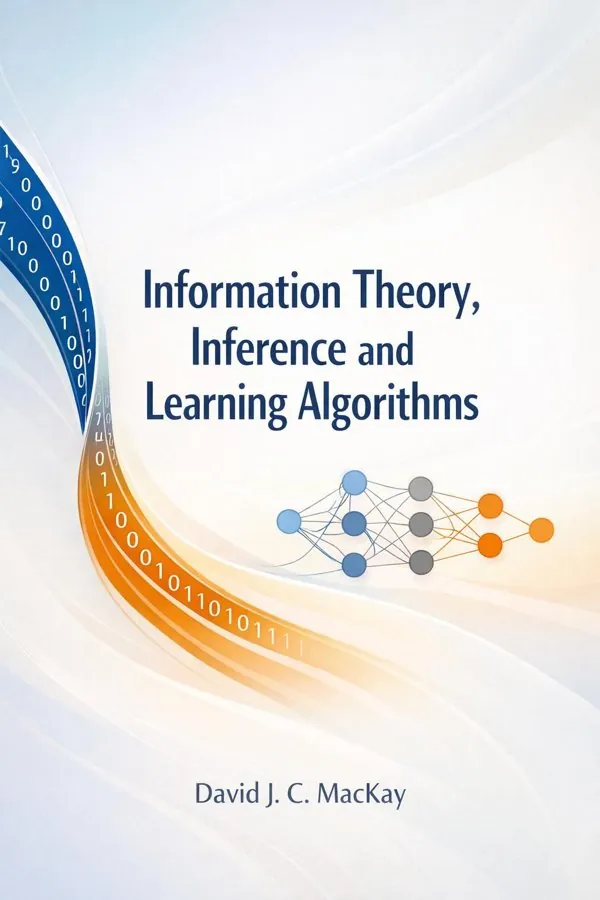
Information Theory, Inference and Learning Algorithms: Summary & Key Insights
 10 min10 chaptersAudio available
What Is Information Theory, Inference and Learning Algorithms About?
Information Theory, Inference and Learning Algorithms by David J. C. MacKay is a ai_ml book spanning 10 pages. This comprehensive textbook introduces the fundamental principles of information theory, probabilistic inference, and machine learning. It unifies these fields through a coherent mathematical framework, covering topics such as data compression, error-correcting codes, Bayesian inference, and neural networks. The book emphasizes practical algorithms and includes numerous examples and exercises to deepen understanding.
This FizzRead summary covers all 10 key chapters of Information Theory, Inference and Learning Algorithms in approximately 10 minutes, distilling the most important ideas, arguments, and takeaways from David J. C. MacKay's work. Also available as an audio summary and Key Quotes Podcast.
Information Theory, Inference and Learning Algorithms
This comprehensive textbook introduces the fundamental principles of information theory, probabilistic inference, and machine learning. It unifies these fields through a coherent mathematical framework, covering topics such as data compression, error-correcting codes, Bayesian inference, and neural networks. The book emphasizes practical algorithms and includes numerous examples and exercises to deepen understanding.
Who Should Read Information Theory, Inference and Learning Algorithms?
This book is perfect for anyone interested in ai_ml and looking to gain actionable insights in a short read. Whether you're a student, professional, or lifelong learner, the key ideas from Information Theory, Inference and Learning Algorithms by David J. C. MacKay will help you think differently.
- ✓Readers who enjoy ai_ml and want practical takeaways
- ✓Professionals looking to apply new ideas to their work and life
- ✓Anyone who wants the core insights of Information Theory, Inference and Learning Algorithms in just 10 minutes
Want the full summary?
Get instant access to this book summary and 100K+ more with Fizz Moment.
Get Free SummaryAvailable on App Store • Free to download
Key Chapters
We begin where the story of modern communication truly starts — with Shannon. His 1948 paper defined information as the reduction of uncertainty, quantifying it with entropy. Entropy tells us how unpredictable a variable is, how much surprise each observation carries. This simple yet profound insight made a new kind of science possible: a mathematics not of signals or hardware, but of concepts.
In my exposition, I revisit Shannon’s key results: the source coding theorem, which ties entropy to the minimum achievable average code length, and the channel coding theorem, defining the capacity of a noisy channel. To grasp these fully, we wade through the clean waters of probability theory, defining random variables, expectations, and distributions as the framework for all future reasoning. Probability is not just algebra; it is the language of disciplined uncertainty.
As we study mutual information — the measure of how one random variable tells us about another — we see how knowledge and communication intertwine. Every logical deduction, every act of prediction, is a transfer of information. When we design codes or infer models, we are optimizing this transfer against noise and ignorance. Information theory thus becomes the cornerstone for all learning: to learn is to increase mutual information between the data and our hypotheses.
Once the notion of entropy has been established, the next natural question arises: how can we use it to compress data without losing meaning? In these chapters, I take you through both lossless and lossy compression, showing how optimal codes are those whose average length matches the entropy of the source. Huffman and arithmetic coding emerge as practical examples of this principle, demonstrating that the mathematics predicts real-world efficiency.
Compression isn’t merely about saving space; it’s about understanding structure. When you capture redundancy, you uncover the patterns hidden in data. This insight bridges the world of communication and the world of cognition. A brain that compresses experiences efficiently is one that understands them deeply.
Lossy compression adds another layer — the art of trading accuracy for brevity. Shannon’s rate-distortion theory tells us how much information we can discard before perception noticeably degrades. This interplay between precision and approximation mirrors how we reason in life: we seldom retain every detail, only what matters for our decisions. Understanding compression thus means grasping the mathematics of abstraction itself.
+ 8 more chapters — available in the FizzRead app
All Chapters in Information Theory, Inference and Learning Algorithms
About the Author
David J. C. MacKay (1967–2019) was a British physicist, information theorist, and professor at the University of Cambridge. He was known for his contributions to information theory, machine learning, and sustainable energy. MacKay also served as Chief Scientific Adviser to the UK Department of Energy and Climate Change and authored influential works on energy and computation.
Get This Summary in Your Preferred Format
Read or listen to the Information Theory, Inference and Learning Algorithms summary by David J. C. MacKay anytime, anywhere. FizzRead offers multiple formats so you can learn on your terms — all free.
Available formats: App · Audio · PDF · EPUB — All included free with FizzRead
Download Information Theory, Inference and Learning Algorithms PDF and EPUB Summary
Key Quotes from Information Theory, Inference and Learning Algorithms
“We begin where the story of modern communication truly starts — with Shannon.”
“Once the notion of entropy has been established, the next natural question arises: how can we use it to compress data without losing meaning?”
Frequently Asked Questions about Information Theory, Inference and Learning Algorithms
Information Theory, Inference and Learning Algorithms by David J. C. MacKay is a ai_ml book that explores key ideas across 10 chapters. This comprehensive textbook introduces the fundamental principles of information theory, probabilistic inference, and machine learning. It unifies these fields through a coherent mathematical framework, covering topics such as data compression, error-correcting codes, Bayesian inference, and neural networks. The book emphasizes practical algorithms and includes numerous examples and exercises to deepen understanding.
You Might Also Like
Life 3.0
Max Tegmark
10 min
Superintelligence
Nick Bostrom
10 min
TensorFlow in Action
Thushan Ganegedara
10 min
AI Made Simple: A Beginner’s Guide to Generative AI, ChatGPT, and the Future of Work
Rajeev Kapur
10 min
AI Snake Oil
Arvind Narayanan, Sayash Kapoor
10 min
AI Superpowers: China, Silicon Valley, and the New World Order
Kai-Fu Lee
10 minBrowse by Category
Ready to read Information Theory, Inference and Learning Algorithms?
Get the full summary and 100K+ more books with Fizz Moment.