
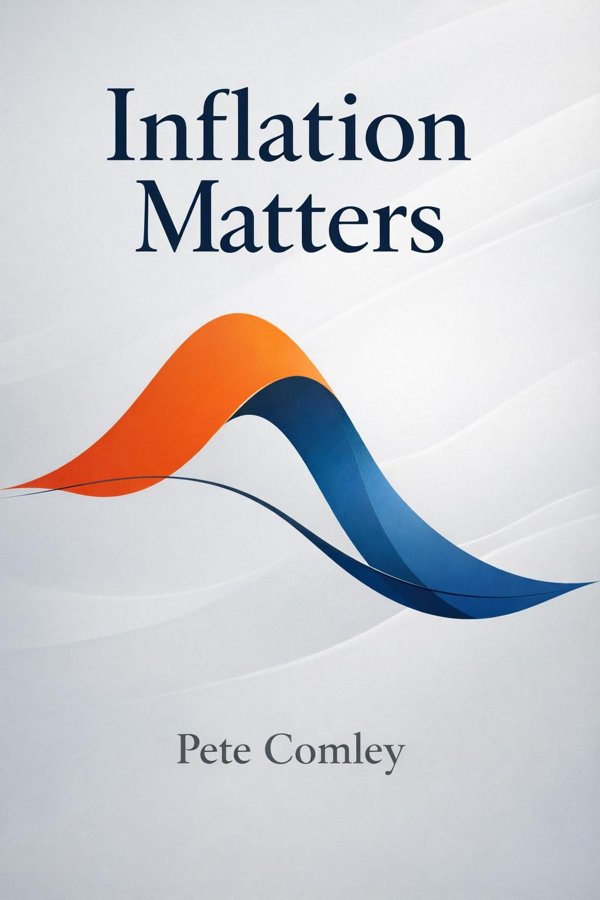
Inflation Matters: Inflationary Wave Theory, Its Impact on Inflation Past and Present and the Deflation Yet to Come: Summary & Key Insights
by Pete Comley
 10 min5 chaptersAudio available
What Is Inflation Matters: Inflationary Wave Theory, Its Impact on Inflation Past and Present and the Deflation Yet to Come About?
Inflation Matters: Inflationary Wave Theory, Its Impact on Inflation Past and Present and the Deflation Yet to Come by Pete Comley is a economics book spanning 5 pages. Inflation Matters is a comprehensive guide to understanding inflation, its causes, history, and effects on the economy. Pete Comley explains in an accessible way how inflation impacts different sectors and how individuals can protect themselves from its consequences. The author introduces the Inflationary Wave Theory to analyze cycles of inflation and deflation over time.
This FizzRead summary covers all 5 key chapters of Inflation Matters: Inflationary Wave Theory, Its Impact on Inflation Past and Present and the Deflation Yet to Come in approximately 10 minutes, distilling the most important ideas, arguments, and takeaways from Pete Comley's work. Also available as an audio summary and Key Quotes Podcast.
Inflation Matters: Inflationary Wave Theory, Its Impact on Inflation Past and Present and the Deflation Yet to Come
Inflation Matters is a comprehensive guide to understanding inflation, its causes, history, and effects on the economy. Pete Comley explains in an accessible way how inflation impacts different sectors and how individuals can protect themselves from its consequences. The author introduces the Inflationary Wave Theory to analyze cycles of inflation and deflation over time.
Who Should Read Inflation Matters: Inflationary Wave Theory, Its Impact on Inflation Past and Present and the Deflation Yet to Come?
This book is perfect for anyone interested in economics and looking to gain actionable insights in a short read. Whether you're a student, professional, or lifelong learner, the key ideas from Inflation Matters: Inflationary Wave Theory, Its Impact on Inflation Past and Present and the Deflation Yet to Come by Pete Comley will help you think differently.
- ✓Readers who enjoy economics and want practical takeaways
- ✓Professionals looking to apply new ideas to their work and life
- ✓Anyone who wants the core insights of Inflation Matters: Inflationary Wave Theory, Its Impact on Inflation Past and Present and the Deflation Yet to Come in just 10 minutes
Want the full summary?
Get instant access to this book summary and 100K+ more with Fizz Moment.
Get Free SummaryAvailable on App Store • Free to download
Key Chapters
When we look back through history, inflation reveals itself as a recurring companion to human progress. It’s not an invention of modern capitalism but has been with us since the earliest coinages in ancient Lydia. Inflation tends to emerge whenever societies expand trade, increase money supply, or find new ways to produce wealth faster than they produce goods. Yet, it’s also deeply tied to greed and fear—the emotional rhythms that drive humanity.
Consider the Renaissance. As precious metals from the New World poured into Europe, prices surged dramatically—a phenomenon historians later named the Price Revolution. Ordinary people found their wages lagging behind costs, and entire social orders shifted. Money, once stable, became an unreliable store of value. Fast-forward to the twentieth century, and similar patterns appear: the German hyperinflation of the 1920s reduced savings to dust, while in the 1970s, oil shocks and rapid monetary expansion unleashed new waves of price increases across the developed world.
Inflation’s impact is never uniform. Borrowers often thrive during inflationary periods because they repay old debts with cheaper money. Savers, on the other hand, see the purchasing power of their hard-earned savings erode. Businesses that can quickly adjust prices adapt more easily, while those that cannot—especially small enterprises—struggle. The outcome is always redistributive: inflation transfers wealth, often silently, from one class or generation to another.
But inflation is not always the enemy it’s made out to be. In moderation, it oils the wheels of commerce. It encourages spending and investment rather than hoarding. The danger lies in extremes. When people lose faith in money, economies unravel. When fear of deflation grips them instead, growth can stall as consumers delay purchases expecting prices to fall further. The historical record shows us that inflation, deflation, and stability form a repeating triad—a cycle as natural as the tides.
Economists have long tried to capture inflation in equations. The Quantity Theory of Money, associated with Milton Friedman, claims that prices rise proportionally when the money supply grows faster than output. Keynesian models, by contrast, focus on aggregate demand and employment levels: when demand outstrips productive capacity, prices rise. Yet despite their elegance, both approaches only tell part of the story.
In the real world, inflation often behaves irrationally. Prices rise when money supply falls, or remain stable despite massive injections of liquidity. The missing element, I realized, is the human one: collective psychology, expectation, and memory. My Inflationary Wave Theory combines economics with behavioral insight to explain why inflation doesn’t simply follow policy—it follows people.
According to this theory, inflation moves in long waves lasting several decades. Each wave begins when confidence in money and growth is low—sometimes after depression or deflation. As optimism returns, spending, investment, and borrowing expand. Gradually, this enthusiasm builds momentum, driving prices upward. At the wave’s peak, exuberance gives way to complacency: governments and central banks often miscalculate, assuming the good times will last. Then comes correction—sometimes slow, sometimes sudden—ushering in a deflationary or disinflationary phase.
By analyzing data from centuries of economic history—from the gold rush of the nineteenth century to the postwar booms—I saw these waves repeat. They are not perfect cycles but psychological tides reflecting our tendency to swing between fear and greed. Recognizing these patterns gives us the foresight to prepare rather than react.
+ 3 more chapters — available in the FizzRead app
All Chapters in Inflation Matters: Inflationary Wave Theory, Its Impact on Inflation Past and Present and the Deflation Yet to Come
About the Author
Pete Comley is a British researcher and author specializing in behavioral economics and personal finance. He has written several books on economic and financial topics, known for his ability to explain complex concepts clearly and understandably.
Get This Summary in Your Preferred Format
Read or listen to the Inflation Matters: Inflationary Wave Theory, Its Impact on Inflation Past and Present and the Deflation Yet to Come summary by Pete Comley anytime, anywhere. FizzRead offers multiple formats so you can learn on your terms — all free.
Available formats: App · Audio · PDF · EPUB — All included free with FizzRead
Download Inflation Matters: Inflationary Wave Theory, Its Impact on Inflation Past and Present and the Deflation Yet to Come PDF and EPUB Summary
Key Quotes from Inflation Matters: Inflationary Wave Theory, Its Impact on Inflation Past and Present and the Deflation Yet to Come
“When we look back through history, inflation reveals itself as a recurring companion to human progress.”
“Economists have long tried to capture inflation in equations.”
Frequently Asked Questions about Inflation Matters: Inflationary Wave Theory, Its Impact on Inflation Past and Present and the Deflation Yet to Come
Inflation Matters: Inflationary Wave Theory, Its Impact on Inflation Past and Present and the Deflation Yet to Come by Pete Comley is a economics book that explores key ideas across 5 chapters. Inflation Matters is a comprehensive guide to understanding inflation, its causes, history, and effects on the economy. Pete Comley explains in an accessible way how inflation impacts different sectors and how individuals can protect themselves from its consequences. The author introduces the Inflationary Wave Theory to analyze cycles of inflation and deflation over time.
You Might Also Like
Business Adventures
John Brooks
10 min
Nudge
Richard H. Thaler, Cass R. Sunstein
10 min
The Hitchhiker"s Guide to the Galaxy
Douglas Adams
10 minThe Muqaddimah
Ibn Khaldun
10 minThe Outsiders
William N. Thorndike
10 min
A Little History of Economics
Niall Kishtainy
10 minBrowse by Category
Ready to read Inflation Matters: Inflationary Wave Theory, Its Impact on Inflation Past and Present and the Deflation Yet to Come?
Get the full summary and 100K+ more books with Fizz Moment.