
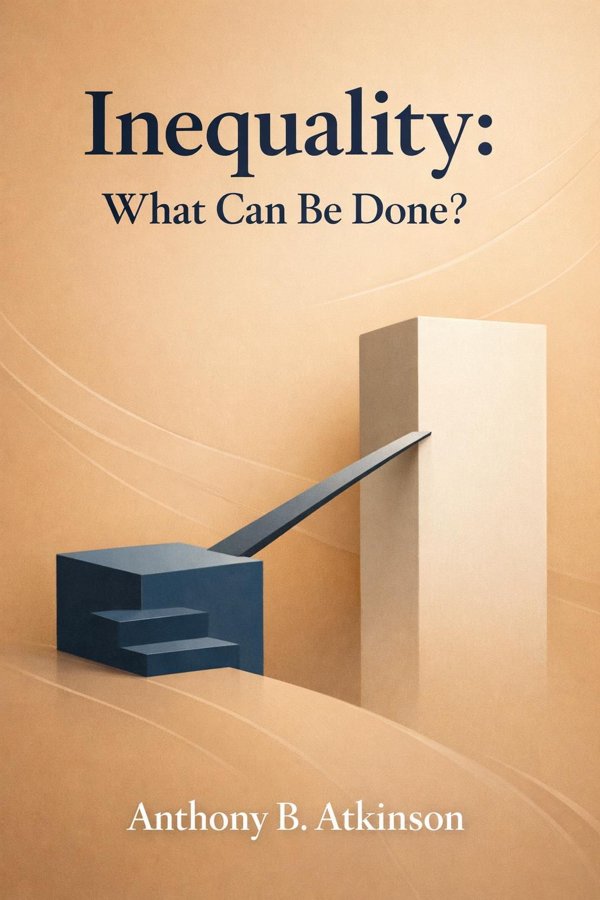
Inequality: What Can Be Done?: Summary & Key Insights
 10 min11 chaptersAudio available
What Is Inequality: What Can Be Done? About?
Inequality: What Can Be Done? by Anthony B. Atkinson is a economics book spanning 11 pages. In this influential work, economist Anthony B. Atkinson explores the causes and consequences of economic inequality and argues that it is not an inevitable outcome of modern capitalism but a result of policy choices. Drawing on decades of research, Atkinson proposes a comprehensive set of practical measures to reduce inequality, including progressive taxation, social investment, and technological innovation policies aimed at inclusive growth.
This FizzRead summary covers all 11 key chapters of Inequality: What Can Be Done? in approximately 10 minutes, distilling the most important ideas, arguments, and takeaways from Anthony B. Atkinson's work. Also available as an audio summary and Key Quotes Podcast.
Inequality: What Can Be Done?
In this influential work, economist Anthony B. Atkinson explores the causes and consequences of economic inequality and argues that it is not an inevitable outcome of modern capitalism but a result of policy choices. Drawing on decades of research, Atkinson proposes a comprehensive set of practical measures to reduce inequality, including progressive taxation, social investment, and technological innovation policies aimed at inclusive growth.
Who Should Read Inequality: What Can Be Done??
This book is perfect for anyone interested in economics and looking to gain actionable insights in a short read. Whether you're a student, professional, or lifelong learner, the key ideas from Inequality: What Can Be Done? by Anthony B. Atkinson will help you think differently.
- ✓Readers who enjoy economics and want practical takeaways
- ✓Professionals looking to apply new ideas to their work and life
- ✓Anyone who wants the core insights of Inequality: What Can Be Done? in just 10 minutes
Want the full summary?
Get instant access to this book summary and 100K+ more with Fizz Moment.
Get Free SummaryAvailable on App Store • Free to download
Key Chapters
To understand inequality today, we must begin with its historical trajectory. After the Second World War, many developed economies experienced an extraordinary decline in income disparities. Progressive taxation, strong labor unions, expanding welfare states, and full-employment policies together created what some have called the ‘Golden Age of Equality’. Economic growth was shared broadly, with wages rising proportionally across sectors. Yet, beginning in the late 1970s and accelerating through the 1980s, the pendulum swung back. Liberalization of capital markets, deregulation of labor, and reduced taxation on high incomes restored the steep gradients of wealth. The share of national income going to the top one percent increased dramatically in the United States, United Kingdom, and other OECD countries.
Inequality did not return because technology suddenly required it. It returned because our institutions changed. In the postwar era, societies saw government as the manager of social outcomes. Later, the narrative of market inevitability—‘there is no alternative’—took hold. My work challenges that doctrine directly. By comparing data across decades and countries, we can see that policy choice explains the difference between high-equity and high-inequality outcomes. Sweden or Denmark did not simply inherit equality—they built it, actively, through taxation, wages policy, and social spending. The United States did not lose equality because its citizens demanded it—it lost it through shifts in regulation and bargaining power.
This historical lens is vital because it establishes a moral and empirical foundation for change. If previous generations could significantly reduce inequality, so can we.
To address inequality, we must be clear about what we mean by it. Economists often speak of income inequality, but I argue we must also consider wealth inequality and opportunity inequality. Income measures tell us how much people earn per year. Wealth measures reveal ownership—the accumulation of property, investments, and inheritances. Opportunity captures whether individuals have meaningful access to resources that permit them to flourish.
Measurement is not a mere technical issue; it conditions how societies think about fairness. I have worked for decades on improving inequality measurement, developing the Atkinson Index, which expresses social aversion to inequality in quantifiable terms. This index helps us ask normative questions: what degree of inequality is society willing to tolerate? What trade-offs occur between efficiency and equity? Once we can interpret these distributions, we recognize that extreme inequality does not simply reflect productive differences—it undermines social welfare. Economically, it inhibits demand stability and long-term growth. Politically, it breeds polarization. Morally, it erodes the sense of shared citizenship.
I challenge the reader to move beyond abstract averages and explore how unequal outcomes translate into lived realities. When we talk of a ‘Gini coefficient’ or ‘income quintiles’, we are talking about children born into different neighborhoods, mothers balancing two jobs without security, and entrepreneurs struggling to access credit. Inequality, properly understood, has human faces.
+ 9 more chapters — available in the FizzRead app
All Chapters in Inequality: What Can Be Done?
About the Author
Anthony B. Atkinson (1944–2017) was a British economist and one of the world’s leading scholars on income distribution and inequality. He served as a professor at the London School of Economics, the University of Oxford, and Nuffield College, and authored numerous influential works on welfare economics and social policy.
Get This Summary in Your Preferred Format
Read or listen to the Inequality: What Can Be Done? summary by Anthony B. Atkinson anytime, anywhere. FizzRead offers multiple formats so you can learn on your terms — all free.
Available formats: App · Audio · PDF · EPUB — All included free with FizzRead
Download Inequality: What Can Be Done? PDF and EPUB Summary
Key Quotes from Inequality: What Can Be Done?
“To understand inequality today, we must begin with its historical trajectory.”
“To address inequality, we must be clear about what we mean by it.”
Frequently Asked Questions about Inequality: What Can Be Done?
Inequality: What Can Be Done? by Anthony B. Atkinson is a economics book that explores key ideas across 11 chapters. In this influential work, economist Anthony B. Atkinson explores the causes and consequences of economic inequality and argues that it is not an inevitable outcome of modern capitalism but a result of policy choices. Drawing on decades of research, Atkinson proposes a comprehensive set of practical measures to reduce inequality, including progressive taxation, social investment, and technological innovation policies aimed at inclusive growth.
You Might Also Like
Business Adventures
John Brooks
10 min
Nudge
Richard H. Thaler, Cass R. Sunstein
10 min
The Hitchhiker"s Guide to the Galaxy
Douglas Adams
10 minThe Muqaddimah
Ibn Khaldun
10 minThe Outsiders
William N. Thorndike
10 min
A Little History of Economics
Niall Kishtainy
10 minBrowse by Category
Ready to read Inequality: What Can Be Done??
Get the full summary and 100K+ more books with Fizz Moment.