
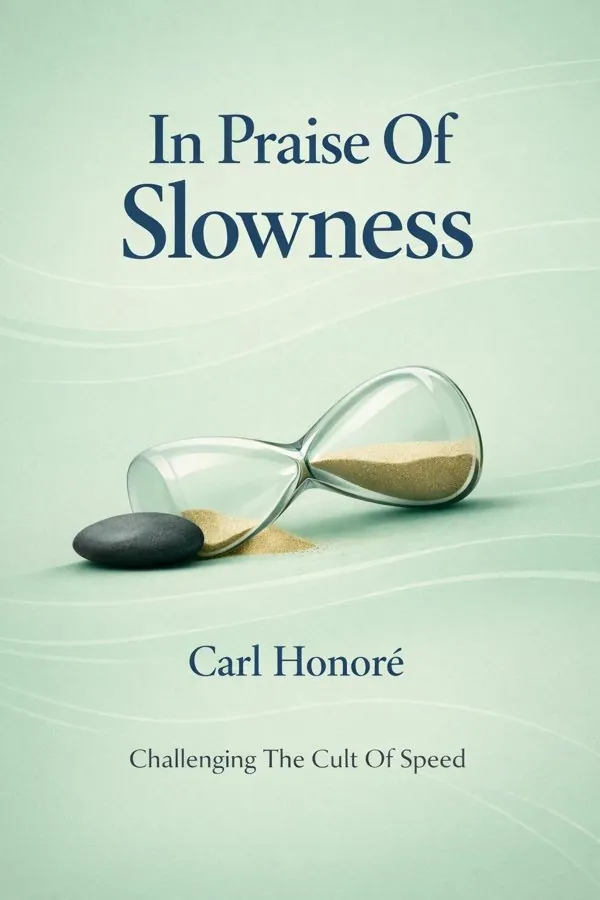
In Praise Of Slowness: Challenging The Cult Of Speed: Summary & Key Insights
by Carl Honoré
 10 min11 chaptersAudio available
What Is In Praise Of Slowness: Challenging The Cult Of Speed About?
In Praise Of Slowness: Challenging The Cult Of Speed by Carl Honoré is a mindset book spanning 11 pages. In this influential work, journalist Carl Honoré explores the global 'slow movement'—a cultural revolution against the notion that faster is always better. Through examples from work, food, medicine, and parenting, Honoré argues for a more balanced approach to time, advocating for mindfulness, quality, and connection over relentless acceleration.
This FizzRead summary covers all 11 key chapters of In Praise Of Slowness: Challenging The Cult Of Speed in approximately 10 minutes, distilling the most important ideas, arguments, and takeaways from Carl Honoré's work. Also available as an audio summary and Key Quotes Podcast.
In Praise Of Slowness: Challenging The Cult Of Speed
In this influential work, journalist Carl Honoré explores the global 'slow movement'—a cultural revolution against the notion that faster is always better. Through examples from work, food, medicine, and parenting, Honoré argues for a more balanced approach to time, advocating for mindfulness, quality, and connection over relentless acceleration.
Who Should Read In Praise Of Slowness: Challenging The Cult Of Speed?
This book is perfect for anyone interested in mindset and looking to gain actionable insights in a short read. Whether you're a student, professional, or lifelong learner, the key ideas from In Praise Of Slowness: Challenging The Cult Of Speed by Carl Honoré will help you think differently.
- ✓Readers who enjoy mindset and want practical takeaways
- ✓Professionals looking to apply new ideas to their work and life
- ✓Anyone who wants the core insights of In Praise Of Slowness: Challenging The Cult Of Speed in just 10 minutes
Want the full summary?
Get instant access to this book summary and 100K+ more with Fizz Moment.
Get Free SummaryAvailable on App Store • Free to download
Key Chapters
To understand why speed has become our master, we need to trace the origins of our obsession. Before industrialization, human life followed natural rhythms—the cycles of the sun, seasons, and bodily need. People worked as long as there was light and rested when darkness fell. Time was fluid, personal, and governed by context. The Industrial Revolution fractured that rhythm. Suddenly, time became mechanical—a thing measured, sliced, sold. The clock tower became the new sun. With factories came schedules, and with schedules came punctuality elevated to virtue. Dickens and other chroniclers of the age wrote of the alienation this brought: men and women reduced to moving parts in a larger machine.
Fast-forward to the twentieth century, and technology amplified this acceleration exponentially. Cars, planes, telephones, computers—all promised to save time, yet somehow left us with less of it. Each invention designed to speed up life seems to ignite in us the hunger for even more speed. We built cultures of instant gratification and economies where success depends on relentless motion. In the modern corporate world, we even fetishize stress, mistaking exhaustion for achievement.
It’s important to see that speed itself is not the villain. The trouble begins when speed becomes our only lens. Because the more we mechanize time, the further we drift from its humane dimension. Our lives turn into schedules instead of experiences, and time, once our companion, becomes our adversary.
Why do we equate speed with success? It’s not mere habit—it’s psychological programming reinforced by a culture that glorifies accomplishment and visibility. We believe that moving quickly signals competence. We link slowness with laziness, inefficiency, even moral weakness. This bias stems partly from the way modern economies reward throughput—the tangible outputs that can be measured, counted, compared. It’s a mindset born of scarcity and competition.
Yet beneath this lies a deeper emotional layer: fear. We fear missing out, falling behind, being judged irrelevant. Speed becomes our armor, a way to outrun insecurity. We scroll faster, respond quicker, multitask harder—not because it brings joy, but because it gives the illusion of control. This illusion, however, exacts a heavy toll. Neuroscience shows that rushing triggers the body’s stress response, flooding us with cortisol and adrenaline. Briefly, we feel energized, but sustained acceleration erodes focus, creativity, and empathy.
I came to realize that slowing down actually grants more control, not less. When we pause, we make choices rather than react. We shift from velocity to direction—from mere movement to meaning. The greatest thinkers, artists, and innovators in history all understood this paradox: creativity flourishes not in haste but in spaciousness. To slow down is to reclaim the capacity to be deliberate, present, and whole.
+ 9 more chapters — available in the FizzRead app
All Chapters in In Praise Of Slowness: Challenging The Cult Of Speed
About the Author
Carl Honoré is a Canadian journalist and author known for his writings on the Slow Movement. His works, including 'In Praise of Slowness' and 'Under Pressure', have been translated into multiple languages and have inspired readers worldwide to rethink their relationship with time and speed.
Get This Summary in Your Preferred Format
Read or listen to the In Praise Of Slowness: Challenging The Cult Of Speed summary by Carl Honoré anytime, anywhere. FizzRead offers multiple formats so you can learn on your terms — all free.
Available formats: App · Audio · PDF · EPUB — All included free with FizzRead
Download In Praise Of Slowness: Challenging The Cult Of Speed PDF and EPUB Summary
Key Quotes from In Praise Of Slowness: Challenging The Cult Of Speed
“To understand why speed has become our master, we need to trace the origins of our obsession.”
“It’s not mere habit—it’s psychological programming reinforced by a culture that glorifies accomplishment and visibility.”
Frequently Asked Questions about In Praise Of Slowness: Challenging The Cult Of Speed
In Praise Of Slowness: Challenging The Cult Of Speed by Carl Honoré is a mindset book that explores key ideas across 11 chapters. In this influential work, journalist Carl Honoré explores the global 'slow movement'—a cultural revolution against the notion that faster is always better. Through examples from work, food, medicine, and parenting, Honoré argues for a more balanced approach to time, advocating for mindfulness, quality, and connection over relentless acceleration.
You Might Also Like

Browse by Category
Ready to read In Praise Of Slowness: Challenging The Cult Of Speed?
Get the full summary and 100K+ more books with Fizz Moment.