
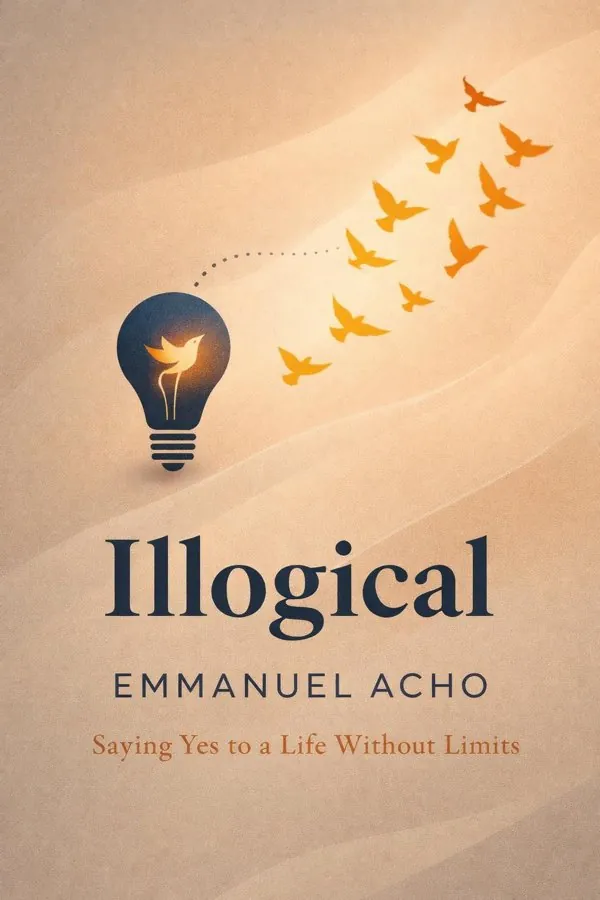
Illogical: Saying Yes to a Life Without Limits: Summary & Key Insights
 10 min9 chaptersAudio available
Key Takeaways from Illogical: Saying Yes to a Life Without Limits
The most dangerous limitations are often the ones that feel responsible.
A single yes can disrupt years of hesitation.
Walking away from something impressive can be more courageous than chasing it.
You do not need perfect visibility to take the next right step.
People often fear failure because they think it will define them.
What Is Illogical: Saying Yes to a Life Without Limits About?
Illogical: Saying Yes to a Life Without Limits by Emmanuel Acho is a mindset book spanning 11 pages. In "Illogical: Saying Yes to a Life Without Limits," Emmanuel Acho argues that the safest path is often the one that keeps us smallest. What most people call logic—choosing certainty, avoiding risk, following familiar expectations—can become a quiet trap that prevents courage, purpose, and growth. Acho invites readers to question the assumptions that shape their lives and to consider a different approach: one rooted in faith, bold action, and a willingness to step into uncertainty when the conventional route no longer aligns with who they are meant to become. The book blends personal storytelling, motivational insight, and practical reflection. Acho draws on his own journey from the NFL to media, leadership, and public influence, showing how pivotal moments often require decisions that appear irrational from the outside. That perspective gives the book unusual authority: he is not simply preaching risk-taking in theory, but describing the cost, fear, and reward of living it. For readers feeling stuck between comfort and calling, "Illogical" offers a compelling challenge: stop building your life around what seems sensible, and start building it around what is meaningful.
This FizzRead summary covers all 9 key chapters of Illogical: Saying Yes to a Life Without Limits in approximately 10 minutes, distilling the most important ideas, arguments, and takeaways from Emmanuel Acho's work. Also available as an audio summary and Key Quotes Podcast.
Illogical: Saying Yes to a Life Without Limits
In "Illogical: Saying Yes to a Life Without Limits," Emmanuel Acho argues that the safest path is often the one that keeps us smallest. What most people call logic—choosing certainty, avoiding risk, following familiar expectations—can become a quiet trap that prevents courage, purpose, and growth. Acho invites readers to question the assumptions that shape their lives and to consider a different approach: one rooted in faith, bold action, and a willingness to step into uncertainty when the conventional route no longer aligns with who they are meant to become.
The book blends personal storytelling, motivational insight, and practical reflection. Acho draws on his own journey from the NFL to media, leadership, and public influence, showing how pivotal moments often require decisions that appear irrational from the outside. That perspective gives the book unusual authority: he is not simply preaching risk-taking in theory, but describing the cost, fear, and reward of living it. For readers feeling stuck between comfort and calling, "Illogical" offers a compelling challenge: stop building your life around what seems sensible, and start building it around what is meaningful.
Who Should Read Illogical: Saying Yes to a Life Without Limits?
This book is perfect for anyone interested in mindset and looking to gain actionable insights in a short read. Whether you're a student, professional, or lifelong learner, the key ideas from Illogical: Saying Yes to a Life Without Limits by Emmanuel Acho will help you think differently.
- ✓Readers who enjoy mindset and want practical takeaways
- ✓Professionals looking to apply new ideas to their work and life
- ✓Anyone who wants the core insights of Illogical: Saying Yes to a Life Without Limits in just 10 minutes
Want the full summary?
Get instant access to this book summary and 100K+ more with Fizz Moment.
Get Free SummaryAvailable on App Store • Free to download
Key Chapters
A single yes can disrupt years of hesitation. One of the central themes of "Illogical" is that transformation often begins when people stop waiting for certainty and start responding with openness. Saying yes does not mean being reckless or impulsive. It means refusing to let fear make every important decision. Acho presents yes as an act of trust—trust that clarity often comes after movement, not before it.
Many people imagine they need complete information before they can commit to a new direction. They want guarantees before making a change, whether in work, calling, creativity, or relationships. But life rarely offers guarantees. Opportunities often arrive disguised as ambiguity. A speaking invitation, a career pivot, a move to a new city, or a difficult conversation may all seem inconvenient or ill-timed. Yet those moments can become the turning points that reshape a person’s life. By saying yes to possibility, people create space for growth that logic alone would have denied.
This idea is especially powerful for those who feel trapped in overthinking. Over-analysis can produce paralysis, and paralysis often feels justified because it appears thoughtful. Acho pushes against that pattern. Sometimes the real danger is not making the wrong move, but never moving at all. A yes does not eliminate uncertainty; it simply chooses motion over stagnation.
To apply this, think of one invitation, opportunity, or inner prompting you have been postponing. Instead of asking, "What if this fails?" ask, "What might become possible if I engage it fully?" The actionable takeaway: choose one meaningful opportunity this week and respond with a deliberate yes, even if every outcome is not yet visible.
Walking away from something impressive can be more courageous than chasing it. Acho’s personal story of leaving the NFL illustrates a crucial truth: external success is not always the same as inner alignment. From the outside, a professional sports career looks like a dream achieved. It carries status, recognition, and the appearance of arrival. But Acho shows that even highly respected success can become limiting if it no longer fits the deeper purpose of a person’s life.
What makes this story resonate is that many readers face their own version of the same problem. They may not be leaving professional football, but they may be staying in a role, identity, or ambition that once made sense and no longer does. The difficulty is that walking away from visible success invites misunderstanding. Others may see ingratitude, instability, or failure. Yet Acho argues that obedience to purpose sometimes requires leaving environments that have already rewarded you. The question is not simply, "Is this good?" but, "Is this still mine to do?"
This reframes career and life decisions in a liberating way. You do not have to remain committed to a path just because it brought you this far. Growth often demands release. In practical terms, this could mean changing industries, starting a business, accepting less prestige for more meaning, or redefining what winning actually looks like.
A useful exercise is to list the roles in your life that earn admiration from others. Then ask which of them energize you and which drain you. The actionable takeaway: if a path looks successful on paper but feels misaligned in practice, begin planning one concrete step toward the life that reflects your true purpose.
You do not need perfect visibility to take the next right step. Acho repeatedly emphasizes that faith is not the absence of questions; it is the decision to move despite incomplete answers. In a culture obsessed with planning, prediction, and control, uncertainty is often treated as a sign to stop. But "Illogical" presents uncertainty differently: not as proof that a path is wrong, but as the environment in which trust becomes real.
Faith in this book is both spiritual and practical. Spiritually, it involves believing that your life has meaning beyond what you can currently see. Practically, it means understanding that many worthy pursuits come without immediate evidence of success. Starting over, speaking truth, launching a creative project, ending a draining situation, or stepping into leadership all involve a season where results are unclear. Logic tends to demand proof before commitment. Faith allows commitment to generate proof over time.
This does not mean ignoring wisdom or dismissing preparation. Rather, it means accepting that some of life’s most important decisions cannot be validated in advance. They become clear only in retrospect. Acho encourages readers to stop interpreting uncertainty as automatic danger. Sometimes it is simply the cost of becoming.
One practical application is to replace the demand for certainty with the search for conviction. Ask: do I have enough reason to believe this step is right, even if I cannot predict the full outcome? If yes, then waiting for total clarity may be avoidance. The actionable takeaway: choose one area where uncertainty has frozen you, and commit to one faith-based action that moves you forward before you feel fully ready.
People often fear failure because they think it will define them. Acho challenges that assumption by reframing failure as an event, not an essence. A failed attempt, missed opportunity, or disappointing outcome can sting deeply, but it does not have the authority to name your worth or your future. The real threat is not failure itself; it is allowing fear of failure to dictate the size of your life.
This shift matters because fear is one of the main forces that keeps people logical in the worst sense. They choose the route with the fewest chances of embarrassment. They hide behind perfectionism, endless preparation, or strategic delay. Yet by trying to avoid failure, they also avoid growth. Acho’s perspective encourages readers to see mistakes as tuition rather than tragedy. Every setback contains feedback: about timing, skill, motivation, resilience, or direction.
In practical life, this means your first business may not work, your first application may be rejected, your first speech may fall flat, and your first attempt at change may feel awkward. None of that means you are incapable. It means you are learning in public. The people who eventually create remarkable lives are usually not the ones who never fail; they are the ones who refuse to let failure settle the question.
A useful exercise is to revisit one past failure and write down three things it taught you that success could not have taught as quickly. This turns regret into resource. The actionable takeaway: stop asking how to avoid all failure, and start asking what meaningful risk you are willing to take because the lesson is worth the possibility of falling short.
A life that looks impressive can still feel empty. One of Acho’s strongest contributions is his insistence that success must be defined internally rather than borrowed from culture. Society tends to reward visible markers: money, titles, fame, credentials, followers, and public validation. These indicators are easy to measure, which is why they become the default standard. But if a person reaches those milestones while abandoning peace, purpose, relationships, or integrity, the result may be achievement without fulfillment.
Acho invites readers to ask harder questions. Does your current definition of success reflect your real values, or merely your conditioning? Are you building a life that feeds your ego or serves your calling? Redefining success requires honesty because many people discover they have been chasing goals they did not consciously choose. They inherited them from parents, peers, industry norms, or social media comparisons.
This concept has direct practical implications. It may mean declining a promotion that would erode your family life, pursuing work that matters more than work that impresses, or measuring a season by growth and contribution rather than income alone. It does not condemn ambition. Instead, it asks ambition to become aligned. A meaningful life is not anti-success; it is success reordered around purpose.
To apply this, write your own definition of success in one sentence without using words like money, title, fame, or approval. Then compare that sentence with how you currently spend your time. The actionable takeaway: make one adjustment this month that brings your daily choices closer to your personal definition of success rather than society’s default script.
Original lives are built by people willing to be misunderstood. Acho links illogical living with creativity because both require departure from the expected. Creativity is not limited to art, writing, or performance. It includes how you solve problems, structure your career, build relationships, serve your community, and imagine your future. But creativity always carries a social cost: if you do something new, some people will not understand it at first.
That is why courage matters so much. Many capable people are not lacking ideas; they are lacking the willingness to endure perception. They worry about looking naive, inconsistent, or overly ambitious. As a result, they edit themselves into acceptability. Acho’s message pushes back against this self-censorship. If your life is driven entirely by what others will endorse, you will likely end up with a life others recognize but you do not fully own.
In practical terms, courage may look like pitching an unconventional project, sharing your story publicly, changing your routine, starting a side venture, or expressing a conviction that challenges group expectations. The point is not rebellion for its own sake. It is faithful originality—living in a way that reflects your gifts and calling instead of your fear of standing out.
A helpful application is to notice where you habitually water down your ideas to make them easier for others to accept. That pattern often points to a place where more courage is needed. The actionable takeaway: act on one creative idea you have been minimizing, and let the possibility of misunderstanding become a price you are willing to pay for authenticity.
Purpose becomes clearer when your life stops revolving only around you. Although "Illogical" is a book about courage and possibility, it is not a call to self-centered ambition. Acho repeatedly grounds his message in service. He suggests that true fulfillment is not found merely in pursuing what excites you, but in using your gifts in ways that benefit other people. This is an important correction because modern self-improvement can easily become obsessed with personal optimization while neglecting contribution.
Service gives shape to purpose. It helps distinguish between ego-driven goals and meaningful ones. A talent becomes a calling when it meets a need. A platform becomes significant when it elevates others. A story becomes powerful when it creates hope, healing, or challenge beyond the self. This is part of what makes Acho’s own career transition compelling: he moved from one kind of influence to another, but the deeper thread was impact.
Practically, purpose through service does not always require dramatic public action. It can look like mentoring, teaching, speaking honestly, leading with integrity, creating helpful work, or supporting people through your professional strengths. The key question is not only, "What am I good at?" but, "Who benefits when I use what I have?" That perspective often clarifies decisions that pure self-interest leaves blurry.
To apply this idea, identify one skill, experience, or strength you possess that could tangibly help another person this week. Offer it intentionally. The actionable takeaway: when you feel uncertain about your purpose, stop searching only inward and start serving outward—clarity often grows through contribution.
Comparison is one of the fastest ways to abandon your own assignment. Acho warns that many people live within limits not because they lack ability, but because they are too busy measuring themselves against someone else’s timeline, personality, success, or platform. Comparison creates distortion. It makes your progress seem slow, your gifts seem ordinary, and your calling seem less legitimate because it does not resemble another person’s.
This is especially destructive in an age of constant visibility. Social media gives readers endless curated evidence of what they are not doing, not earning, and not achieving. Under those conditions, logic begins to whisper that you should imitate whatever appears to be working for others. But imitation can quietly disconnect you from your own purpose. What is logical for someone else’s life may be completely wrong for yours.
Acho’s broader message is that freedom requires self-possession. You cannot say yes to a life without limits if you are using someone else as the benchmark for what your life should look like. Progress becomes sustainable only when it is anchored in your values, your season, and your assignment. This does not mean ignoring others completely; healthy inspiration can be useful. The problem begins when inspiration turns into self-erasure.
One practical strategy is to audit what triggers comparison in you most consistently—certain accounts, environments, conversations, or achievements. Reduce unnecessary exposure and increase reflection on your own goals. The actionable takeaway: define one meaningful metric for your current season that has nothing to do with anyone else, and let that measure your growth for the next 30 days.
All Chapters in Illogical: Saying Yes to a Life Without Limits
About the Author
Emmanuel Acho is an American author, speaker, media personality, and former NFL linebacker known for combining personal experience with thoughtful cultural and motivational commentary. After playing college football at the University of Texas, he went on to a professional career in the NFL before transitioning into broadcasting and television. He became widely recognized for his bestselling book "Uncomfortable Conversations with a Black Man," as well as for his work as a host and analyst. Across his writing and public platform, Acho often explores identity, courage, purpose, leadership, and personal growth. In "Illogical," he draws on his own career pivots and life lessons to encourage readers to challenge limiting assumptions and pursue a more purposeful, expansive life.
Get This Summary in Your Preferred Format
Read or listen to the Illogical: Saying Yes to a Life Without Limits summary by Emmanuel Acho anytime, anywhere. FizzRead offers multiple formats so you can learn on your terms — all free.
Available formats: App · Audio · PDF · EPUB — All included free with FizzRead
Download Illogical: Saying Yes to a Life Without Limits PDF and EPUB Summary
Key Quotes from Illogical: Saying Yes to a Life Without Limits
“The most dangerous limitations are often the ones that feel responsible.”
“A single yes can disrupt years of hesitation.”
“Walking away from something impressive can be more courageous than chasing it.”
“You do not need perfect visibility to take the next right step.”
“People often fear failure because they think it will define them.”
Frequently Asked Questions about Illogical: Saying Yes to a Life Without Limits
Illogical: Saying Yes to a Life Without Limits by Emmanuel Acho is a mindset book that explores key ideas across 9 chapters. In "Illogical: Saying Yes to a Life Without Limits," Emmanuel Acho argues that the safest path is often the one that keeps us smallest. What most people call logic—choosing certainty, avoiding risk, following familiar expectations—can become a quiet trap that prevents courage, purpose, and growth. Acho invites readers to question the assumptions that shape their lives and to consider a different approach: one rooted in faith, bold action, and a willingness to step into uncertainty when the conventional route no longer aligns with who they are meant to become. The book blends personal storytelling, motivational insight, and practical reflection. Acho draws on his own journey from the NFL to media, leadership, and public influence, showing how pivotal moments often require decisions that appear irrational from the outside. That perspective gives the book unusual authority: he is not simply preaching risk-taking in theory, but describing the cost, fear, and reward of living it. For readers feeling stuck between comfort and calling, "Illogical" offers a compelling challenge: stop building your life around what seems sensible, and start building it around what is meaningful.
More by Emmanuel Acho

You Might Also Like



Browse by Category
Ready to read Illogical: Saying Yes to a Life Without Limits?
Get the full summary and 100K+ more books with Fizz Moment.