
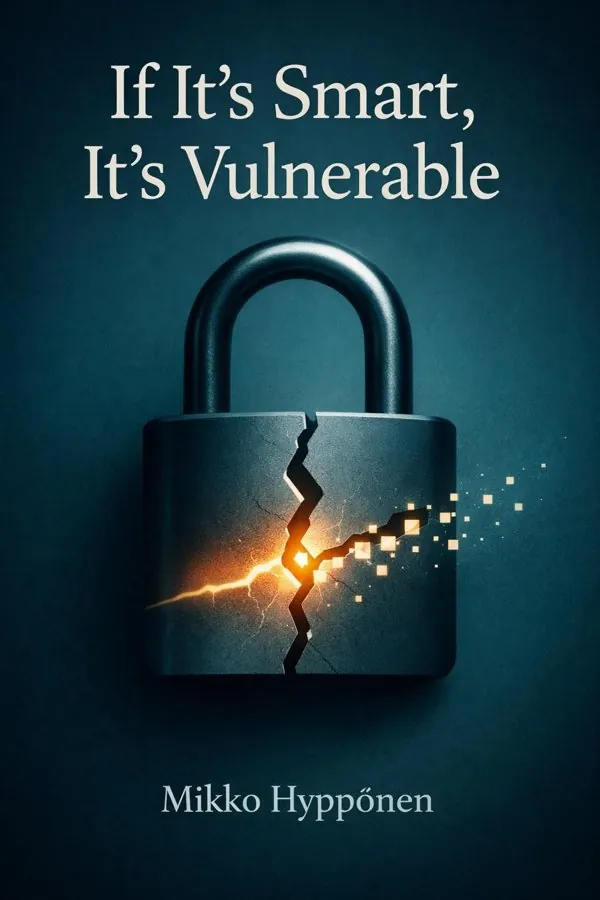
If It's Smart, It's Vulnerable: Summary & Key Insights
 10 min9 chaptersAudio available
Key Takeaways from If It's Smart, It's Vulnerable
Security became essential the moment computers stopped being alone.
The history of malware is the history of motive.
Convenience has a hidden geometry: every connected feature creates another point of entry.
If a service feels free or frictionless, your data is often paying the bill.
When software escapes the screen, digital failures become physical ones.
What Is If It's Smart, It's Vulnerable About?
If It's Smart, It's Vulnerable by Mikko Hyppönen is a digital_culture book spanning 6 pages. What happens when every useful object around us becomes a computer—and every computer becomes a potential target? In If It's Smart, It's Vulnerable, cybersecurity expert Mikko Hyppönen examines the hidden bargain behind modern convenience: the smarter our devices become, the more exposed we are to attack, surveillance, and systemic failure. From laptops and smartphones to connected cars, medical devices, industrial systems, and household gadgets, Hyppönen shows that connectivity always expands opportunity and risk at the same time. This is not a book driven by panic, but by clarity. Drawing on decades spent tracking malware, cybercriminals, and digital threats, Hyppönen explains how the internet evolved from a limited network of trusted systems into a global battlefield shaped by crime, espionage, corporate incentives, and geopolitical conflict. He makes technical issues understandable without oversimplifying them, showing why security failures are not accidents at the margins but predictable consequences of how connected technology is built and deployed. The book matters because digital systems no longer sit outside everyday life—they run it. Hyppönen’s central warning is simple and urgent: once something becomes smart, it becomes vulnerable, and we must design, regulate, and use it accordingly.
This FizzRead summary covers all 9 key chapters of If It's Smart, It's Vulnerable in approximately 10 minutes, distilling the most important ideas, arguments, and takeaways from Mikko Hyppönen's work. Also available as an audio summary and Key Quotes Podcast.
If It's Smart, It's Vulnerable
What happens when every useful object around us becomes a computer—and every computer becomes a potential target? In If It's Smart, It's Vulnerable, cybersecurity expert Mikko Hyppönen examines the hidden bargain behind modern convenience: the smarter our devices become, the more exposed we are to attack, surveillance, and systemic failure. From laptops and smartphones to connected cars, medical devices, industrial systems, and household gadgets, Hyppönen shows that connectivity always expands opportunity and risk at the same time.
This is not a book driven by panic, but by clarity. Drawing on decades spent tracking malware, cybercriminals, and digital threats, Hyppönen explains how the internet evolved from a limited network of trusted systems into a global battlefield shaped by crime, espionage, corporate incentives, and geopolitical conflict. He makes technical issues understandable without oversimplifying them, showing why security failures are not accidents at the margins but predictable consequences of how connected technology is built and deployed.
The book matters because digital systems no longer sit outside everyday life—they run it. Hyppönen’s central warning is simple and urgent: once something becomes smart, it becomes vulnerable, and we must design, regulate, and use it accordingly.
Who Should Read If It's Smart, It's Vulnerable?
This book is perfect for anyone interested in digital_culture and looking to gain actionable insights in a short read. Whether you're a student, professional, or lifelong learner, the key ideas from If It's Smart, It's Vulnerable by Mikko Hyppönen will help you think differently.
- ✓Readers who enjoy digital_culture and want practical takeaways
- ✓Professionals looking to apply new ideas to their work and life
- ✓Anyone who wants the core insights of If It's Smart, It's Vulnerable in just 10 minutes
Want the full summary?
Get instant access to this book summary and 100K+ more with Fizz Moment.
Get Free SummaryAvailable on App Store • Free to download
Key Chapters
Security became essential the moment computers stopped being alone. In the earliest days of computing, machines were isolated islands. They lived in universities, labs, and large organizations, performing calculations or storing records with little reason to communicate externally. In that world, the idea of cybersecurity barely existed, because there was no practical path for large-scale remote abuse. A machine could fail, but it was unlikely to be attacked by someone on the other side of the world.
Hyppönen explains that this changed fundamentally once networks connected computers to one another. The internet turned local tools into globally reachable systems. That transformation created enormous value: instant communication, digital commerce, cloud services, remote work, and collaboration across borders. But it also erased physical barriers that once protected systems by default. A vulnerability in one connected machine could now be exploited remotely, automatically, and at massive scale.
This shift helps explain why so many digital problems feel built into the modern world rather than incidental. A smart refrigerator, a connected camera, a hospital database, and a smartphone all share the same basic condition: they are no longer closed tools. They are nodes in a network, exposed to software flaws, weak passwords, bad updates, phishing, and supply-chain compromise.
The insight is bigger than technology itself. Connectivity changes incentives. Attackers no longer need to be nearby, wealthy, or highly visible. They can be anonymous, global, and automated. A single exploit can be reused millions of times.
Actionable takeaway: every time you connect a device or service, stop thinking of it as a standalone product. Treat it as part of a larger attack surface and ask what new risks connectivity has introduced.
The history of malware is the history of motive. Early computer viruses were often written by curious hobbyists, students, or pranksters testing what was technically possible. They spread through floppy disks and local systems, causing annoyance more often than strategic damage. Their creators often sought reputation, experimentation, or mischief rather than money. That era now feels almost innocent compared with what followed.
Hyppönen traces how malware evolved as the internet created a new criminal economy. Once attackers realized that code could steal bank credentials, harvest credit cards, extort businesses, or hijack machines into botnets, cyber threats became professionalized. Criminal groups began operating like companies, complete with developers, affiliates, customer support, and monetization systems. Ransomware is one of the clearest examples: attackers encrypt a victim’s files, demand payment, and increasingly threaten to leak stolen data as additional pressure.
This transition matters because it changes how we defend ourselves. You are no longer protecting your systems from random digital graffiti. You are facing determined adversaries with financial incentives, repeatable methods, and global reach. A phishing email today may be part of a sophisticated campaign designed to impersonate a supplier, steal login credentials, and move laterally through an organization before triggering extortion.
Hyppönen also emphasizes that cybercrime thrives because digital systems make scaling easy. One criminal gang can target thousands of victims in multiple countries at once, often while hiding behind weak international enforcement. The internet lowers costs for both innovation and abuse.
Actionable takeaway: defend against cyber threats as you would any organized crime risk—use backups, multi-factor authentication, software updates, and staff awareness training, because today’s attackers are running businesses, not pranks.
Convenience has a hidden geometry: every connected feature creates another point of entry. Hyppönen’s core argument is captured in the book’s title. A device does not become vulnerable because it is badly marketed or unusually complex. It becomes vulnerable because intelligence plus connectivity means software, remote access, updates, data flows, and therefore exploitable weaknesses.
This applies far beyond laptops and phones. Smart TVs listen for voice commands. Doorbells stream video to cloud services. Thermostats learn behavior patterns. Cars receive over-the-air updates. Industrial sensors report machine performance in real time. Each innovation promises efficiency, comfort, or savings. Yet each also introduces passwords, APIs, firmware, wireless protocols, cloud dependencies, and vendor trust assumptions that can fail.
The danger is not only that a hacker takes over a gadget. It is that millions of poorly secured devices can be weaponized together. Hyppönen points to botnets made from compromised cameras and routers, which have been used to launch massive distributed denial-of-service attacks. A single vulnerable product line can become a platform for much larger disruption. In homes, insecure devices can leak video, reveal habits, or expose home networks. In businesses, one weak connected component can become the stepping stone to critical systems.
Consumers often assume that if a product is on store shelves, it must meet meaningful security standards. But the market frequently rewards speed, novelty, and low cost more than long-term protection. Manufacturers may abandon updates quickly, leaving devices “smart” but unsupported.
Actionable takeaway: before buying any smart device, ask three questions—how is it updated, how long is it supported, and can it be secured with strong authentication and privacy controls?
If a service feels free or frictionless, your data is often paying the bill. Hyppönen shows that the smart world does not merely create security risks; it creates a surveillance economy. Connected devices and digital platforms gather enormous amounts of information about where we go, what we buy, what we watch, whom we talk to, and how we behave. This data can improve products, but it can also be exploited for advertising, profiling, manipulation, and control.
The troubling part is that privacy loss rarely arrives as a dramatic event. It comes as an accumulation of permissions, defaults, and convenience features. A fitness tracker logs movement and sleep. A voice assistant captures commands and background speech. A smart car records location and driving habits. A phone app requests contacts, camera, microphone, and precise location even when those permissions are not strictly necessary. Each data point may seem harmless alone, yet together they produce an intimate portrait of a person’s life.
Hyppönen argues that privacy is not an abstract luxury. It is tied to autonomy, dignity, and power. When companies or states know too much, individuals lose room to experiment, dissent, or simply exist without constant observation. Data breaches make this worse by exposing personal information to criminals, while opaque business models make it hard for users to understand where their information travels.
The book encourages readers to move beyond passive acceptance. Privacy is not about rejecting technology completely; it is about demanding restraint, transparency, and informed consent. Practical habits matter: adjusting app permissions, disabling unnecessary tracking, using encrypted services, and choosing vendors with stronger privacy practices.
Actionable takeaway: audit your devices and apps regularly, revoke permissions that are not essential, and favor products that minimize data collection rather than normalize surveillance.
When software escapes the screen, digital failures become physical ones. One of Hyppönen’s most important insights is that cybersecurity can no longer be treated as a niche technical concern affecting only files, emails, or websites. As computation spreads into infrastructure and physical products, software flaws can affect transportation, healthcare, energy, manufacturing, and home safety.
A bug in a social media app may be annoying; a vulnerability in a medical device, car system, or industrial controller can be life-threatening. Connected cars illustrate the point well. The same features that enable navigation, diagnostics, entertainment, and remote updates can also create pathways for intrusion if systems are poorly segmented or insecurely designed. Hospitals face similar risks when networked equipment and outdated systems coexist under constant operational pressure. A ransomware attack on an office is expensive; a ransomware attack on a hospital can delay care and endanger patients.
Hyppönen stresses that our assumptions have not kept pace with this change. People still tend to think of cyberattacks as virtual incidents with limited real-world consequence. But critical infrastructure operators, city governments, logistics networks, and industrial firms now depend on connected systems at every level. This means software assurance, update discipline, and resilience planning are no longer optional technical hygiene—they are forms of public safety.
The lesson for organizations is clear: digital transformation without security-by-design is irresponsible. Reliability, fail-safes, segmentation, and incident response planning must be built into systems from the beginning, especially when physical processes are involved.
Actionable takeaway: if a connected system can affect health, safety, mobility, or essential services, treat cybersecurity as a core operational risk and design defenses before deployment, not after a crisis.
Markets alone do not reliably produce secure technology. Hyppönen argues that while individual responsibility matters, the burden cannot rest entirely on users who lack visibility into product architecture, update practices, or hidden data flows. Consumers cannot reasonably inspect firmware, verify cloud security, or negotiate privacy terms with multinational platforms. That is why law, regulation, and public policy have an essential role in shaping safer digital environments.
The problem is that technology evolves faster than institutions. Legislators and regulators often act after harms become obvious, while companies release products into the market with minimal accountability for long-term insecurity. A cheap smart camera may be sold globally even if it uses weak default credentials or receives only short-lived support. The result is a flood of vulnerable products that create collective risk far beyond the original buyer.
Hyppönen supports stronger expectations around security standards, breach disclosure, software maintenance, and data protection. If manufacturers are allowed to externalize the cost of insecurity onto users and society, insecure design becomes profitable. Regulation can change incentives by requiring safer defaults, longer support windows, clearer labeling, and accountability when negligence causes harm.
This is not an argument against innovation. It is an argument for mature innovation. We do not accept unsafe cars, contaminated food, or structurally unsound buildings as the cost of progress. Digital systems should not be exempt simply because they are newer or more complex.
For organizations, policy awareness is practical as well as ethical. Compliance requirements, privacy laws, and reporting obligations increasingly shape cybersecurity strategy. The best companies prepare early instead of waiting for enforcement.
Actionable takeaway: support and adopt security standards that make safer design the default, and choose products and partners that treat compliance and transparency as trust-building commitments, not box-ticking exercises.
The internet did not remain a neutral utility; it became a theater of power. Hyppönen explains that cyber conflict now extends far beyond criminal fraud and isolated hacks. Nation-states use digital tools for espionage, sabotage, influence operations, and strategic advantage. This means cybersecurity is no longer just an IT issue or even a business risk. It is part of international politics, national defense, and civil resilience.
State-linked attacks differ from ordinary cybercrime in motive and scale. A criminal may want money; a government may want access, intelligence, disruption, or deniability. Critical infrastructure, telecom systems, defense contractors, public institutions, and election-related systems become especially attractive targets. Sometimes operations remain hidden for years, gathering information quietly. Other times, destructive malware or coordinated disruption sends a message.
For ordinary citizens, this can feel distant, but the effects are increasingly personal. Supply chains are disrupted. Public services are interrupted. Disinformation campaigns shape public opinion. A vulnerability in a widely used software product can become a strategic opening for multiple actors at once. The same connected world that enables global communication also creates shared fragility.
Hyppönen’s broader point is that societies must think in terms of resilience, not just prevention. No country, company, or individual can eliminate all digital threats. But they can reduce dependency on brittle systems, prepare for outages, improve information sharing, and build institutions that respond quickly when incidents occur.
Actionable takeaway: whether you lead a company or manage your household, plan for cyber disruption as a real possibility—maintain backups, continuity plans, trusted communication channels, and alternatives when essential digital services fail.
Most serious security failures are not caused by users being careless in isolation; they are caused by systems being built with unsafe assumptions. Hyppönen pushes back against the idea that cybersecurity can be solved mainly through better user behavior. Users matter, but many vulnerabilities arise because products are rushed to market, default settings are insecure, updates are poorly handled, and convenience is prioritized over resilience.
Security-by-design means anticipating misuse from the beginning. That includes minimizing unnecessary features, reducing permissions, encrypting data, requiring strong authentication, separating critical functions, logging suspicious activity, and making updates automatic and reliable. It also means planning for failure: what happens if credentials leak, if a vendor goes out of business, or if a cloud service becomes unavailable? A secure system is not one that assumes perfection. It is one that limits damage when things go wrong.
Examples are everywhere. A home router shipped with a unique default password is safer than one using the same factory credentials across millions of units. A service that offers multi-factor authentication by default reduces account takeover. A medical or industrial system segmented from general office networks is less likely to be compromised through ordinary phishing. Good design quietly protects users even when they do not fully understand the threat landscape.
Hyppönen’s message is ultimately hopeful: vulnerability is inevitable, but recklessness is not. We can build smarter systems without pretending they are harmless. The quality of the digital future depends on whether security becomes a foundational design principle rather than an afterthought.
Actionable takeaway: when evaluating any technology, prefer products and services that make the secure choice the easy choice through strong defaults, transparent update policies, and resilient architecture.
In a connected society, cybersecurity is no longer just a specialist profession; it is part of everyday citizenship. Hyppönen suggests that understanding digital risk now belongs alongside financial literacy and basic health knowledge. People do not need to become security engineers, but they do need enough awareness to recognize manipulation, protect accounts, assess products, and understand the consequences of living through networked systems.
This matters because many attacks exploit human trust rather than technical complexity. Phishing emails imitate banks, coworkers, or delivery services. Social engineering preys on urgency and emotion. Fake websites collect credentials. Misleading app permissions normalize excessive data access. People often become vulnerable not because they are foolish, but because digital systems are designed to demand quick decisions without full context.
Digital literacy also includes understanding broader social questions. Who controls the data generated by smart devices? What trade-offs are hidden inside “free” platforms? Why does software support length matter when buying a connected appliance? How should schools, employers, and governments balance convenience with privacy? These are not niche questions anymore; they shape daily life.
Hyppönen’s perspective encourages a culture shift. Instead of treating cyber awareness as a once-a-year compliance lecture, families, schools, and organizations should treat it as an ongoing practice. Teaching children about scams, helping older adults secure accounts, and making security conversations normal at work all strengthen collective resilience.
Actionable takeaway: build simple digital habits that you repeat consistently—use a password manager, enable multi-factor authentication, verify unexpected requests, and talk openly about scams and privacy with the people around you.
All Chapters in If It's Smart, It's Vulnerable
About the Author
Mikko Hyppönen is a Finnish cybersecurity expert, researcher, and public commentator best known for explaining how digital threats shape modern life. He serves as Chief Research Officer at WithSecure, formerly F-Secure, where he has spent decades investigating malware, cybercrime, online surveillance, and emerging security risks. Hyppönen has advised companies, governments, and international audiences on the implications of connected technology, and he is widely respected for making complex cybersecurity issues understandable to non-specialists. Through keynote talks, writing, and media appearances, he has become one of the most recognizable global voices on digital security and privacy. His work combines technical depth with social insight, focusing not only on how attacks happen, but on what they mean for freedom, trust, and the future of networked society.
Get This Summary in Your Preferred Format
Read or listen to the If It's Smart, It's Vulnerable summary by Mikko Hyppönen anytime, anywhere. FizzRead offers multiple formats so you can learn on your terms — all free.
Available formats: App · Audio · PDF · EPUB — All included free with FizzRead
Download If It's Smart, It's Vulnerable PDF and EPUB Summary
Key Quotes from If It's Smart, It's Vulnerable
“Security became essential the moment computers stopped being alone.”
“The history of malware is the history of motive.”
“Convenience has a hidden geometry: every connected feature creates another point of entry.”
“If a service feels free or frictionless, your data is often paying the bill.”
“When software escapes the screen, digital failures become physical ones.”
Frequently Asked Questions about If It's Smart, It's Vulnerable
If It's Smart, It's Vulnerable by Mikko Hyppönen is a digital_culture book that explores key ideas across 9 chapters. What happens when every useful object around us becomes a computer—and every computer becomes a potential target? In If It's Smart, It's Vulnerable, cybersecurity expert Mikko Hyppönen examines the hidden bargain behind modern convenience: the smarter our devices become, the more exposed we are to attack, surveillance, and systemic failure. From laptops and smartphones to connected cars, medical devices, industrial systems, and household gadgets, Hyppönen shows that connectivity always expands opportunity and risk at the same time. This is not a book driven by panic, but by clarity. Drawing on decades spent tracking malware, cybercriminals, and digital threats, Hyppönen explains how the internet evolved from a limited network of trusted systems into a global battlefield shaped by crime, espionage, corporate incentives, and geopolitical conflict. He makes technical issues understandable without oversimplifying them, showing why security failures are not accidents at the margins but predictable consequences of how connected technology is built and deployed. The book matters because digital systems no longer sit outside everyday life—they run it. Hyppönen’s central warning is simple and urgent: once something becomes smart, it becomes vulnerable, and we must design, regulate, and use it accordingly.
You Might Also Like
An Ugly Truth: Inside Facebook’s Battle for Domination
Sheera Frenkel, Cecilia Kang
10 min
Cyber Citizens
Ian Goodfellow
10 min
Digital Minimalism: Choosing a Focused Life in a Noisy World
Cal Newport
10 min
E‑Books & Beyond
Various Authors
10 min
The Future of Media
Various Authors
10 min
This Is Why We Can't Have Nice Things
Whitney Phillips
10 minBrowse by Category
Ready to read If It's Smart, It's Vulnerable?
Get the full summary and 100K+ more books with Fizz Moment.