
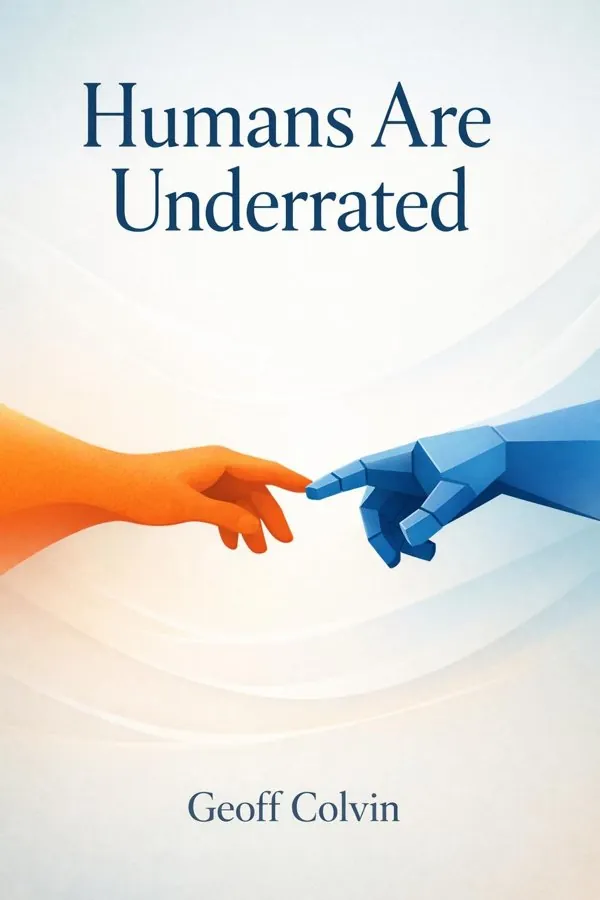
Humans Are Underrated: What High Achievers Know That Brilliant Machines Never Will: Summary & Key Insights
by Geoff Colvin
 10 min10 chaptersAudio available
What Is Humans Are Underrated: What High Achievers Know That Brilliant Machines Never Will About?
Humans Are Underrated: What High Achievers Know That Brilliant Machines Never Will by Geoff Colvin is a leadership book spanning 10 pages. In this book, Geoff Colvin explores how the rapid advancement of technology and automation is reshaping the workforce and the skills that matter most. He argues that as machines take over more analytical and technical tasks, the most valuable human abilities will be empathy, creativity, collaboration, and relationship-building. Drawing on research and real-world examples, Colvin shows how individuals and organizations can thrive by cultivating these deeply human skills.
This FizzRead summary covers all 10 key chapters of Humans Are Underrated: What High Achievers Know That Brilliant Machines Never Will in approximately 10 minutes, distilling the most important ideas, arguments, and takeaways from Geoff Colvin's work. Also available as an audio summary and Key Quotes Podcast.
Humans Are Underrated: What High Achievers Know That Brilliant Machines Never Will
In this book, Geoff Colvin explores how the rapid advancement of technology and automation is reshaping the workforce and the skills that matter most. He argues that as machines take over more analytical and technical tasks, the most valuable human abilities will be empathy, creativity, collaboration, and relationship-building. Drawing on research and real-world examples, Colvin shows how individuals and organizations can thrive by cultivating these deeply human skills.
Who Should Read Humans Are Underrated: What High Achievers Know That Brilliant Machines Never Will?
This book is perfect for anyone interested in leadership and looking to gain actionable insights in a short read. Whether you're a student, professional, or lifelong learner, the key ideas from Humans Are Underrated: What High Achievers Know That Brilliant Machines Never Will by Geoff Colvin will help you think differently.
- ✓Readers who enjoy leadership and want practical takeaways
- ✓Professionals looking to apply new ideas to their work and life
- ✓Anyone who wants the core insights of Humans Are Underrated: What High Achievers Know That Brilliant Machines Never Will in just 10 minutes
Want the full summary?
Get instant access to this book summary and 100K+ more with Fizz Moment.
Get Free SummaryAvailable on App Store • Free to download
Key Chapters
As the digital revolution has accelerated, we’ve reached an extraordinary reversal. For most of human history, the more skilled you were at analytical or technical work, the more valuable you were. Today, that correlation is weakening. Computers are becoming unbeatable at precisely those skills—calculating, analyzing, and optimizing. The paradox of automation is that as machines become more capable, the premium on technical proficiency alone declines.
We can see this everywhere. Expert chess players used to train for decades to reach grandmaster level; now computer programs like Stockfish can demolish any human in seconds. Financial analysts once held the key to deciphering markets; now algorithms trade billions in nanoseconds with near-perfect precision. Even medical diagnostics—long considered a bastion of human expertise—are being transformed by deep learning systems that outperform radiologists in interpreting images.
Most people see these changes and assume human work is being squeezed out. But that assumption misses a crucial dimension. When machines take over routine and analytical tasks, what remains is everything they *can’t* do: leading, empathizing, creating, building trust. Our value doesn’t disappear—it shifts.
Consider the role of a doctor. In an age when AI can identify tumors more accurately than any human, what remains irreplaceable is the doctor’s ability to comfort, to interpret, to connect with a patient’s story. The data delivers clinical answers; the human delivers meaning. The doctor’s unique strength is no longer in diagnosis but in empathy.
This pattern repeats in every profession. Lawyers who once billed hours researching case law now rely on software to do it in seconds; their new value lies in counseling, persuasion, negotiation—all profoundly human capacities. Engineers, consultants, and managers who once focused on analysis now distinguish themselves through imagination, collaboration, and leadership.
The paradox, then, is liberating: the more technology automates routine intellectual labor, the more precious our human qualities become. Yet, to benefit from this shift, we must retrain our focus. The education system and workplace cultures built to reward technical mastery must evolve to honor emotional intelligence, adaptability, and social acuity. These are the frontiers where human performance will now be measured.
As I delved deeper into the evidence, a clear pattern emerged. The capabilities that remain exclusively human are those that arise from our social and emotional nature. Machines, no matter how sophisticated, lack consciousness, context, and compassion. They cannot truly understand another’s perspective, feel gratitude, or build trust over time. These are the arenas of humanity—and they are exactly the qualities the future economy demands most.
Empathy sits at the core of this advantage. It’s the capacity to feel what another person feels, to imagine the world through their eyes. Alongside empathy stands creativity—the uniquely human impulse to connect ideas that never coexisted before. Then we have cooperation and communication: the ability to align with others toward a shared goal, to persuade through story and emotion, not just through logic.
Think about what happens when these traits work together. The best performing teams at organizations like IDEO or Pixar succeed not because they have the smartest technicians, but because they have the most connected humans—people who sense one another’s moods, trade ideas fluidly, and co-create stories that move others. Machines can process data, but they cannot nurture trust. They can analyze options, but they cannot commit to a shared dream.
In today’s marketplace, relationships are often the most decisive currency. Studies show that customers remain loyal not just to quality or price but to the experience of being cared for and understood. A world saturated with technology paradoxically elevates our hunger for real human attention. When you reframe your advantage around this truth, you stop competing on efficiency and start competing on empathy.
The leaders and organizations that are thriving in this environment understand the shift. They cultivate cultures of connection, openly reward collaboration, and design experiences that make people feel valued. To them, technology is a tool, not a tyrant—and being human is the ultimate competitive edge.
+ 8 more chapters — available in the FizzRead app
All Chapters in Humans Are Underrated: What High Achievers Know That Brilliant Machines Never Will
About the Author
Geoff Colvin is a senior editor-at-large at Fortune magazine and a respected business journalist and speaker. He is known for his insightful analysis of leadership, management, and the future of work. Colvin is also the author of the bestseller 'Talent Is Overrated'.
Get This Summary in Your Preferred Format
Read or listen to the Humans Are Underrated: What High Achievers Know That Brilliant Machines Never Will summary by Geoff Colvin anytime, anywhere. FizzRead offers multiple formats so you can learn on your terms — all free.
Available formats: App · Audio · PDF · EPUB — All included free with FizzRead
Download Humans Are Underrated: What High Achievers Know That Brilliant Machines Never Will PDF and EPUB Summary
Key Quotes from Humans Are Underrated: What High Achievers Know That Brilliant Machines Never Will
“As the digital revolution has accelerated, we’ve reached an extraordinary reversal.”
“As I delved deeper into the evidence, a clear pattern emerged.”
Frequently Asked Questions about Humans Are Underrated: What High Achievers Know That Brilliant Machines Never Will
Humans Are Underrated: What High Achievers Know That Brilliant Machines Never Will by Geoff Colvin is a leadership book that explores key ideas across 10 chapters. In this book, Geoff Colvin explores how the rapid advancement of technology and automation is reshaping the workforce and the skills that matter most. He argues that as machines take over more analytical and technical tasks, the most valuable human abilities will be empathy, creativity, collaboration, and relationship-building. Drawing on research and real-world examples, Colvin shows how individuals and organizations can thrive by cultivating these deeply human skills.
More by Geoff Colvin

You Might Also Like

Extreme Ownership
Jocko Willink
10 min
Dare to Lead
Brene Brown
10 min
Leaders Eat Last
Simon Sinek
10 min
The 21 Irrefutable Laws of Leadership
John Maxwell
10 min
Start With Why
Simon Sinek
10 min
How to Lead When You're Not in Charge
Clay Scroggins
10 minBrowse by Category
Ready to read Humans Are Underrated: What High Achievers Know That Brilliant Machines Never Will?
Get the full summary and 100K+ more books with Fizz Moment.