
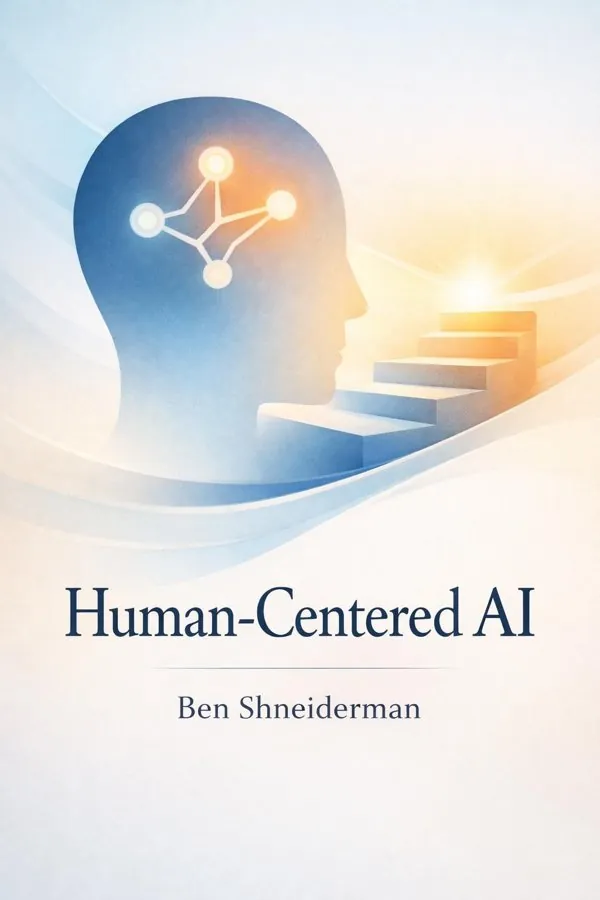
Human-Centered AI: Summary & Key Insights
 10 min9 chaptersAudio available
What Is Human-Centered AI About?
Human-Centered AI by Ben Shneiderman is a ai_ml book spanning 9 pages. Human-Centered AI explores how artificial intelligence systems can be designed to enhance human performance, empower creativity, and ensure ethical responsibility. Ben Shneiderman advocates for a design philosophy that prioritizes human values, transparency, and accountability, offering practical frameworks for integrating AI into society in ways that augment rather than replace human capabilities.
This FizzRead summary covers all 9 key chapters of Human-Centered AI in approximately 10 minutes, distilling the most important ideas, arguments, and takeaways from Ben Shneiderman's work. Also available as an audio summary and Key Quotes Podcast.
Human-Centered AI
Human-Centered AI explores how artificial intelligence systems can be designed to enhance human performance, empower creativity, and ensure ethical responsibility. Ben Shneiderman advocates for a design philosophy that prioritizes human values, transparency, and accountability, offering practical frameworks for integrating AI into society in ways that augment rather than replace human capabilities.
Who Should Read Human-Centered AI?
This book is perfect for anyone interested in ai_ml and looking to gain actionable insights in a short read. Whether you're a student, professional, or lifelong learner, the key ideas from Human-Centered AI by Ben Shneiderman will help you think differently.
- ✓Readers who enjoy ai_ml and want practical takeaways
- ✓Professionals looking to apply new ideas to their work and life
- ✓Anyone who wants the core insights of Human-Centered AI in just 10 minutes
Want the full summary?
Get instant access to this book summary and 100K+ more with Fizz Moment.
Get Free SummaryAvailable on App Store • Free to download
Key Chapters
Artificial intelligence didn’t emerge overnight. Its roots go back to ambitious dreams of mimicking human reasoning. In the early decades, AI was largely built on rule-based and symbolic systems — attempts to encode human logic and explicit decision-making into computer programs. Those systems gave people control; they were comprehensible, structured, and modular. But as machine learning evolved, we moved toward data-driven models that derived patterns from experience rather than predefined logic. That shift was powerful — it enabled breakthroughs in vision, speech, and prediction — yet also brought a troubling erosion of human oversight.
When data replaced explicit rules, transparency suffered. Human operators began feeling that they were losing the ability to understand or challenge decisions made by systems they built. This gradual transition from controllable automation to opaque autonomy transformed the conversation entirely. The promise of convenience and efficiency overshadowed the necessity of responsibility.
Yet history offers us a valuable perspective. Every technological wave, from industrial machines to computers, has raised similar questions: What is the role of humans in a world of intelligent tools? By reinterpreting this historical path, I wish to restore agency. AI should not be seen as the ultimate stage of automation but as a new chapter of collaboration — an opportunity to design systems that respect human choice while expanding human capability.
The Human-Centered AI framework is built on a simple but profound idea: the best outcomes arise when humans and machines work together at high levels of both automation and control. Rather than seeing these forces as opposites, I see them as complementary dimensions. High automation means that computers can perform complex, repetitive, or data-intensive tasks efficiently. High human control ensures that moral judgment, creativity, and contextual understanding always guide decision-making.
Visualize this framework as a two-dimensional space. In one corner lies low automation and high control — traditional manual tasks. In the opposite, high automation and low control — fully autonomous systems. But the ideal region is the quadrant of synergy, where machines handle complexity without removing human oversight. This model provides a practical design goal for engineers and policymakers alike.
In applying this framework, we must rethink our methods of interaction. Interfaces should empower users to understand system behavior, make corrections, and express intent clearly. By combining automation with informed supervision, we build trust. Human-Centered AI isn’t an abstract ideal but a design orientation: systems created for engagement, explainability, and continuous human learning.
This balanced approach leads to reliability and safety. A system that invites human involvement early and often becomes self-correcting and socially responsible. Autonomy alone cannot guarantee justice, but collaboration can.
+ 7 more chapters — available in the FizzRead app
All Chapters in Human-Centered AI
About the Author
Ben Shneiderman is an American computer scientist and professor at the University of Maryland. He is known for pioneering work in human-computer interaction, including the development of direct manipulation interfaces and the concept of information visualization. His research focuses on designing technology that supports human creativity and ethical decision-making.
Get This Summary in Your Preferred Format
Read or listen to the Human-Centered AI summary by Ben Shneiderman anytime, anywhere. FizzRead offers multiple formats so you can learn on your terms — all free.
Available formats: App · Audio · PDF · EPUB — All included free with FizzRead
Download Human-Centered AI PDF and EPUB Summary
Key Quotes from Human-Centered AI
“Artificial intelligence didn’t emerge overnight.”
“The Human-Centered AI framework is built on a simple but profound idea: the best outcomes arise when humans and machines work together at high levels of both automation and control.”
Frequently Asked Questions about Human-Centered AI
Human-Centered AI by Ben Shneiderman is a ai_ml book that explores key ideas across 9 chapters. Human-Centered AI explores how artificial intelligence systems can be designed to enhance human performance, empower creativity, and ensure ethical responsibility. Ben Shneiderman advocates for a design philosophy that prioritizes human values, transparency, and accountability, offering practical frameworks for integrating AI into society in ways that augment rather than replace human capabilities.
You Might Also Like
Life 3.0
Max Tegmark
10 min
Superintelligence
Nick Bostrom
10 min
TensorFlow in Action
Thushan Ganegedara
10 min
AI Made Simple: A Beginner’s Guide to Generative AI, ChatGPT, and the Future of Work
Rajeev Kapur
10 min
AI Snake Oil
Arvind Narayanan, Sayash Kapoor
10 min
AI Superpowers: China, Silicon Valley, and the New World Order
Kai-Fu Lee
10 minBrowse by Category
Ready to read Human-Centered AI?
Get the full summary and 100K+ more books with Fizz Moment.