
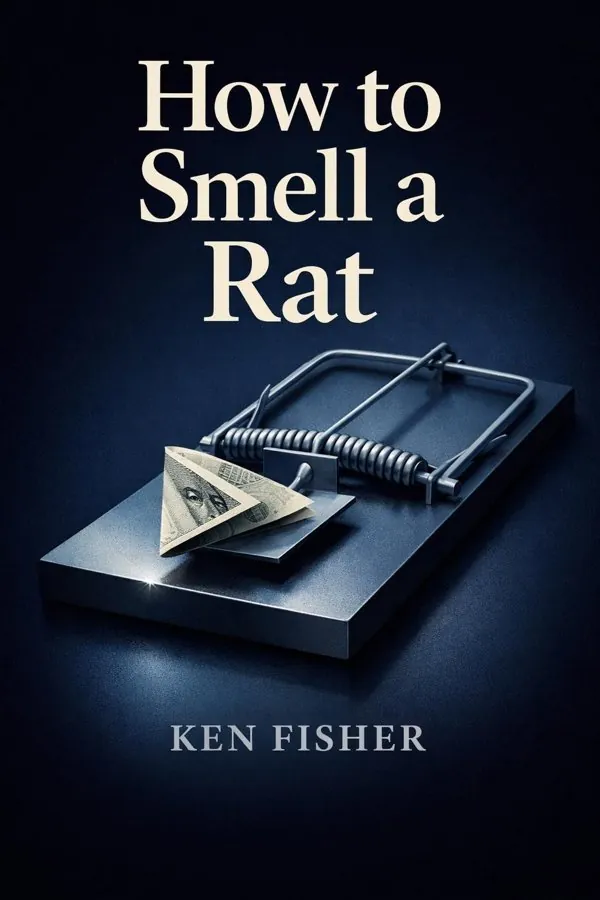
How to Smell a Rat: The Five Signs of Financial Fraud: Summary & Key Insights
by Ken Fisher
 10 min9 chaptersAudio available
What Is How to Smell a Rat: The Five Signs of Financial Fraud About?
How to Smell a Rat: The Five Signs of Financial Fraud by Ken Fisher is a finance book spanning 9 pages. In this book, investment expert Ken Fisher explains how to identify and avoid financial frauds by recognizing five key warning signs. Drawing on historical examples and his decades of experience, Fisher provides practical advice for investors to protect themselves from scams and dishonest financial schemes.
This FizzRead summary covers all 9 key chapters of How to Smell a Rat: The Five Signs of Financial Fraud in approximately 10 minutes, distilling the most important ideas, arguments, and takeaways from Ken Fisher's work. Also available as an audio summary and Key Quotes Podcast.
How to Smell a Rat: The Five Signs of Financial Fraud
In this book, investment expert Ken Fisher explains how to identify and avoid financial frauds by recognizing five key warning signs. Drawing on historical examples and his decades of experience, Fisher provides practical advice for investors to protect themselves from scams and dishonest financial schemes.
Who Should Read How to Smell a Rat: The Five Signs of Financial Fraud?
This book is perfect for anyone interested in finance and looking to gain actionable insights in a short read. Whether you're a student, professional, or lifelong learner, the key ideas from How to Smell a Rat: The Five Signs of Financial Fraud by Ken Fisher will help you think differently.
- ✓Readers who enjoy finance and want practical takeaways
- ✓Professionals looking to apply new ideas to their work and life
- ✓Anyone who wants the core insights of How to Smell a Rat: The Five Signs of Financial Fraud in just 10 minutes
Want the full summary?
Get instant access to this book summary and 100K+ more with Fizz Moment.
Get Free SummaryAvailable on App Store • Free to download
Key Chapters
Fraud is not a modern invention. It is woven into the very fabric of finance, as predictable as the cycles of boom and bust. When we look back—at the South Sea Bubble of the 18th century, at Ponzi’s postal-reply coupons, at Madoff’s shadowed empire—we see human susceptibility repeating itself. Investors want certainty, and in the search for it, they surrender scrutiny.
In every era, the fraudster has understood something fundamental about human nature: people crave simplicity and exclusivity. A scheme that claims to sidestep volatility or promise effortless profits feels safe. History shows how these temptations override reason. During the South Sea Bubble, otherwise rational men sold their estates to buy shares in companies 'promising to undertake something of great importance, but nobody knows what it is.' Centuries later, Madoff whispered similarly opaque assurances into the ears of millionaires who should have known better.
What fascinates and frightens me about these patterns is their consistency. You and I aren’t any smarter than the victims centuries ago; we’re simply equipped with hindsight—if we choose to use it. Fraud survives because we forget. That’s why understanding history isn’t academic in this context; it’s self-defense. Until investors view every pitch through the lens of human weakness, the past will forever repeat.
If I could tattoo one phrase onto every investor’s forehead, it would be this: 'Returns come with risk.' Any promise that detaches the two—guaranteeing high returns with no volatility—is the first scent of a rat. Fraudsters thrive in this illusion because it appeals to our deepest desires: security and success without pain.
Throughout my career, I’ve heard pitches that sound like small miracles—investment opportunities offering double-digit gains regardless of economic conditions, strategies allegedly immune to downturns. The math never supports them. No strategy escapes the reality that markets fluctuate. When someone insists their returns are always smooth, you can be certain that either they’re lying or they’re cooking the books.
Ponzi himself mastered this trap. His scheme promised a 50% return in 45 days—a figure designed precisely to bypass rational thought. People didn’t ask how it worked because their minds were dazzled by possibility. That’s how fraud operates: it suspends critical faculties.
A legitimate investor welcomes market messiness; a fraudster hides it. As I tell my clients, if performance seems too stable, dig deeper. Examine the data. Demand transparency. If the explanation doesn’t add up—or if it’s brushed aside—you’ve likely caught the first stench. Remember, honest investment involves uncertainty. Fraud thrives on the pretense of perfection.
+ 7 more chapters — available in the FizzRead app
All Chapters in How to Smell a Rat: The Five Signs of Financial Fraud
About the Author
Ken Fisher is an American billionaire investor, founder and executive chairman of Fisher Investments. He is known for his contributions to investment theory and his long-running column in Forbes magazine.
Get This Summary in Your Preferred Format
Read or listen to the How to Smell a Rat: The Five Signs of Financial Fraud summary by Ken Fisher anytime, anywhere. FizzRead offers multiple formats so you can learn on your terms — all free.
Available formats: App · Audio · PDF · EPUB — All included free with FizzRead
Download How to Smell a Rat: The Five Signs of Financial Fraud PDF and EPUB Summary
Key Quotes from How to Smell a Rat: The Five Signs of Financial Fraud
“It is woven into the very fabric of finance, as predictable as the cycles of boom and bust.”
“If I could tattoo one phrase onto every investor’s forehead, it would be this: 'Returns come with risk.”
Frequently Asked Questions about How to Smell a Rat: The Five Signs of Financial Fraud
How to Smell a Rat: The Five Signs of Financial Fraud by Ken Fisher is a finance book that explores key ideas across 9 chapters. In this book, investment expert Ken Fisher explains how to identify and avoid financial frauds by recognizing five key warning signs. Drawing on historical examples and his decades of experience, Fisher provides practical advice for investors to protect themselves from scams and dishonest financial schemes.
You Might Also Like




Browse by Category
Ready to read How to Smell a Rat: The Five Signs of Financial Fraud?
Get the full summary and 100K+ more books with Fizz Moment.