
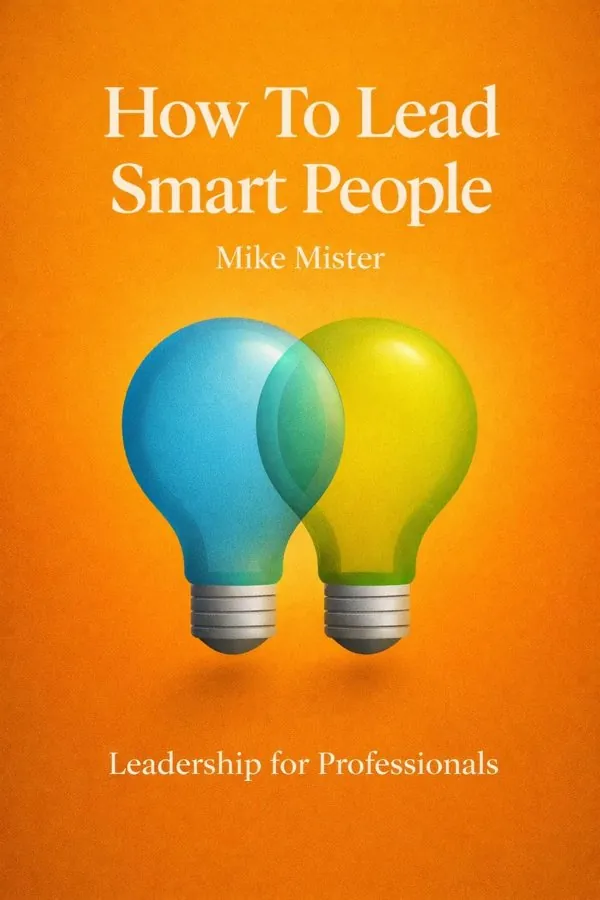
How To Lead Smart People: Leadership for Professionals: Summary & Key Insights
by Mike Mister
 10 min9 chaptersAudio available
Key Takeaways from How To Lead Smart People: Leadership for Professionals
Smart professionals do not just have expertise; they often are their expertise.
The more capable your team is, the less leadership can rely on authority alone.
Smart people are rarely impressed by titles, but they are deeply influenced by credibility.
Highly skilled people are not usually motivated by the same levers used in routine work.
A group of brilliant individuals does not automatically become a high-performing team.
What Is How To Lead Smart People: Leadership for Professionals About?
How To Lead Smart People: Leadership for Professionals by Mike Mister is a leadership book spanning 6 pages. Leading experts is one of the hardest jobs in management. Highly skilled professionals do not respond well to rigid control, generic motivation, or leadership based purely on hierarchy. They value autonomy, intellectual respect, and the freedom to exercise judgment. In How To Lead Smart People: Leadership for Professionals, Mike Mister explores what leadership looks like when the people you lead are knowledgeable, independent, and often as technically capable as, or more capable than, you are. The book focuses on the realities of professional environments such as consulting firms, law practices, engineering teams, and specialist service organizations, where influence matters more than command. Mister shows that effective leadership in these settings is not about overpowering expertise but creating the conditions in which expertise can be shared, challenged, and directed toward collective goals. Drawing on his work as a leadership consultant and educator in professional services, he offers a practical framework for building credibility, earning trust, managing difficult decisions, and sustaining your own effectiveness. The result is a clear guide for anyone who must lead smart people without diminishing what makes them valuable.
This FizzRead summary covers all 9 key chapters of How To Lead Smart People: Leadership for Professionals in approximately 10 minutes, distilling the most important ideas, arguments, and takeaways from Mike Mister's work. Also available as an audio summary and Key Quotes Podcast.
How To Lead Smart People: Leadership for Professionals
Leading experts is one of the hardest jobs in management. Highly skilled professionals do not respond well to rigid control, generic motivation, or leadership based purely on hierarchy. They value autonomy, intellectual respect, and the freedom to exercise judgment. In How To Lead Smart People: Leadership for Professionals, Mike Mister explores what leadership looks like when the people you lead are knowledgeable, independent, and often as technically capable as, or more capable than, you are. The book focuses on the realities of professional environments such as consulting firms, law practices, engineering teams, and specialist service organizations, where influence matters more than command. Mister shows that effective leadership in these settings is not about overpowering expertise but creating the conditions in which expertise can be shared, challenged, and directed toward collective goals. Drawing on his work as a leadership consultant and educator in professional services, he offers a practical framework for building credibility, earning trust, managing difficult decisions, and sustaining your own effectiveness. The result is a clear guide for anyone who must lead smart people without diminishing what makes them valuable.
Who Should Read How To Lead Smart People: Leadership for Professionals?
This book is perfect for anyone interested in leadership and looking to gain actionable insights in a short read. Whether you're a student, professional, or lifelong learner, the key ideas from How To Lead Smart People: Leadership for Professionals by Mike Mister will help you think differently.
- ✓Readers who enjoy leadership and want practical takeaways
- ✓Professionals looking to apply new ideas to their work and life
- ✓Anyone who wants the core insights of How To Lead Smart People: Leadership for Professionals in just 10 minutes
Want the full summary?
Get instant access to this book summary and 100K+ more with Fizz Moment.
Get Free SummaryAvailable on App Store • Free to download
Key Chapters
Smart professionals do not just have expertise; they often are their expertise. That is the first reality any leader must understand. In professional environments, people build their confidence, status, and self-worth around specialized knowledge developed over years of training and practice. As a result, work is never only work. Feedback can feel personal, change can feel threatening, and oversight can feel like disrespect.
Mike Mister argues that this identity-based relationship to work explains why traditional management approaches often fail with highly qualified teams. A lawyer, architect, consultant, or engineer is not usually motivated by simple compliance or narrow supervision. They want to be trusted as competent adults whose judgment matters. When leaders ignore this, they create resistance. A manager who rewrites an expert’s work without discussion, imposes decisions with no rationale, or treats everyone as interchangeable will quickly lose credibility.
A better approach is to acknowledge the value people attach to their craft. That means asking informed questions rather than pretending to know everything, inviting experts to explain their reasoning, and recognizing that disagreement may be rooted in professional standards rather than stubbornness. For example, when introducing a new process, a leader can frame it not as control but as a way to improve quality, reduce avoidable friction, and protect time for higher-value work. That language respects professional identity.
Leaders also need to separate challenge from threat. You can question assumptions, demand accountability, and set standards, but you must do so in ways that preserve dignity. The goal is not to flatter expertise but to work with its psychological reality.
Actionable takeaway: Before pushing for performance or change, identify what your team members are proud of professionally and speak to that identity when setting expectations.
The more capable your team is, the less leadership can rely on authority alone. In expert organizations, positional power may get attention, but it rarely earns commitment. Professionals will often comply outwardly while disengaging inwardly if they feel they are being directed by someone who does not understand their work or has not earned the right to lead them.
Mister’s central point is that leadership among smart people is fundamentally relational. You do not lead by having all the answers. You lead by creating confidence that your judgment, intentions, and decisions are worth following. Influence grows when people believe you add value beyond technical expertise: clarity, coordination, perspective, prioritization, and political cover.
This is especially important for leaders who are no longer the top technical expert in the room. Many new leaders overcompensate by micromanaging, asserting authority, or trying to prove they are still the smartest person present. That usually backfires. A stronger move is to shift your contribution. Instead of solving every technical problem, shape the environment in which good decisions happen. Clarify goals, reduce unnecessary conflict, connect people across silos, and ensure choices serve both client and organizational interests.
Imagine a department head overseeing senior specialists. If those specialists disagree on direction, the leader’s role is not necessarily to dictate the method. It may be to define the decision criteria, surface trade-offs, and help the group converge on a path they can support. That is leadership through influence.
Actionable takeaway: Ask yourself each week, “Am I trying to prove my expertise, or am I helping experts do their best work together?” Then adjust your behavior accordingly.
Smart people are rarely impressed by titles, but they are deeply influenced by credibility. Trust is the currency of leadership in professional settings, and credibility is how that trust is built over time. Mister emphasizes that professionals assess leaders constantly: Do you understand our world? Are your decisions fair? Do you follow through? Can you handle pressure without becoming arbitrary?
Credibility has several dimensions. One is competence, though not necessarily technical mastery. Team members need confidence that you grasp enough of the work to ask sensible questions and make sound judgments. Another is consistency. If your standards change with the political weather, people will stop trusting your direction. A third is integrity. Professionals quickly detect leaders who say one thing publicly and another privately, or who claim to value quality while rewarding only short-term numbers.
Practical credibility often comes from small but visible behaviors. Prepare before meetings. Acknowledge what you do not know. Give credit accurately. Defend your team when criticism is unfair. Make decisions transparently, especially when trade-offs are difficult. If a project must be reprioritized, explain why, what criteria were used, and what support will be provided. This does not remove disappointment, but it reduces cynicism.
Trust also deepens when leaders show respect under pressure. Experts may tolerate mistakes more readily than disrespect. A leader who listens carefully during disagreement, invites dissent without punishment, and avoids public humiliation creates a climate where people can speak honestly. That honesty is essential for quality and risk management.
Actionable takeaway: Build a personal credibility checklist focused on preparation, fairness, transparency, and follow-through, and review it after major interactions with your team.
Highly skilled people are not usually motivated by the same levers used in routine work. They care about compensation, of course, but sustained engagement comes from meaningful challenge, professional growth, recognition, and control over how work is done. Mister shows that smart people often lose motivation not because they are lazy or difficult, but because their environment blocks the very conditions that allow them to do excellent work.
One major motivator is autonomy. Professionals want room to exercise judgment. When leaders over-specify methods, interfere in every detail, or treat experts as executors rather than thinkers, motivation declines. Another motivator is mastery. Talented people want to keep learning, tackle interesting problems, and refine their craft. If work becomes repetitive or politically constrained, they disengage. A third motivator is purpose. Experts want to know that their contribution matters to clients, colleagues, and the wider mission.
Leaders can strengthen motivation by designing work more thoughtfully. For example, instead of assigning tasks mechanically, they can match people to problems that stretch their capabilities. They can also involve team members in shaping solutions, not just delivering them. Recognition should be specific and intelligent. Telling a specialist “good job” is weaker than saying, “Your judgment on that risk issue prevented a major mistake.” That demonstrates real appreciation.
Mister also warns against assuming all professionals are motivated in the same way. Some crave visibility, others value freedom, and others care most about impact or development. Good leadership requires paying attention to those differences.
Actionable takeaway: In your next one-to-one conversation, ask each team member what kind of work energizes them, what frustrates them, and what support would help them perform at their best.
A group of brilliant individuals does not automatically become a high-performing team. In fact, the more expertise in a room, the greater the potential for fragmentation, rivalry, and unproductive debate. Mister highlights a common leadership mistake: assuming collaboration will emerge naturally because everyone is smart. Intelligence can generate insight, but without structure it can also generate conflict, duplication, and paralysis.
Professional teams often struggle because specialists are trained to defend standards, spot flaws, and argue for precision. Those qualities are valuable, yet they can make coordination difficult. Different disciplines may define success differently. A finance expert may want control and efficiency, a designer may want quality and originality, and a client lead may want speed and flexibility. Collaboration improves when leaders make these differences discussable instead of personal.
That means setting clear roles, decision rights, and expectations for debate. Who contributes input? Who recommends? Who decides? What criteria matter most? Without this clarity, meetings become arenas where the loudest voice or highest-status expert dominates. With clarity, disagreement becomes more productive. For instance, a project leader might explicitly state that all experts will challenge assumptions during the first phase, but that once a decision is made, the team aligns on execution unless new evidence appears.
Leaders should also reward collaborative behavior, not just individual brilliance. If promotions and praise go only to rainmakers or solo experts, teamwork will remain weak. People need to see that sharing knowledge, supporting others, and helping the wider system succeed are valued contributions.
Actionable takeaway: For your next cross-functional project, define decision roles, success criteria, and rules for debate at the outset rather than waiting for friction to expose the gaps.
Experts are often labeled resistant to change, but Mister suggests a more useful interpretation: professionals resist poorly led change, especially when it appears to ignore evidence, undermine standards, or impose disruption without a convincing case. Smart people ask hard questions. That is not disloyalty; it is often a sign of professional seriousness.
Leading change in expert environments therefore requires more than announcing a new direction. Leaders must explain why change is necessary, what problem it solves, what trade-offs it involves, and how quality will be protected. If a new technology, workflow, or structure is introduced without thoughtful engagement, professionals will often challenge it, bypass it, or comply superficially.
A more effective approach combines logic, participation, and practical support. Start with a case that respects people’s intelligence. Use evidence, not slogans. Then involve respected practitioners in shaping the implementation. Peer influence matters enormously among professionals; people are more open when trusted colleagues have helped test and refine the idea. Leaders should also acknowledge losses honestly. Change often removes familiar routines, status markers, or preferred ways of working. Pretending otherwise damages trust.
For example, if a firm introduces standardized project management across specialist teams, the leader should not frame it as a cure-all. Instead, they might say: this will reduce preventable errors, improve handovers, and free experts from repetitive administrative confusion, while still preserving professional discretion in technical judgments. That is a more credible narrative.
Actionable takeaway: When leading change, prepare answers to four questions in advance: Why now, why this, what will improve, and what concerns are legitimate and being addressed?
The true test of leadership is not how you behave when people agree with you, but how you respond when performance slips, egos clash, or standards are compromised. In professional settings, difficult conversations are often delayed because leaders fear damaging relationships with high-status experts or being drawn into technical debates they feel unqualified to win. Mister argues that avoidance is costly. Problems left unaddressed harden into resentment, inconsistency, and cultural decay.
Leading smart people requires the confidence to address issues directly without becoming heavy-handed. The key is to focus on observable behavior, shared standards, and impact rather than personality. Instead of saying, “You are difficult to work with,” a leader might say, “In the last three meetings, others were interrupted repeatedly, and two decisions had to be revisited because concerns were raised too late. That is affecting team trust and delivery.” This keeps the conversation specific and professional.
It also helps to distinguish between expertise and immunity. A star performer should not be exempt from expectations around collaboration, client care, or conduct. In many organizations, toxic expertise is tolerated because the individual brings revenue or prestige. Mister warns that this sends a destructive message: brilliance matters more than behavior. Over time, good people leave and the culture weakens.
At the same time, difficult conversations should invite dialogue. Professionals are more likely to respond well when leaders show respect, ask for perspective, and connect feedback to standards they themselves value. The aim is not to win an argument but to restore effective contribution.
Actionable takeaway: Do not wait for frustration to build; address one important issue this week using specific evidence, clear expectations, and a respectful invitation to problem-solve.
One of the least visible leadership risks is the leader’s own ego. Professionals are demanding, opinionated, and often highly persuasive. In that environment, leaders can become defensive, approval-seeking, overly controlling, or conflict-averse without fully realizing it. Mister stresses that self-awareness is not a soft extra; it is a practical requirement for leading smart people well.
Leaders bring their own identity issues into expert settings. Some feel they must always appear authoritative. Others cannot tolerate being challenged. Some retreat into consensus because they want to be liked by capable colleagues. All of these patterns distort judgment. A leader who needs to be the smartest person in the room may suppress stronger ideas. A leader who avoids tension may allow poor behavior to continue. A leader who overidentifies with one discipline may lose fairness across the wider team.
Self-awareness starts with noticing your default reactions under pressure. Do you interrupt when you feel insecure? Do you micromanage when stakes rise? Do you become vague when decisions may be unpopular? These tendencies can be changed only if they are observed honestly. Trusted feedback, reflection after key meetings, and deliberate pauses before responding can all help.
Sustaining effectiveness also means protecting your capacity. Leading professionals requires emotional stamina because the work is intellectually intense and politically complex. Without boundaries, reflection, and support, leaders can become reactive and depleted. Calm, thoughtful leadership is especially important when others are anxious or divided.
Actionable takeaway: After your next challenging meeting, write down what triggered you, how you responded, and what a more effective response would look like next time.
Professional culture is not created mainly by mission statements or formal values. It is created by what leaders repeatedly notice, reward, tolerate, and ignore. Mister shows that in expert organizations, culture is often shaped less by speeches and more by subtle signals: whose opinions count, how mistakes are handled, what gets promoted, and whether people feel safe to question assumptions.
This matters because smart people watch for inconsistencies. If leaders say collaboration matters but reward only individual billings, the real message is clear. If they claim learning is valued but punish honest mistakes, people will hide risk. If they talk about inclusion but defer only to senior insiders, expertise will narrow rather than expand. Culture becomes the lived answer to the question, “What really succeeds here?”
Leaders influence culture through routines and rituals. Team meetings can encourage curiosity or silence. Performance reviews can reinforce development or fear. Client debriefs can focus on blame or learning. Even small behaviors matter: Does the leader ask junior experts for input? Are dissenting views welcomed before decisions are finalized? Are overloaded high performers supported or simply praised for endurance?
A strong culture among professionals combines high standards with psychological safety. People should know that rigor is expected, but so is openness. They should be able to challenge ideas, raise concerns, and admit uncertainty without losing respect. That combination allows quality and innovation to coexist.
Actionable takeaway: Identify one recurring team practice, such as meetings or reviews, and redesign it so that it reinforces the culture you want rather than the habits you have drifted into.
All Chapters in How To Lead Smart People: Leadership for Professionals
About the Author
Mike Mister is a leadership consultant, facilitator, and educator who specializes in helping professional services firms and other expert-led organizations strengthen leadership capability. His work focuses on the distinctive demands of leading highly skilled professionals, especially in environments where authority is distributed, expertise is prized, and influence matters more than hierarchy. Over the course of his career, he has worked with partners, senior executives, and managers to improve collaboration, decision-making, organizational culture, and leadership effectiveness. Mister is particularly known for translating complex leadership challenges into practical guidance that leaders can apply in real workplaces. His perspective is grounded in direct experience with professional firms, making his advice especially relevant for those responsible for leading independent, intelligent, and ambitious teams.
Get This Summary in Your Preferred Format
Read or listen to the How To Lead Smart People: Leadership for Professionals summary by Mike Mister anytime, anywhere. FizzRead offers multiple formats so you can learn on your terms — all free.
Available formats: App · Audio · PDF · EPUB — All included free with FizzRead
Download How To Lead Smart People: Leadership for Professionals PDF and EPUB Summary
Key Quotes from How To Lead Smart People: Leadership for Professionals
“Smart professionals do not just have expertise; they often are their expertise.”
“The more capable your team is, the less leadership can rely on authority alone.”
“Smart people are rarely impressed by titles, but they are deeply influenced by credibility.”
“Highly skilled people are not usually motivated by the same levers used in routine work.”
“A group of brilliant individuals does not automatically become a high-performing team.”
Frequently Asked Questions about How To Lead Smart People: Leadership for Professionals
How To Lead Smart People: Leadership for Professionals by Mike Mister is a leadership book that explores key ideas across 9 chapters. Leading experts is one of the hardest jobs in management. Highly skilled professionals do not respond well to rigid control, generic motivation, or leadership based purely on hierarchy. They value autonomy, intellectual respect, and the freedom to exercise judgment. In How To Lead Smart People: Leadership for Professionals, Mike Mister explores what leadership looks like when the people you lead are knowledgeable, independent, and often as technically capable as, or more capable than, you are. The book focuses on the realities of professional environments such as consulting firms, law practices, engineering teams, and specialist service organizations, where influence matters more than command. Mister shows that effective leadership in these settings is not about overpowering expertise but creating the conditions in which expertise can be shared, challenged, and directed toward collective goals. Drawing on his work as a leadership consultant and educator in professional services, he offers a practical framework for building credibility, earning trust, managing difficult decisions, and sustaining your own effectiveness. The result is a clear guide for anyone who must lead smart people without diminishing what makes them valuable.
You Might Also Like

Extreme Ownership
Jocko Willink
10 min
Dare to Lead
Brene Brown
10 min
Leaders Eat Last
Simon Sinek
10 min
The 21 Irrefutable Laws of Leadership
John Maxwell
10 min
Start With Why
Simon Sinek
10 min
How to Lead When You're Not in Charge
Clay Scroggins
10 minBrowse by Category
Ready to read How To Lead Smart People: Leadership for Professionals?
Get the full summary and 100K+ more books with Fizz Moment.